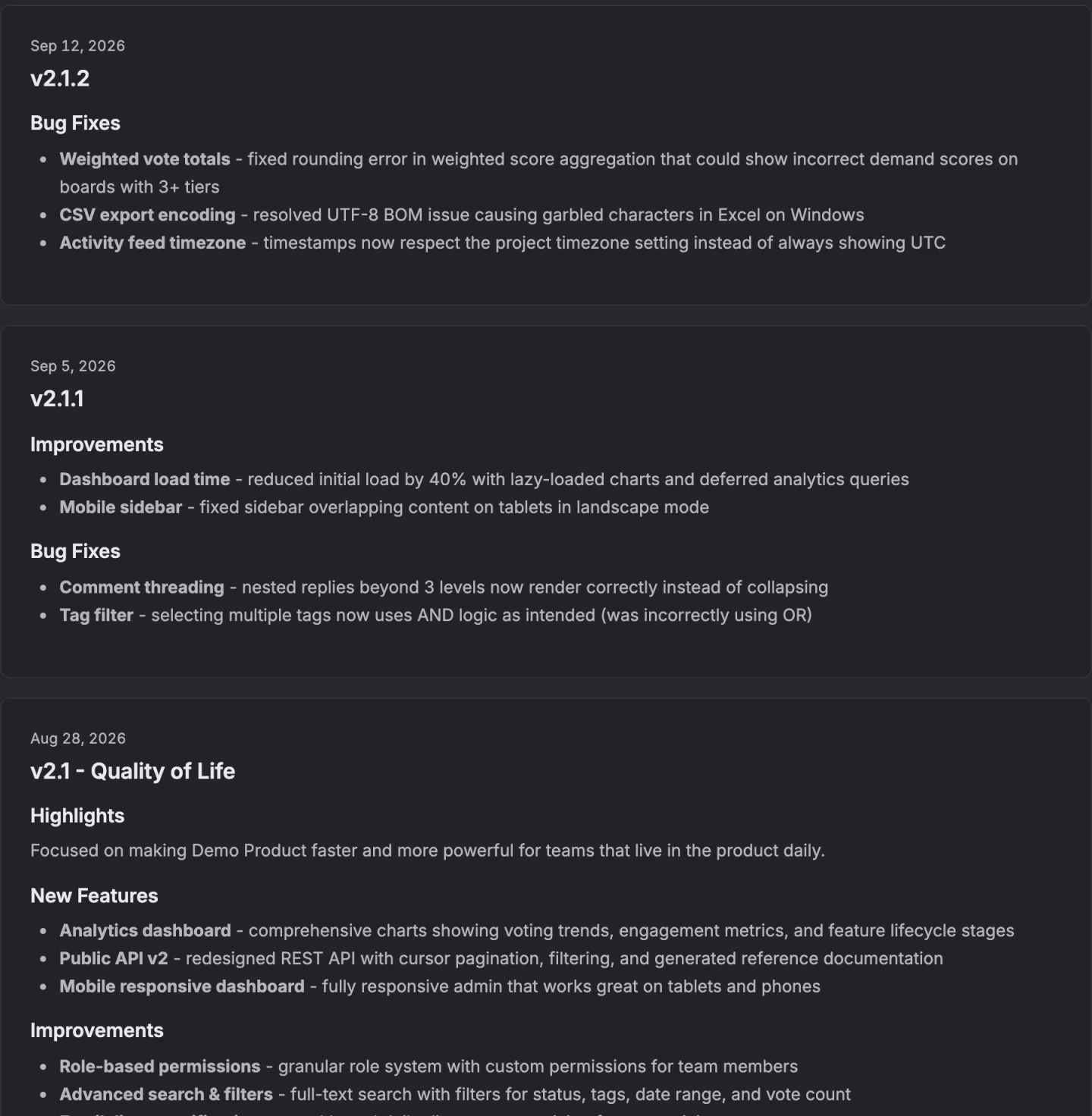
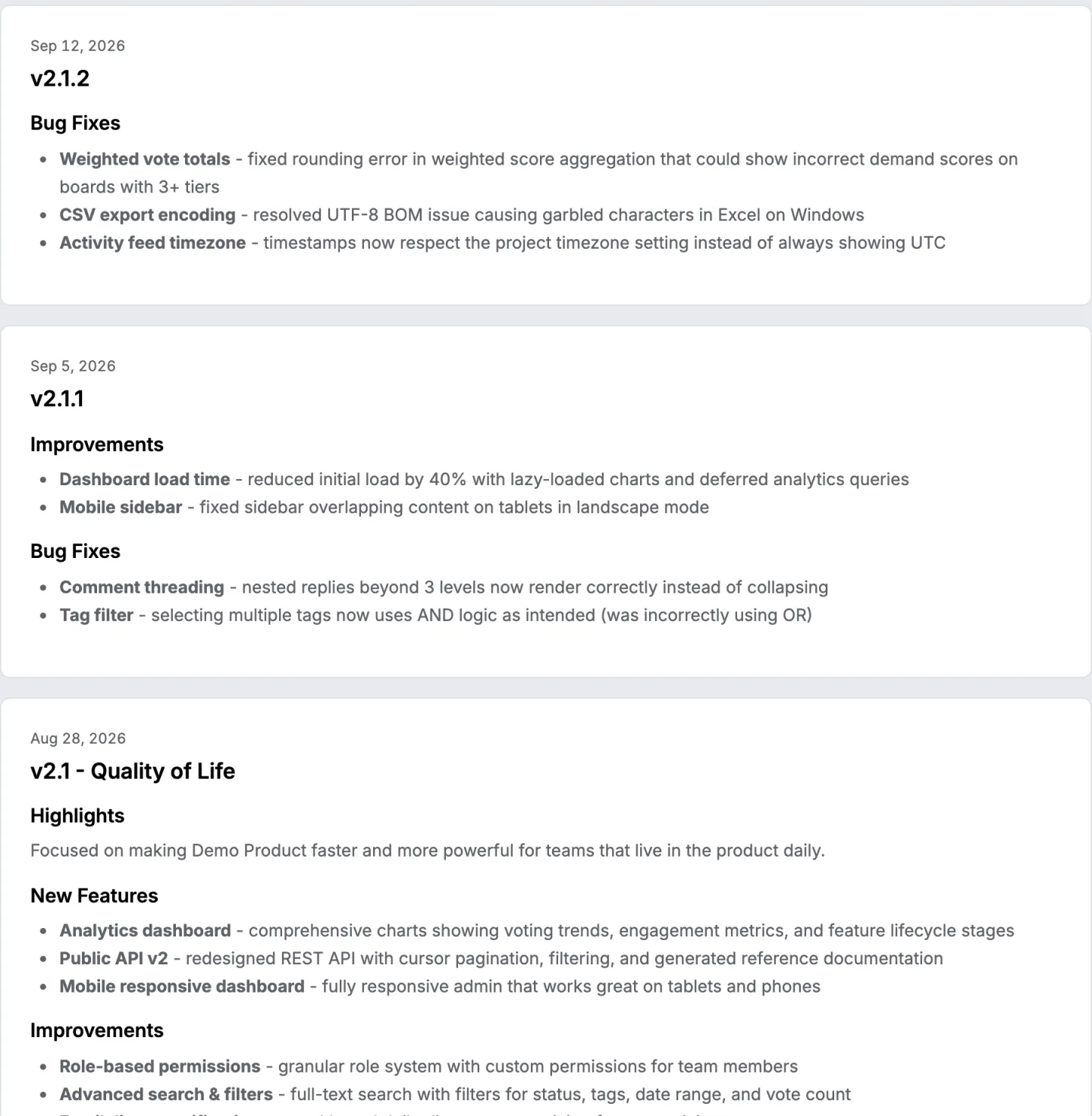
This is our real changelog, produced the same way yours would be, and the feature behind it is written up here.
A card reaches the Completed column on our roadmap, and that is what a release note is made of.
There is no separate changelog tool here and no second document to maintain. That is the entire design.
Now the honest part, because we would rather say it than have you find it. There is one release on that page and it is dated 29 April 2026. We have shipped plenty since. It is not on the changelog because the work went out without cards moving to Completed on the public board first, which is exactly the discipline this page is recommending to you.
That is the real argument for building a changelog this way rather than as a separate document. A separate document can be kept tidy by someone whose job is tidiness. This one only moves when the board moves, so when it goes quiet the reason is visible instead of hidden. Ours went quiet. If you want the tool to keep you honest, it will, including on days you would rather it did not.
Who gets an email when a release goes out?
Signed in voters whose own vote is in that release. That is the whole list.
If a release contains three features, the email reaches the people who voted for those three features and who have an account. It is not an announcement to a mailing list, because there is no mailing list to announce to.
The reasoning is that somebody who asked for a thing wants to know it shipped, and somebody who never asked has just received marketing. One of those builds a habit of opening your email and the other destroys it.
Whether you agree is a fair question, and several tools in this category do it the other way with a real subscriber list. If that is what you need, we have written down which ones confirm it on their own sites.
There is a live board behind all of this, and the demo is open without an account.
Is there an RSS feed?
Yes, since 14 September 2026, and it was a real gap until that day.
Every public changelog answers an Atom feed at its own address, and the address is listed in the page head so a reader's feed application finds it without being told where to look.
The feed carries every published release in the order the changelog page shows them, featured first and then most recent, each entry holding the body of the release rather than a link to it.
One qualification belongs here. The feed is in the code and not yet on the servers, because the copy of the product running this changelog is the release before it. It arrives here when the next one goes out.
Four of the ten changelog tools we checked publish a feed, and until this week we were not one of them.
Does the changelog write itself?
No. The card comes from the board and the words are still written by a person.
Reaching Completed makes a card eligible. Nothing here generates prose, drafts a summary or turns a commit message into a release note.
At least one tool in this category does draft them for you, and if that is the part that would save you time each week, that is a genuine reason to look at them.
What this removes is the copying, not the writing.
What does a changelog cost here?
Nothing extra. It is part of the nine dollar plan along with the board and the roadmap, and the changelog widget that embeds it in your own product is not held back for the higher plan either.
Why this page exists
Two reasons, and one of them is about search.
The first is that a changelog nobody maintains is worse than no changelog, so showing you ours still running is more useful than describing the feature.
The second is that people looking for a changelog tool do not type changelog tool. They type whole sentences with constraints in them, about company size, about how updates reach people, and about how hard it would be to leave.
This page tries to answer the middle one properly, which is who actually receives the message, because most comparison lists get that wrong about several vendors including some who do not send email at all.
14 days, a card at signup, then $9 or $39 a month.
This page suits somebody deciding whether this product is maintained. A reader who wants to know how a changelog is built rather than what shipped here wants the feature page instead.
If you are comparing changelog tools
We checked ten of them on their own sites on one day, for whether they deliver by email, whether they publish a feed, and whether they have an in app widget. Seven confirm email, four confirm a feed, and all ten have a widget.
We are not on the recommended list for every one of those requirements, and the comparison says so.