A public roadmap is a promise you have to keep, which is why most of them quietly stop being updated. The ones that survive are the ones where updating them is the same action as running the board.
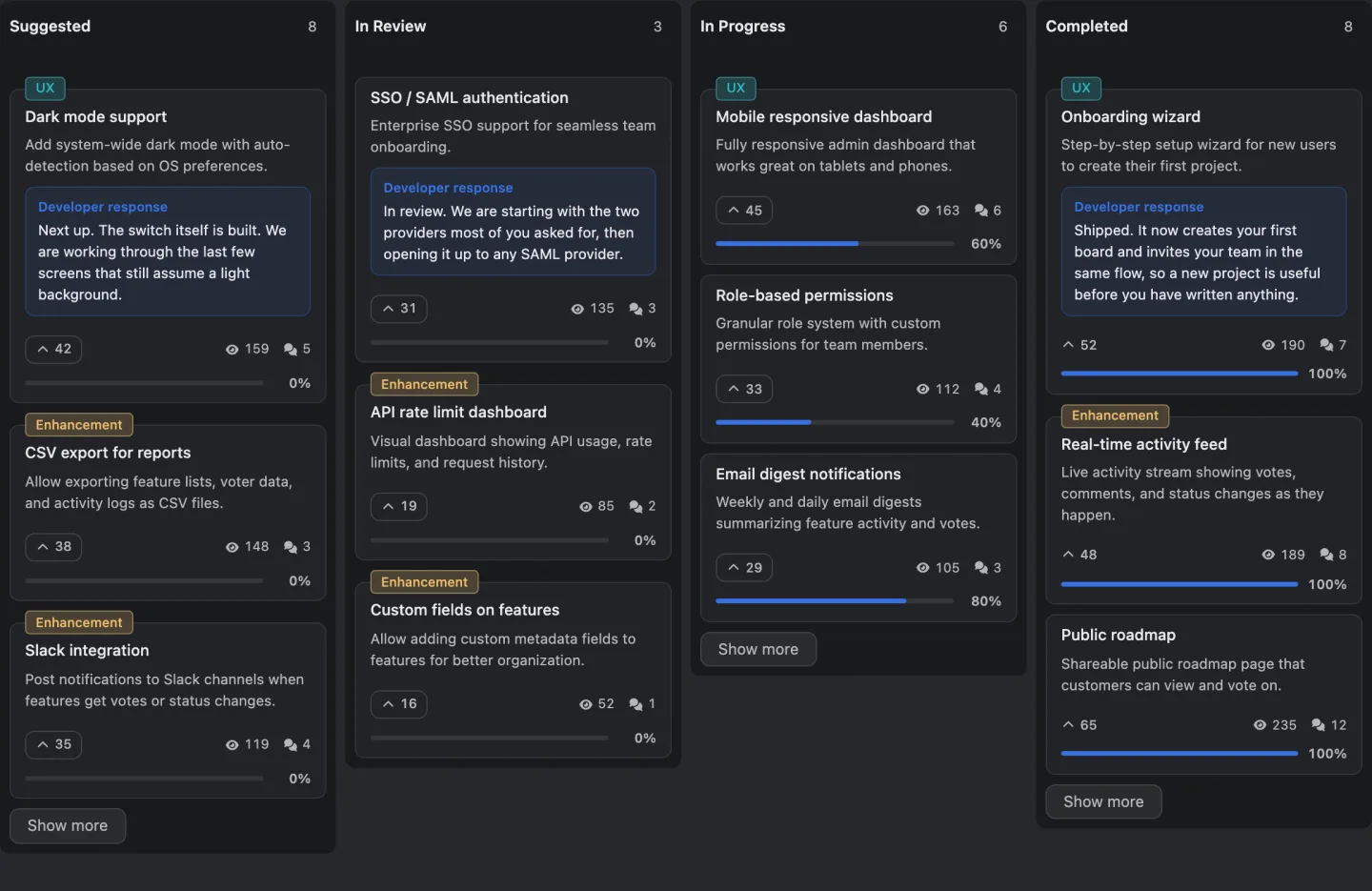
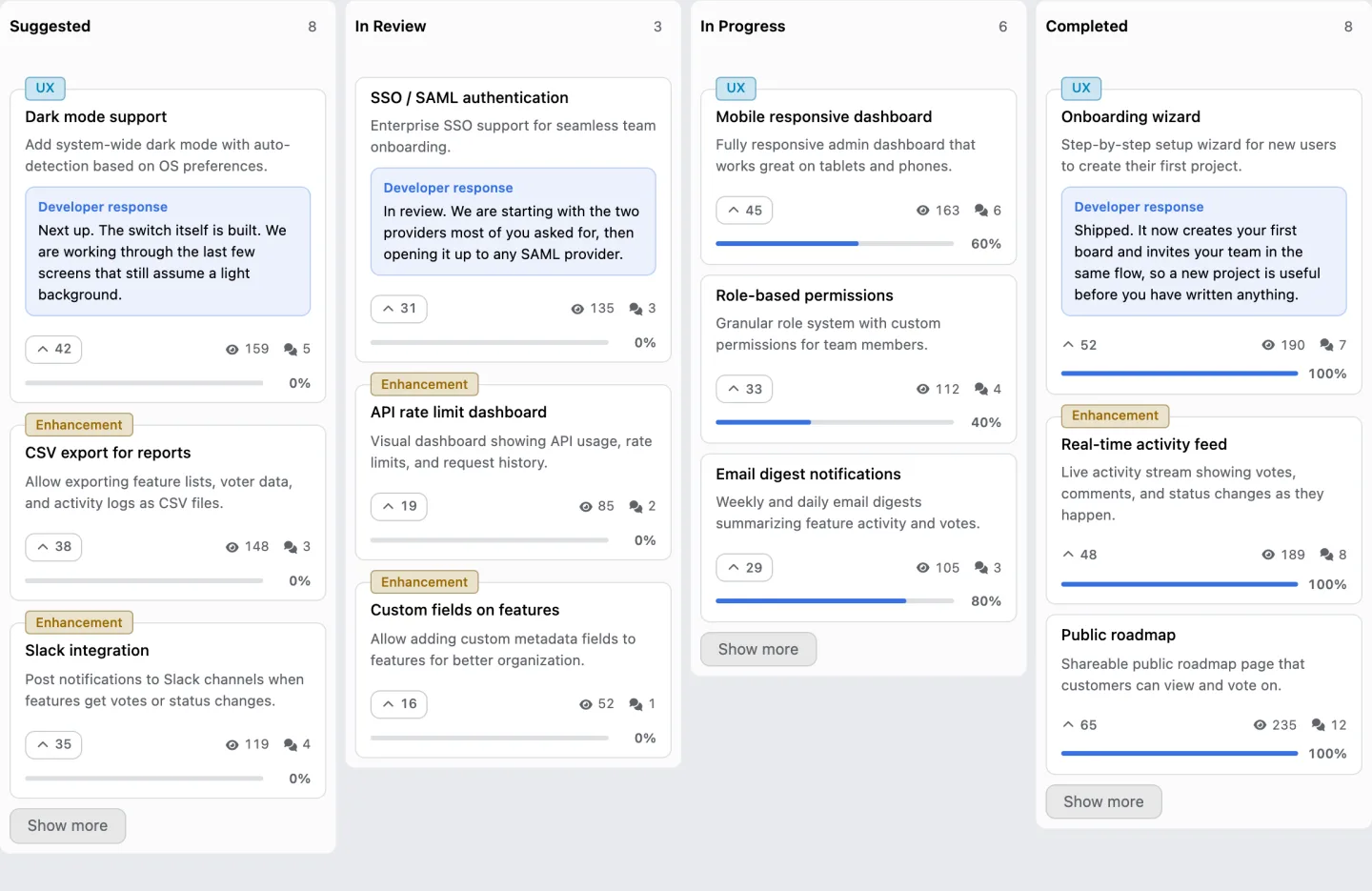
That is how this one works. Cards move between columns as you work, the public page reads the same data, and there is no second place to maintain. The same columns can be drawn inside your own site with one script tag.
What can a visitor do on my roadmap without signing in?
Vote, comment, suggest a feature, search, filter by tag and sort. All of it with no account and no email address.
An anonymous cookie is set the first time somebody loads the page, and their identity comes from that. It gives them a stable readable name rather than a number, so the same person is recognisable across visits without ever having told you who they are.
Each of the three write actions has its own switch. You can run a roadmap that takes votes but not comments, or one that is read only, without turning the whole thing off.
Sorting is by most voted, least voted, most viewed, or the order you set yourself. Whichever they pick, anything you have pinned comes first, in all four, without exception.
A pin is the only way to put one card above the sort a visitor chose. Search needs two characters and looks at both the heading and the description. Columns show twenty cards at a time.
It is on by default on a new board, so a 14 day trial with a card at signup is enough to see it working.
What are the columns?
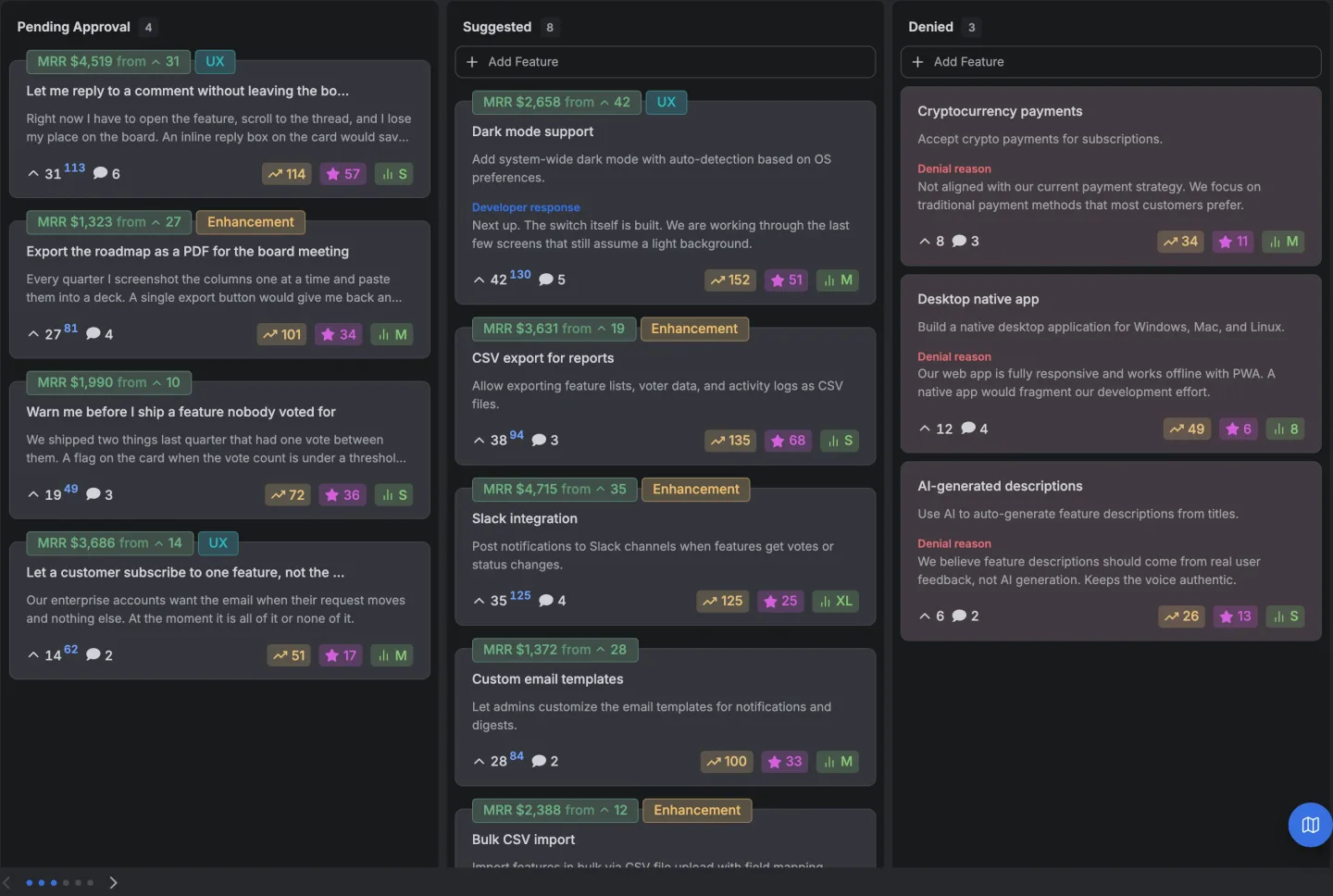
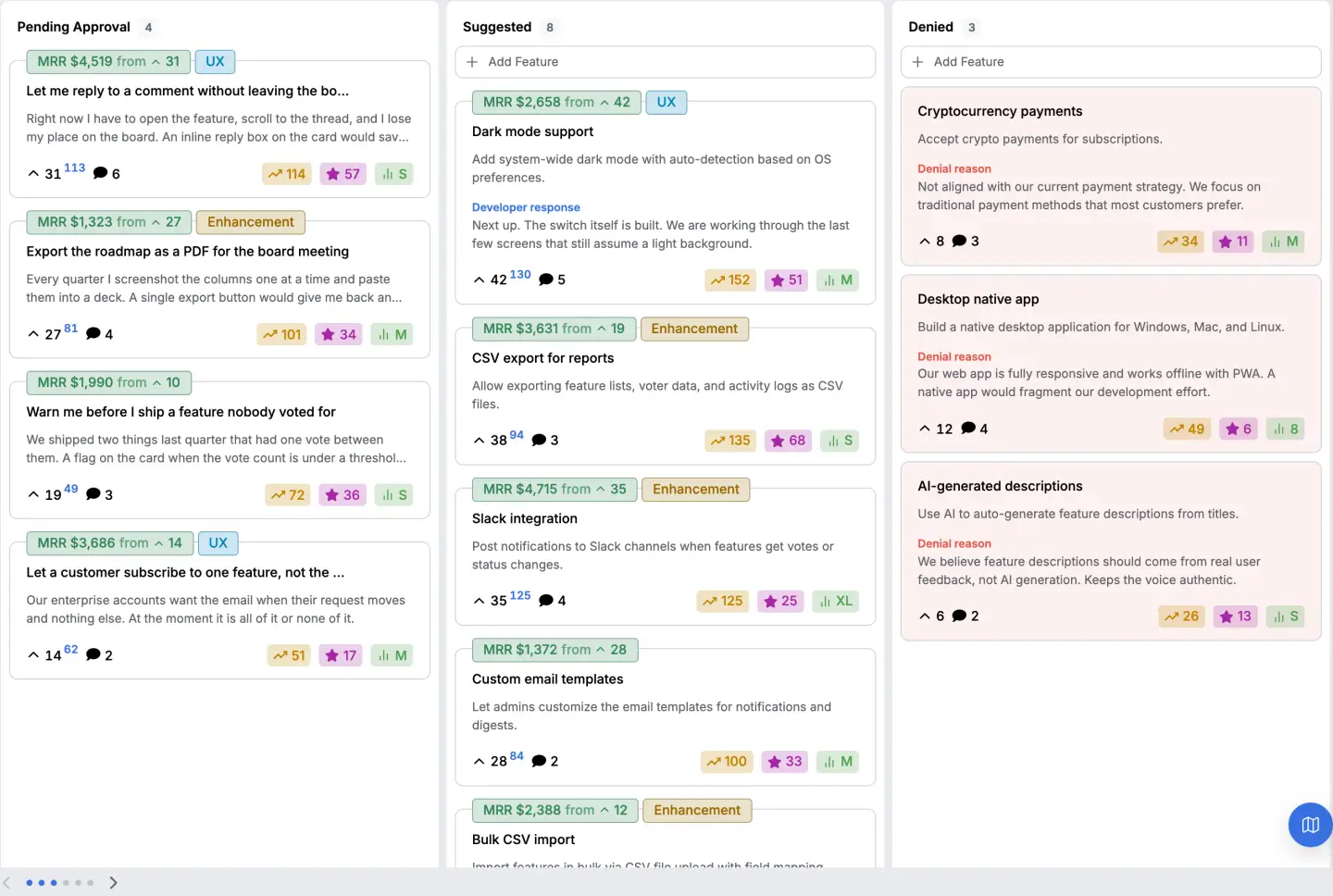
Five by default. Suggested, Denied, In Review, In Progress and Completed.
Denied is the interesting one and it is on unless you turn it off. That is unusual in this category and it is deliberate.
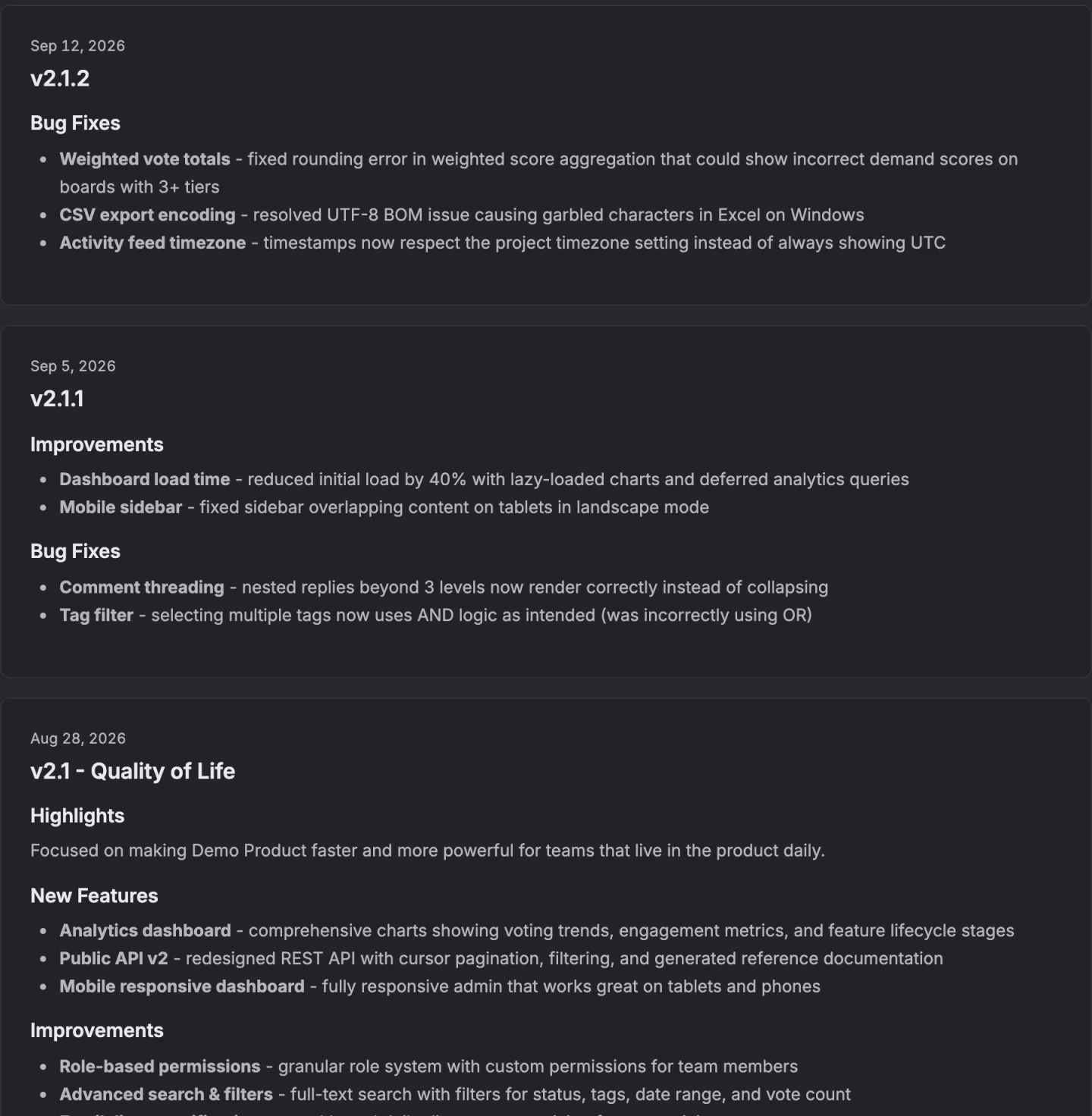
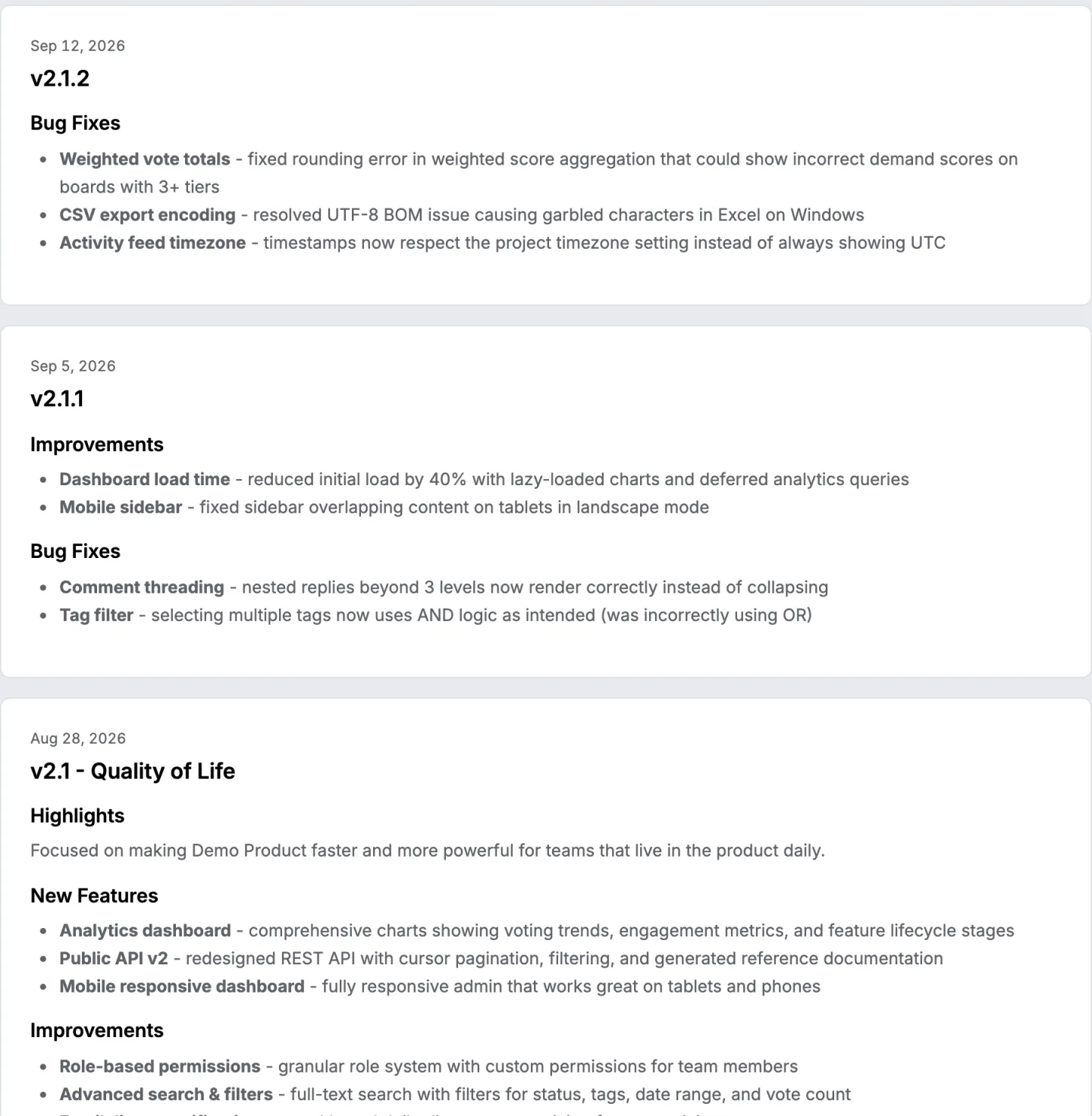
Completed is what the changelog treats as shipped, so a card finishing its journey across the board is the same event that puts it in your release notes.
Can I put the roadmap on my own domain?
Yes, on the PRO plan at thirty nine dollars a month. On LITE it lives on ours, and the widget puts it on your own site with no upgrade.
PRO also lets you run more than one board, each with its own address, its own columns and its own public flag, which is how an internal board and a customer facing one live side by side.
Can I change the colours and the fonts?
Yes, and further than most. You set the background, the main text colour, the secondary text colour, the accent, the card background, the border colour, the font and the corner radius.
You set all of that separately for the dark theme and the light one, so a roadmap that matches your site in both modes is configuration rather than custom code. Dark is the default and light is available to the visitor. Six fonts are offered.
14 days, a card at signup, then $9 or $39 a month.
Can I make the board private?
No. A board is public or it is not, and there is nothing between the two.
There is no password, no invite list and no per person access control. We checked the project record field by field before writing that sentence, because it is exactly the sort of thing people reasonably assume is there.
What you can do on PRO is keep a second board unpublished. That is not the same as a private board with named members, and if that is what you need, several products in this category have it and we do not.
Can I hide one card rather than a whole column?
Yes. Every card carries a hidden flag of its own, and it is honoured on every public route rather than only on the grid.
That is worth spelling out because the obvious implementation would not do it. A card you hide does not appear in the columns, does not come back from the paging routes, cannot be voted on, cannot be commented on, and cannot be reached by its own address by somebody who already had the link.
Every one of those routes carries the same condition rather than trusting the list to have filtered it.
The same care applies to the column switches. Turning the Denied column off does not simply stop drawing it.
A denied card is then refused when it is asked for by id, so a link a customer already has stops resolving rather than quietly still working. The code carries a comment on that line recording it, because the first version was reachable that way.
Archiving works the same way in reverse. An archived card is unreachable while the archived column is off, and reachable again the moment you turn it on.
Two more conditions sit alongside those on every public route. A suggestion that has not been approved is unpublished everywhere, and the condition names the suggestions column specifically because approval means nothing anywhere else.
And a card living on a custom board is public exactly when that board is, so unpublishing a board takes its cards with it.
Can I hide a column?
Denied is on and you can switch it off. Archived is off and you can switch it on. The four working columns are the shape of the board rather than options, so there is nothing to hide there.
What your visitors do not see
Revenue never leaves your side. No card, no payload and no public route carries an MRR figure, a tier name or a multiplier, and the one part of the API that reads money refuses the embed key outright.
The vote number is more nuanced and we would rather be exact than reassuring. On this hosted page a card shows the plain headcount. In the embedded widget it shows the weighted total instead, whenever you have weighted voting switched on, and there is no option to make the widget show the plain count.
So the honest summary is that your tier structure stays private and one aggregate number does not. Nobody can work backwards from a weighted total to what any individual pays, but if you would rather publish a plain headcount, use the hosted page rather than the widget.
There is a third thing on the same list and it surprises people. A request carries a target date and a start date, neither of them appears anywhere on this page, and both are readable through the published embed key by anybody who asks the API for your features.
Every other publishable number on that view respects one of your settings and those two respect nothing, so treat a target date as public. Why a public roadmap is better off without dates at all is a longer answer than this page has room for.
What this costs
Nine dollars a month on LITE covers one project with the board, the roadmap, the changelog and weighted voting. Thirty nine on PRO adds more projects, the API and a custom domain.
There is a fourteen day trial on whichever plan you choose, and a card is required to start it.
If you want to sketch the order in a spreadsheet before you publish anything, there is a roadmap template on this site as a CSV, with the effort and priority columns most of them leave out.
If you are still choosing, eight roadmap products sorted by who is allowed to look at the roadmap is the comparison worth reading first, because on one of them the answer is nobody outside your company.
Our own roadmap runs on this, publicly, and you can vote on it without an account. It is also the page where we admit we are not following our own advice about the declined column, which is worth reading before you take ours.