You are not buying a feedback board for a department. You are buying it for yourself, between support replies, to stop losing track of what your first users asked for. VoteFirst is a feedback board built for exactly that: one project at nine dollars a month, weighted voting included, a fourteen day trial with a card asked at signup.
Does this look familiar
Three or four people who actually pay you have each asked for something different, in a DM, a support email, and a comment on your own launch post. You remember two of the three. The third one you will remember the day they cancel and mention it in the exit survey.
A spreadsheet works for a week. Then somebody asks the same thing twice and you cannot tell whether that is one vote or two, and a thread in your own inbox cannot be sorted by anything except the date it arrived. Nobody outside your head can see what you are already planning to build, so every new user asks the same question your oldest user already answered.
That is the job a board does. It is not a product decision maker and it will not tell you what to build. It gives your requests one place to land, lets the people who asked for something see that it landed, and sorts by something other than whoever emailed you last.
How it works, in the product
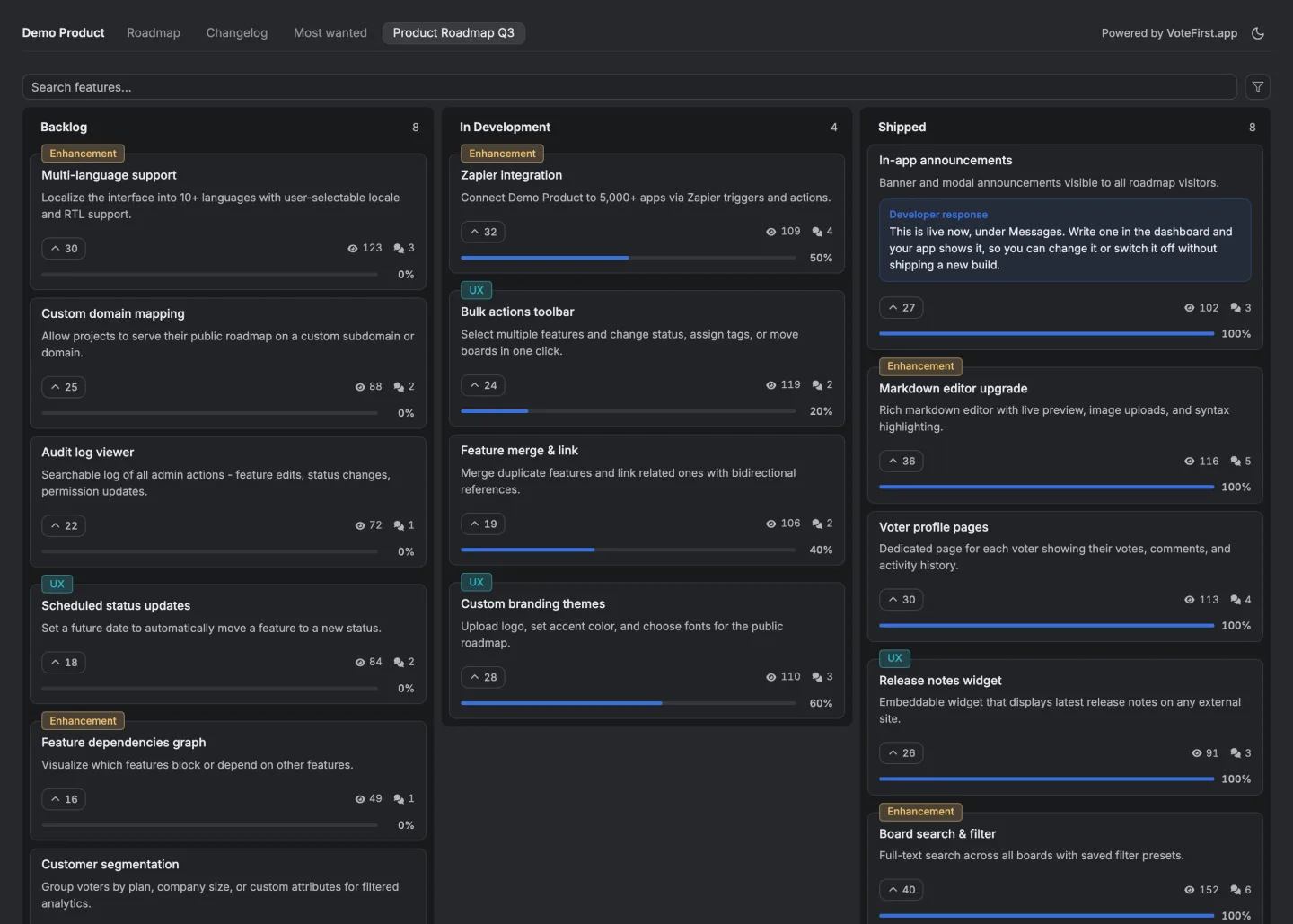
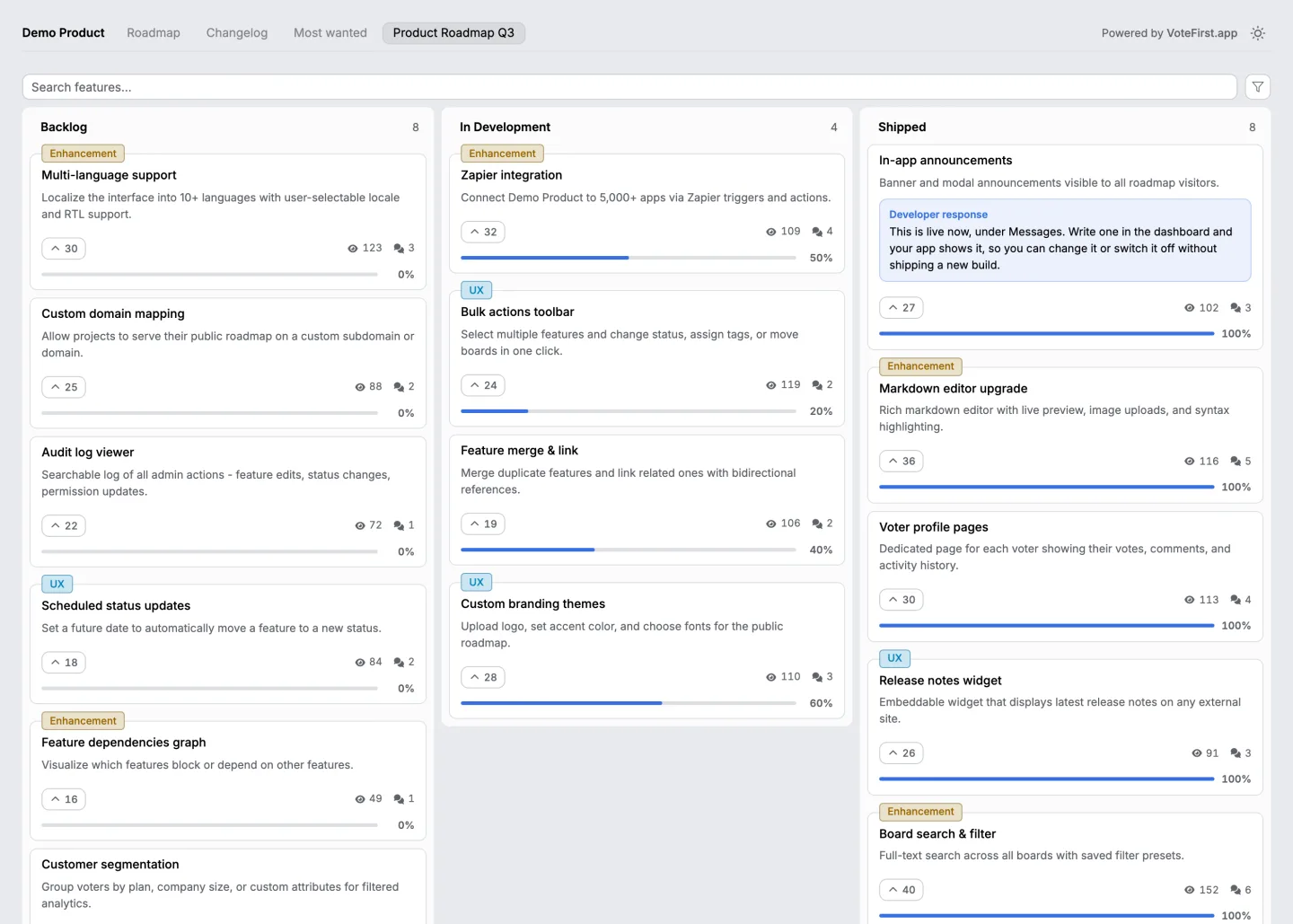
A board is one public page. People post a request, other people vote on it, and you move each request through five columns on a public roadmap: Suggested, In Review, In Progress, Completed and Denied. Nothing requires a login to vote, and nothing you post goes live until you approve it, so a first troll post does not sit on your board waiting for you to notice.
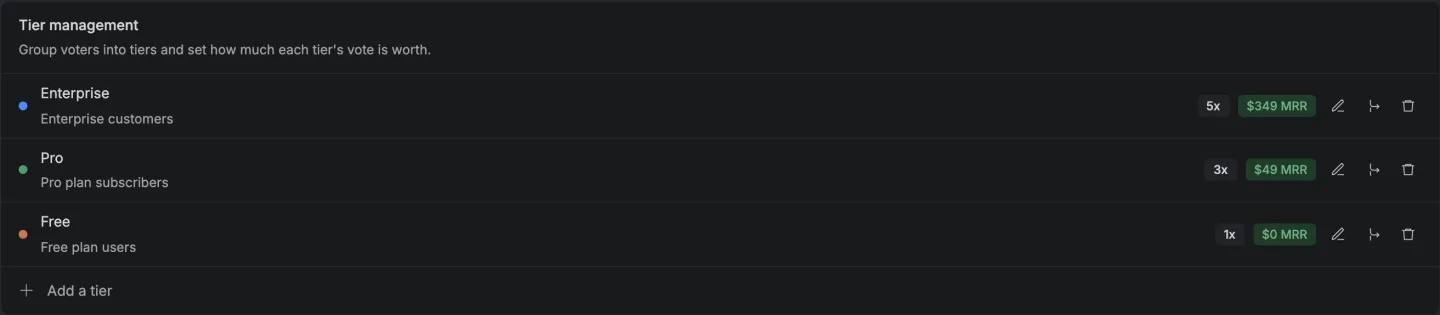
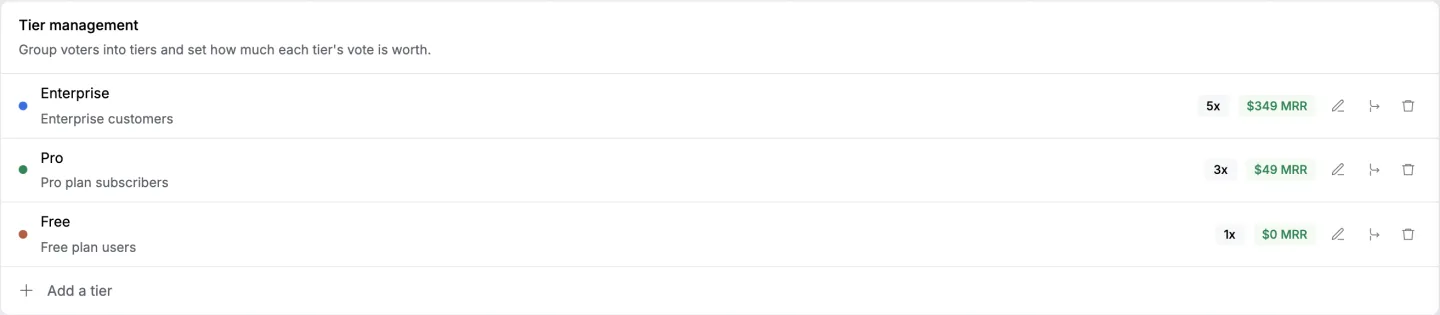
If a handful of your voters already pay you different amounts, you can weight their vote instead of just counting it. Import what each customer pays from Stripe, Paddle or a CSV, and every vote they cast afterward carries a whole number multiplier on top of the plain count, which stays visible next to it. How the weighting itself works is a separate page; here it matters only because it is included on the nine dollar plan, not held back for a bigger one.
What a board actually costs you, at this size
A solo founder weighing this is usually looking at Canny, Upvoty, Fider or Featurebase too. Prices below were read from each vendor's own pricing page on 2 October 2026, so check them again before you commit; vendors change these pages.
| VoteFirst | Canny | Upvoty | Fider | |
|---|---|---|---|---|
| Entry price | $9 a month, one project | Free up to 25 tracked users, then $79 a month | $15 a month (Power, named for solo founders) | Free, self hosted, fair use of 250 requests a month; $25 a month hosted |
| Weighted voting | Included on every plan | Not listed on its pricing page | Not listed on its pricing page | Not listed on its pricing page |
| Card required to try | Yes, a 14 day trial | No, the free plan never asks | No, 14 day trial with no card | No |
| Canny board import | One paste, Settings, Import Board | n/a | Not checked here | Not checked here |
Canny's free plan is genuinely cheaper than VoteFirst while you are under 25 tracked users, which it counts as anyone who has given feedback at all, not just the people who voted. The full ladder and a calculator that runs your own numbers says so without hiding it. The jump when you cross that line is the thing to plan around, not the free number.
Featurebase is not really the same purchase. Its free plan is one support seat with live chat and a ticket inbox, and its paid tiers start at $29 a seat a month billed yearly, because the product it is selling is a help desk with a feedback board attached, not a feedback board on its own.
Nine more tools, priced at 50, 500 and 5,000 voters rather than at VoteFirst's own size, if the four above are not the whole shortlist you want to weigh.
Is a feedback board premature for you
Probably, if you have fewer than ten people who have ever asked for anything. A board earns its place when you cannot hold the open requests in your head and cannot tell, from memory, which one three different people have asked for. Below that, a plain list in a note app or a pinned thread in your own inbox does the same job for free, and setting up a board at that point is work you are doing instead of shipping.
The signal to switch is not a number of users, it is losing track once. The first time you promise the same feature to two people and only remember promising one of them, you have the problem a board solves.
How to get your first ten votes
Nobody finds a brand new board by searching for it. The people who vote on it are the people you already have, so ask them directly: the three or four customers you talk to by email, the handful who filed a support ticket with a feature request buried in it, anyone who commented on a launch post. Point them at the board once, by name, and ask what they would want next.
Reading a public Canny board before you move one is free and takes no account, if you are curious what another small board's post and vote counts actually look like before building your own.
Keeping a roadmap honest when you ship everything yourself
The columns are the whole mechanism. Move a request to In Progress only when you have actually started it, not when you intend to get to it this quarter, because a board with everything sitting In Progress forever reads as a board nobody is running. Move it to Completed only once it has shipped, and say so in the changelog, because the gap between "planned" and "true" is the thing that makes a one person roadmap feel less honest than a team's, even when it is more accurate.
A small board moving slowly and saying so truthfully reads better than a board where every column is full and nothing ever leaves In Progress.
How the changelog tells people a thing shipped
Publishing a release sends one email, to every signed in voter whose own vote is attached to something in that release, and to nobody else. An anonymous vote, cast without an account, leaves no address behind, so it gets no email when the thing it voted for ships. If you want your early users to hear about it directly, voting under an identity is what makes that possible, not a setting you flip separately.
What happens to the board if you stop paying
The board does not disappear the day the card fails. The plan moves to expired, the "Powered by VoteFirst" badge comes back on the public pages, and the account is kept for a year if it ever paid, or for thirty days if it never did. Two warning emails go out before that date: thirty days and seven days ahead for an account that paid, a week and a day ahead for one that did not. Deletion is not allowed to run until both have actually been sent, so an account is never deleted silently. If you reactivate before the date, nothing is lost. If the date passes, the board, its requests, its votes and its team members are removed with the account.
What VoteFirst does not do
No SAML or OIDC, JWT only. No Slack, Zapier or outgoing webhooks. No AI features anywhere, on this plan or any other. No Android SDK, the native option is Swift for iOS and macOS. A custom domain, when you are on a plan that includes one, only serves the public roadmap, the voting board and one named board, never the changelog or the most wanted list.
Try it on your own numbers
The calculator runs every vendor's own ladder against your own count, and reading a public board before you commit to moving it needs no account either.
What this costs
Lite
$9 /mo
Pro
$39 /mo
Lifetime
$999 once
Fourteen day trial of Pro, card asked for at signup. Nothing here counts the people who vote, so the bill does not move when the board starts working. The long version, with what happens if you stop paying.
Other use cases
Feedback board for early stage startups, once a second founder shares the board. Feature voting software, for the fuller picture once you have more than one plan to weigh. Anonymous voting, if you are not sure whether to require an account to vote. Switch from Canny, if you already have a board there and the tracked user count is the reason you are reading this page.