If you are looking for a feature voting tool you have already decided that voting is the mechanism you want. Not a survey, not a support inbox, not a spreadsheet of what the loudest customer said last week. A place where people put ideas up and other people say yes, this one.
Good. That decision is the hard part and most of the category will serve you well. What is left is four questions, and only one of them usually gets asked.
What is feature voting, and what is a feature voting tool?
Feature voting is letting the people who use a product say which suggestion matters most by voting on it in public, and a feature voting tool is the software that holds the board those votes are cast on.
The practice and the product are worth separating, because the practice works on a spreadsheet and a shared document and plenty of teams start there. What the software adds is that the count is visible to the person who asked, which changes what they do next.
It gives a suggestion a public number.
That is genuinely the whole trick, and it works because of what the number does to a conversation. Before the board, a feature request is one person's email and its weight is however recently you read it.
After the board, it is a card with eleven votes on it, and eleven is an argument that does not depend on who spoke last.
The rest of these products exist to make that number trustworthy and to close the loop afterwards. Roadmaps show what you picked. Changelogs show what you shipped. Both matter, and both are downstream of whether the number means anything.
You can do the same thing on a board of your own inside the 14 days a trial runs.
What actually varies between voting tools?
Four things, and the fourth is the one people find out about later.
Whether the voter needs an account. Some tools require a sign in before anybody can vote. Others let a visitor vote immediately.
What the bill is metered on. Two of the twenty one tools we checked charge by the number of people who participate, and a third charges by how many people see your changelog. The rest charge for a seat, a project, a board or a workspace. On the metered ones a popular board is an expensive board.
Whether a vote can be embedded. Some tools give you a board on their domain and stop there. Others let you put the board, or a single vote control, inside your own product.
Whether every vote counts the same. Almost all of them, yes. And that is the assumption worth examining, because it is invisible until it costs you something.
Does the voter need an account?
On VoteFirst, no.
A signed out visitor gets an anonymous identity minted in their own browser the first time they do anything, and voting, commenting and suggesting are open from that first page load. There is no form, no email address and no confirmation link.
This is not a small convenience. Every step between a person having an opinion and that opinion being recorded loses some of the people.
The ones who push through are not a representative sample of your users, they are the unusually motivated, and a board that only hears from them is measuring persistence rather than demand.
Requiring an account buys something real in exchange. It gives you attribution, so you know exactly who wanted what. If that matters more to you than volume, buy a tool that requires it, and several good ones do.
How does the vote actually get recorded?
This is the part most pages in this category will not tell you, and it is the part that decides whether the numbers on your board mean anything.
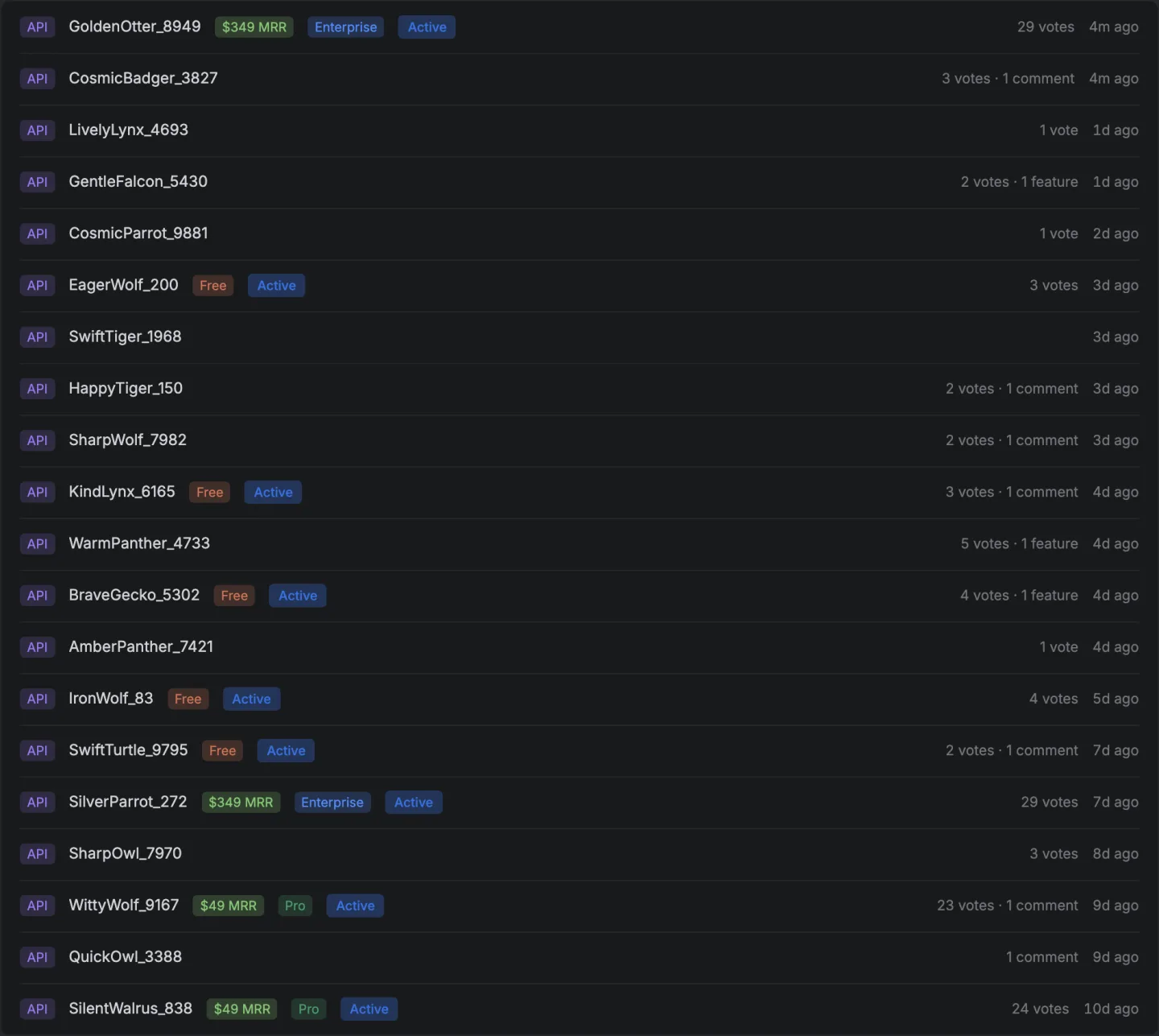
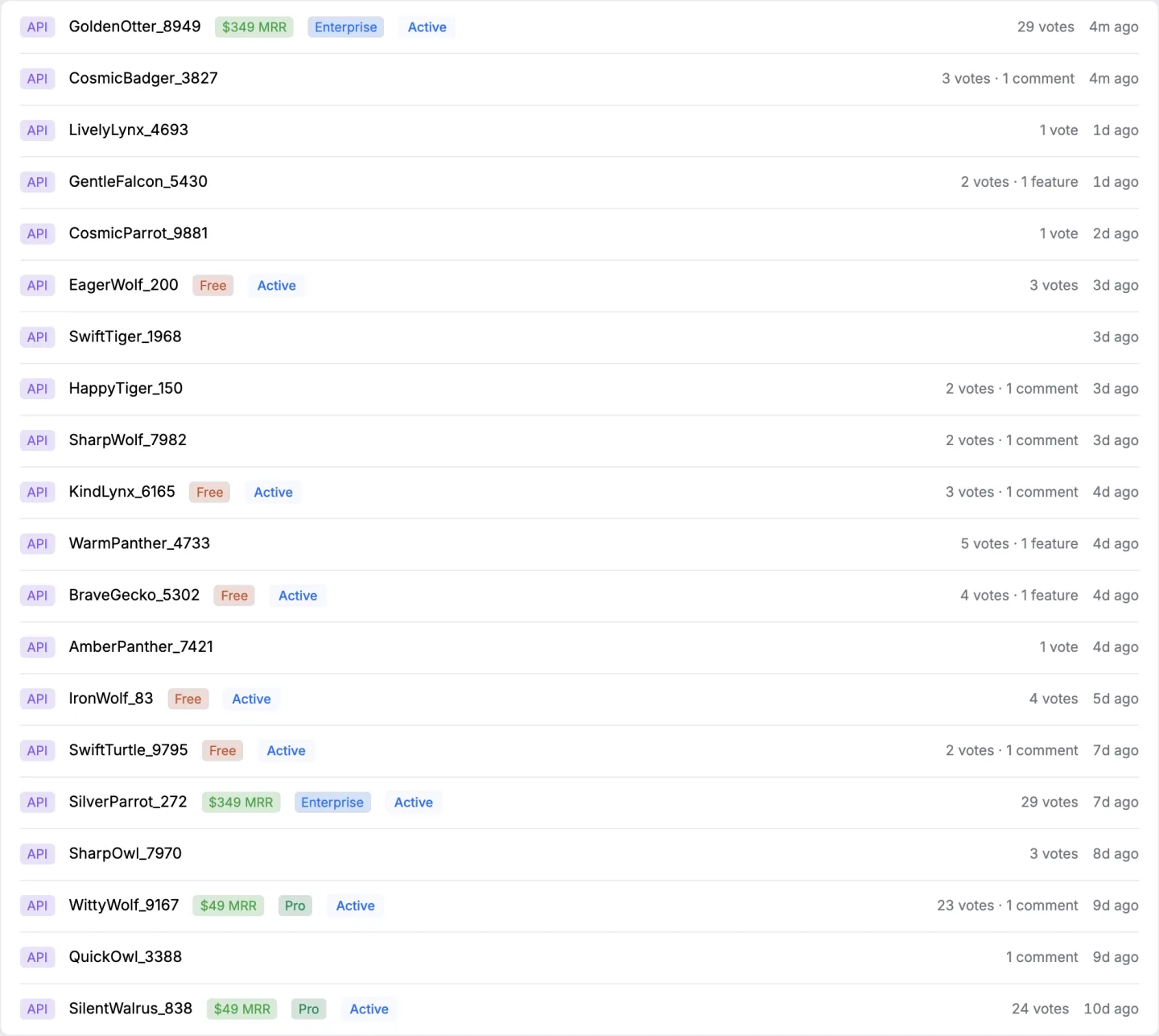
A vote here is one row with three things on it. Who cast it, which request it was for, and what that vote was worth at the moment it was cast.
The first two carry a database uniqueness constraint across the pair, so one voter can hold one vote on one request and a second attempt updates the row rather than adding to the total. That matters because it is a constraint the database itself refuses to break rather than a rule the application checks and could forget under load, which is the difference between a count you can show a customer and a count you have to apologise for.
The third is the weight, and it defaults to one. On a board with no tiers set up, every vote is worth one and the total is a plain headcount, which is exactly what you want when your voters are interchangeable.
The weight is written onto the vote when the vote happens rather than being looked up later. That is a deliberate choice with a consequence worth understanding. If a customer moves from a small plan to a large one tomorrow, the votes they cast yesterday keep yesterday's weight. The board records what was true when people spoke, so a total cannot be quietly rewritten by a change in somebody's subscription. If you want their old votes to count for more, you recast them deliberately.
Who is allowed to vote, and how do you know who they are?
Three answers, and you pick one per project rather than being sold up a ladder.
Anonymous. The board is public, a visitor votes with one click, and the identity is a cookie. Most votes on most boards work this way and it is the reason public boards collect anything at all. It is also the weakest identity, and anybody claiming otherwise is selling you something. What that choice costs you, and where it fights with weighting, is a page of its own.
Signed in to your product. Your application issues a signed token for the person already logged in, we verify it against a secret held on the project, and the vote is recorded against that real person. It is a JSON web token with an HMAC signature, and a token signed any other way is refused rather than trusted. This is on the PRO plan. It is the mechanism that makes weighting worth anything, because a weight is only as good as knowing who is voting.
Through the API. You record votes from your own systems, which is also PRO.
Worth being precise, because the phrase single sign on covers two different products. This one identifies your customers so they vote as themselves. It is not SAML, it does not connect to your company directory, and it will not sign your staff in through Okta. The exact shape is on the integrations page. If you need the directory kind, we do not have it.


What is a vote worth when your customers pay differently?
This is the question the category mostly does not ask.
A plain vote count answers how many people want this. That is the right question for a community product where everybody pays the same, and it is the wrong question for a business where one customer pays you two thousand dollars a month and another pays nothing.
Two requests, twelve votes each. One came from twelve people on your free tier. The other came from twelve people who are collectively most of your revenue. A board that treats every vote as one shows you two identical cards, and the information that separates them was never recorded.
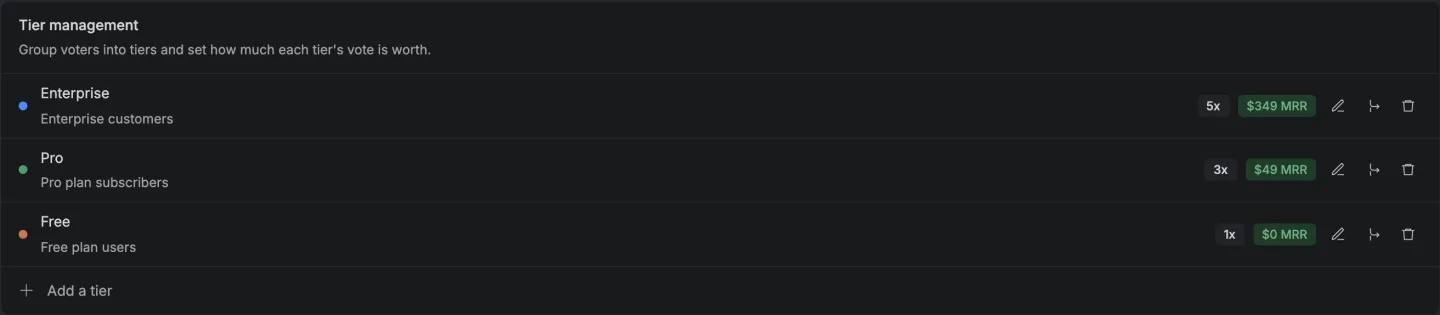
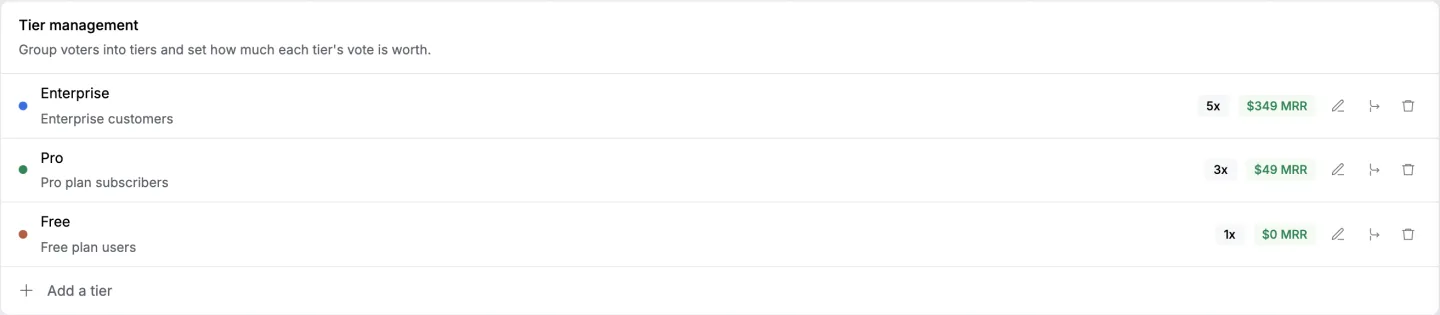
On VoteFirst you create voting tiers, set a whole number multiplier on each one, and assign each voter to a tier. A vote then carries that tier's multiplier, written onto the vote at the moment it is cast.
A voter in no tier counts as one. A multiplier below one is read as one. Nothing is ever rounded, because every multiplier is a whole number, so the weighted total is a whole number too.
Both totals sit on the same card. You see sixty one weighted votes from forty three voters and you know instantly that the paying accounts are behind it. The full mechanism, including what it deliberately does not do, is here.
Seven of the twenty one tools we checked ship some form of revenue weighting. This is not a mechanism only we have, and any page telling you otherwise is selling.
Where do the votes actually come from?
Three places, and the third is the one worth planning for.
Your public board. A page anybody can find, where suggestions are held for review before they appear.
Widgets inside your own product. The board, the roadmap, the changelog and a single vote button for one feature, embedded with one script tag. None of them are held back for the higher plan.
The API. Read a board, list features, vote, comment, take a vote back. Twenty one routes, of which two need your secret key and the PRO plan.
The reason the third matters is population. A public board mostly reaches people who went looking for it. A vote control on a screen inside your paid product reaches somebody you already know is paying, at the moment they hit the thing that is missing. Those are the votes that make weighting worth having.
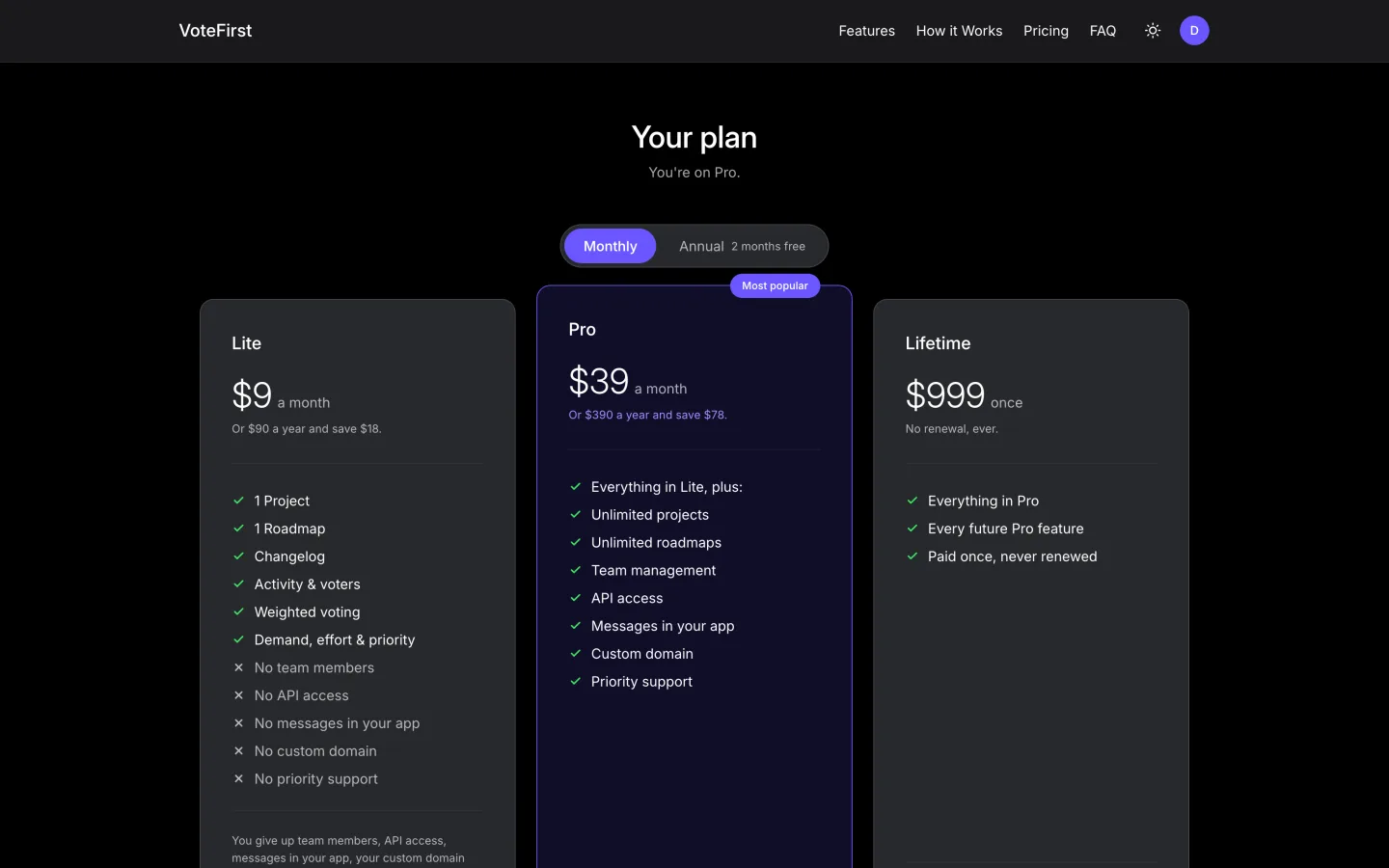
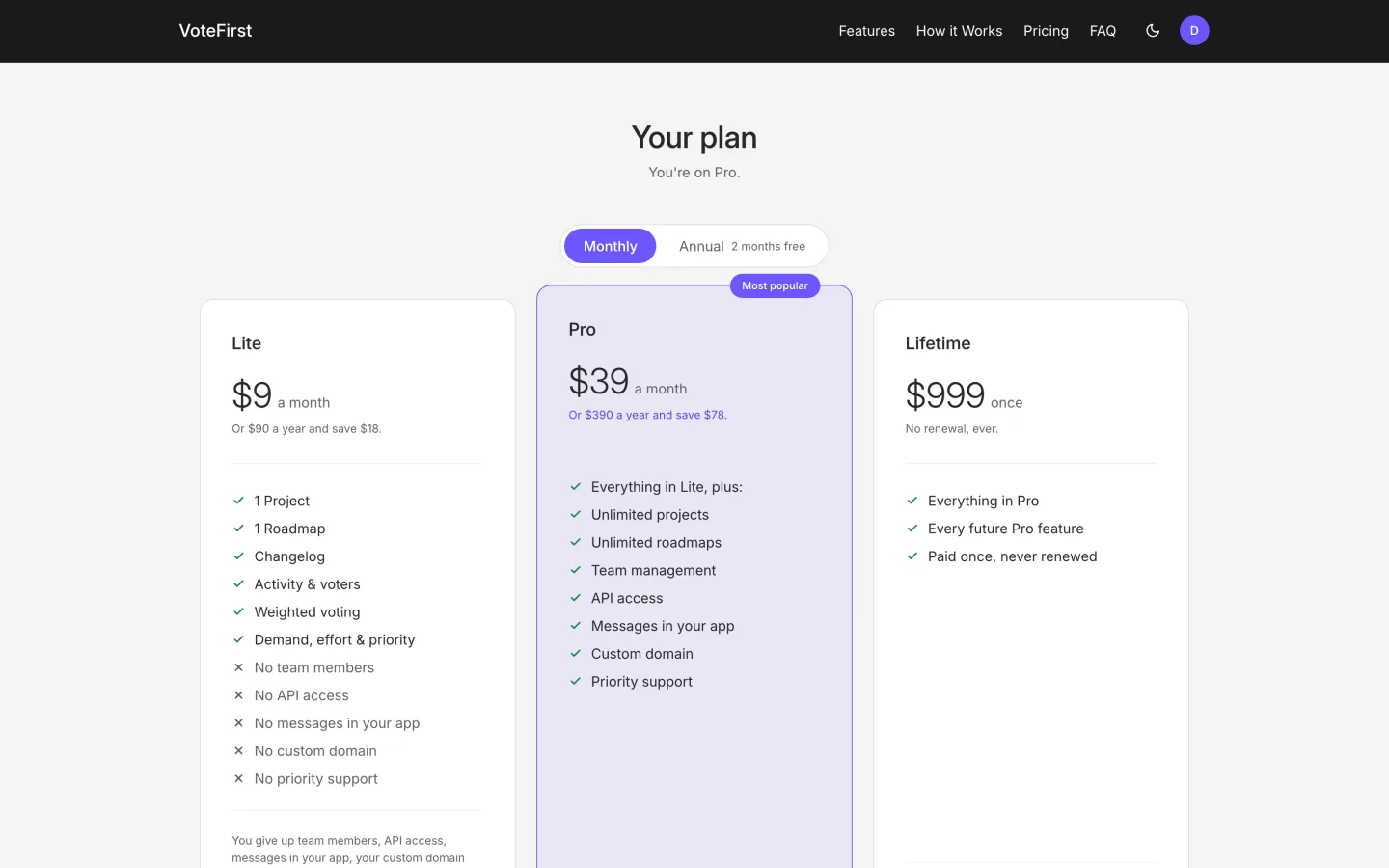
14 days, a card at signup, then $9 or $39 a month.
Who should not buy voting software?
Two teams, and being honest about them costs us nothing.
A team with no paying customers yet. Voting sorts demand you already have. It does not create demand, and at this stage ten conversations will teach you more than a hundred votes.
A team that already knows what to build. If your roadmap is full for a year and the constraint is engineering time rather than certainty, a voting board is a place for requests to queue and go stale. That is worse than not having one, because a public board nobody acts on reads as neglect.
A third case is narrower. If every one of your customers pays the same, weighting has nothing to weigh, and you should pick on price and on whether voting needs an account.
What does it cost?
Nine dollars a month for one project, with weighted voting included at that price.
There is no per voter meter anywhere in it. A board with fifty voters and a board with fifty thousand cost the same, and no widget is gated behind a higher plan.
We do not have a free tier. If your board will stay very small, a free plan elsewhere is cheaper than us. The full price and unit table for the category is here and it names the vendors who beat us on that.