Canny's Pro plan starts at $79 a month billed yearly for 100 tracked users, and the meter counts every visitor, admin or auto discovered contact who posts, votes or comments. Of the 47 other tools this page's table lists, 41 either charge less than that $79 entry rate or bill on a flat plan or project instead of counting people. VoteFirst, the product this site sells, is $9/mo for one project on LITE, with PRO at $39/mo, and neither price moves with how many people vote. VoteFirst vs Canny reads your own public Canny board and prices it at your size.
Canny is the best known product in this category and it is well built. This page is about the arithmetic on their pricing page, and about the thing that causes it.
Two differences matter and everything else is detail. Canny requires an identity before anybody can participate, and Canny bills you for each identity it collects. Those two facts are the same fact.
Every Canny alternative we could open, with its price
If you came here for the list, it is this one, and it is the whole list rather than the six that happened to pay for placement somewhere.
Every figure below was read on the vendor's own pricing page. Where a vendor publishes nothing we say so instead of estimating, and the second column is the part most comparison tables leave out, because the unit is what decides your bill two years from now rather than the number.
| Vendor | From | Billed per | Free plan | Trial |
|---|---|---|---|---|
| Trello | $5/user/mo | user | Yes | – |
| VoteFirst | $7.50/mo | plan | – | 14 days, card |
| Features.Vote | $7.50/mo | project | – | 14 days |
| Jira Product Discovery | $10/creator/mo | creator | 3 creators | – |
| LoopedIn | $12/mo | plan | 1 of each | – |
| WishKit | $12.50/mo | project | 5 requests | – |
| Sleekplan | $13/mo | workspace | 1 admin | 30 days, no card |
| Upvoty | $13.50/mo | project | – | 14 days |
| Noora | $14/mo | workspace | – | 7 days |
| Convas | $15/mo | tracked user | 25 users | – |
| FeedBear | $15/mo | project | – | 14 days |
| Supahub | $15/mo | workspace | 1 board | 10 days |
| ProductLift | $19/mo | workspace | – | 14 days |
| Productboard | $19/maker/mo | maker | 500 notes | – |
| Roadmunk | $19/creator/mo | creator | – | 14 days |
| Ducalis | $20/mo | changelog subscriber | 500 subs | – |
| Frill | $22/mo | workspace | – | 14 days |
| Fider | $25/mo | workspace | 250 items | – |
| Featurebase | $29/seat/mo | seat | 1 seat | – |
| Headway | $29/mo | plan | Yes | – |
| Nolt | $29/mo | board | – | – |
| UserJot | $29/mo | workspace | 2 boards | 14 days |
| Aha! Ideas | $39/user/mo | user | – | Yes |
| Savio | $39/mo | paid user | – | 14 days |
| Beamer | $49/mo | monthly active user | 1,000 MAU | – |
| Feature Upvote | $49/board/mo | board | – | 30 days |
| Rapidr | $49/mo | workspace | – | 14 days |
| Suggested | $49/mo | plan | – | 15 days |
| Gleap | $49/mo | plan | – | 14 days |
| FeatureOS | $50/mo | plan | – | 30 days, no card |
| Olvy | $60/mo | plan | 25 items | – |
| AnnounceKit | $39/mo | module | – | 15 days, no card |
| Canny | $79/mo | tracked user | 25 users | – |
| LaunchNotes | $249/mo | plan | – | 14 days |
| Pendo | Not published | monthly active user | Beta | – |
| ProdPad | Not published | module | – | 7 days |
| UserVoice | Not published | quoted | – | 30 days |
| airfocus | Not published | quoted | – | – |
| ProductPlan | Not published | quoted | – | – |
| Productroad | $9/mo | plan | 50 users | 14 days, no card |
| Quackback | $29/mo | plan | 1 board, 50 posts | 14 days, no card |
| ProdCamp | $99/mo | plan | 2 admins, 1 product | – |
| Harvestr | $65/editor/mo | editor | – | 14 days |
| Productlane | $29/user/mo | user | – | Yes |
| Ideanote | $6/user/mo | user | 10 users, 250 ideas | – |
| Craft.io | $19/editor/mo | editor | – | 14 days, no card |
| HYPE Boards | €79/mo | plan | – | 14 days, no card |
| Noticeable | $24/mo | plan | 1 project, watermarked | 14 days, no card |
Every tool in this market that publishes anything, and ours. Seven of them weight votes by what the customer pays, so if that is what brought you here, it is not a thing only we do and anybody telling you otherwise is selling. The full table with what each one includes is here.
Two things in that table are worth saying out loud because they go against us. Ten of these tools have a free tier and we have none, so if your budget is zero today, ten of them will take you and we will not.
And the entry price is the least reliable number in any comparison, including this one, because it is the column vendors tune and the unit is the column that decides what you actually pay.
The same two products, line by line
Read on each vendor's own pages on the date in the row above. Not published means nobody could read it on the pages opened that day, never that the feature is absent.
If you have already decided and want to know what happens to your data, what moves and what does not is on its own page.
That is why the second column exists and why this page continues past the table. Canny's unit is the only one here that grows without you hiring anybody or launching anything, and the next section is about why.
None of the above is hard to verify, because the trial is 14 days and the price after it is $9 or $39 a month.
What this costs
Lite
$9 /mo
Pro
$39 /mo
Lifetime
$999 once
Fourteen day trial of Pro, card asked for at signup. Nothing here counts the people who vote, so the bill does not move when the board starts working. The long version, with what happens if you stop paying.
What is a tracked user?
A tracked user is anybody with a post, a vote or a comment attributed to them. That is Canny's own definition and it is the unit your invoice is calculated from.
Three details in it are worth reading slowly, because they are where the surprise usually lives. A user an admin voted on behalf of still counts. A user whose feedback their automated discovery found still counts. And your own admins count, if they post, vote or comment.
So the meter does not measure your customers. It measures everybody who touched the board, including the people on your side of it.
How much does Canny cost for 1,000 users?
529 dollars a month billed yearly on the Pro plan.
The ladder is worth seeing in one place, because the pricing page shows you the bottom of it.
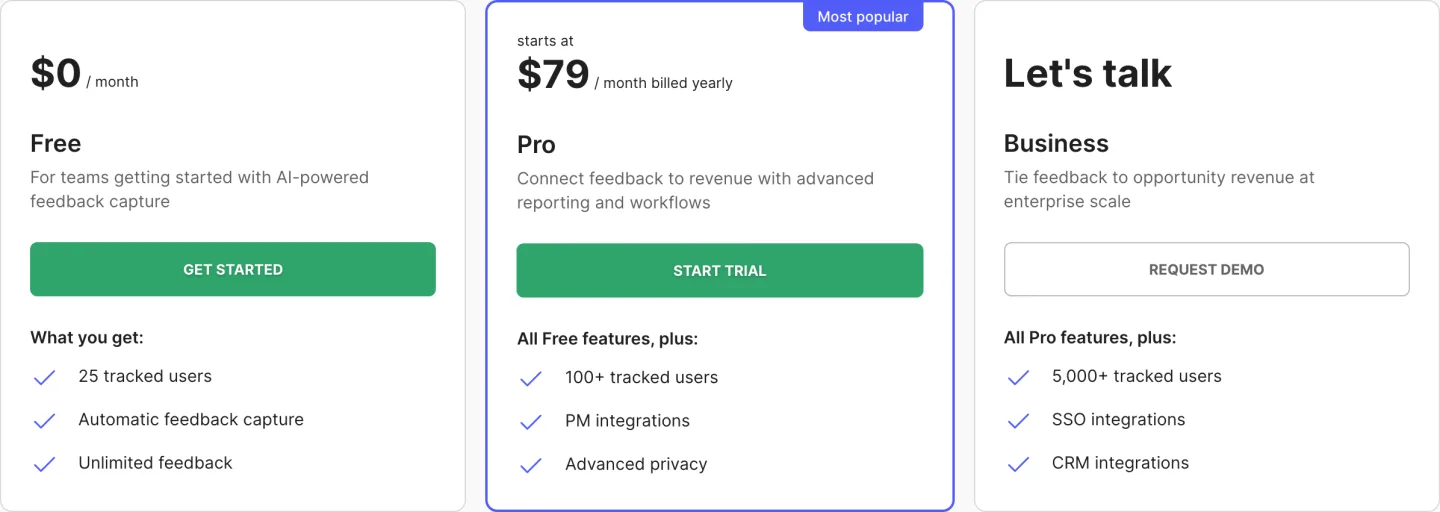
Free is 0 dollars for 25 tracked users. Pro starts at 79 dollars a month billed yearly for 100 tracked users, or $99 billed monthly. At 1,000 tracked users Pro is $529 a month billed yearly. At 5,000 it is $1,079 a month billed yearly. Business has no published price and you talk to somebody.
Those are their numbers from their own pricing page and help centre, read on the day this page was written.
What happens when I go over the limit?
You move to the next increment automatically. Canny states plainly that exceeding the tracked user limit moves the account up.
That is how a metered product has to work, and no criticism is meant by saying so. It is worth knowing because the thing that moves you is your board becoming popular, which is the outcome you bought the board hoping for.
Does the spend cap stop the bill or stop the product?
It stops the product. This is the single most useful thing on this page.
Canny lets you set a monthly spend limit, which sounds like exactly the safety net you want. What their own documentation says happens when you hit it is that Canny stops tracking feedback from new users. Their automated conversation analysis also stops until you raise the limit.
So the cap protects your invoice by turning off the part of the product that collects feedback from people who have not been counted yet.
A new customer arrives with an idea and the board does not record them. That is a defensible engineering decision and it is not what most people picture when they set a budget ceiling.
Can people vote without an account?
Not on Canny. Their own help centre states that they do not allow completely anonymous feedback and that a name and an email are required before anyone can post, vote or comment.
They have a feature called anonymous boards on the Pro and Business plans, and it is worth being precise about what it does. It hides who voted from other visitors. It does not remove the sign in step, and the identity is still collected and still counted.
This is the difference the whole page turns on, and it is a design choice rather than an oversight. Requiring an identity gives Canny attribution, segments and revenue reporting that a cookie cannot. It also puts a form in front of the person with the idea, and it is what makes the meter run.
On VoteFirst an anonymous cookie is set on the first page load. Voting, commenting and suggesting are open from that moment with no form, which you can check on our own board without signing up, and there is no per user charge at any board size.
14 days, a card at signup, then $9 or $39 a month.
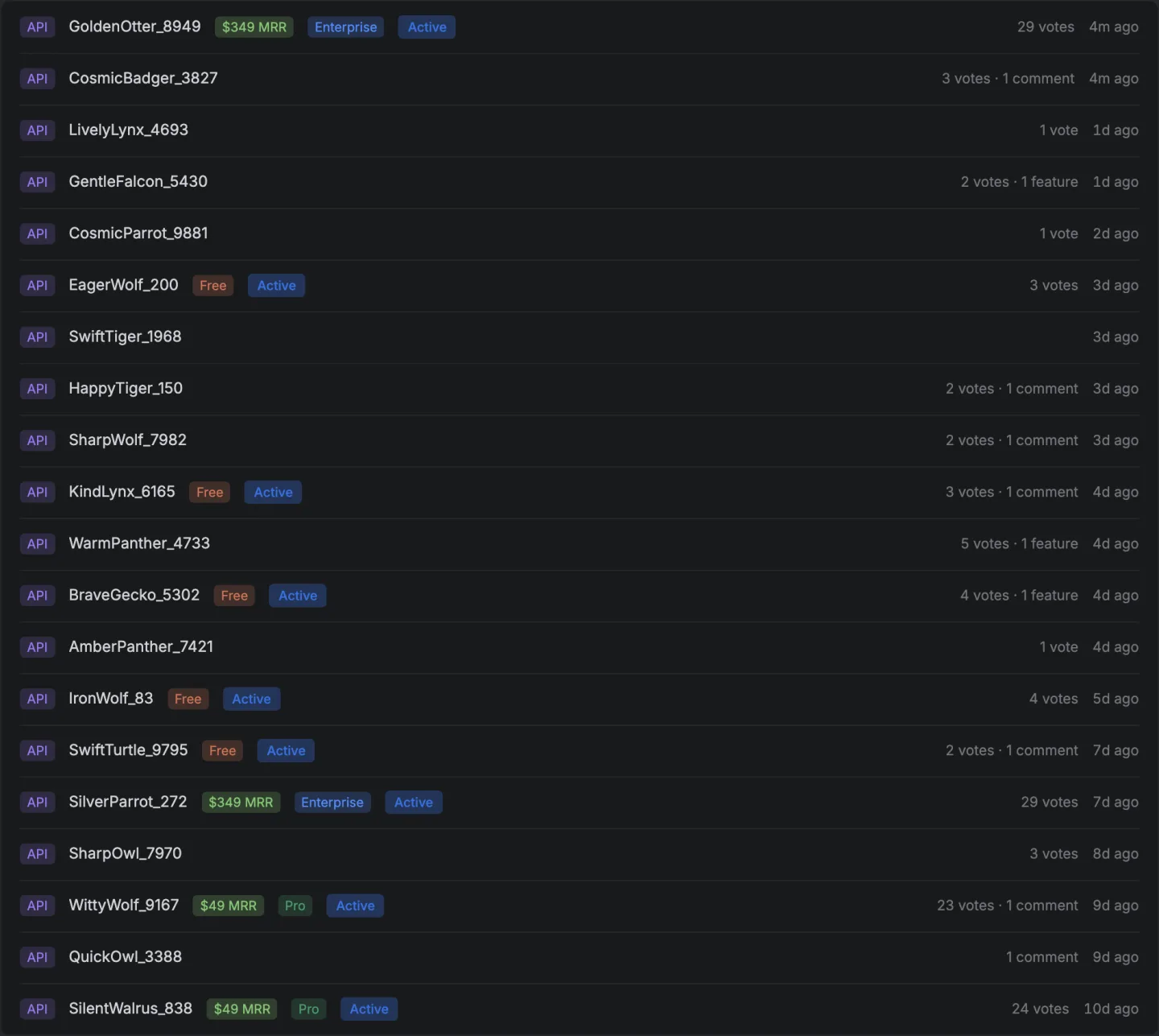
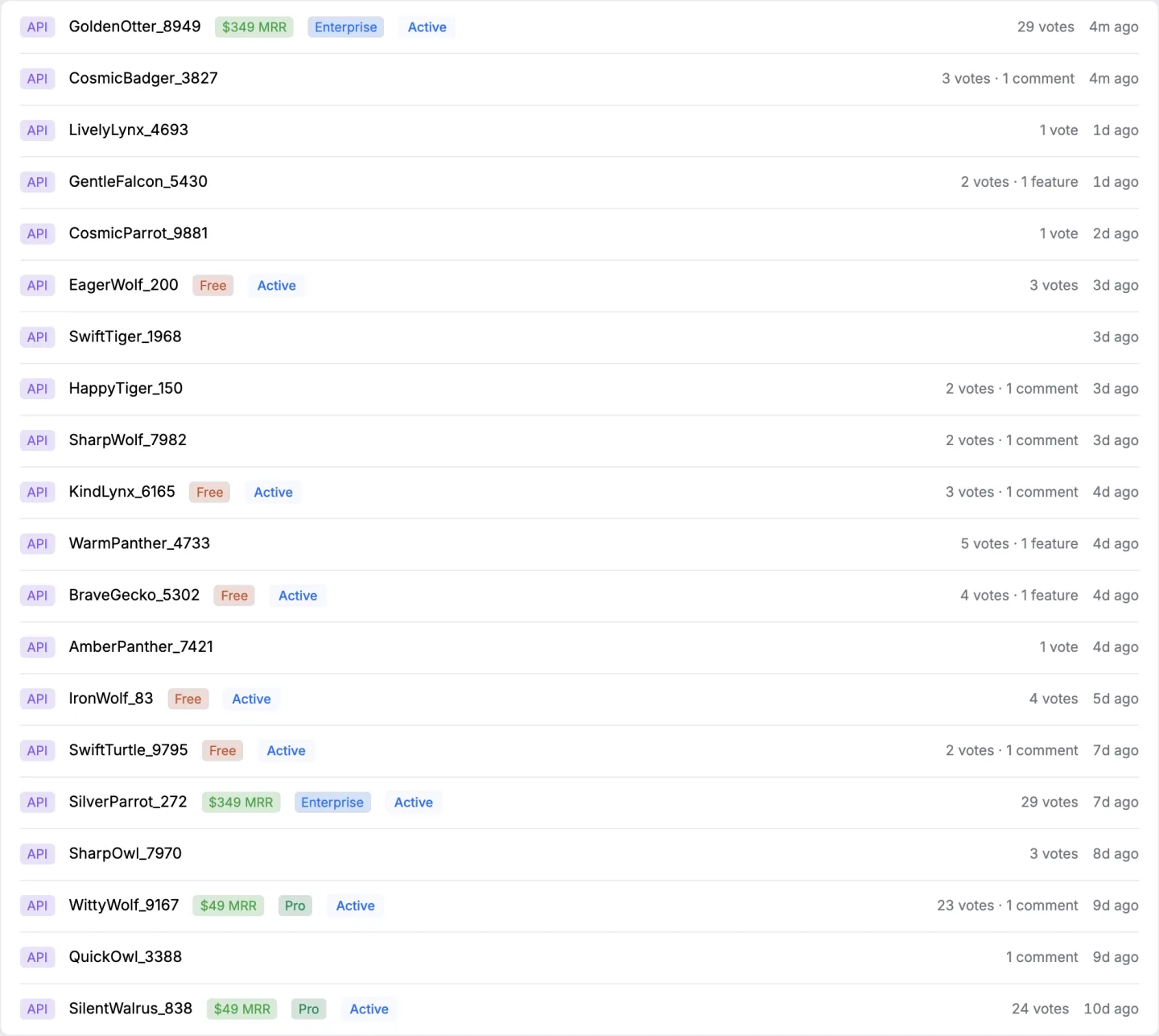
Does Canny weight votes by revenue?
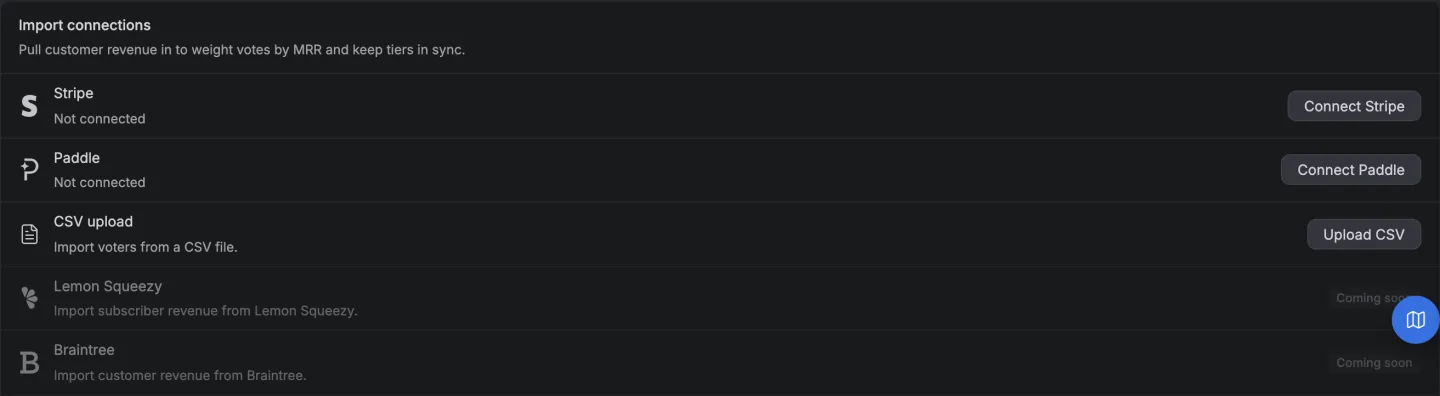
Yes, and better than we do in several ways. They sort boards by monthly revenue impact, they list it as a named feature, and they will pull recurring revenue in from a CRM or through their own interface.
We are not going to pretend otherwise, and anybody telling you weighting is unique to us is wrong. Eight of the thirty two tools we checked ship a form of it, and Canny is one of them.
One nuance from their documentation that is genuinely clever and worth borrowing. Canny counts a company's revenue once per post, however many people from that company vote on it. That stops a large team looking like a large amount of money.
The differences that survive are about where it sits. Their revenue reporting depth is on the higher plans and their sales tools sync is on Business. Ours is on the nine dollar plan.
Ours is also simpler, an integer multiplier on a tier that you set yourself, which is easier to explain to a colleague and easier to distrust when it says something strange.
Can I export my data from Canny?
Yes, and this is one of the places Canny behaves better than most of the category. Their export is real and documented rather than a support ticket.
If you are evaluating an exit before you evaluate an entrance, which is a sensible order, read their export documentation rather than anybody's summary of it. We went through what their export file actually contains column by column.
Does Canny have a free plan?
Yes, capped at twenty five tracked users on their pricing page read on 14 September 2026. That cap is the thing to read carefully, because a tracked user is anybody associated with feedback, so the plan ends when twenty five customers have voted rather than when you invite a colleague.
Does Canny have a public roadmap and single sign on?
Canny publishes a public roadmap from the board. Canny carries single sign on in its base features, with the SSO integrations on Business.
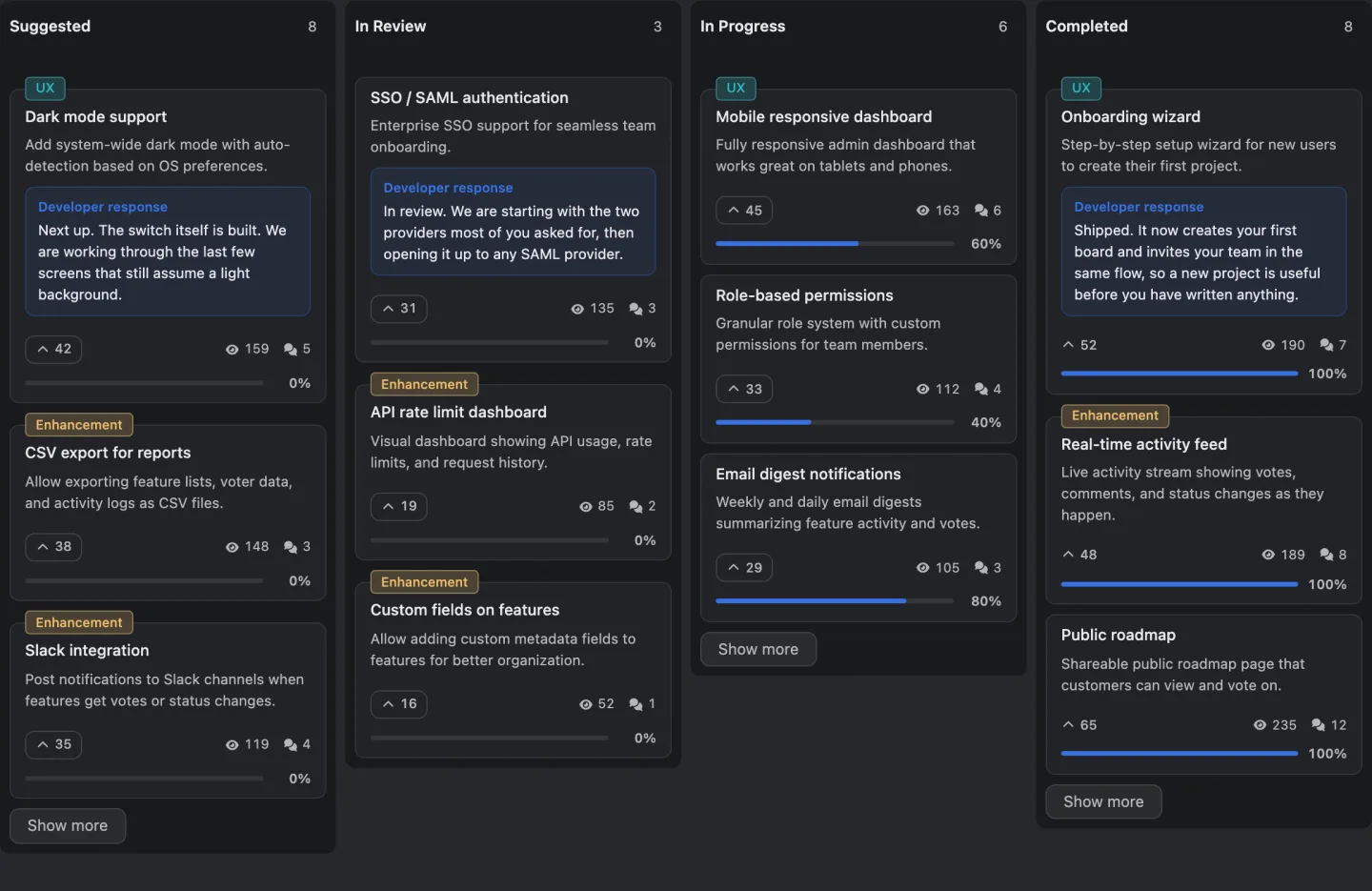
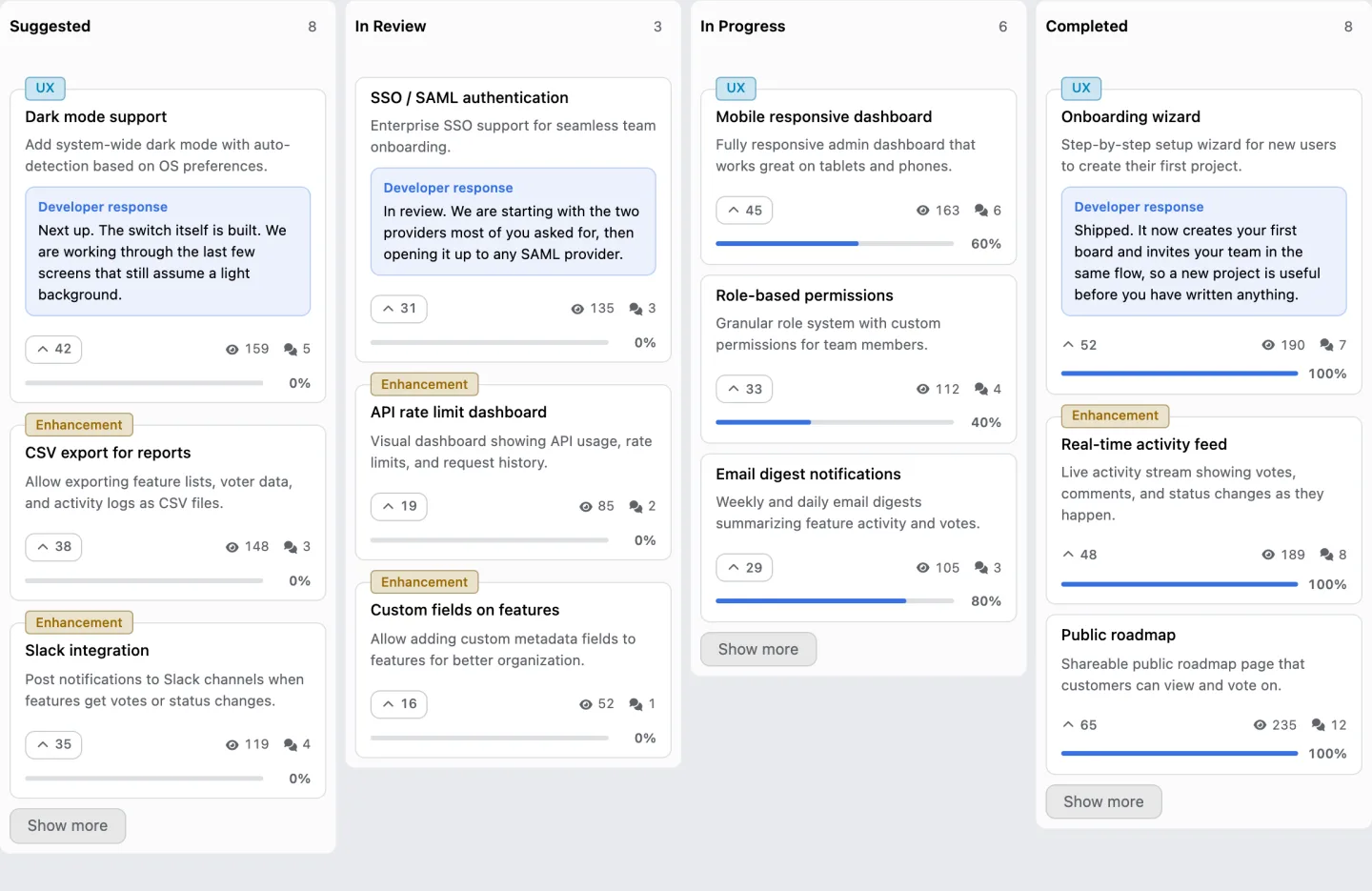
Ours publishes a public roadmap with a Denied column on every plan, and signs a voter in with a token from your own application on the thirty nine dollar plan rather than with SAML.
Is there a free Canny alternative?
Yes, several, and none of them is Canny. Fider is the free one to know about, because it is open source and its hosted tier runs to two hundred and fifty feedback items.
UserJot gives two boards and three admin roles, Supahub gives one board and one admin, Featurebase gives one seat, and Sleekplan's Indie tier is a single admin workspace that does not expire.
All five were read on their own pages on 14 September 2026. This product is not one of them. There is no free plan here, only a fourteen day trial that asks for a card at signup.
Is Canny worth it, and when is it the better answer?
Private boards on every plan, including Free. We have nothing that does this.
A board of ours is either published to everybody or published to nobody, and there is no password, no invite list and no way to let one named customer in. If your feedback must sit behind a login, stop reading and buy Canny.
Unlimited boards and unlimited feedback on every plan, including Free. If you have many small products and few voters, their free tier is genuinely generous and ours is not, because we do not have one.
Sales tools integration. If your revenue lives in a CRM and you need feedback joined to open opportunities and churn, they have built that and we have not.
Their free plan at 25 tracked users is a real place to start. For a board that will stay small, it costs nothing and it works.
One thing to check before you commit
Search engine indexing of a Canny board is a paid feature. If part of why you want a public roadmap is that people find it in a search, that is not on the free plan.
We are not in a position to sell you that contrast, so here is where we stand.
The application serves one robots file for every host it answers on, a customer's own domain included, and that file disallows every path, so a crawler that obeys it does not read a board of ours on any plan.
The page underneath is built for the opposite, with its own address, its own description, its own canonical link and no instruction in the markup to stay away, and the file in front of it says no anyway.
The canonical link was missing until we checked it for this page, and it is on every public page of ours now.
One board of ours is in Google's results even so, because an address can be indexed from the links pointing at it without its page ever being fetched. That is not the good version of being found. It means the page nobody read is the page being listed.
Theirs is a pricing decision you could buy your way past. Ours is a blanket line on a host that also carries boards whose owners may not want them public, so it is not a one line fix, and neither of those facts is a reason to choose us this week.
What ours costs
Nine dollars a month on LITE, one project, weighted voting included. Thirty nine on PRO, which adds more projects, the API and a custom domain. The rest of the category is priced in one table with the unit each vendor bills on.
One price whatever the board does. No tracked users, no per voter charge, and no automatic move to the next increment when a lot of people turn up. A board with fifty voters and a board with fifty thousand cost the same.
There is a fourteen day trial on whichever plan you pick, and a card is required to start it.
If you are on Canny today and the number that bothers you is the tracked user count rather than the product, what a tracked user really costs across the category is priced at whatever number you enter.
If you want the list rather than one side by side, the Canny alternatives shortlist puts seven products of different shapes on one page, and the head to head pages take Canny against one rival at a time.
Your board comes with you
Leaving does not mean starting over. Paste your Canny board's address into Settings and posts, statuses and vote counts come across, finished and closed posts included. Comments stay behind. Read your board first to see what it holds and what Canny charges at that size, no account needed.
Canny against the others, one at a time
Twenty pages here take Canny and one rival at a time, working out where the two bills cross and what each one does with a vote from a paying customer.
- Aha vs Canny, and the two people each one bills
- Canny bills voters, Frill bills open ideas
- Canny bills voters, Sleekplan bills seats
- Canny vs Feature Upvote, and two opposite bills
- Canny vs FeedBear, and which wall you hit first
- Canny vs Fider, a bill against a server you would run
- Canny vs Nolt, and what a second board costs
- Canny vs Noora, a meter against a flat rate
- Canny vs UserJot, a meter against a flat rate
- Canny vs Pendo, tracked users against active users
- Canny vs Productboard, priced on the same day
- Canny vs Savio, tracked users against paid seats
- Canny vs Upvoty, priced on the same day
- Canny vs UserVoice, priced and not priced
- Featurebase vs Canny, seats against tracked users
- Features.Vote vs Canny, flat against metered
- Hellonext vs Canny, and the page neither vendor wrote
- ProductLift vs Canny, a seat fee against a tracked user
- Rapidr vs Canny, a seat count against a crowd count
- Supahub vs Canny, the two price lists tested
- airfocus vs Canny, and only one of them has a price