Rapidr and Canny both show a monthly figure on their own pricing pages, and the two figures answer different questions. Rapidr asks how many people work on your side. Canny asks how many people used the board at all, your own colleagues included if they post or vote.
Everything below was read on each vendor's own pages on 15 September 2026.
What does each one charge?
Forty nine dollars a month for Rapidr's entry plan, seventy nine for Canny's, and nine here, and only one of the three counts the people who use the board rather than the people who run it.
| Vendor | From | Billed per | Free plan | Trial |
|---|---|---|---|---|
| VoteFirst | $7.50/mo | plan | – | 14 days, card |
| Rapidr | $49/mo | workspace | – | 14 days |
| Canny | $79/mo | tracked user | 25 users | – |
Read on each vendor's own pricing page on 2026-09-15.
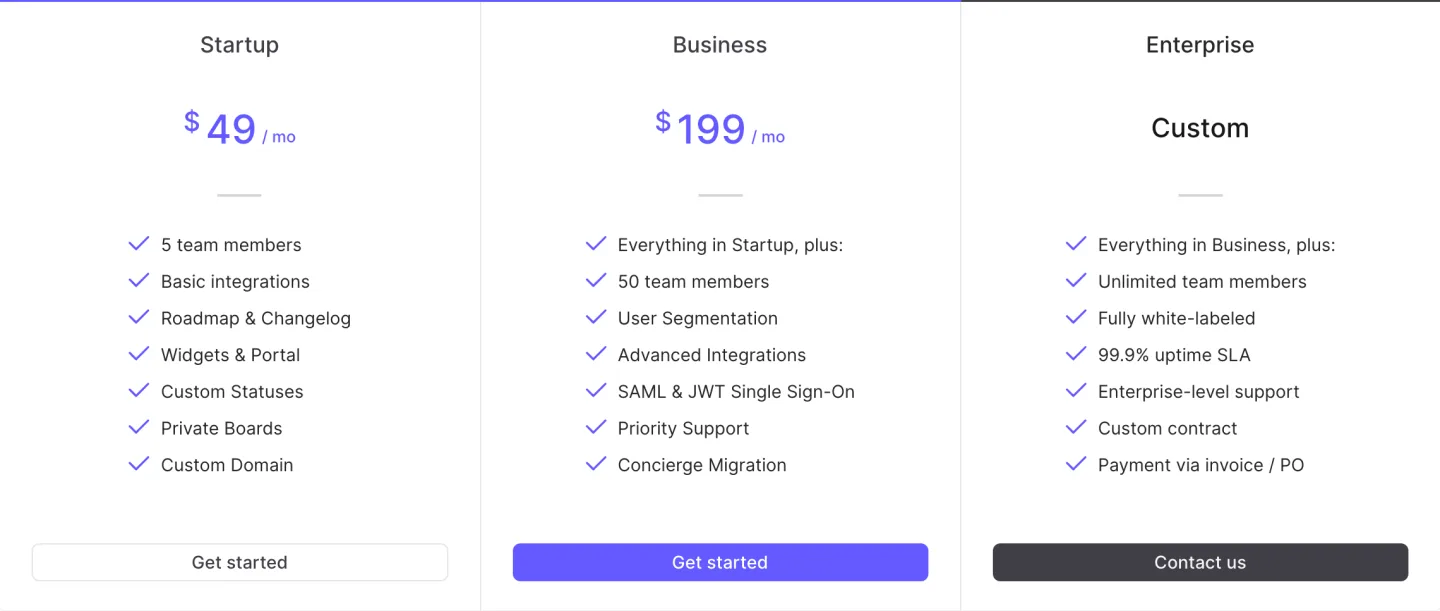
Rapidr's own pricing page draws a clean line. A user is a customer who votes, comments or leaves feedback, and a team member is a colleague invited to the account. Only the second kind lands on the invoice, so a board that suddenly gets busy produces no extra bill at all.
Canny's meter runs the other way. A tracked user is anybody with a post, a vote or a comment attributed to them, and that includes an admin on your own side if they take part. Their free plan holds twenty five of those before the bill starts.
How much does Rapidr cost compared to Canny?
It depends on which side of your business is larger, the people on your payroll or the people who show up to vote, and here is the arithmetic at three sizes.
| Your situation | Rapidr | Canny |
|---|---|---|
| 2 team members, 15 customers vote | $49/mo on Startup, well under its 5 member cap | Free, under the 25 tracked user line |
| 8 team members, 90 customers vote | $199/mo on Business, since Startup's cap is 5 | $79/mo, inside the first paid step at 100 tracked users |
| 45 team members, 900 customers vote | $199/mo on Business, still under its 50 member cap | Above $79/mo, at a rate their page does not print between the 100 and 1,000 tracked user steps |
The middle row is the one to sit with. A sixth colleague is what moves Rapidr's bill, not the ninety people voting. Canny does not care how many colleagues you add, only that ninety customers crossed its free line.
Canny does not publish a figure between its $79 step at 100 tracked users and the $529 a month it names at 1,000. Their own worked example on the alternative page gives that $529 figure directly, and nothing prints the numbers in between.
If you would rather look at a board than read about billing, the demo is open without an account.
Which one should you choose?
They meter opposite things and the honest answer keeps both in view.
Rapidr is the better answer for a small team that expects a busy board. Five colleagues and unlimited customers fit on its forty nine dollar plan, and the price does not move no matter how many people vote.
Canny is genuinely the more finished public board, and their automated layer that reads support and sales conversations for feedback nobody typed in is a real capability we do not have. It also ships private boards and unlimited feedback on its free tier, which a team that wants many small boards will find hard to beat at zero cost.
Rapidr's own comparison table marks five rows as not yet available, an MRR filter among them, and a buyer choosing it for that row today is choosing a promise rather than a shipped feature.
Why choose Rapidr over Canny, or Canny over Rapidr?
Because one of them prices your payroll and the other prices your crowd.
Choose Rapidr when you expect a busy board and a small team, because five colleagues are already covered at forty nine dollars and the bill will not move no matter how popular the board gets.
Choose Canny when your team is larger than five and your board is likely to stay quiet, because Canny never charges for a colleague at all, only for the customers who take part.
The choice follows from which number in your own business is the one likely to grow.
Fourteen days of Pro, a card at signup, then nine or thirty nine a month.
Is there a cheaper alternative to both?
Yes, and which one looks expensive depends on whether your growing number is colleagues or customers.
Against Rapidr's team member cap, anything with a flat single price is cheaper the moment a sixth person needs a login. Against Canny's tracked user meter, anything flat is cheaper the moment the board starts working.
What each meter costs at a number you choose is worked out here, and the full field with the unit each vendor bills on is one page. Ours is nine dollars a month flat, for comparison, whichever meter would have hurt you.
What does each do with a vote from a big customer?
Rapidr has announced this and not shipped it. Canny has shipped it and does more with it than we do.
| Vendor | Weighting by revenue | Single sign on | Private boards |
|---|---|---|---|
| Rapidr | No, their own table marks the MRR filter coming soon | Business, SAML and JWT | Startup, their entry plan |
| Canny | Yes, sorts boards by monthly revenue impact | Base features on every plan | Every plan, including Free |
| VoteFirst | All plans, a whole number multiplier on the vote itself | Pro, a token from your own app | None at any price |
Read on each vendor's own pages on 2026-09-15.
Ordering a board by revenue is what Canny's sort does. Counting a company's revenue once per post rather than once per voter, which their own documentation states plainly, is the detail that keeps a large team from looking like a large amount of money.
Neither Canny's sort nor Rapidr's planned filter multiplies the weight of the vote a person actually cast, which is the whole of what our own mechanism does instead.
Checking our own vendor matrix of thirty two feedback tools, eight write something revenue related into their own pages, and four of those eight go as far as weighting the vote itself, so it is a difference rather than something only we do.
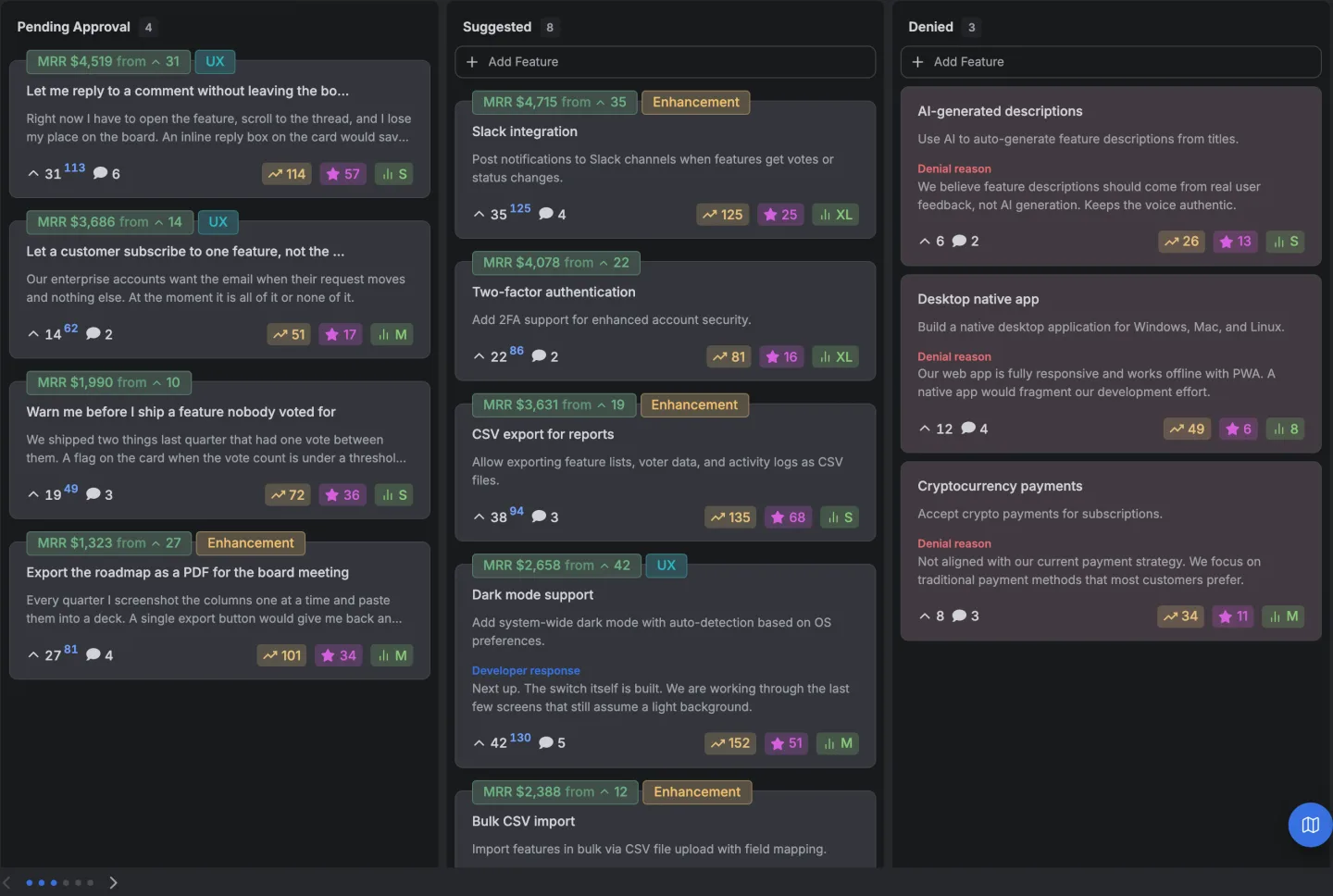
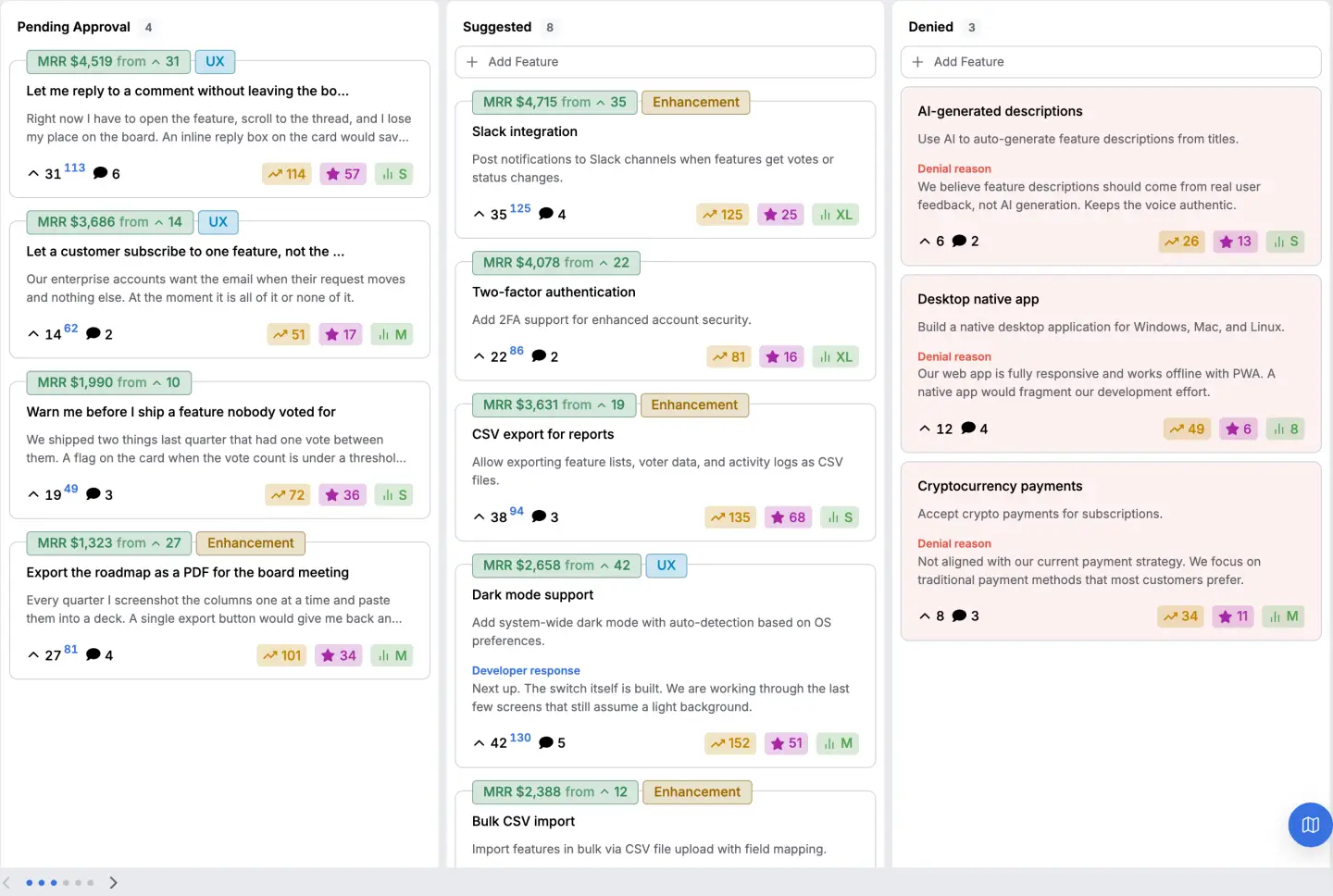
Can I move from one to the other?
Canny's export is real and documented, and what the file actually contains is written up separately. Rapidr's own pricing page names a concierge migration on its Business plan but does not state what an export from Rapidr itself contains, so that claim is left out rather than guessed at.
What usually does not survive a move between any two tools in this category is who cast each vote rather than the total, the threading on comments, and the original timestamps.
Where we fit, and where we do not
Both Rapidr and Canny sell a private board, and we have none at any price. Rapidr puts private boards on its forty nine dollar entry plan. Canny puts them on every plan including Free. A board of ours is public to everybody or to nobody, with no password and no invite list.
Both of them also carry a form of single sign on, and ours is not the same thing. Rapidr puts SAML and JWT on its Business plan at a hundred and ninety nine dollars. Canny includes SSO in its base features on every plan. Our Pro plan signs a voter in with a token issued from your own application rather than with SAML.
What this product does instead is put a whole number multiplier on a tier and write that weight onto the vote the moment it is cast, on the nine dollar plan as well as the thirty nine dollar one, with the plain count still shown beside it.
What is Rapidr, and what is Canny?
Rapidr is a feedback board with a roadmap and a changelog, billed by the colleagues on your own side rather than by the customers who vote.
Canny is a feedback board with a roadmap and a changelog too, billed by the tracked users associated with the feedback, your customers and your own admins alike.
Does either one have a free plan?
Canny does. Rapidr does not.
Canny's pricing page read on 15 September 2026 gives twenty five tracked users free, ending when twenty five customers have taken part rather than when a colleague joins.
Rapidr's page carries no free tier, only a fourteen day trial that its own page says asks for no card, with any plan refundable inside the first thirty days.
What this costs
Lite
$9 /mo
Pro
$39 /mo
Lifetime
$999 once
Fourteen day trial of Pro, card asked for at signup. Nothing here counts the people who vote, so the bill does not move when the board starts working. The long version, with what happens if you stop paying.
The honest summary
Rapidr's bill answers to your headcount and stays flat while a board fills up. Canny's bill answers to the crowd and stays flat while your team grows. A small team expecting a lot of voters saves money on Rapidr. A large team on a quiet board saves money on Canny.
Neither one weights a single vote by what its voter pays, the way ours does at nine dollars flat.
The Rapidr alternative page and the Canny one carry each side on its own.
14 days, a card at signup, then $9 or $39 a month.