A tracked user is a person outside your company that a feedback tool counts because they took part, and on three tools in this category it is the unit your invoice is calculated from.
The term matters because three independent vendors answer it as a frequently asked question on their own sites, which means buyers keep arriving at the category not knowing what they are being charged for. It is the only billing unit in this field whose number you do not control.
What is a tracked user?
Anybody with a post, a vote or a comment attributed to them.
That is the definition on the tool that popularised the term, and three things inside it surprise people. Your own admins count when they take part. A user an admin voted on behalf of counts. A user discovered by automated tooling counts.
So the meter is not counting your customers. It is counting participation, which is the thing the product exists to increase.
Which vendors use the word, and what does each one mean by it?
Six, and they disagree, read on each vendor's own pages on 14 September 2026 except the last, read on 15 September 2026.
| Vendor | Billed per | Bill moves with it |
|---|---|---|
| Canny | tracked user | Yes |
| Convas | tracked user | Yes |
| Beamer | monthly active user | Changelog only |
| Pendo | monthly active user | Yes |
| Sleekplan | workspace | No |
| Upvoty | project | No |
| Noora | workspace | No |
The disagreement is the useful part. Three vendors bill on the count. Three more print the phrase on their pricing page and then say unlimited beside it, which uses the reader's fear of the meter to sell a plan that does not have one.
A seventh unit arrived this month, being Ducalis charging per changelog subscriber, which counts a different population again.
Does a tracked user ever stop being counted?
Not on the tool that defined the term.
As long as a post, a vote or a comment is attributed to somebody, that person stays counted. Delete the request and the person who asked for it stays on the meter. Close a card as shipped two years ago and everybody who voted for it is still counted.
So the number on the invoice is how many people have ever used the board, added up since the day it opened, rather than how many used it this month.
A meter that only counts upward behaves differently from every other line on a bill, and a board that has gone quiet can sit in a band set by one busy week nobody remembers.
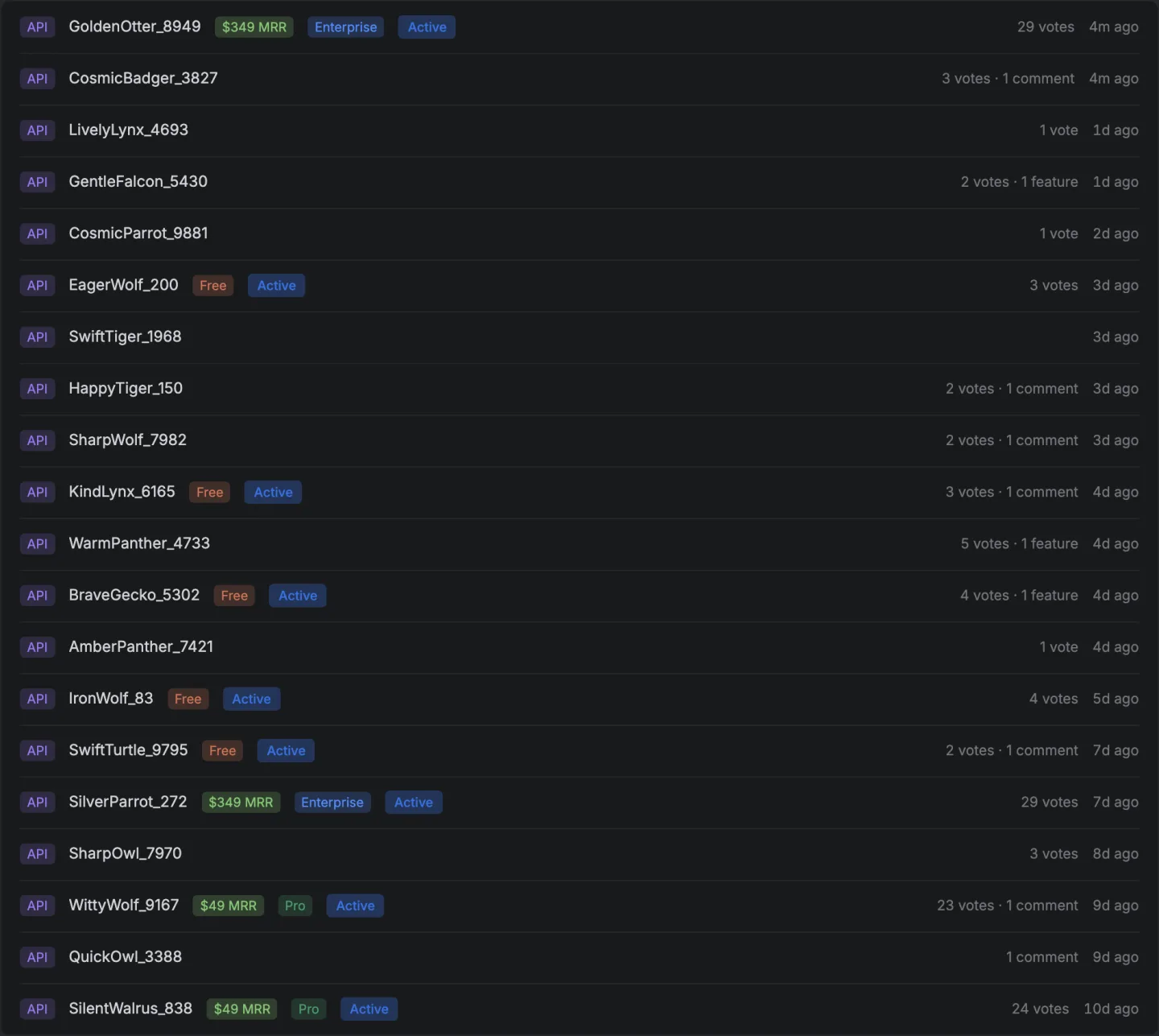
Why does the bill grow when the board works?
Because on a metered tool the number that sets the price is the number the product exists to raise.
A board with ten people on it is a board that failed. A board with a thousand people on it is a board that worked.
That is a coherent way to build a business and no kind of trick, and it is worth understanding before you choose, because the cost arrives at exactly the moment you were hoping to be pleased.
The arithmetic across the whole field at a number of voters you pick is a calculator, and the published ladder for the tool that defined the term is written out in full.
Does this product meter tracked users?
No, and there is no counter of any kind on the people who take part.
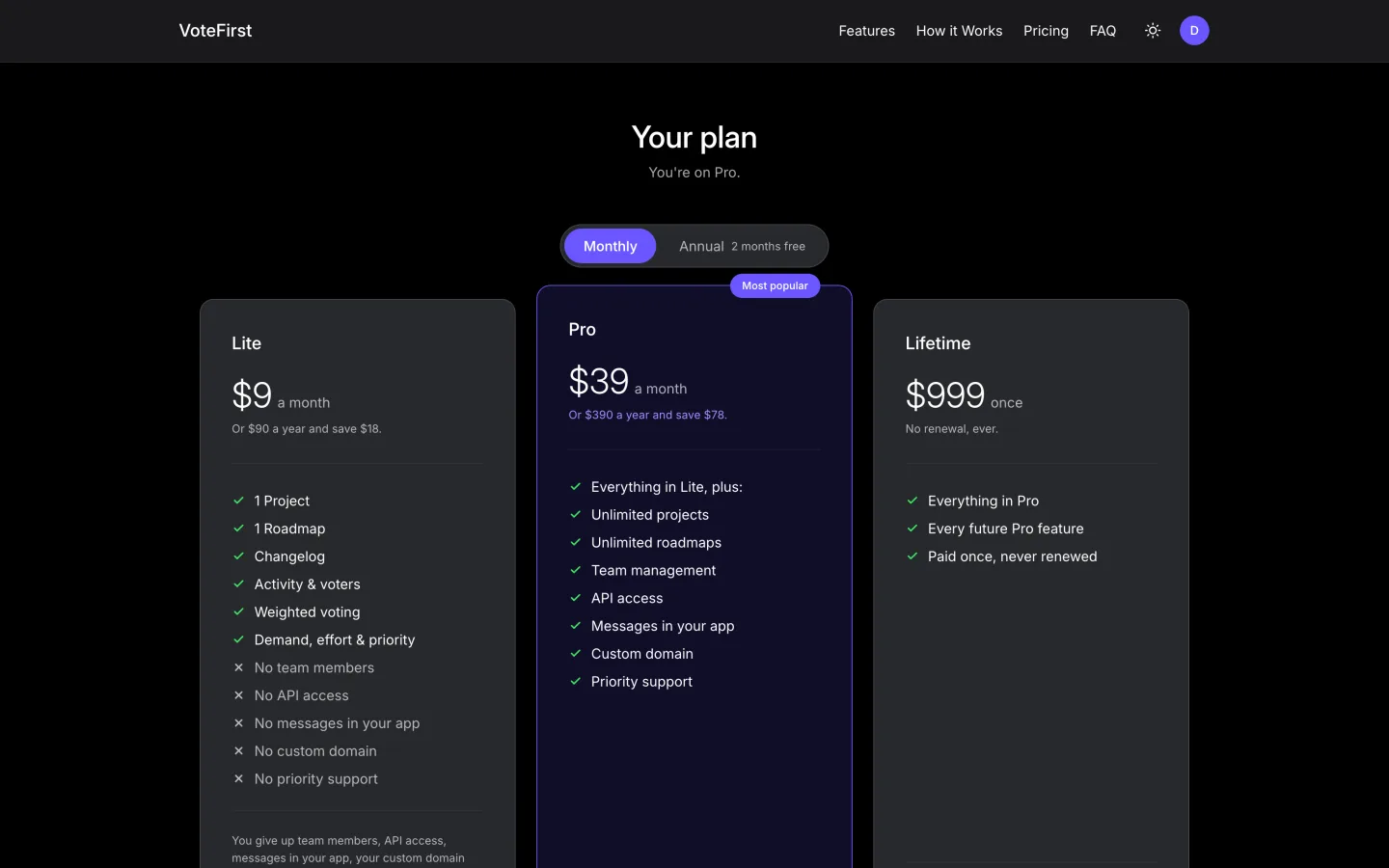
Voters, commenters, subscribers and the people who only look are all uncounted here. The plan counts projects and nothing else, so a board that suddenly works does not produce an invoice. That is the whole of the position and it is not a feature so much as an absence.
The honest trade is that a flat price is worse value than a metered one while the board is small. Several vendors are genuinely free at one board and one admin, and this one is nine dollars from the first day.
14 days, a card at signup, then $9 or $39 a month.