Ducalis is a prioritisation suite, and the fastest way to understand what it costs is to notice that its own pricing page prints no figure at all.
The number arrives from a calculator that runs after the page loads, and it takes two inputs, being how many people work on your backlog and how many people read your release notes.
That second input is the unusual one and it is the reason to read this page rather than a table. Ducalis bills by the audience for your changelog.
Everything below was read on their own pages on 15 September 2026.
What is Ducalis?
A prioritisation tool that sits between your task tracker and a public voting board.
Work arrives from Jira, Linear, Asana, Trello, ClickUp, GitHub or YouTrack, gets scored against criteria your team agrees on, and goes back with the score attached. A voting board and a release notes module sit alongside that, so requests can arrive from customers as well as from the backlog.
The centre of it is the scoring rather than the board. Where a feedback board asks your customers what matters, Ducalis asks your team, one criterion at a time, and reports where the team disagreed with itself.
Where does Ducalis publish its prices?
On its home page, for six competitors, and nowhere for itself.
The path a reader would guess answers 404. The apex redirects to a subdomain whose pricing page does answer, and that page carries a calculator in place of a figure.
The only number a visitor can take away without operating the calculator is on the home page, which says the suite starts from $20 a month for all features.
Beside that sentence sits a table comparing seven products on price, users and boards.
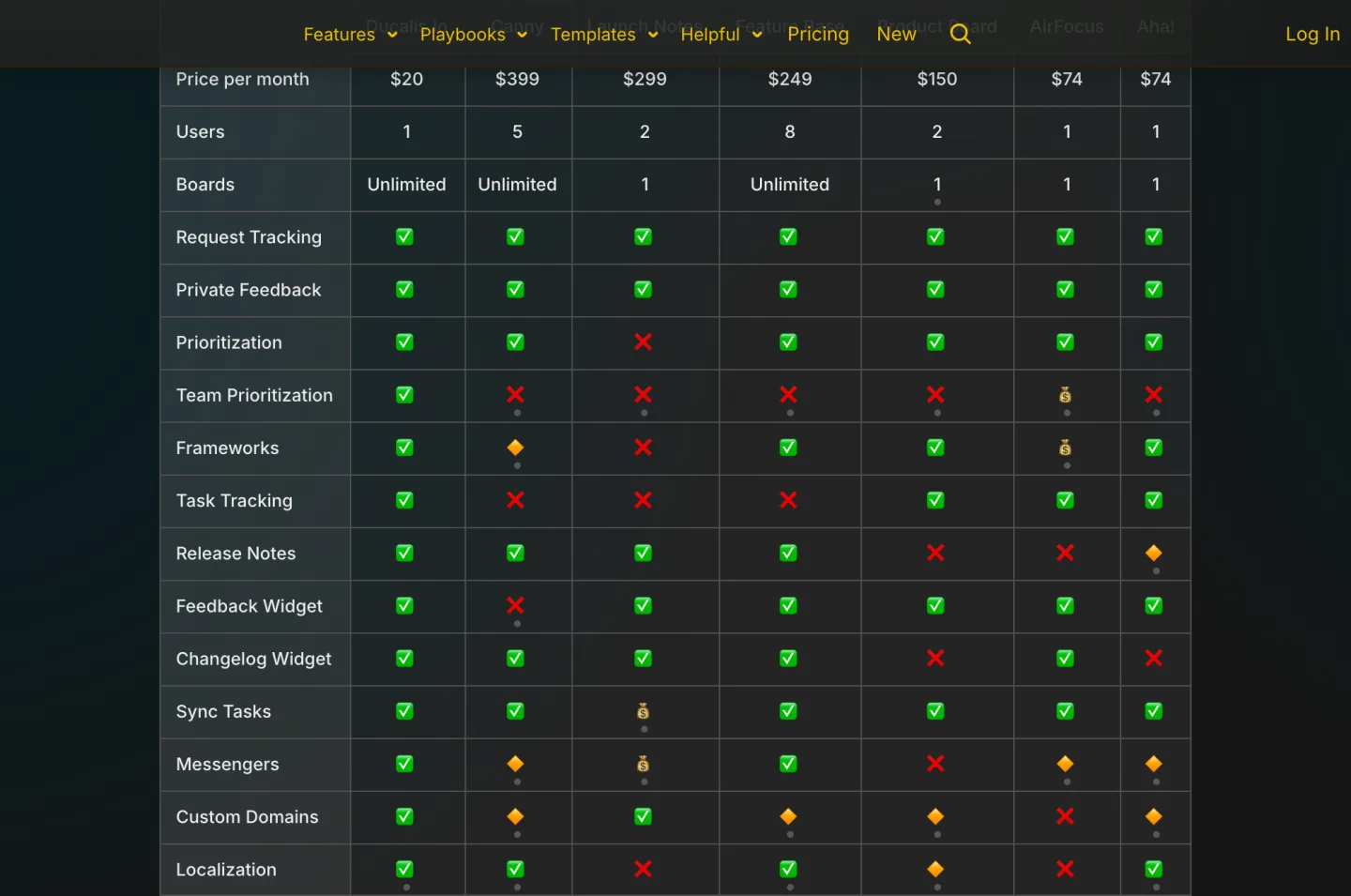
| Product, as their table names it | Price | Users | Boards |
|---|---|---|---|
| Ducalis.io | $20 | 1 | Unlimited |
| Canny | $399 | 5 | Unlimited |
| Launch Notes | $299 | 2 | 1 |
| Feature Base | $249 | 8 | Unlimited |
| Product Board | $150 | 2 | 1 |
| AirFocus | $74 | 1 | 1 |
| Aha! | $74 | 1 | 1 |
Three things about that table are worth a reader's attention, and all three are checkable against the vendors' own pages.
AirFocus publishes no price. Both of its plans say request pricing, read on its own pricing page on 14 September 2026, and the whole of that reading is written out separately. There is no published figure for a table to quote.
Two of the figures are stated in a unit the vendor does not bill in. Canny meters tracked users, meaning anybody associated with feedback, so a column headed Users with a 5 in it is not Canny's meter. LaunchNotes bills by the page, with one page and two users on its Growth plan.
Every figure sits above that vendor's own published entry price. Canny is $79 a month billed yearly at 100 tracked users with a free tier at 25. LaunchNotes is $249 billed annually. Featurebase is $29 a seat billed yearly and free at one seat. Productboard is $19 a maker billed annually and free at 500 feedback notes. Aha! Ideas is $39 a user a month. All five were read on the vendor's own pricing page on 14 September 2026.
The fair reading is that the table compares configured prices at team sizes Ducalis chose rather than entry prices, and it prints no billing period, no plan name and no date to say so. Four of the six products in it publish a free tier and the table has no column for one.
What does Ducalis cost?
Twenty dollars a month at the smallest size, rising with the number of people who receive your release notes.
Their own words for the unit are that you pay per recipient rather than per message sent, and that each unique email address receiving status updates or release notes counts as one subscriber whatever it receives. Team members are separate and unlimited on both plans.
| Plan | Subscribers | Account users | Roles |
|---|---|---|---|
| Free | 500 | Unlimited | Admins only |
| Business | Up to 100,000 | Unlimited | Admins and members |
| Enterprise | Custom | Unlimited | Custom |
Annual billing takes 20 percent off and the Business trial runs 14 days. Above 100,000 subscribers their page asks you to write to them. Every plan, the subscriber meter and what a real team pays are written out on the pricing page for them.
So the meter is the audience rather than the team, which is a third billing unit in a category this site has otherwise measured as per seat or per tracked user.
It is a reasonable model for a product whose release notes go out by email, and it has one consequence worth naming. Growing your readership raises the bill, and a changelog that works is a changelog more people subscribe to.
Does Ducalis have a free plan?
Yes, capped at 500 subscribers, and it gives the admin role only.
That cap is generous next to the rest of this category. The role limit is the part to read twice, because a colleague who should be able to score a backlog without administering the account has nowhere to sit on the free plan.
Does Ducalis do a changelog, a roadmap and single sign on?
Ducalis ships release notes and a changelog widget, both on its paid plan, with a custom email domain beside them. Ducalis publishes a public roadmap from the same board the votes arrive on.
Ducalis puts single sign on, a custom domain, private voting boards and multi language on that same paid plan rather than on a higher one, which is unusually flat for this category.
Do they weight a vote by what the customer pays?
Nothing on the pages read on 15 September 2026 describes weighting a vote by revenue.
Their prioritisation is the team scoring an issue against criteria, and the voting board feeds requests into that rather than ordering it by money. That is an absence on their published pages rather than proof about their software.
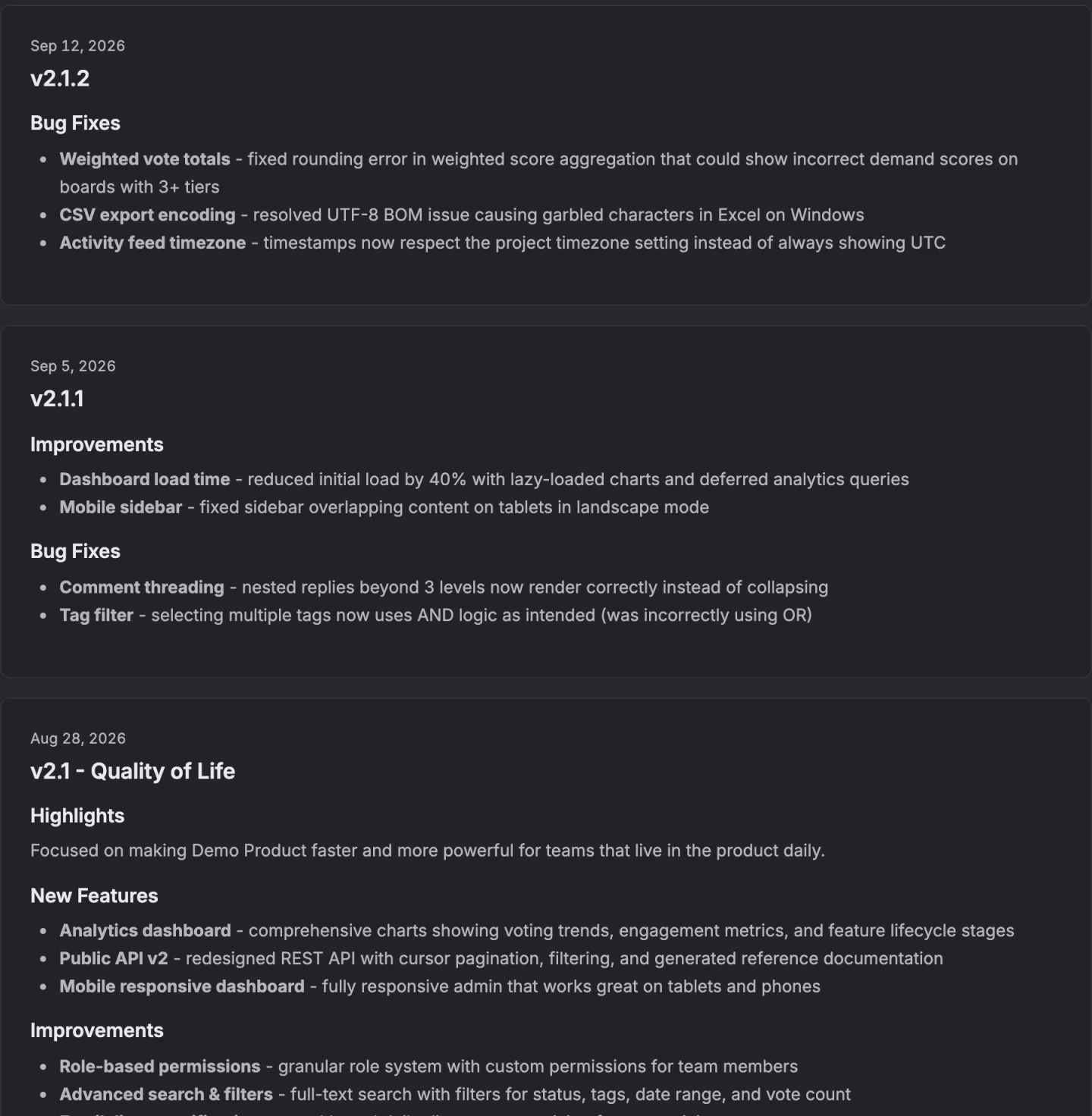
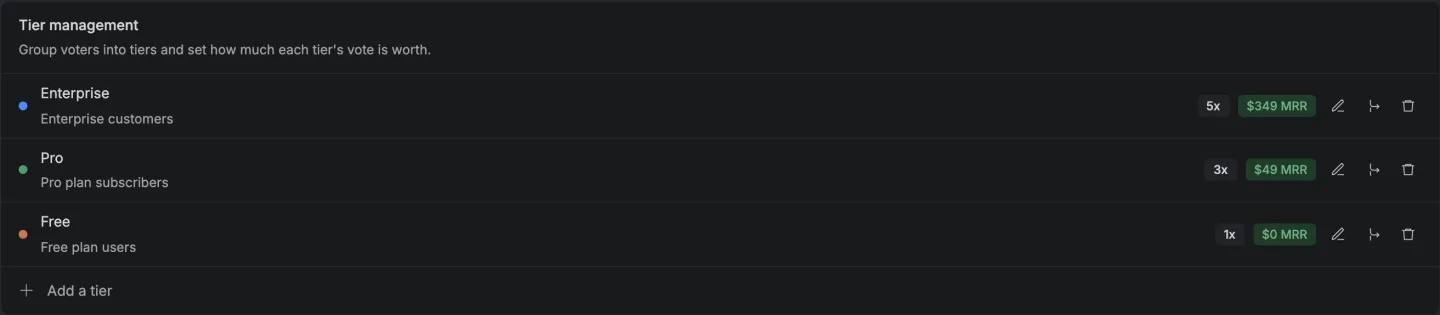
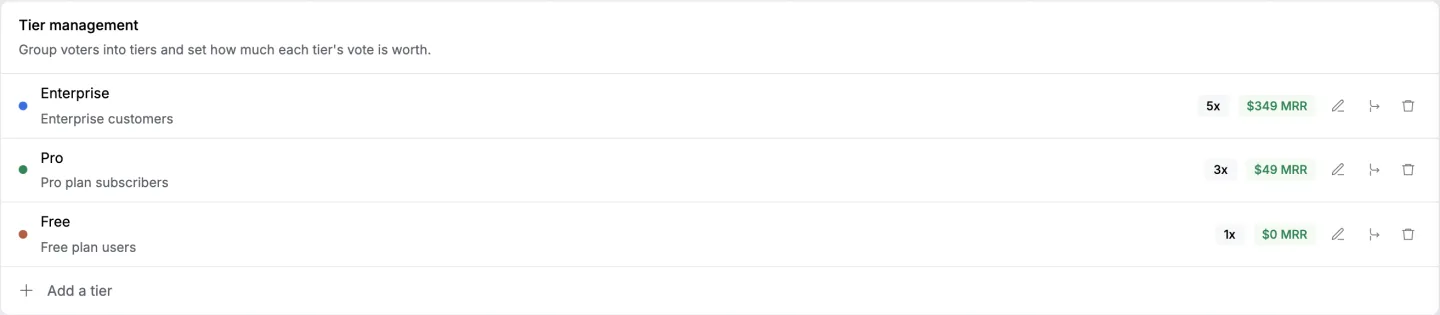
This product does the other thing. Each voter sits in a tier with a whole number multiplier, the weight is written onto the vote when it is cast, and the plain count stays beside the weighted total on the same card.
The mechanism is written out in full, and a calculator runs the same arithmetic on your own tiers.
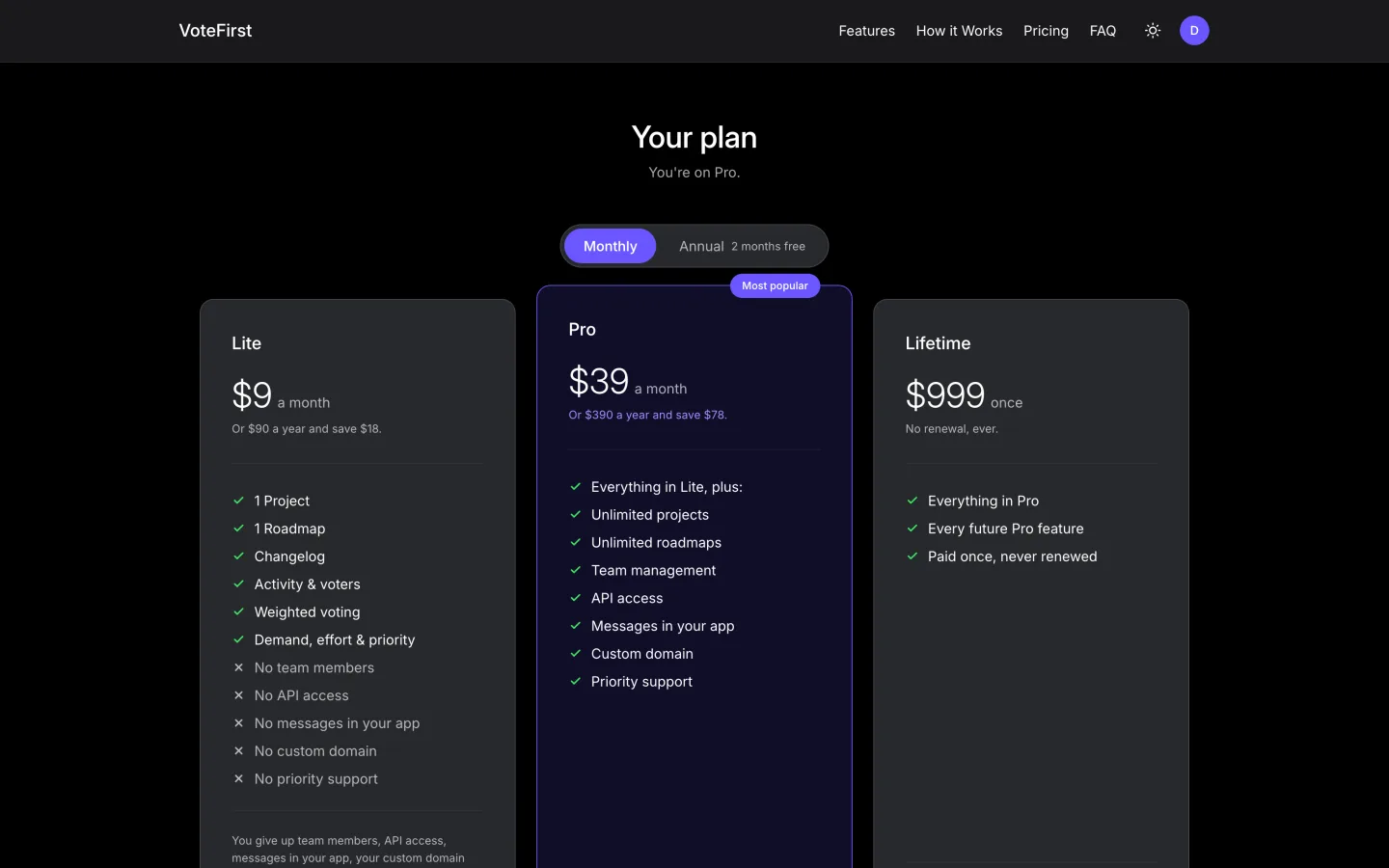
14 days, a card at signup, then $9 or $39 a month.
Is there a free Ducalis alternative?
Several, and Ducalis itself is one of them up to 500 subscribers.
Fider is the open source one, hosted to 250 feedback items. UserJot gives two boards and three admin roles, Supahub gives one board and one admin, Featurebase gives one seat, and Sleekplan's Indie tier is a single admin workspace that does not expire. All were read on their own pages on 14 September 2026.
This product is not among them. There is no free plan here at any point, only a 14 day trial that asks for a card at signup.
Is Ducalis worth it, and who should buy it instead of this?
A team that argues about priority order and wants the argument made visible should buy Ducalis.
That is the job it is built for. Scoring an issue against agreed criteria, one person at a time, then showing where the team split, is a real method and this product does not do it.
If your problem is that five people rank the backlog five different ways, a voting board will not settle it and their alignment report might.
A team whose release notes go to a large list should read the meter first. At 100,000 subscribers the bill is a different conversation from the twenty dollars on the home page, and the figure is only visible inside their calculator.
A team that wants customers to vote and wants the votes ordered by what those customers pay is the reader this product is for.
What does moving actually involve?
More work than a button, and the honest version is short.
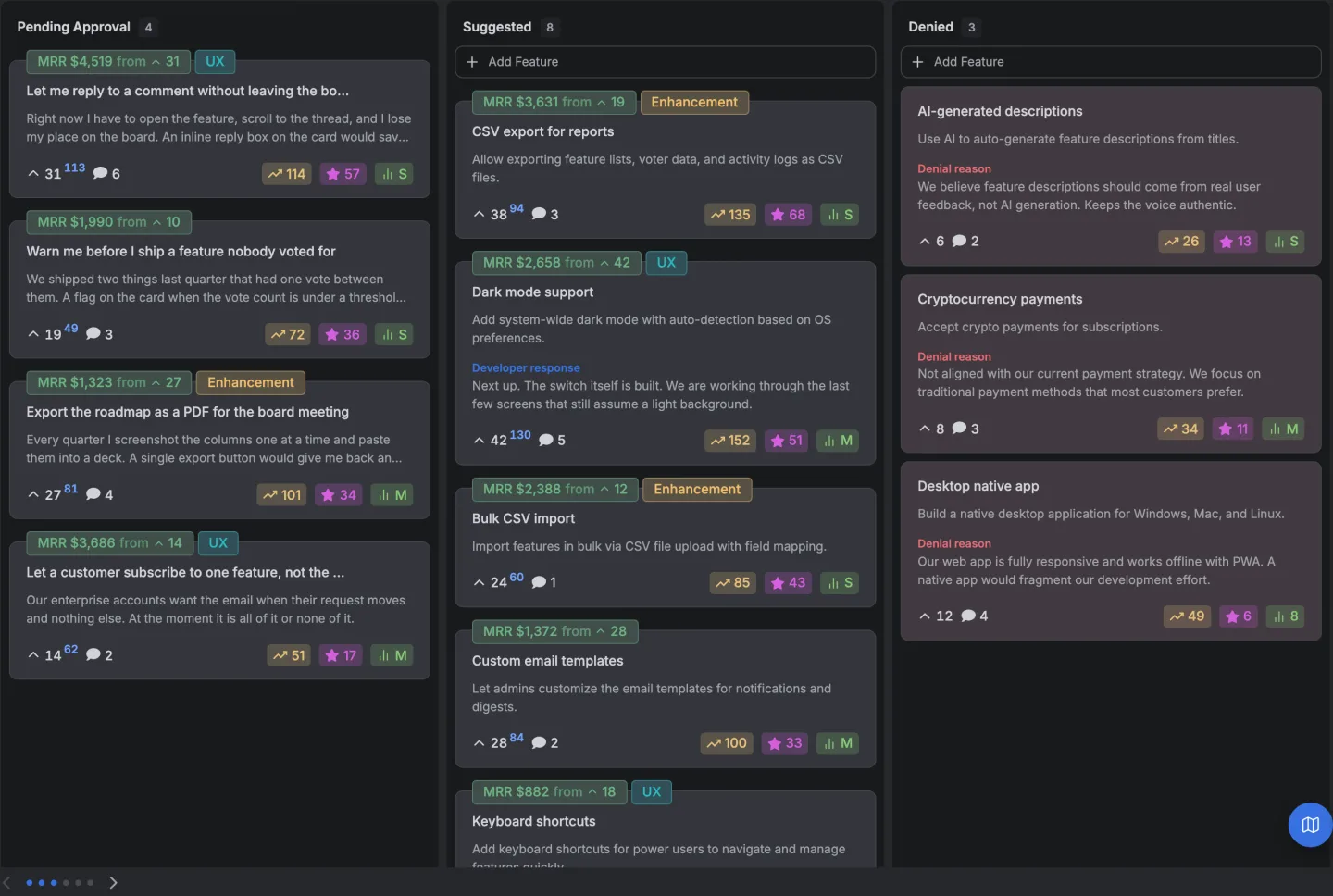
There is no importer for Ducalis boards, issues or votes here. Voters and the revenue behind them arrive from a CSV or from a billing connection, which is what the weighting needs. Requests are rebuilt by hand or by a script against the API, and vote counts start again from zero.
Ducalis lists migration from other tools on its Enterprise plan, so the traffic in the other direction is a supported thing there and the traffic in this direction is not.
That is worth knowing before anybody moves. The five steps with the endpoint each one uses are written out in full, and they are the same five whatever you are leaving.
What does this one cost?
Nine dollars a month for one project, and nothing counts the people who read it.
Thirty nine adds unlimited projects, colleagues, the API and a custom domain. Nobody is metered here, not the voters, not the subscribers to a changelog and not the people who only look, so the bill does not move when the board starts working.
Against their twenty dollars at the smallest size this is cheaper and narrower. They are selling a prioritisation method with a board attached and this is selling the board. The full field with the unit each vendor bills on is one page.