Ducalis pricing starts from twenty dollars a month for all features, and that sentence is on the home page rather than on the pricing page. The pricing page shows a calculator with two inputs and no printed figure anywhere in the document it serves.
The two inputs are the thing to understand before the number. One is your team. The other is the number of people who receive your release notes, and that is the one that moves.
Everything below was read on their own pages on 15 September 2026.
How much does Ducalis cost?
From twenty dollars a month, with the rest computed from two numbers you type in.
| Plan | Subscribers | Account users | Roles | Trial |
|---|---|---|---|---|
| Free | 500 | Unlimited | Admins only | not applicable |
| Business | Up to 100,000 | Unlimited | Admins and members | 14 days |
| Enterprise | Custom | Unlimited | Custom | On request |
Annual billing takes 20 percent off. Above 100,000 subscribers their page asks you to write to them rather than quoting a rate.
Account users are unlimited on every plan, which is unusual and good. The charge is elsewhere.
What counts as a subscriber?
Each unique email address that receives status updates or release notes, whatever it receives.
That is their own wording, and the distinction they draw is that you pay per recipient rather than per message. A subscriber cannot reach your Ducalis account and sees the voting board only.
So the meter is your changelog's readership. It is the clearest example in this category of a vendor charging for the audience rather than for the team, and it has a consequence worth naming before anybody budgets.
A changelog that works is a changelog more people subscribe to, and the bill follows the success rather than the effort.
Does Ducalis have a free plan?
Yes, at 500 subscribers, with unlimited account users and the admin role only.
Five hundred is a real cap rather than a demonstration. What the free plan withholds is the member role, so everybody who touches the account on it is an administrator, and the paid plan is where a colleague gets a seat that is not one.
Where is the price actually published?
On the home page, in one sentence, and in a table about other vendors.
The path a reader would guess answers 404. The apex address redirects to a subdomain, and that subdomain's pricing page answers and carries the calculator. The document it serves contains no dollar amount at all, so a reader who does not run the calculator leaves with the one sentence on the home page.
Beside that sentence sits a table pricing six competitors.
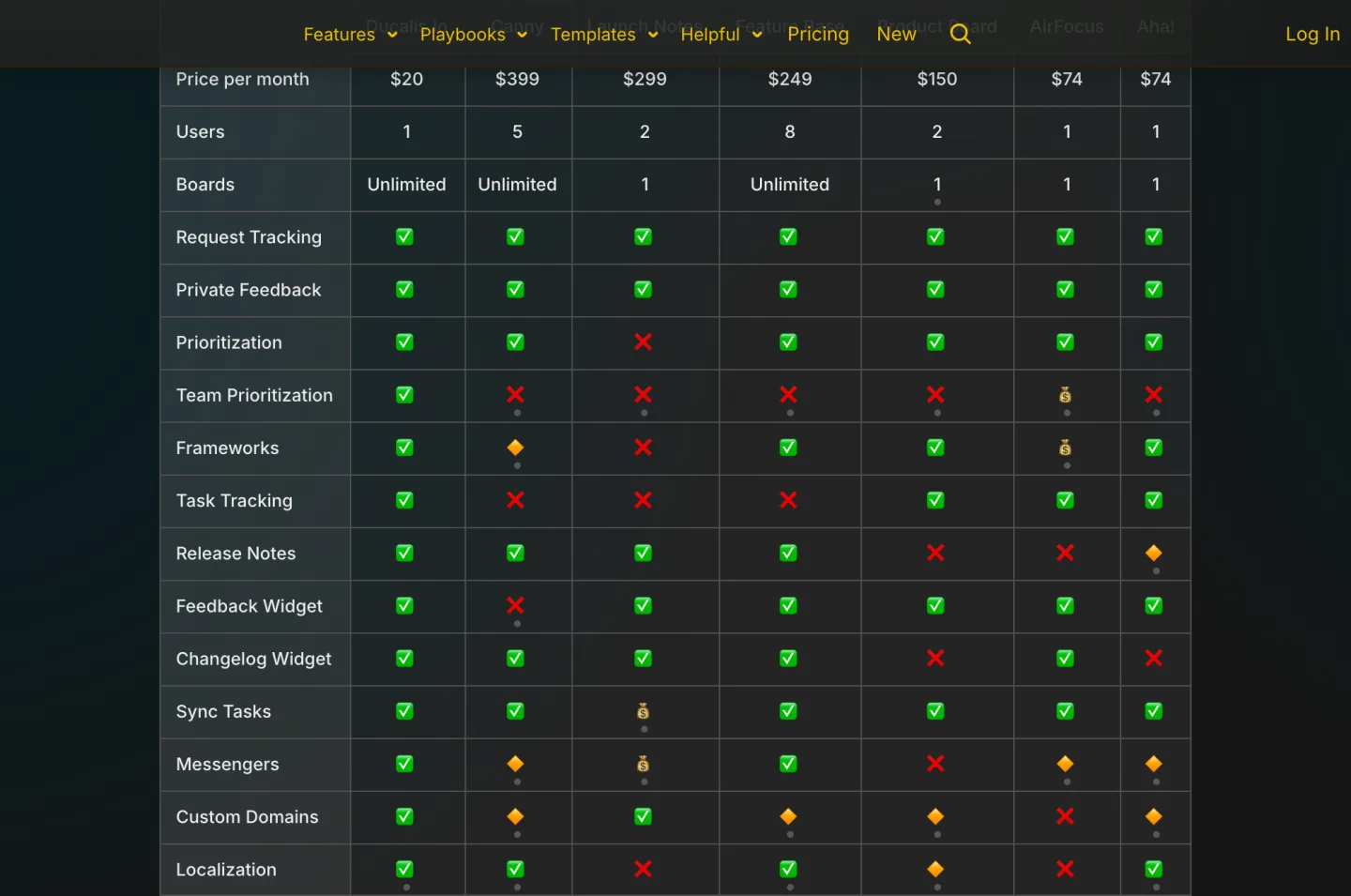
| Product, as their table names it | Price | Users | Boards |
|---|---|---|---|
| Ducalis.io | $20 | 1 | Unlimited |
| Canny | $399 | 5 | Unlimited |
| Launch Notes | $299 | 2 | 1 |
| Feature Base | $249 | 8 | Unlimited |
| Product Board | $150 | 2 | 1 |
| AirFocus | $74 | 1 | 1 |
| Aha! | $74 | 1 | 1 |
Those figures do not match what those vendors publish, read on each vendor's own pricing page on 14 September 2026.
| Vendor | Their table | That vendor's own published entry |
|---|---|---|
| Canny | $399 at 5 users | $79/mo, free at 25 |
| Launch Notes | $299 at 2 users | $249/mo, 1 page, 2 users |
| Feature Base | $249 at 8 users | $29/seat/mo, free at 1 seat |
| Product Board | $150 at 2 users | $19/maker/mo, free at 500 notes |
| AirFocus | $74 at 1 user | Nothing published |
| Aha! | $74 at 1 user | $39/user/mo, minimum 3 |
The AirFocus row is the one that cannot be explained by a different plan, because there is no published figure to quote. What their pricing page actually says is written out separately.
The other rows are best read as configured prices at team sizes Ducalis chose. That is a different claim from an entry price, and the table prints no billing period, no plan name and no date to say which it is.
Four of the six vendors in it publish a free tier and the table has no column for one.
What does a real team actually pay?
Whatever the calculator returns, and the only figures published outside it are twenty dollars and nothing.
This is the honest limit of what can be written here. A vendor whose price appears after the page loads cannot be quoted in a table, and inventing a figure from the shape of the calculator would be worse than saying so.
What can be said is the structure, being that team size does not move the bill and subscriber count does, and that the two ends of the published range are the free plan at 500 subscribers and the request a quote message above 100,000.
If your release notes go to a few hundred people, their smallest size is the sentence on the home page. If they go to tens of thousands, the number is theirs to give you and this page will not guess it.
Is Ducalis the same kind of product as this one?
No. Ducalis is a prioritisation method with a board attached and this is the board.
Their centre is a team scoring issues against agreed criteria and reporting where the team disagreed.
Ducalis ships release notes, a changelog widget and a custom email domain on its paid plan, so the changelog is a first class part of it rather than an extra. The alternative page works through what overlaps and what does not.
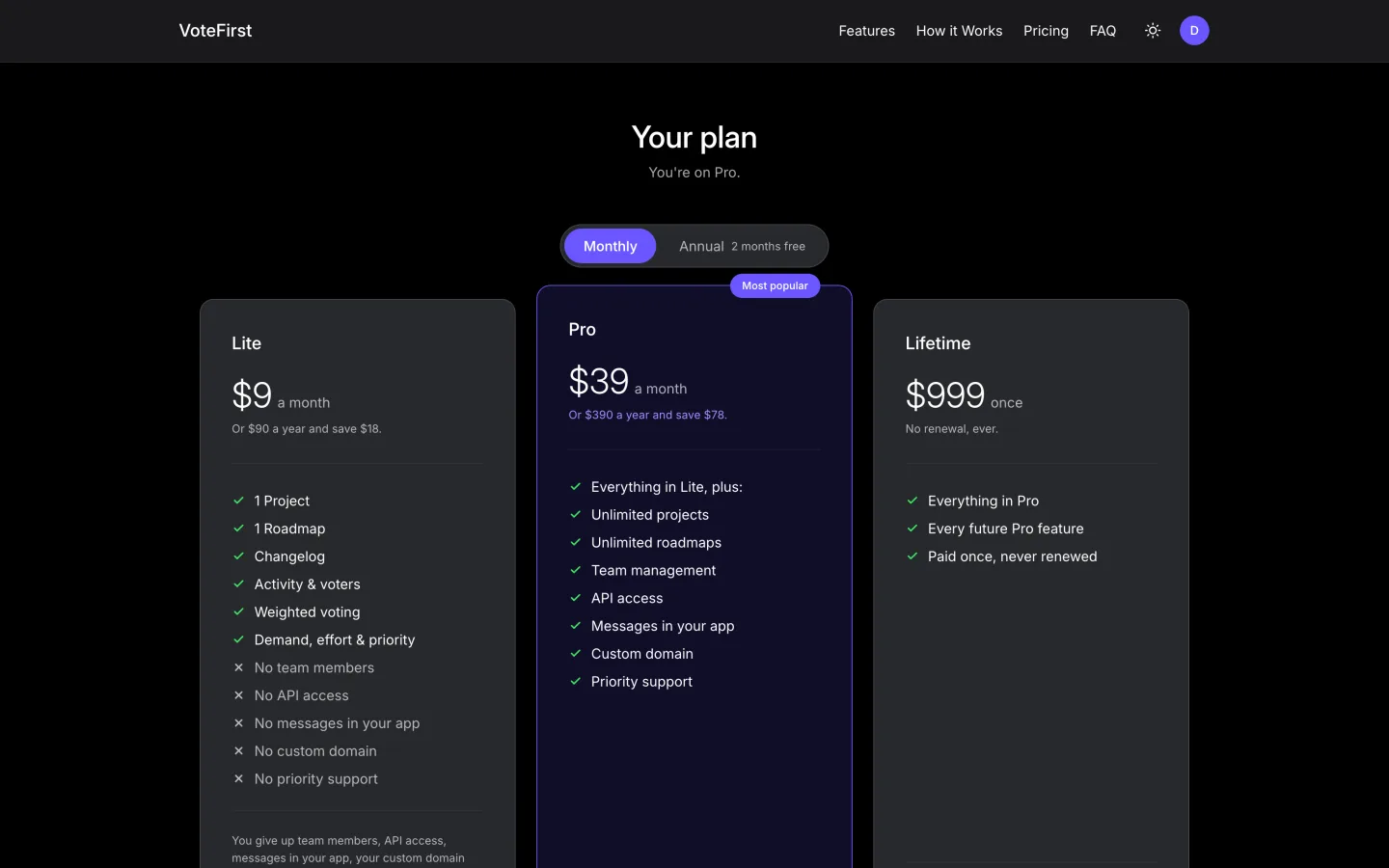
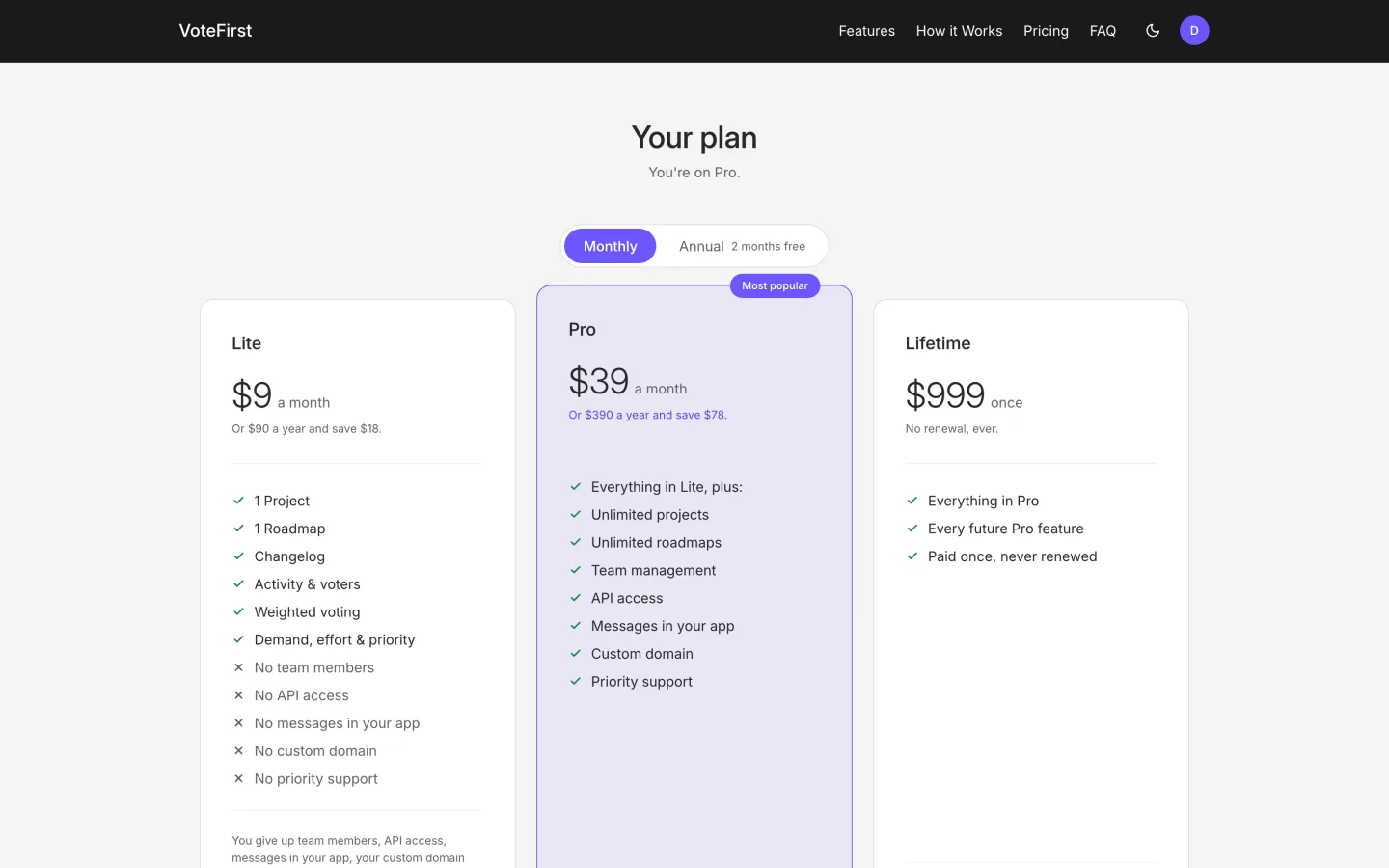
14 days, a card at signup, then $9 or $39 a month.
What does the board on its own cost here?
Nine dollars a month for one project, thirty nine for unlimited projects, colleagues, the API and a custom domain.
Nothing here counts subscribers, voters or viewers, so a changelog that reaches more people costs the same as one that reaches nobody. That is the single sharpest difference between the two price lists, and it cuts both ways, because a product that meters the audience has a reason to help you grow it.
What a tool that meters your customers costs instead is worked out in a calculator, and both of the figures here are published on one page.