This is the fourth calculator built for Canny pricing, not the first, and saying so up front seems fairer than letting you find out. Three other pages already answer it and one of them has held the top result for a long time.
What we can offer that they mostly do not is the date this was read, the full published ladder rather than four sample rows, and the definition of the word that decides your number, printed before the calculator instead of after it.
Everything below was read on Canny's own pricing page and in their own help centre on 9 September 2026.
What is a tracked user?
This is the part to read slowly, because a reader who assumes it means paying customer will misread every number on this page.
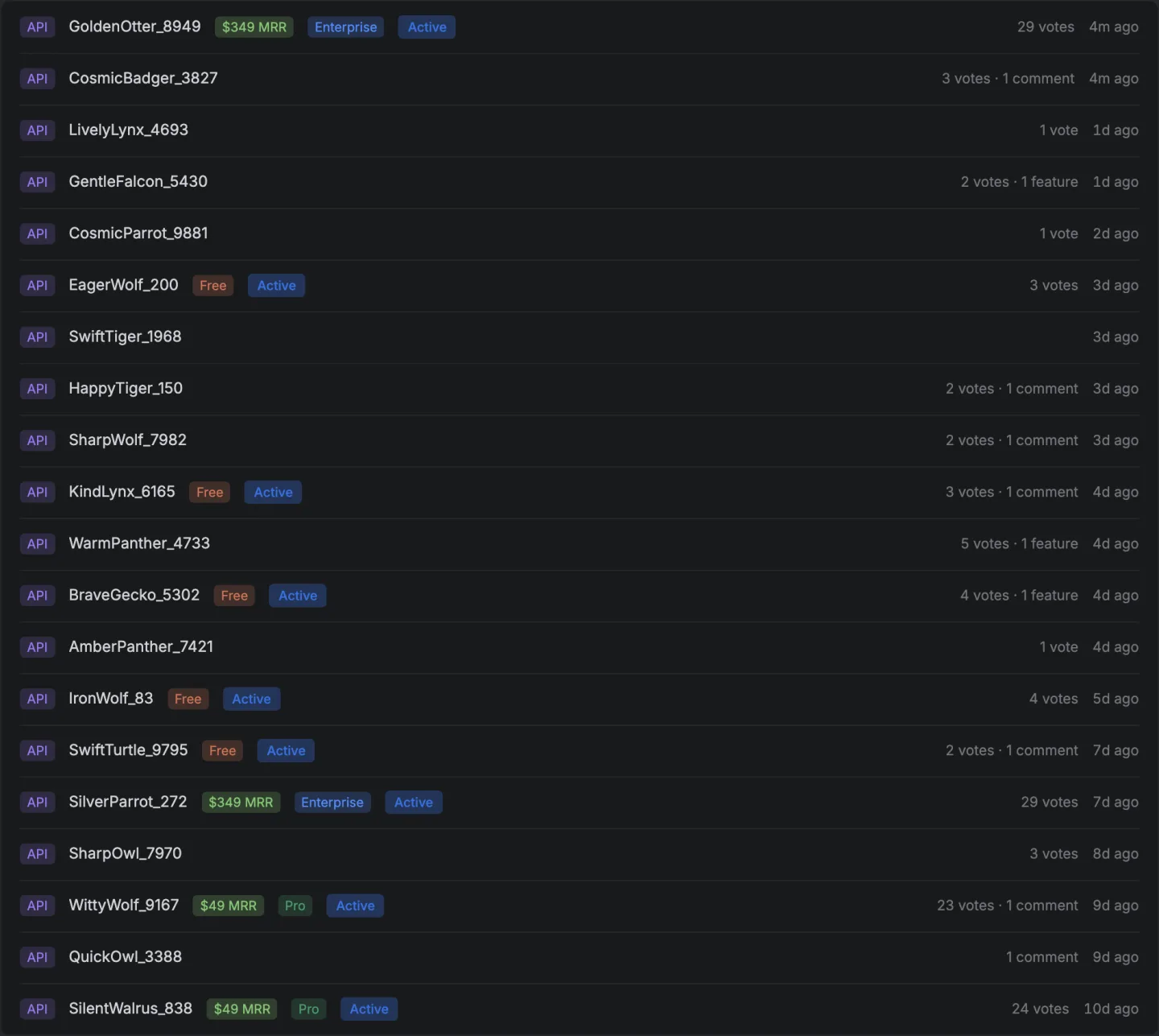
A tracked user is anybody with a post, a vote or a comment attributed to them.
Three groups inside that definition surprise people, and all three are Canny's own documentation rather than our reading of it.
A person an admin voted on behalf of counts. A common workflow is that a customer emails you, you add their vote to the board so it is not lost, and that person is now tracked although they never visited.
A person their automated tooling discovered in a support conversation counts.
Your own team counts. An admin who posts, votes or comments is a tracked user and appears on your invoice.
The meter counts participation, and several of the ways participation happens are things you do rather than things your customers do.
The demo is open with no account and no email if reading about it is not enough.
What does it cost at my number?
Put in the number of tracked users you expect and it gives you Canny's own published price at that step beside ours.
Enter a number to see both prices.
If the box above is not working, the whole ladder is printed below it, so nothing on this page depends on the script.
What is the full published ladder?
Twenty steps, from Canny's help centre and matching their own pricing page code.
| Tracked users | Pro monthly | Pro yearly, per month |
|---|---|---|
| 100 | $99 | $79 |
| 200 | $161 | $129 |
| 300 | $224 | $179 |
| 400 | $286 | $229 |
| 500 | $349 | $279 |
| 600 | $411 | $329 |
| 700 | $474 | $379 |
| 800 | $536 | $429 |
| 900 | $599 | $479 |
| 1,000 | $661 | $529 |
| 1,250 | $724 | $579 |
| 1,500 | $786 | $629 |
| 1,750 | $849 | $679 |
| 2,000 | $911 | $729 |
| 2,250 | $974 | $779 |
| 2,500 | $1,036 | $829 |
| 3,000 | $1,099 | $879 |
| 4,000 | $1,224 | $979 |
| 5,000 | $1,349 | $1,079 |
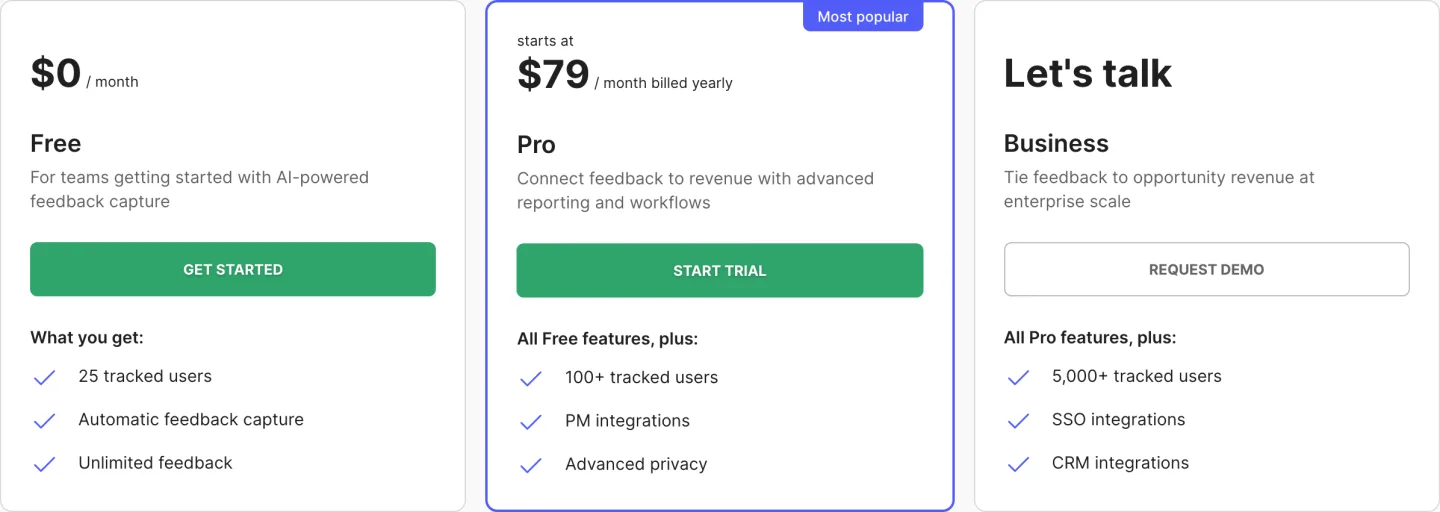
Free stops at 25 tracked users. Business publishes no price and you talk to somebody.
Above 5,000 there is no published figure, which is why this page and the calculator both stop there rather than guessing.
What happens when I cross a step?
You move up, automatically, unless you have set a spend limit.
Canny states it plainly in their help centre. They will increase the price to the next increment when the limit is exceeded, and no further increase happens until the next increment after that. If no spend limit is set they upgrade the account and charge a prorated amount for the rest of the billing period.
The spend limit is worth understanding before you rely on it. What it does when you hit it is stop tracking feedback from new users, and their automated conversation analysis stops too until you raise it.
So the cap protects the invoice by switching off the part of the product that collects feedback from people who have not been counted yet.
Somebody new arrives with an idea and nothing records it. That is a coherent way to build it, though it is rarely what people picture when they set a budget ceiling.
Does their AI raise the number you pay for?
Yes, and they say so themselves rather than hiding it.
Autopilot is their AI layer and their pricing page puts it on every plan, free one included. What it does is read your support conversations, your sales calls and your customer reviews, find feedback in them, and file it for you. It is a genuinely useful idea and it is the headline of their pricing page.
Now read it next to the meter. Their own answer to what Autopilot is ends with this.
Users with feedback found by Autopilot count towards your tracked user count.
So the feature that costs nothing is the feature that raises the quantity you are billed on. A customer who never visited your board, never voted and never commented becomes a tracked user because the AI found them complaining in a Zendesk ticket. That is not a trick. It follows directly from their definition, where a tracked user is anybody with feedback attributed to them, and Autopilot's whole job is attributing feedback to people.
What it means practically is that your tracked user count no longer depends only on how many people you invited to the board. It depends on how much your support desk says, which is a number you do not control and did not previously think of as a billing input.
We have no equivalent, and not because we ran out of time. VoteFirst has no AI features at all, by decision. A vote gets counted because a person cast it. That is a smaller product and on this particular page it is also the reason the second column of the table above never moves.
How many of your own team can use it?
Fewer than the tracked user ladder suggests, and this is the limit most comparisons miss.
Their table gives a separate manager count. Free carries five managers, Pro carries ten, and Business is custom. Contributors are unlimited on all three, so the people who only read and comment are not the constraint. Managers are.
So two ceilings apply at once. The tracked user ladder decides your monthly rate, and the manager count decides how many colleagues can actually run the thing. A team of fifteen product and support people on Pro has run out of managers long before it has run out of plan.
On ours there is no manager tier and no per seat charge. What there is instead is a plan boundary, and it goes against us at the bottom. Our nine dollar plan has no team members at all, so if you need a second colleague administering the board you are on the thirty nine dollar plan. Their ten managers on Pro is more seats than our thirty nine dollars gives you.
If this arithmetic is what pushed you to look elsewhere, what actually moves when you leave is here, including the part that does not.
Why does the number only ever grow?
Because nothing in the definition resets.
A tracked user is somebody with an attributed post, vote or comment. Once that has happened it has happened. An account that went quiet two years ago is still a person with a vote attributed to them.
That is the fact that makes this calculator worth building. Your tracked user count is not your customer count and it does not track your customer count. It tracks the total number of people who have ever participated, which only goes one way, and your bill follows it.
If your board works, this is the shape of your invoice. That is not a criticism of metered pricing, which aligns what you pay with how much the product is doing. It is just worth seeing on one screen before you choose.
What does VoteFirst cost at the same numbers?
Nine dollars a month, at every number in the table above.
That is LITE, which is one project, one roadmap and weighted voting included, with no API, no custom domain and no team members. Thirty nine dollars a month on PRO adds those.
There is no per voter meter and no per seat multiplier anywhere in the product, so a board with fifty voters and a board with fifty thousand cost the same. Against Canny's staircase, ours is a flat line.
We do not have a free tier. If your board will stay under about twenty five participants, Canny's free plan is genuinely cheaper than us and the calculator says so at those numbers.
Which should you actually buy?
If your feedback has to sit behind a login, buy Canny. Their private boards are on every plan including the free one and we do not have that.
If you have many small products and few voters, their free tier is more generous than anything we offer.
If you expect a lot of participation, look at every tool that does not meter voters rather than only at us, because most of the category does not meter them either.
If your voters pay you very different amounts and you need to tell the loudest group from the largest account, that is what this product does, and the fuller comparison is here.
14 days, a card at signup, then $9 or $39 a month.