Any feature request tool comparison that lines up monthly prices is comparing numbers that look alike and are not. One tool charges 15 dollars and another charges 60, and which one costs you more depends entirely on something neither number tells you.
Forty nine pricing pages were read between 14 and 16 September 2026 and what each one meters was written down. There are fifteen different answers, and five of the forty nine print no figure at all.
That is the useful finding and it is the whole reason for this page. Before you compare two numbers, check they are counting the same thing.
If you have not picked a shortlist yet, start with the three questions that actually decide it and come back here for the prices. If you are leaving Canny in particular, the Canny alternatives shortlist is its own page. If what you want is a roadmap rather than a request board, that is a different shortlist.
What is the unit each tool bills on?
The unit each tool bills on is a workspace or a plan on most of them, and a person on the rest, which is the difference that decides whether the price grows as the board fills up.
| Vendor | From | Billed per | Free plan | Trial |
|---|---|---|---|---|
| Trello | $5/user/mo | user | Yes | – |
| VoteFirst | $7.50/mo | plan | – | 14 days, card |
| Features.Vote | $7.50/mo | project | – | 14 days |
| Jira Product Discovery | $10/creator/mo | creator | 3 creators | – |
| LoopedIn | $12/mo | plan | 1 of each | – |
| WishKit | $12.50/mo | project | 5 requests | – |
| Sleekplan | $13/mo | workspace | 1 admin | 30 days, no card |
| Upvoty | $13.50/mo | project | – | 14 days |
| Noora | $14/mo | workspace | – | 7 days |
| Convas | $15/mo | tracked user | 25 users | – |
| FeedBear | $15/mo | project | – | 14 days |
| Supahub | $15/mo | workspace | 1 board | 10 days |
| ProductLift | $19/mo | workspace | – | 14 days |
| Productboard | $19/maker/mo | maker | 500 notes | – |
| Roadmunk | $19/creator/mo | creator | – | 14 days |
| Ducalis | $20/mo | changelog subscriber | 500 subs | – |
| Frill | $22/mo | workspace | – | 14 days |
| Fider | $25/mo | workspace | 250 items | – |
| Featurebase | $29/seat/mo | seat | 1 seat | – |
| Headway | $29/mo | plan | Yes | – |
| Nolt | $29/mo | board | – | – |
| UserJot | $29/mo | workspace | 2 boards | 14 days |
| Aha! Ideas | $39/user/mo | user | – | Yes |
| Savio | $39/mo | paid user | – | 14 days |
| Beamer | $49/mo | monthly active user | 1,000 MAU | – |
| Feature Upvote | $49/board/mo | board | – | 30 days |
| Rapidr | $49/mo | workspace | – | 14 days |
| Suggested | $49/mo | plan | – | 15 days |
| Gleap | $49/mo | plan | – | 14 days |
| FeatureOS | $50/mo | plan | – | 30 days, no card |
| Olvy | $60/mo | plan | 25 items | – |
| AnnounceKit | $39/mo | module | – | 15 days, no card |
| Canny | $79/mo | tracked user | 25 users | – |
| LaunchNotes | $249/mo | plan | – | 14 days |
| Pendo | Not published | monthly active user | Beta | – |
| ProdPad | Not published | module | – | 7 days |
| UserVoice | Not published | quoted | – | 30 days |
| airfocus | Not published | quoted | – | – |
| ProductPlan | Not published | quoted | – | – |
| Productroad | $9/mo | plan | 50 users | 14 days, no card |
| Quackback | $29/mo | plan | 1 board, 50 posts | 14 days, no card |
| ProdCamp | $99/mo | plan | 2 admins, 1 product | – |
| Harvestr | $65/editor/mo | editor | – | 14 days |
| Productlane | $29/user/mo | user | – | Yes |
| Ideanote | $6/user/mo | user | 10 users, 250 ideas | – |
| Craft.io | $19/editor/mo | editor | – | 14 days, no card |
| HYPE Boards | €79/mo | plan | – | 14 days, no card |
| Noticeable | $24/mo | plan | 1 project, watermarked | 14 days, no card |
Read on each vendor's own pricing page, with the billing switch on the yearly side wherever one is published. Re-read 2026-09-16.
Every figure was read on the vendor's own pricing page, most recently on 16 September 2026, and lives in one file, so a price that changes is one cell and not one edit per page that quotes it. That file is published as a CSV with the date and the address behind every row.
From is the cheapest paid rate a vendor publishes, per month, with the billing switch on the yearly side wherever the vendor publishes one, which is why several of these figures are lower than the number on the front of the card. VoteFirst is in the column on the same terms as everybody else's.
Not published means nobody could read a figure on the pages that were opened, never that the vendor is hiding something. VoteFirst is the only trial in the table that asks for a card.
Twenty two of these publish a free plan, and fourteen of them are written up with the exact line each one stops at.
Seven products that used to be in lists like this one no longer answer at their own address at all, and what each of those addresses returned on 16 September 2026 is written down.
If you want to see the product rather than read about it, the demo board is open without an account.
Which of these is cheapest at 1,000 voters?
Almost all of them, and that is the point of the question.
Only two tools in the table charge you anything at all for the number of people who use the board. Canny and Convas meter tracked end users. Beamer is a third case, because its feedback product is free or flat and the monthly active visitor meter sits on its changelog instead.
For everyone else, a thousand voters and a hundred voters cost the same. The whole field priced at whatever number you expect is on one page, with the date each figure was read beside it.
So if a thousand people are going to vote, the shortlist is not the cheapest headline price. That is the question a feature voting tool is bought to answer, and it is a different question from which vendor is cheapest on a headline.
It is any tool that does not meter voters at all, and then whichever of those has the features you want.
What is a tracked user?
A tracked user is anybody with a post, a vote or a comment attributed to them. That is Canny's definition and it is the clearest published one, so it is the one worth learning.
Three things about it surprise people. Your own admins count when they participate. A user an admin voted on behalf of counts. And a user discovered by automated tooling counts. The meter is not counting your customers, it is counting participation.
If you are on a tracked user plan today and want the arithmetic on your own number, the calculator prices the whole field at a number you choose.


What is the difference between per seat and per workspace?
Per seat charges for your colleagues. Per workspace charges for the thing itself and lets you add colleagues up to a cap.
It decides which direction your bill grows. On a per seat tool, hiring is what increases the invoice. On a per workspace tool with a seat cap, hiring is free until you cross the cap and then it steps. On a per project or per board tool, launching a second product is what increases it.
None of those is wrong. They are bets about which kind of customer the vendor wants, and the useful exercise is working out which of the three things you are most likely to do in the next year.
Which of these weight votes by revenue?
Four change the vote itself. Five more order or filter by revenue without changing a vote, and the difference matters.
They weight the vote. Frill says weight votes by customer revenue. ProductLift says revenue behind every vote, from MRR and plan data via Stripe, and puts it on its Pro plan at forty nine dollars a month billed yearly. Sleekplan says tune the weights to customer impact, B2B revenue, raw votes, engagement and happiness. And VoteFirst does, on every plan including the nine dollar one.
They order by revenue. Canny sorts by MRR impact, which tracks the revenue a feature affects. Savio sorts and prioritizes by account MRR or plan, from HubSpot or Salesforce. Featurebase ties feedback to revenue and filters by it. Aha! Ideas prioritizes ideas by potential revenue. UserVoice describes revenue weighted insights and publishes no price.
Rapidr's own pricing table marks its MRR filter coming soon, which is not the same as having it.
The difference between the two groups is what happens to a request with four votes from your four largest accounts and thirty from a free tier.
A tool that weights the vote moves that request up the board on its own. A tool that orders by revenue shows you the money in a column and leaves the board where it was.
Sleekplan's pricing page does not mention this; its feature page does list it.
For every other row, nothing appeared on the pages read on the day. That is an absence of evidence on a marketing site rather than proof about the software.
| Vendor | Revenue and the vote |
|---|---|
| Frill | Weights the vote |
| ProductLift | Weights the vote, Pro |
| Sleekplan | Weights the vote |
| VoteFirst | Weights the vote, all plans |
| Aha! Ideas | Orders by revenue |
| Canny | Orders by revenue |
| Featurebase | Orders by revenue |
| Savio | Orders by revenue |
| UserVoice | Orders by revenue |
| Rapidr | Marked coming soon |
| Headway | No voting at all |
| Trello | No |
| AnnounceKit | – |
| Beamer | – |
| Convas | – |
| Feature Upvote | – |
| FeatureOS | – |
| FeedBear | – |
| Fider | – |
| Nolt | – |
| Noora | – |
| Pendo | – |
| ProdPad | – |
| Productboard | – |
| Suggested | – |
| Supahub | – |
| Upvoty | – |
| UserJot | – |
Read on each vendor's own pricing page on 2026-09-14.
What this costs
Lite
$9 /mo
Pro
$39 /mo
Lifetime
$999 once
Fourteen day trial of Pro, card asked for at signup. Nothing here counts the people who vote, so the bill does not move when the board starts working. The long version, with what happens if you stop paying.
What else does each one include?
Seven capabilities. A cell names the cheapest plan that carries it. A dash means nobody could read it on the pages opened that day, not that the capability is absent.
| Vendor | Single sign on | API | Export | Changelog | Custom domain | Private board | Self hosted |
|---|---|---|---|---|---|---|---|
| Aha! Ideas | – | Yes | Yes | – | – | – | No |
| AnnounceKit | SSO & SAML add-on | Yes | – | Yes | Custom Branding add-on | – | – |
| Beamer | Yes | Yes | – | Yes | Yes | Yes | – |
| Canny | All plans | Pro | – | Yes | Yes | Pro | No |
| Convas | – | – | – | – | Yes | Private, $99/mo | – |
| Featurebase | Enterprise | Growth | – | Yes | – | – | – |
| Feature Upvote | Indie | – | – | – | Indie | Indie | – |
| FeedBear | Business | – | – | Lite | Startup | Lite | – |
| Fider | – | – | – | – | – | – | Yes |
| Frill | All plans | All plans | CSV | Yes | All plans | Add on | Enterprise |
| Headway | – | Free | – | Yes | Pro | Pro | – |
| FeatureOS | Growth | Growth | – | Starter | Starter | – | – |
| Nolt | Essential | Pro | Pro | – | – | Essential | – |
| Noora | Growth | Growth | – | Startup | Growth | Growth | – |
| Pendo | – | – | – | – | – | – | – |
| ProdPad | – | – | – | – | – | – | – |
| Productboard | Yes | Yes | Requesters only | – | Yes | – | No |
| ProductLift | Business | Pro | Yes | Starter | All plans | – | – |
| Rapidr | Business | – | – | Startup | Startup | Startup | – |
| Savio | All plans | Professional | All plans | – | – | Essential | – |
| Sleekplan | Starter | Starter | – | Indie | Business | – | – |
| Suggested | Yes | – | Voters only | – | Yes | Yes | – |
| Supahub | Growth | Premium | – | Yes | Growth | – | – |
| Trello | Enterprise | – | Premium | – | – | – | No |
| Upvoty | Hyper | Hyper | – | Super | Power | – | – |
| UserJot | Professional | – | – | Free | Starter | Starter | – |
| UserVoice | – | Yes | – | – | – | – | – |
| VoteFirst | Pro, no SAML | Pro | CSV | All plans | Pro | No | No |
Read on each vendor's own pricing page on 2026-09-14.
Which of these are still actively developed?
Most of them, and two are worth a note.
FeedBear's footer says 2024, which reads as abandoned. It is not. Their own changelog restarted after a gap of roughly two years.
Convas loads and sells, and their changelog is easy to miss because it is a page on their feedback board rather than the address you would guess. Read on 10 September 2026, its newest entries are labelled four quarters ago.
Hellonext no longer exists as a brand. The domain permanently redirects to FeatureOS, and they are one product. A surprising number of comparison pages still list them separately.
14 days, a card at signup, then $9 or $39 a month.
Who each one is for
A price list without this is a price list you cannot act on.
Canny. Teams who want the most complete product in the category and whose revenue lives in a CRM. Private boards on every plan, including the free one.
Feature Upvote. One product, one board, and a team that wants every feature on every paid plan with no ladder. Their moderation is unusually good.
Fider. Teams who already run Docker and Postgres and want the board on their own infrastructure. Free, and every feature is free when self hosted. VoteFirst against Fider, priced at a real board.
Sleekplan. Small teams who want feedback, changelog, roadmap and surveys under one workspace price. Their free tier is real and generous for one person.
Noora. Small teams who want a flat price with unlimited colleagues on it, and who would rather read revenue alongside the votes than change the size of a vote. Their entry plan is fourteen dollars a month billed yearly.
FeedBear. Small teams who want the board to draft comments and changelog posts for them, and who are fine paying from day one because there is no free plan.
Featurebase. Teams who want a helpdesk and a feedback board in one subscription. Priced per seat, with usage charges for the AI agent on top.
Nolt. Single product teams who want one very good public board, with private boards on the entry plan and no cap on colleagues.
Suggested. Teams who want one flat price with every feature in it, including feedback that only a named customer or a named email domain can see. Forty nine dollars a month, and the trial asks for no card.
Rapidr. Teams who want private boards, a custom domain and five colleagues on day one, and who can wait for the MRR filter their table marks as coming.
Upvoty. Solo founders who want a flat price for one project with no meter on voters. Fifteen dollars a month, and the wall is the project count. VoteFirst against Upvoty, project by project.
Supahub. Teams who want the Canny shape at the lowest price, with a real free plan carrying one board and one admin.
Frill. Teams who want surveys and a board from one vendor, and whose board will stay under fifty ideas on the entry plan.
AnnounceKit. Teams whose actual problem is announcing releases in app rather than collecting votes. Their board is now a separate thirty nine dollar a month product, not a feature gated behind a higher plan.
Beamer. Product teams announcing to a large logged in audience, who can live with a meter counting everyone who sees the widget.
Olvy. Teams whose release notes and feedback sit in one product, and who can predict how much of that feedback they will want to analyse. Sixty dollars a month allows a hundred items and the next plan is two hundred and forty for ten thousand, with nothing in between.
UserJot. Anybody with no budget yet. Free forever with unlimited users and two boards, and they argue in public against charging per user.
Productboard. Product teams rather than founders, who need teamspaces and product usage data alongside feedback. Priced per maker.
Savio. Teams whose feedback arrives in Intercom or Help Scout rather than on a public board. Priced per paid user.
ProductLift. Product managers who already bill through Stripe and want the revenue link to maintain itself, plus RICE, ICE and MoSCoW frameworks. The Stripe integration is on their Pro plan.
UserVoice. Organisations where sales, success and product all need the same view of an account. They publish no price and the only route in is a sales conversation.
Convas. Indie makers whose board will stay small, since twenty five tracked users are free and every plan carries unlimited colleagues.
FeatureOS. Teams who want five modules including forms and a knowledge base from one vendor. Sixty dollars is the floor and both the extra board and the extra seat are fifteen more. It used to be called Hellonext.
Productroad. Teams whose board will stay small, at nine dollars a month with a free plan that runs until fifty people have left feedback. Nine dollars more for every additional fifty tracked users is the line to read before you commit.
Quackback. Teams who want a support inbox, a help centre and a status page beside the board for one subscription, and teams who would rather host it themselves, because the code is AGPL and the self hosted route has no software fee.
ProdCamp. Teams who want NPS surveys and an email forward address alongside the board, and for whom the step from their free plan to ninety nine dollars is an easy yes. There is nothing in between those two numbers.
Harvestr. Product organisations of three or more, priced per editor with contributors unlimited and free. A second allowance counts AI categorisations, and single sign on is a quoted contract.
Productlane. Teams where support and product are the same people, because the inbox is the product and the feature request portal hangs off it. Per user, with AI resolutions metered on top.
Ideanote. Companies collecting ideas from their own staff rather than requests from customers. Six dollars a head is a pilot price and the plan caps at fifty people.
Craft.io. Product organisations that want strategy, OKRs, capacity planning and a portfolio view in the same workspace as the roadmap. Priced per editor, and the step from Starter to Pro is roughly four times.
HYPE Boards, formerly Viima. Companies running an internal innovation programme with an evaluation process on top of it. Seventy nine euros covers ten people and two boards, and extra people are seven euros each.
Noticeable. Teams whose job is the announcement rather than the request. A changelog product with a free watermarked plan, and the second person to publish costs fifty dollars more a month.
Pendo. Not in the table above, because there is no number to put in it. Every paid Pendo plan says custom pricing, the meter is monthly active users rather than seats or boards, and their own roadmap answers say a roadmap built there is internal today.
Aha!. Product teams of three or more who want feedback in the same account as strategy and delivery. Not in the table above either, because their entry price is a multiplication. Ideas Essentials is $39 a user a month with a minimum of three paid users, so the floor is $117. Portal users are unlimited and free.
Trello. Teams whose roadmap is a free Trello board, which is a sensible thing to do and is not in the table because it is not a feedback tool. Two things about it are worth knowing before you commit. Atlassian say a public board is not indexed by search engines, and voting on one needs a Trello account.
Headway. Teams whose whole job is the announcement. A changelog and nothing else, with a free plan carrying unlimited changelogs and no seat count, and $29 a month flat for a custom domain and a team. Their own site never mentions votes, requests, feedback or a roadmap.
ProdPad. Teams whose feedback already arrives through a support system, a CRM and three messaging apps, and who want one place to put it. Not in the table because no price was ever displayed. Their pricing page is a package builder rather than a price list, and it rendered blank on two loads. Reviewers are free and unlimited, and their revenue figure is an annual number an admin types onto a company record rather than one your billing system supplies.
Productboard and UserVoice. Larger product organisations with dedicated product managers, and in UserVoice's case a purchasing process that includes a sales conversation.
Savio. Teams whose feedback arrives through support and a CRM rather than a public board.
Beamer and AnnounceKit. Teams whose actual problem is announcing releases rather than collecting votes.
Upvoty, Frill, Supahub, UserJot, ProductLift, Nolt, Rapidr and Convas. Flat priced boards at a range of price points. If none of the specific notes above describes you, these are where to look for a straightforward public board without a per voter meter.
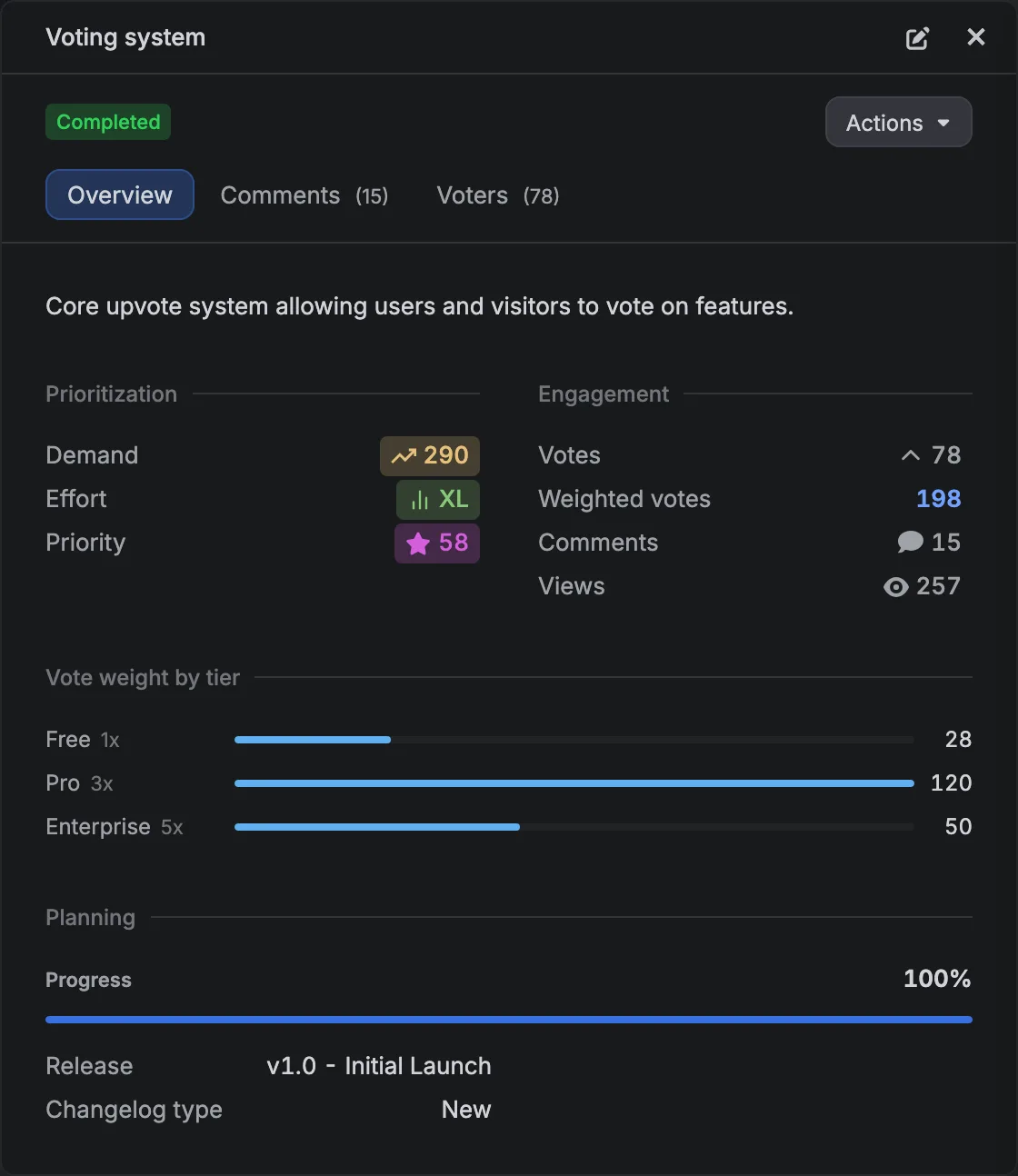
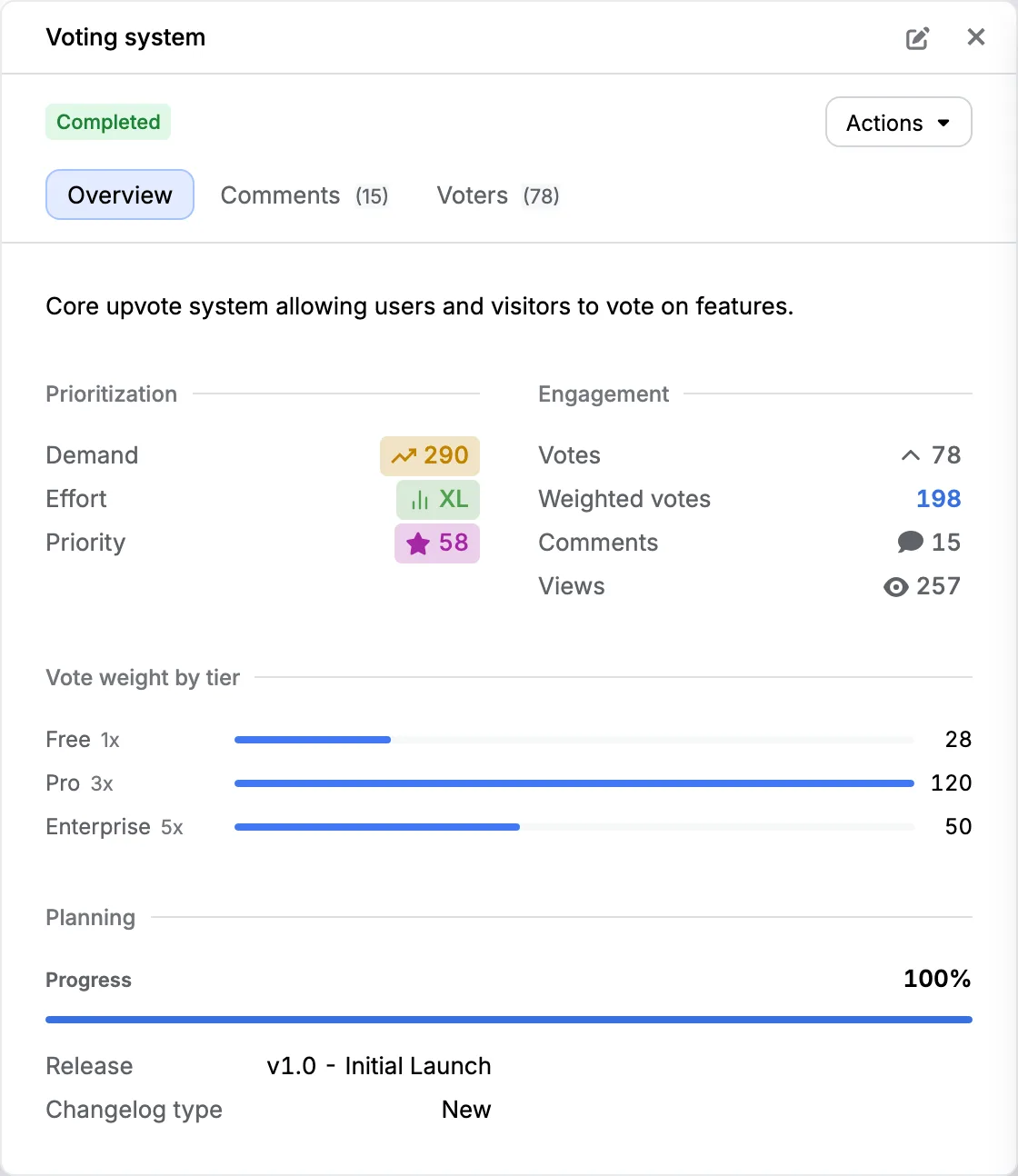
VoteFirst. Teams whose voters pay very different amounts and who need to tell the loudest group from the largest account on the same screen. Nine dollars a month for one project, with a vote weighted by the tier its voter sits in and the plain headcount still visible beside it.
Jira Product Discovery. Teams who already run Jira and want ideas linked to the epics that deliver them. Free forever for three creators, then ten a creator a month, and the people who contribute are free. Not a customer facing board, because a contributor needs an Atlassian account.
Gleap. Teams where support and product are the same people. A support suite with live chat, in app bug reports carrying the session, a knowledge base and an AI agent, with the public roadmap as one module inside it. Forty nine dollars carries one seat and one project with no roadmap at all; feature requests and votes start on Team at a hundred and forty nine.
Userback. Teams that want a bug report widget and a voting portal on one bill. Annotated screenshots, recordings and bug reports in a widget from $29 a month billed annually for five seats, with the voting portal a $31 add-on.
Usersnap. Teams that want to host the widget themselves. Screenshots, recordings and console logs from $49 a month billed yearly for two seats, with no self hosted plan on its pricing page and the voting board on Professional at $209.
LaunchNotes. Teams where release communication is a job somebody owns, with audiences to segment and a brand to keep. Two hundred and forty nine dollars a month billed annually for one page and two users, and everything above that is a quote.
WishKit. Teams shipping an Apple application. A native SwiftUI board for iOS, macOS, visionOS, watchOS and tvOS, fifteen dollars a month flat, unlimited users on every plan, and the only counter is how many projects you run.
Features.Vote. Teams who want the same billing shape VoteFirst has, never metered on voters, with a SwiftUI SDK alongside the web board. Nine dollars for one project and twenty nine for unlimited, read on their own site on 14 September 2026.
Strategic Roadmaps, formerly Roadmunk. Teams presenting a roadmap to executives rather than running a public board. Nineteen, forty nine or ninety nine dollars per editor a month inside Tempo, with reviewers metered separately at five dollars each.
LoopedIn. Teams who want several boards and knowledge bases and never want to pay for voters. Free, or fifteen, thirty or fifty dollars a month, twelve, twenty four or forty billed yearly, and what ladders is the count of boards rather than the size of the crowd.
airfocus. Product organisations with a portfolio to manage and a procurement process to run. Two plans, both asking you to request a price, and their own page says there is no free trial.
ProductPlan. The same reader, with the roadmap as the deliverable. One plan with everything in it, viewers always included, and no figure published anywhere on the page.
Ducalis. A five in one suite from twenty dollars a month billed per subscriber rather than per user, with a free tier to five hundred subscribers, read on 15 September 2026. Seventy seven of the seventy nine searches carrying the name are about a prosecco, so the page exists for one fact that is not in any comparison table, which is that their own pricing page prints no figure while their home page prints one for six rivals.
What is the best Canny alternative?
There is no single best one, and a page that names a winner is usually selling it. Four situations decide it, and the tables above hold the evidence for each.
The meter is why most people leave. Canny bills by tracked user, so the alternatives that remove the problem rather than rename it are the ones billed per workspace or per board, which the unit table above names one by one.
A free tier that outlives a trial. Twenty three of the forty nine publish one. Fider carries 250 feedback items, UserJot two boards and three admin roles, Sleekplan's Indie tier one admin workspace, Supahub one board and one admin, and Featurebase one seat.
A vote that counts what the voter pays. Four change the vote itself, being Frill, ProductLift, Sleekplan and this one, and five more order or filter by revenue without changing a vote.
A board this afternoon. Any row in the table carrying a figure, because a published price is the difference between signing up and booking a call, and the rows that publish nothing say so in the cell.
Which two of these should I compare directly?
Sixty eight pairs have a page of their own, each one pricing both products from their own published pages on the day it was written.
- Canny against Fider, a monthly bill against software you run yourself for the cost of a server.
- Canny against Feature Upvote, a meter on your customers against a meter on your boards.
- Canny against FeatureOS, one board priced by the people who use it against five modules priced by boards and seats.
- Canny against FeedBear, a meter on your customers against a meter on your own colleagues.
- Canny against Nolt, where the second board is a forty dollar step because nothing sits between one and five.
- Canny against Upvoty, where one counts voters and the other never counts a person at all.
- Canny against Productboard, a tracked user meter against a per maker one, and the crossover is where your team stops being smaller than your engaged customer base.
- Canny against UserVoice, a published figure against a plans page whose only button books a call.
- Upvoty against Feature Upvote, two products with almost the same name and two different units.
- Nolt against Feature Upvote, the only pair here that bills on the same unit, and the second board costs a different amount on each.
- Featurebase against Canny, a seat count against a customer count.
- Productboard against Aha, a per maker rate against a per user one with a three seat floor.
- ProductPlan against Productboard, two roadmap suites, one of which will not print a price.
- Canny against Frill, a customer meter against a cap on how many ideas stay open.
- airfocus against Canny, a published figure against a quote.
- Jira Product Discovery against Productboard, ten dollars a creator against nineteen a maker.
- Fider against Nolt, software you run yourself against a hosted board tier.
- Nolt against Upvoty, a board tier against a project count, with neither charging for voters.
- Productboard against UserVoice, a published figure against a sales call.
- Productboard against Nolt, a seat count against a flat board tier.
- UserVoice against Upvoty, a guided rollout against a board you start this afternoon.
- Jira Product Discovery against Aha, free viewers against paid ones.
- Aha against Canny, two products that both talk about revenue and mean different things by it.
- Frill against Upvoty, a cap on open ideas against a cap on projects.
- Beamer against Frill, a meter on everybody who saw the widget against a cap on open ideas.
- Feature Upvote against Fider, a priced board against software you can run yourself.
- Feature Upvote against FeedBear, board count against team size.
- Feature Upvote against Sleekplan, a paid board with SAML against a workspace that is free for one admin.
- Canny against Noora, a voter meter against a flat workspace price.
- Feature Upvote against UserJot, two free boards against a priced first one.
- Canny against Sleekplan, billing the crowd against billing the desk.
- Beamer against Nolt, an audience count against a board count.
- Aha against UserVoice, a seat floor against a price nobody prints.
- Frill against Sleekplan, a cap on open ideas against a cap on seats.
- Canny against Pendo, the customers who take part against everybody who opens the product.
- Upvoty against ProductLift, a meter on projects against a meter on admins.
- Aha against Featurebase, two seat prices with very different floors.
- AnnounceKit against Beamer, two changelog products with a board bolted on.
- Featurebase against UserJot, one free seat against two free boards.
- Productboard against Pendo, a printed rate against custom pricing.
- ProdPad against Productboard, a price built in the browser against one printed on the page.
- LaunchNotes against AnnounceKit, two release notes products with a board attached.
- Sleekplan against Upvoty, a seat count against a project count.
- Supahub against Canny, the cheap replacement claim put against both price lists.
- Hellonext against Featurebase, boards and seats together against seats alone.
- Canny against Savio, metering the customers who vote against metering the colleagues who read.
- Rapidr against Canny, a seat count against a crowd count.
- Gleap against Frill, a support suite with a board attached against a board alone.
- Roadmunk against ProductPlan, two roadmap tools where nobody votes.
- FeedBear against Frill, a headcount against a backlog.
- Jira Product Discovery against UserVoice, a published rate against a quote.
- airfocus against Productboard, a sales call against a number per maker.
- Features.Vote against Canny, a flat bill against a metered one.
- Olvy against Beamer, a cap on stored feedback against a meter on your audience.
- WishKit against UserJot, a board inside a native app against one on the web.
- LoopedIn against Frill, a ladder of boards against a cap on open ideas.
- ProductLift against Canny, a live Stripe figure behind a vote against a list sorted by revenue.
- ProdPad against Aha, free reviewers against a paid seat for everyone.
- Fider against Supahub, software you run yourself against a hosted ladder.
- Savio against ProductLift, revenue read from a CRM against revenue read from Stripe.
- Gleap against Featurebase, two bundles and what the unused half costs.
- Roadmunk against Aha, one editor against a floor of three seats.
- Supahub against Featurebase, two free tiers and the wall each one hits.
- Olvy against LaunchNotes, sixty dollars against two hundred and forty nine at the door.
- Ducalis against airfocus, two vendors who print no rate you can quote.
The full comparison index puts all sixty eight on one page, and the shortlists sort the same field by the job you are hiring it for.
Six of these held page one positions before they were retired to redirects, which is why they are back. Redirecting somebody who typed two product names to a page about one of them is a worse answer than the page they asked for.