Type either of these two names next to the other and the product you are actually shopping for, on both sides, is a way to tell customers what shipped.
A place for those same customers to ask for the next thing rides along on each, as a feedback module rather than a request board built to stand on its own.
The two entry prices sit further apart than any other pair in this corner of the market. Olvy opens at sixty dollars a month. LaunchNotes opens at two hundred and forty nine. Everything below was read on each vendor's own pricing page, Olvy on 15 September 2026 and LaunchNotes on 14 September 2026.
What does each one charge?
Sixty dollars against two hundred and forty nine, and neither number is what the two products actually meter.
| Vendor | From | Billed per | Free plan | Trial |
|---|---|---|---|---|
| VoteFirst | $7.50/mo | plan | – | 14 days, card |
| Olvy | $60/mo | plan | 25 items | – |
| LaunchNotes | $249/mo | plan | – | – |
Read on each vendor's own pricing page on the date named above.
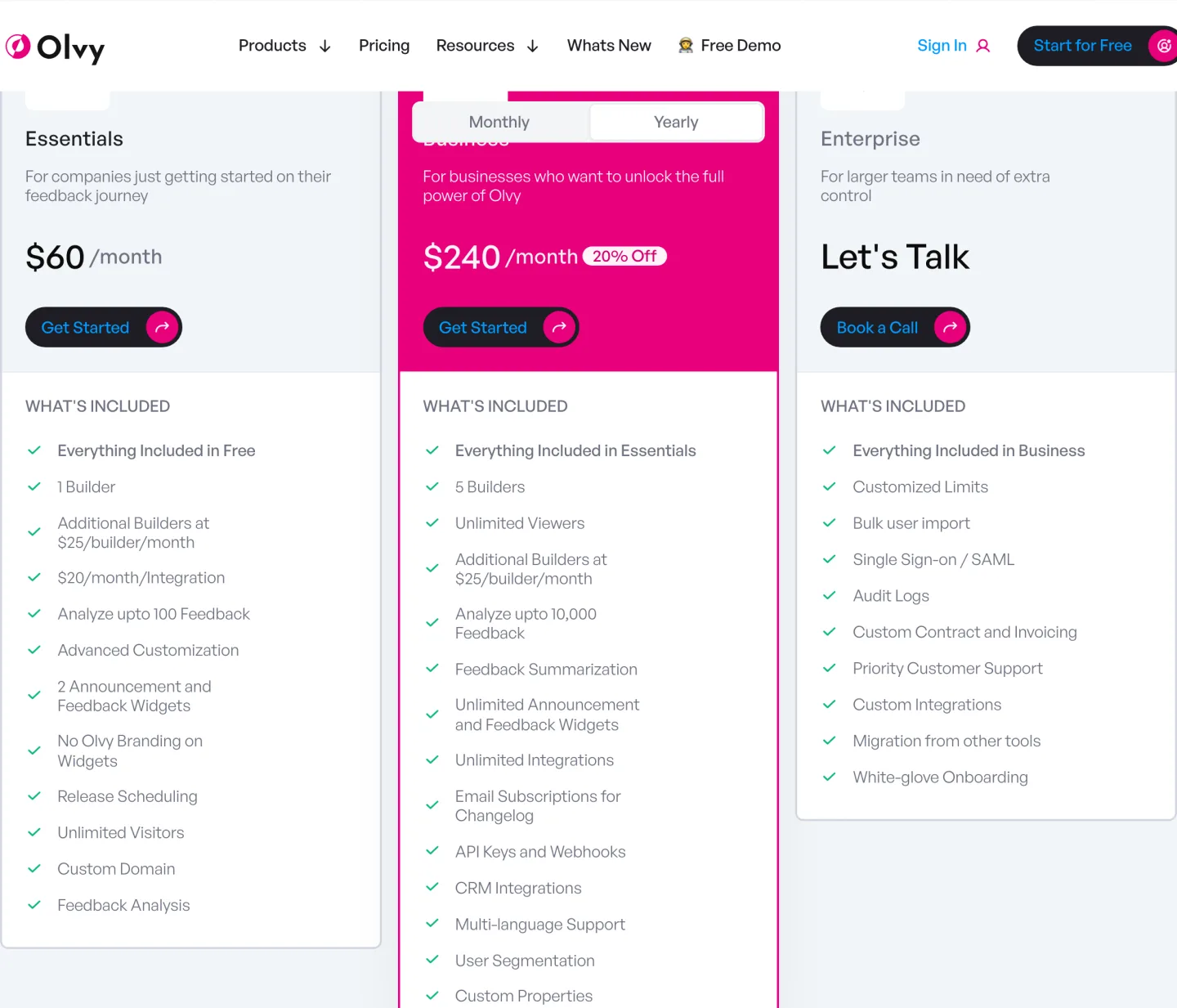

Olvy's sixty dollars is Essentials, one builder, a hundred pieces of feedback you may run through its analysis layer, and twenty dollars a month for each connected integration on top.
Cross the hundred item mark, whatever your team size, and the next rung is Business at two hundred and forty, which raises the cap to ten thousand and folds the integrations into the price.
LaunchNotes has one number on its list. Growth is two hundred and forty nine dollars a month billed annually, for one branded page and two logins. Past either wall, the next step is Premium, and Premium is a quote, not a figure.
So Olvy's meter is how much feedback text you are allowed to run through its reading layer, and LaunchNotes' meter is how many announcement pages and logins your company keeps. Neither counts how many customers show up to vote.
How much does Olvy cost compared to LaunchNotes?
It depends on how much feedback piles up on Olvy's side and how many pages and logins your team needs on LaunchNotes' side, and those two counters have nothing to do with each other.
| Your situation | Olvy | LaunchNotes |
|---|---|---|
| One brand, two logins, a hundred and twenty items of feedback to read, two integrations | Business, past the Essentials cap, $240/mo | Growth, inside the wall, $249/mo |
| One brand, four logins, three thousand items of feedback to read, one integration | Business, still under its ten thousand cap, $240/mo | Past the two login wall, Premium, rate not published |
| Two brands, two logins each, sixty items of feedback to read, three integrations | Essentials plus one extra builder plus three integrations, $145/mo | Past the one page wall, Premium, rate not published |
Row one is the closest the two products come to costing the same. Add a third login or a second brand on the LaunchNotes side, or push past a hundred analysed items on the Olvy side, and one of the two numbers disappears into a sales call while the other stays put.
LaunchNotes prices nothing between its published Growth figure and a quote. One page, two logins, two hundred and forty nine dollars, and the third login or second page has no printed rate anywhere on the page we read.
Olvy's own ladder has a rung missing in the same way. A hundred analysed items at sixty dollars, ten thousand at two hundred and forty, and nothing sold in between the two.
The board itself answers more of this than either invoice does.
Which one should you choose?
They are built to solve different fears, and the honest answer credits both.
LaunchNotes hands a small team a genuinely deep announcement product on its entry plan, single sign on and a GraphQL API included rather than held back for a top tier. Most vendors in this category charge extra or charge more for either.
Olvy's reading layer, summarising a pile of raw feedback text into something a person can act on, is real work neither this board nor a LaunchNotes page attempts. A support inbox full of unsorted complaints gets turned into something usable there.
Choose LaunchNotes when the announcement itself, segmented, branded, drafted and sent to a list, is the job. Choose Olvy when the pile of feedback text is the problem and the board matters less than making sense of what is already sitting in it.
Nothing here counts the people who vote, so a busy board costs the same.
Why choose Olvy over LaunchNotes, or LaunchNotes over Olvy?
Because one of them prices a login and a brand, and the other prices how much written feedback you may feed through its own reading tool.
Pick LaunchNotes when your team is small and fixed, one brand for good, and you would rather pay a larger number once for a finished announcement product than watch a second meter start moving later.
Pick Olvy when what actually keeps you up is a backlog of customer messages nobody has time to read, since the summarising is the entire point of paying them, right up until the analysed item cap on your plan runs out.
Is there a cheaper alternative to both?
Yes, and which one wins depends on whether your risk is a feedback backlog or a login count.
Against Olvy's item cap, a flat rate stops mattering the moment your support inbox calms down. Against LaunchNotes' page and login wall, a flat rate wins the moment a third colleague needs to log in.
The calculator sizes that crossover at a team you choose, and the whole field, each vendor with the unit it bills on, sits on one page. This board is nine dollars a month flat, with neither meter running against you.
What does each do with a vote from a big customer?
Neither company's own pages, read on the day, say anything about ranking or weighting a vote by what the customer pays.
| Vendor | Weighting by revenue | Single sign on | API |
|---|---|---|---|
| Olvy | – | Enterprise, with SAML | Business |
| LaunchNotes | – | JWT on Growth, SAML on Premium | GraphQL, read and management tokens |
| VoteFirst | All plans | Pro, no SAML | Pro |
A dash means our own reading of the pages that day turned up nothing on the point, not that the vendor's software lacks it.
Across the thirty two vendors in our own matrix, eight put some kind of revenue language on their own pages, and half of those eight go further and let a customer's revenue actually multiply the weight of their vote rather than just sorting a list by it.
Olvy sorts users into paid segments on its dearest plan, a filter rather than a weight, and LaunchNotes' segmentation on Premium governs who receives an announcement, not what a vote is worth.
Can I move from one to the other?
LaunchNotes says outright, on the pages we read, that feedback comes back out as a CSV file. Olvy's own pages name migration help as something they offer new arrivals on Enterprise, and say nothing about what leaving with your data looks like.
Whatever an export actually contains on either side, what usually does not survive the move between any two tools in this category is who cast each individual vote rather than the running total, the comment threads underneath a request, the original timestamps, and every board link a customer has already bookmarked.
Where we fit, and where we do not
Both Olvy and LaunchNotes run a broadcast email programme to a subscriber list, Olvy through email subscriptions on its changelog and LaunchNotes with five thousand emails a month included on Growth.
We send to nobody but the person whose own vote sits inside the release being published, which is a narrower message, not a bigger one done cheaper.
Both also sell SAML single sign on somewhere in their ladder, Olvy on Enterprise and LaunchNotes on Premium. Our own sign in is a token your own application hands over, on the thirty nine dollar plan, and there is no SAML here at any price.
Neither of the two above puts a whole number multiplier on a customer's paid tier and writes that weight onto the vote itself, on every plan including the cheapest one. That is the thing this product does that this particular pair does not.
What is Olvy, and what is LaunchNotes?
Olvy is a changelog and release notes tool with a feedback widget and an analysis layer bolted on, billed by how much of that feedback you are allowed to run through the analysis.
LaunchNotes is a release communication product built around one branded page, an in app widget, an AI draft writer and an email programme, with feedback management as one module among several, billed by the page and the login rather than by anyone who votes.
Neither company exists because customers need somewhere to ask for something first. That happens on both, but it sits behind the part each one actually sells.
Does either one have a free plan?
Olvy does. LaunchNotes does not.
Olvy's free tier, read on 15 September 2026, gives one builder, twenty five feedback items to analyse and a thousand unique visitors a month, forever.
LaunchNotes' pricing page, read on 14 September 2026, publishes a single figure and nothing underneath it, so the cheapest thing you can keep on their list is two hundred and forty nine dollars a month.
What this costs
Lite
$9 /mo
Pro
$39 /mo
Lifetime
$999 once
Fourteen day trial of Pro, card asked for at signup. Nothing here counts the people who vote, so the bill does not move when the board starts working. The long version, with what happens if you stop paying.
The honest summary
Both of these exist to get a shipped feature in front of an audience, and both treat the request board as a smaller piece riding along rather than the reason either company was built. Olvy's price climbs with how much feedback text you feed it.
LaunchNotes' price climbs with how many brands and logins your own team keeps.
If the board is the actual reason these two names got typed together, weigh sixty dollars against two hundred and forty nine on the smallest team either of you can imagine, and then price a third login or a fourth thousand feedback items before you sign anything.
The Olvy alternative page and the LaunchNotes one carry each side on its own.
14 days, a card at signup, then $9 or $39 a month.