Enterprise feedback management is the phrase used when a company that already has a security review wants the same feedback board everybody else has, plus the things a security review asks for.
Those things are specific and short. Single sign on, ideally SAML. A board that can be closed to the public. A way to get your data back out. Sometimes the right to run it on your own infrastructure. And a price somebody will actually tell you.
Thirty two products were read on their own pages on 14 September 2026 against all six. What follows is what was on those pages, including where the page said nothing, which happens more often than the category admits.
What does enterprise feedback management actually mean?
Six gates, and only the first is about feedback at all.
The phrase is not a product category with a definition. It is a procurement checklist wearing one, and the useful thing to notice is that every gate on it is about control rather than about collecting opinions. A board that suits a two person company and a board that suits a bank do the same job with the same screens. The difference is who is allowed in, how they prove who they are, and what happens to the data afterwards.
That is why comparing these tools on features produces a tie and comparing them on the six below does not.
| The gate | What it is really asking |
|---|---|
| Single sign on | Can we stop managing a second set of passwords |
| SAML specifically | Will it pass the security review without an argument |
| A private board | Can we collect internally without publishing it |
| Export | Can we leave, and what comes with us |
| Self hosting | Can this run where our data already lives |
| A published price | Can we budget for it without booking a call |
Which tools publish single sign on, and at what tier?
Twenty three of the thirty two, and almost all of them charge more for it.
Single sign on is the most widely published of the six gates, which makes it the least useful one for telling products apart. The tier it sits behind is where they separate.
It arrives lowest on Sleekplan, which names it on Starter at thirteen dollars a month, on Feature Upvote's Indie plan, on Nolt's Essential plan and on UserJot's Professional. It arrives highest on Gleap, whose own page puts it on an Enterprise plan from nine hundred and ninety nine dollars a month.
The remaining nine publish nothing on it. That is an absence of evidence on a marketing site and not proof the software cannot do it, which is a distinction worth holding on to for every row of every table on this page.
Which ones name SAML?
Seven, and this is the gate that thins the field.
Single sign on is a category of thing. SAML is a specific protocol, and it is the one an enterprise identity team names in the requirement rather than a synonym for it. Seven vendors say the word on their own pages.
| Vendor | Where SAML sits |
|---|---|
| AnnounceKit | Scale |
| Feature Upvote | Indie |
| Nolt | Enterprise, with JWT lower down on Essential |
| Productboard | The top tier, with SCIM alongside it |
| Rapidr | Business, with JWT |
| Sleekplan | Enterprise, with other sign on from Starter |
| LaunchNotes | Premium |
Twenty five products do not name it, and we are one of them. Ours is a signed identity handoff from your own application, on the thirty nine dollar plan, and there is no SAML. If the requirement on your desk says SAML, that sentence is the end of your evaluation of us and it saves you the call.
Which ones will not tell you the price?
Three, and one of the three is the oldest name in the category.
Pendo, ProdPad and UserVoice publish no entry price a visitor can read. ProdPad is the interesting case, because the figure exists and is rendered in the browser by a module builder, so the page a crawler receives is blank exactly where the price should be.
An unpublished price is not automatically a bad sign and it is reliably a slow one. It means a call, a scoping conversation and a quote, which is a procurement process rather than a purchase, and it is the single largest difference between buying software in this category at the enterprise end and at every other end.
The other twenty nine publish something you can read today. Every one of those figures, with the unit it is charged on and the address it was read at, is in one table.
Can you run it on your own infrastructure?
Two of the thirty two, and only one of those is free.
Fider is open source and self hosted, which makes it the answer whenever the requirement is that the data never leaves your own machines and the budget is engineering time rather than a subscription. Frill offers dedicated hosting on its Enterprise tier, which is a different promise: still their software and their operations, on infrastructure set aside for you.
Six vendors state plainly that self hosting is not available, including us. Twenty four say nothing either way, which in practice usually means no, and in a procurement process should be asked rather than assumed.
Six open source boards read in their own repositories is the page to read if this gate is the one that matters most, because it also covers which licences are real and which repository is archived.
Which ones let you take your data out again?
Eleven publish an export. Twenty one say nothing about it.
This is the least discussed gate in the category and it is the one that costs the most when it is missed, because you discover the answer at the moment you have already decided to leave.
Frill publishes a bulk CSV. Nolt puts a data export on Pro. Productboard exports the list of feature requesters. Trello publishes one on Premium. Savio, Suggested, ProductLift, WishKit, LaunchNotes and Aha! Ideas each publish something too. Ours is a CSV of the board with twelve columns.
Ask specifically what comes out, because the answers differ more than the yes and no does. An export of your customer list and an export of every request with its comment thread and its vote history are both called an export, and only one of them lets you reconstruct the board somewhere else.
Which ones can keep a board private?
Twelve publish a private board, and two more publish a private changelog. Seventeen say nothing, and one says no.
The one that says no is us. A board here is public or unpublished, and unpublished is not the same thing as private: there is no password, no invite list and no way to show a board to forty named people and nobody else. If internal only collection behind an access list is the requirement, this is not the product and no plan changes that.
The two publishing a private changelog rather than a private board are both changelog first products with no board to close, so read that row carefully before counting them.
Where the twelve do publish a private board, the tier varies widely. Convas puts it on a ninety nine dollar plan, Canny on Pro alongside its advanced permissions, Savio on Essential, and FeedBear, Rapidr, UserJot, Noora and Feature Upvote each name it somewhere in the middle of their ladder.
Is this product an enterprise feedback management platform?
No, and the honest version of that answer is worth more to you than a qualified yes.
Three of the six gates are ones we fail. There is no SAML. There is no self hosted option. There is no private board with an access list. Those are not roadmap items being described as absences, they are the current shape of the product.
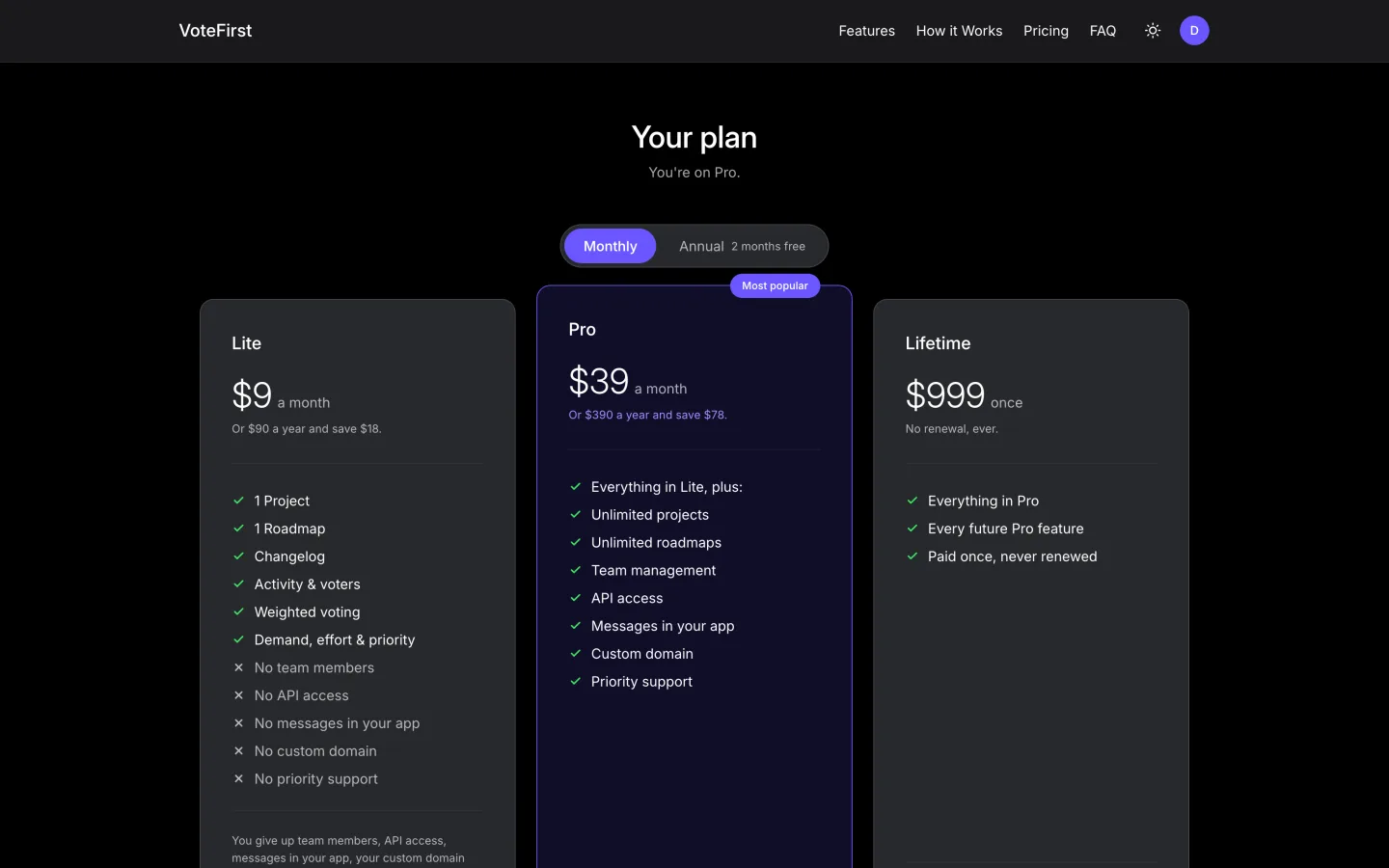
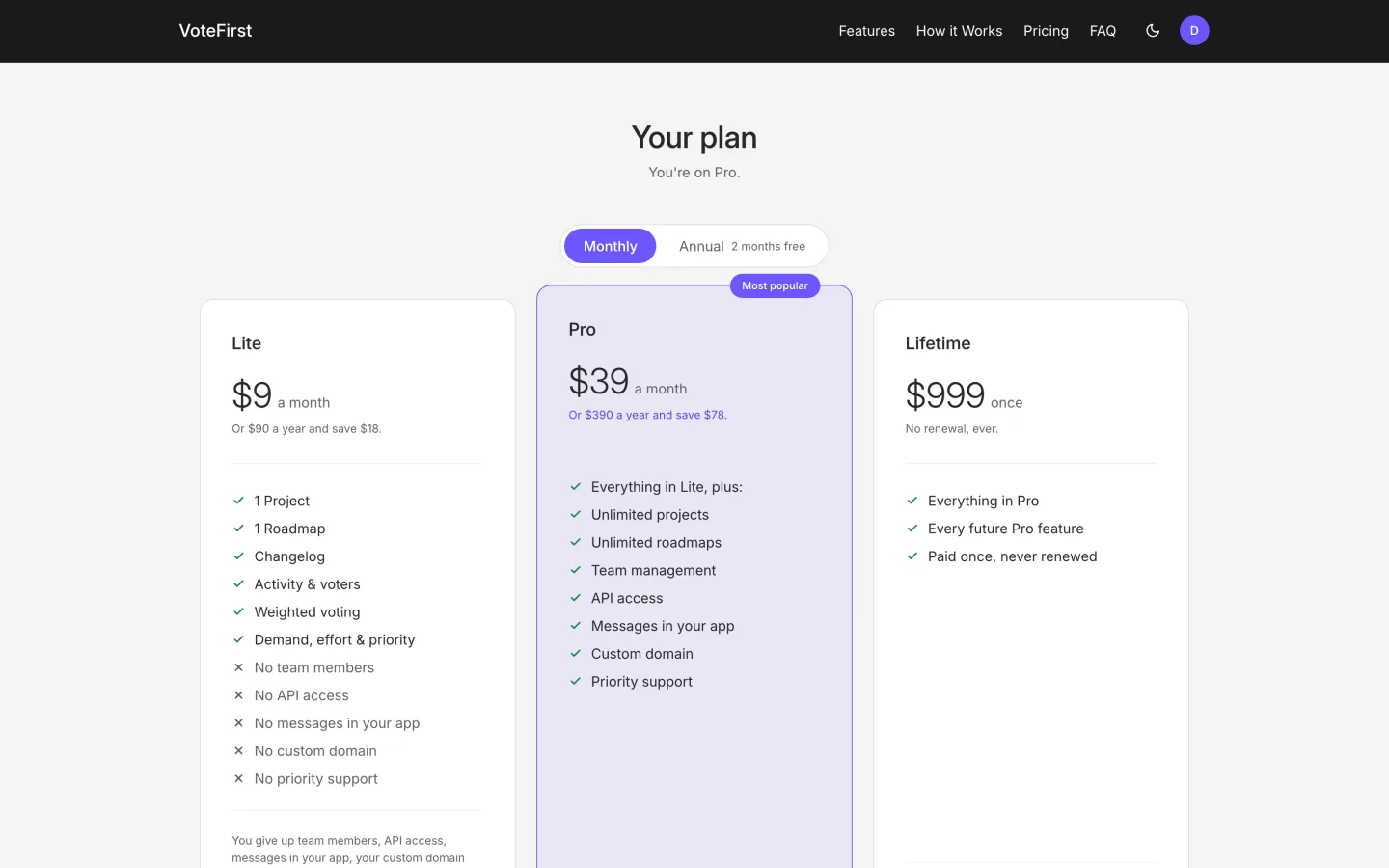
What is here is the other three. Single sign on as a signed handoff from your own application, on the thirty nine dollar plan. An export of the board as a CSV with twelve columns. A published price, which is nine dollars a month for one project or thirty nine for unlimited projects with the API, team members and a custom domain, with a card required to start the fourteen day trial.
So the company this suits is one that wants revenue weighted voting and a real board without a procurement process, not one whose identity team has already written SAML into the requirement. If that is you, the feature list says which of the two plans carries each part.
What should you ask a vendor that a feature page will not answer?
Five questions, and none of them appears on a comparison table anywhere including this one.
What is the meter, exactly? Not the price, the thing that makes the price go up. Seats, projects, boards, or the number of people who participate. That last one is the one that turns a successful board into an expensive board, and the calculator runs your own numbers against every metered vendor at once.
Who counts as a user? On the metered products this is a defined term with surprising members, and reading the definition is worth more than reading the price beside it.
What does the export contain? Not whether one exists. What is in the file.
Does single sign on cover the voters or only the administrators? These are two different features that share a name. One lets your staff in without a second password. The other lets your customers vote under the identity they already have in your product, and only the second one changes what the board is worth.
What happens to the board if we stop paying? Almost nobody publishes this, and seven products in this category no longer answer at their own address at all, so it is not a hypothetical question.
What is on this page and what is not
Thirty two products, each read on its own pages on 14 September 2026, against the six gates above. Nothing here was taken from another comparison list, which is why some of these rows disagree with lists you will find elsewhere.
Where a vendor publishes nothing on a gate, this page says so rather than guessing. An absence on a marketing site is never proof that software cannot do a thing, and every unpublished row on this page is a question to ask rather than an answer to rely on.
The figures move whenever a vendor edits a page, so the date is part of every claim. The whole matrix as a file is free to copy, quote and use commercially with no attribution.
What this costs
Lite
$9 /mo
Pro
$39 /mo
Lifetime
$999 once
Fourteen day trial of Pro, card asked for at signup. Nothing here counts the people who vote, so the bill does not move when the board starts working. The long version, with what happens if you stop paying.