Somebody told you to start collecting feature requests properly. You searched, you found eleven products with clean websites and similar screenshots, and the monthly prices run from nothing to two hundred and fifty dollars.
The thing nobody puts at the top of these pages is that those monthly prices are not comparable numbers. Twenty one pricing pages were read on one day and what each one meters was written down, and there are eight different answers.
Until you know which unit you are reading, a fifteen dollar tool and a sixty dollar tool cannot be ranked. One of them might cost you six hundred dollars a year and the other six thousand, and the headline price will not tell you which.
What does feature request software actually do?
Three jobs, and most products in this category do all three.
It collects. People suggest things, in a public board, in a widget inside your product, or through your support inbox.
It ranks. Other people vote, so you can see which suggestions have company behind them rather than only which arrived most recently. What a feature voting tool does with those votes is where the products stop agreeing.
It closes the loop. When you ship something, the people who asked for it get told, usually through a roadmap and a changelog.
That is the whole category. The differences between vendors are not really about those three jobs, because everybody does them. The differences are about who can participate, what a vote is worth, and how you get billed.
We build one of the tools on this list, so try it for the 14 days a trial runs rather than take our ranking of ourselves at face value.
What is the unit each tool bills on?
Nine units, and three of them grow with the number of people outside your team, being the tracked end user, the monthly active visitor and the changelog subscriber.
| Billed per | What it means | Who bills this way |
|---|---|---|
| Per tracked end user | Anybody with a post, a vote or a comment | Canny, Convas |
| Per monthly active visitor | Anybody who sees the widget | Beamer |
| Per seat | Your colleagues with admin access | Featurebase, Productboard |
| Per paid user | Same idea, different name | Savio |
| Per board | Each public board you run | Feature Upvote |
| Per project | Each product you run | Upvoty, AnnounceKit, FeedBear |
| Per workspace | One flat price, with caps inside it | Sleekplan, Frill, Supahub, UserJot, ProductLift, Rapidr, Nolt, Noora |
| Per changelog subscriber | Every unique email address that receives your release notes | Ducalis |
| Custom | Quoted after a sales conversation | UserVoice |
Every figure behind this table was read on the vendor's own pricing page on 9 September 2026, apart from the last unit, which was read on 15 September 2026. The full table with the actual prices is on our pricing comparison.
The ninth unit is the newest and the strangest. Ducalis charges for the people who receive your release notes rather than for the people who write them, so account users are unlimited on every plan of theirs and the bill rises as your changelog finds readers.
Which unit is the dangerous one?
The first two, and only if your board works.
A tool that bills by tracked end user or by monthly active visitor charges you more as more people participate. That is a coherent way to build a business and it aligns what you pay with what you get. It also means the bill grows with the exact outcome you were hoping for.
Three of the twenty one tools we checked bill this way. Everybody else charges for something you control, which is a seat, a project, a board or a workspace. On those, a thousand voters and a hundred voters cost the same.
A seat is not automatically the cheap unit either, and Gleap's entry plan carries one seat and one project, so a second colleague and a second product cost the same step upward.
If you expect real participation, that single fact narrows the field more than any feature comparison will. What a tracked user actually costs sets out the arithmetic at whatever board size you enter.
What three questions actually decide this?
Will a lot of people vote? If yes, cross off the metered tools or accept the curve. If your board will stay under twenty five participants, several vendors have a genuinely free tier and you should use one.
Do your customers pay you very different amounts? If a customer paying you two thousand dollars a month and a free account both cast one vote, a plain count cannot tell you which request came from where. Seven of the twenty one tools we checked ship some form of revenue weighting, so this question narrows the field hard.
Does the feedback need to sit behind a login? Some teams need that. If you do, the tools that require an account before anybody can vote stop being a drawback and start being the reason you buy them.
Those three questions eliminate most of the list. Feature checklists rarely do, because everybody ships the same features.
Which tools weight votes by revenue?
Seven that we could confirm on their own pages, and one that says it is coming.
UserVoice makes it the headline of their product. Featurebase describes sorting feedback by revenue impact. ProductLift pipes plan tier and revenue from Stripe against each voter, on their Pro plan. Savio lets you slice requests by revenue and plan.
Canny sorts boards by monthly revenue impact and counts a company's revenue once per post however many of its people vote. Sleekplan offers vote weight by plan, by revenue or by segment. Noora asks you to measure revenue impact rather than votes, and combines company and MRR data with the feedback.
Rapidr publishes it as coming soon in their own comparison table, which is not the same as having it.
We have got this count wrong three times. We recorded Sleekplan as not having it, because we read their pricing page where it is not mentioned and never opened the feature page where it is.
We documented Canny's version in one paragraph and then left Canny out of the total two paragraphs later. And we had never opened Noora at all. Every correction moved the number up, and every one came from reading a page nobody had opened.
That is worth saying out loud, because it is exactly the error that gets copied between comparison pages for years. It is also why the sentence above now names how many tools we checked.
A page that tells you seven vendors do something is making a claim about an entire category from whatever sample it happened to open.
For the rest of the twenty one, nothing appeared on the pages read that day. That is an absence of evidence on a marketing site rather than proof about the software.
Which tool should you choose, and who should each one go to?
Five kinds of team, one answer each, and the full table has the detail behind every one of them.
Teams who want the most complete product in the category and whose revenue lives in a CRM should look at Canny. Teams running one product who want every feature on every paid plan should look at Feature Upvote. Teams who already run Docker and Postgres and want to host it themselves should look at Fider.
Larger product organisations with dedicated product managers are the market Productboard and UserVoice are built for. Teams whose feedback arrives through support rather than a public board should look at Savio.
Which tool is better for startups?
The one whose meter does not move when the product works, which rules out the two most popular names in the category.
A startup's problem is that it cannot forecast its own bill. A board that suddenly works brings in voters, and on a tracked user meter those voters are the invoice.
Canny meters anybody associated with feedback and Convas does the same, so success on the board is a cost, and what that actually costs at a size you choose is worked out here.
Against that, a flat unit is predictable whatever happens. Per project, per board and per workspace all bill a thing you own rather than a thing your customers do, which is twelve of the vendors on the unit table above.
The other half of the answer is the free tier, because a startup before revenue is the reader most likely to need one. Five vendors publish a real one and their caps are on the table above.
What should you look for in a feature voting tool?
Four things, in this order, and price is not the first of them.
The unit it bills on. Nine units are sold in this category and three of them grow with the number of people outside your team. That single row decides more of the eventual bill than the headline figure does, and it is the row least likely to be on the comparison page you are reading.
Whether a visitor can vote without an account. A board that asks for a signup before a vote collects from the people already committed to you and hears nothing from anybody else. That is a design decision rather than a defect, and it changes what the vote count means.
What happens when two customers disagree. Forty people asking for one thing and three paying customers asking for another is the actual decision, and most tools give you one number that quietly makes it for you. Seven of the twenty one tools read here weight a vote by what the voter pays.
What does not export. Every tool in this category will take your data in and most will give some of it back, and the part that never survives a move is the vote counts, because a vote belongs to a voting identity the next tool does not have.
What should a saas team look for in a product feature request tool?
Two things the four above do not cover, and both are about the rest of your stack.
Whether the requests can leave the tool. A saas team already has an issue tracker, and a request that has to be retyped into it will be retyped for about three weeks. Look for an export with the votes attached and an API that returns a request with its voters, rather than a one way integration that files a ticket and forgets who asked.
Whether the meter and your growth point the same way. A product feature request tool billed per participant gets more expensive exactly as your product succeeds, which is fine if you planned for it and unpleasant if you did not. The table above says which row each vendor is in.
What if you are actually shopping for a roadmap?
Different question, different shortlist, and worth splitting off before you compare anything here.
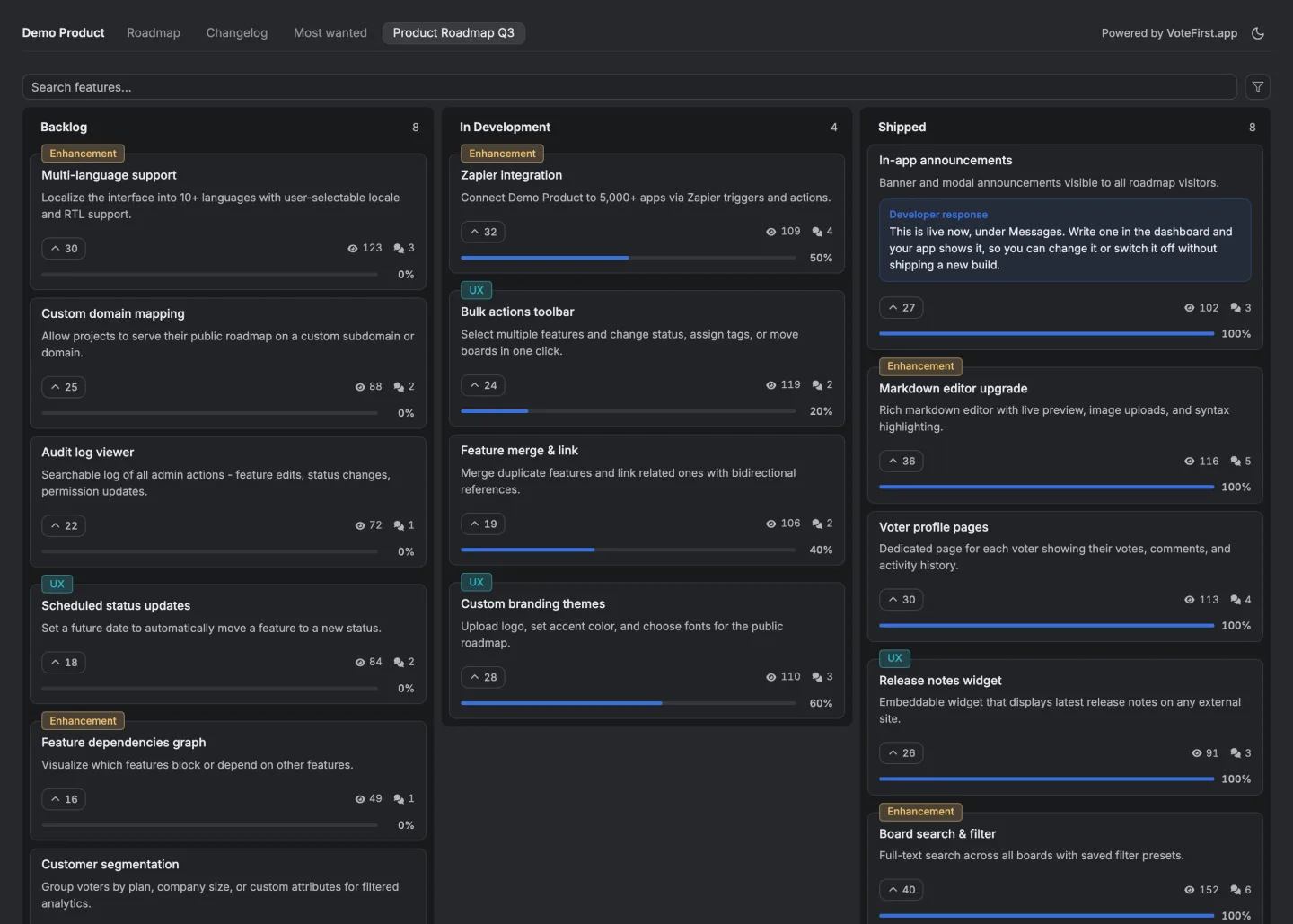
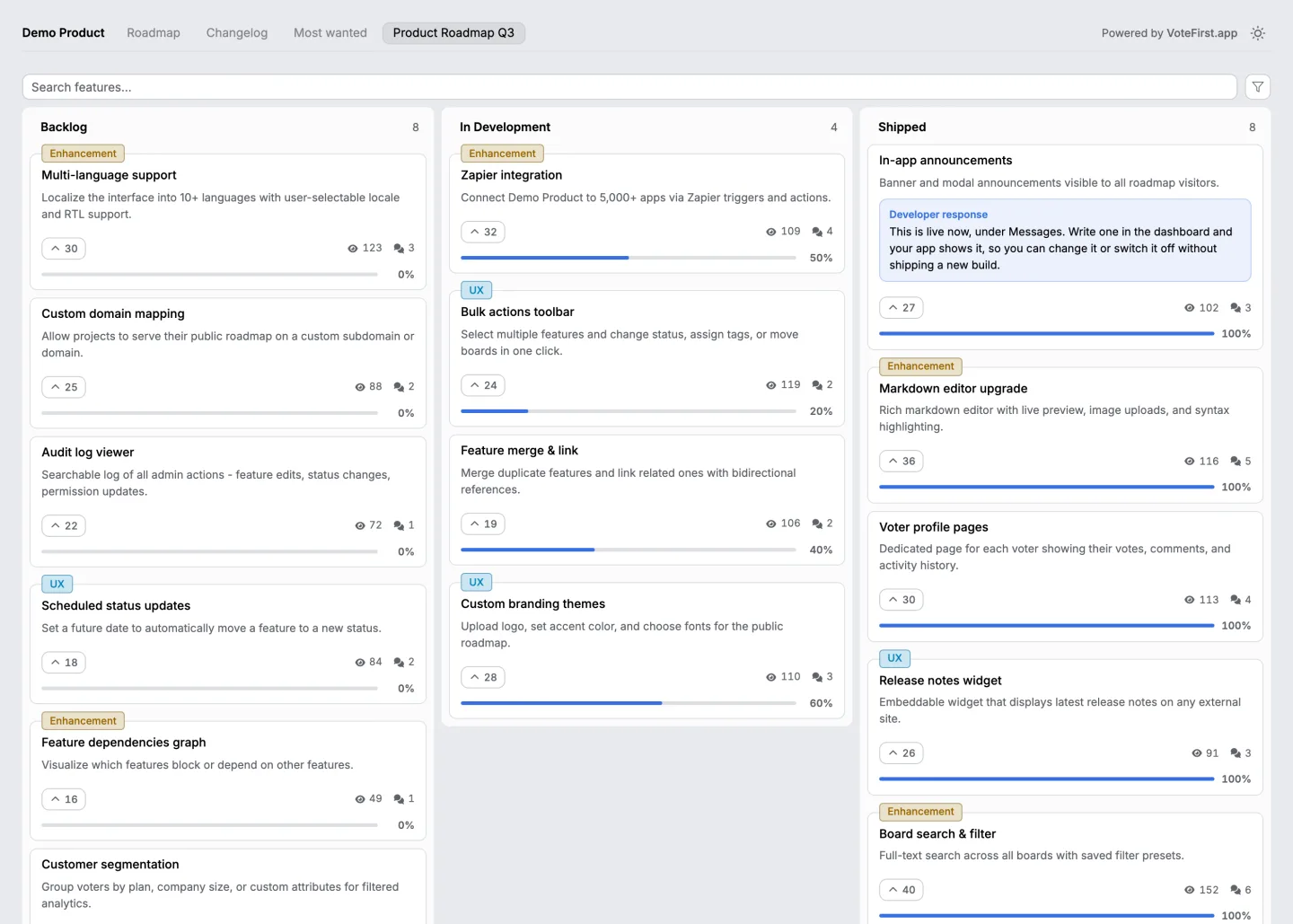
The tools on this page collect requests. A roadmap tool shows people what is coming, and half the products that answer to that name cannot show it to a customer at all. Eight of them are sorted by who is allowed to look, which turns out to separate them faster than any feature list does.
What is the best free feature voting tool, or a free alternative worth using?
Yes, several. Fider is open source and its hosted tier runs to two hundred and fifty feedback items, UserJot gives two boards and three admin roles, Supahub gives one board and one admin, Featurebase gives one seat, and Sleekplan's Indie tier is a single admin workspace that does not expire.
All five were read on their own pages on 14 September 2026, and none of them is this product, which has no free plan.
Is this a different category from a feedback board?
The same products under a heavier name, and the heavier name usually means somebody wants an audit trail.
A feature request management tool is a feedback board with the internal half taken seriously.
The same requests arrive the same way, and what the phrase asks for on top is that each one carries a state somebody owns, that a decision is recorded rather than implied, and that a declined request stays readable instead of disappearing.
Every product in the table above does the first two. The third is where they differ, and the column to read is what happens to a request nobody is going to build.
So the category is not separate and the question behind it is real. If the reason for buying is that requests currently die in a shared inbox with no record of who said no, the thing to compare is what each tool does when the answer is no rather than how the board looks.
Where does VoteFirst fit?
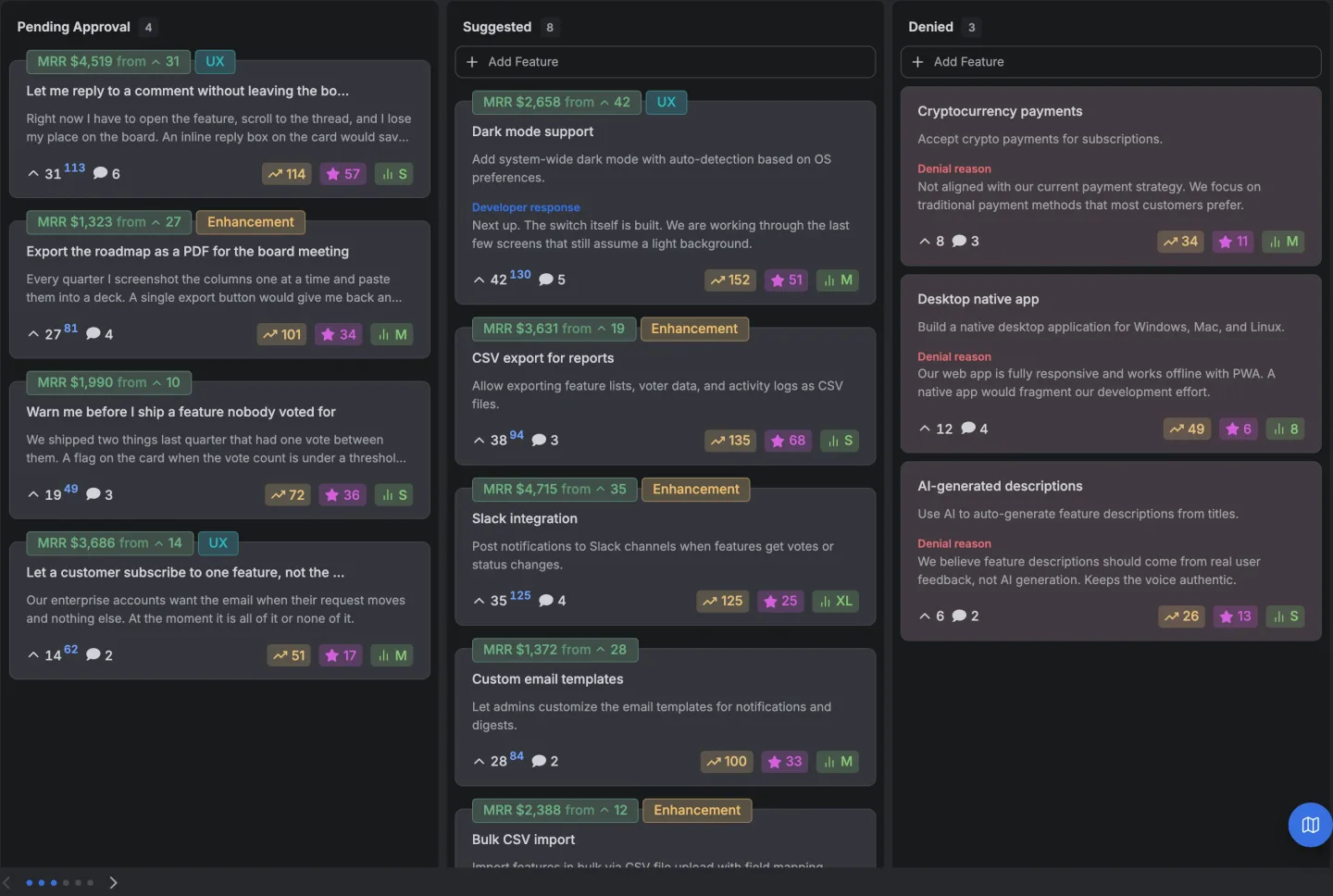
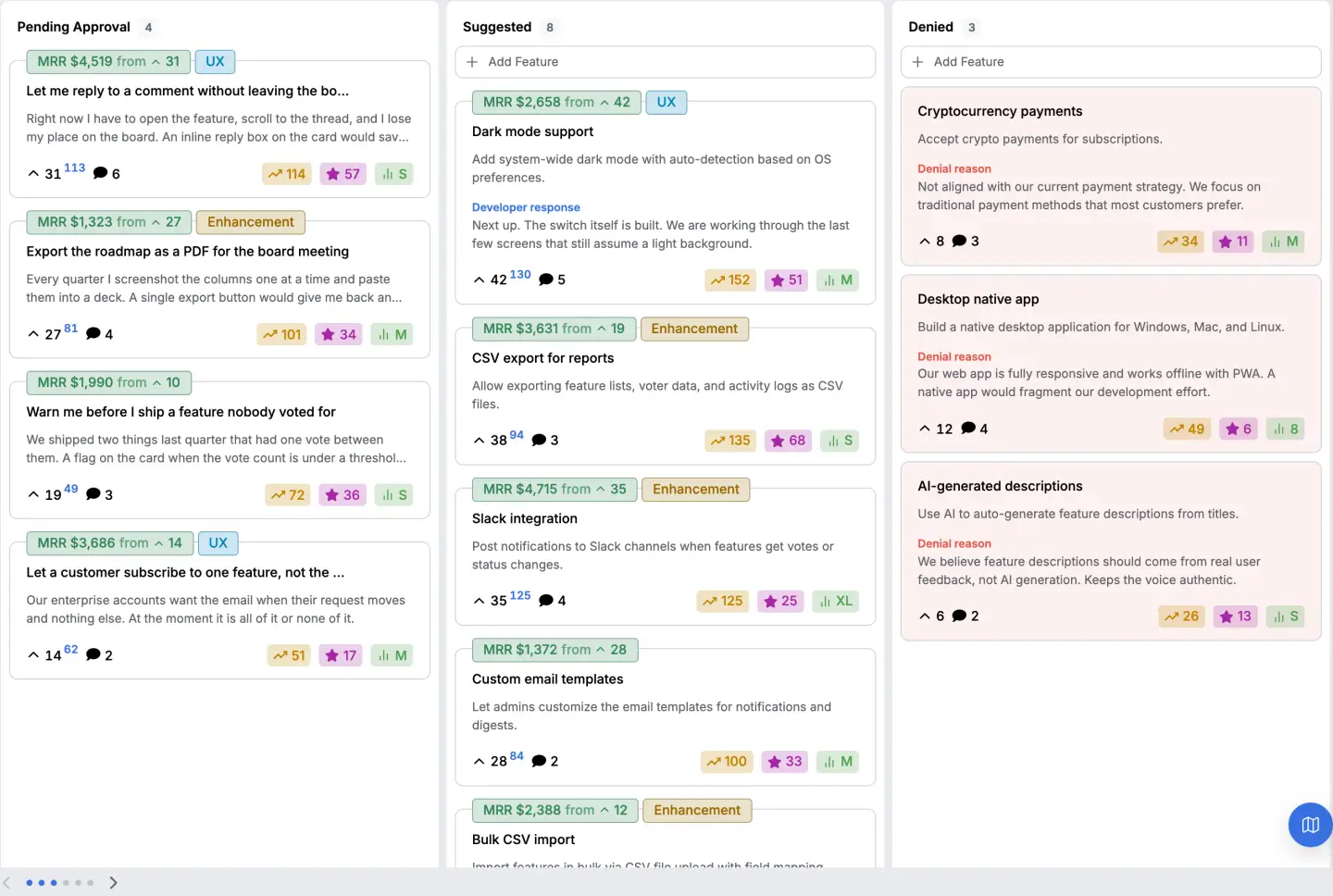
We are for the team whose voters pay very different amounts.
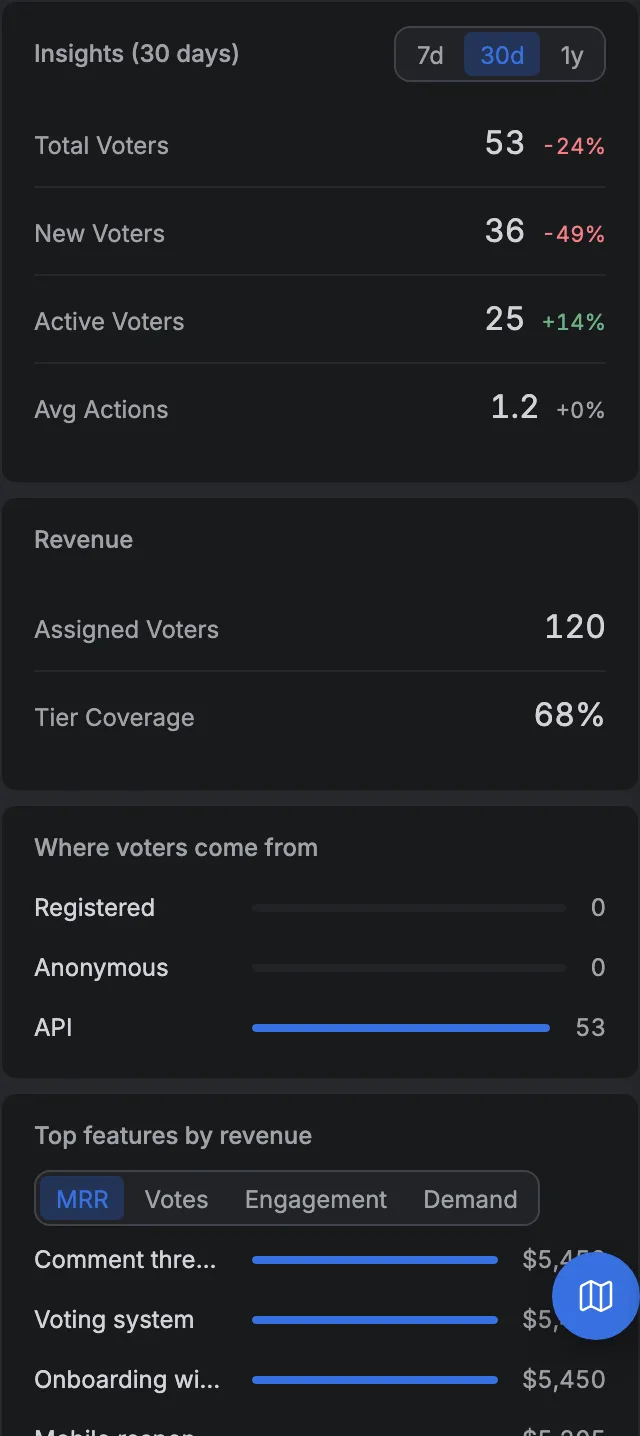
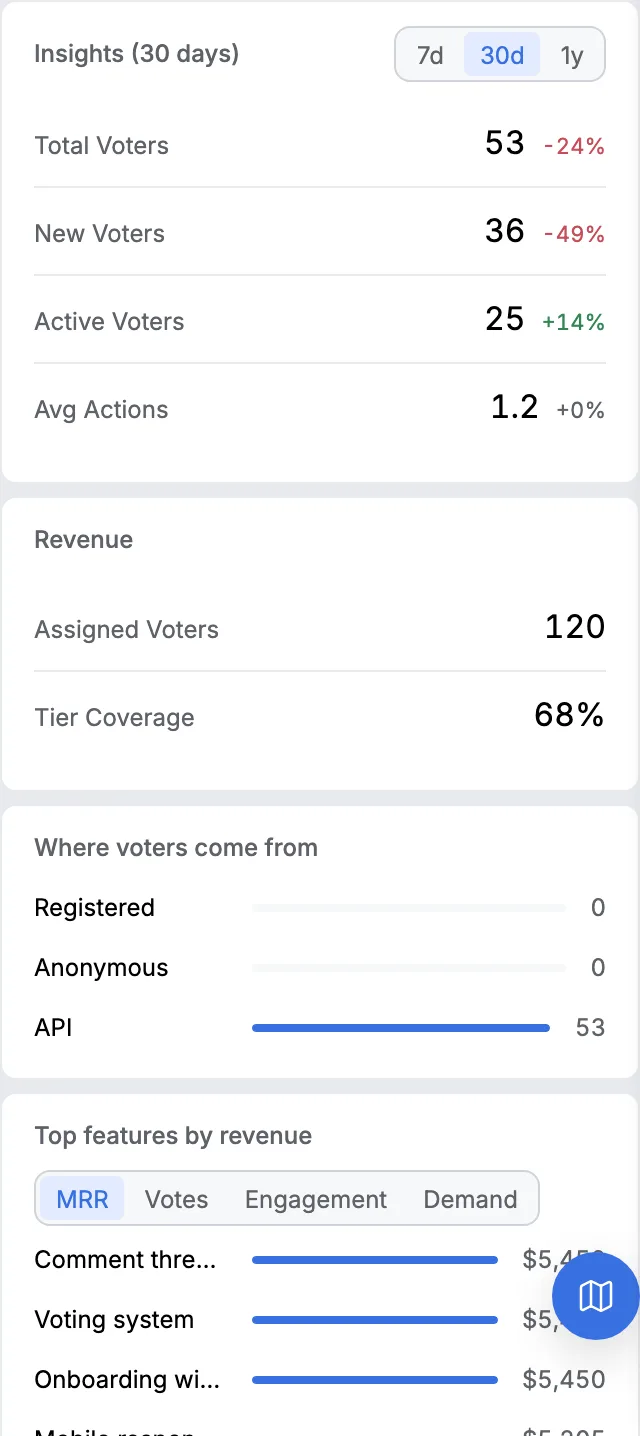
You create voting tiers, you set a whole number multiplier on each one, and you put each voter in a tier. A vote then carries that multiplier.
The plain headcount stays on the same card, so you can see that a request has fourteen weighted votes from six people and know immediately that one large customer is behind it.
The full mechanism is written up here, including the parts it does not do. The revenue figure you store against a tier never multiplies anything, and your public board never shows any of it.
Nine dollars a month for one project. There is no per voter meter of any kind, so a board with fifty voters and a board with fifty thousand cost the same.
We do not have a free tier. If your board will stay small, a free plan elsewhere is genuinely cheaper than us and we would rather you read that here than work it out afterwards.
14 days, a card at signup, then $9 or $39 a month.