Fider's hosted Pro tier is $25 a month per workspace, on top of a free tier capped at 250 feedback items, and self hosting removes the licence fee but shifts the cost to a server and a Postgres database the owner runs. Of the 47 other tools this page's table lists, 33 either charge less than that $25 entry rate or bill on a flat plan or project instead of by workspace. VoteFirst, the product this site sells, is $9/mo for one project on LITE, with PRO at $39/mo covering every extra project on the same rate rather than a second hosted workspace or a second server to run.
Fider is open source under the AGPL, and if you run it yourself you get every feature with no licence to pay. That is not marketing from them and it is not a concession from us, it is what their code does. A self hosted instance sets its own Pro flag to true.
So this page is not going to try to beat Fider on price, because it cannot. It is about the part of the bill that is not the licence, and about the one thing Fider deliberately does not do.
Most people reading this should probably stay on Fider. The last two sections say who should not, and why.
What are the alternatives to Fider?
Fider is the free one everybody names, and the comparison worth making is against what you pay for instead of a licence, which is a server and the hours to keep it up. Here is the rest of the field with the unit each tool charges on.
| Vendor | From | Billed per | Free plan | Trial |
|---|---|---|---|---|
| Trello | $5/user/mo | user | Yes | – |
| VoteFirst | $7.50/mo | plan | – | 14 days, card |
| Features.Vote | $7.50/mo | project | – | 14 days |
| Jira Product Discovery | $10/creator/mo | creator | 3 creators | – |
| LoopedIn | $12/mo | plan | 1 of each | – |
| WishKit | $12.50/mo | project | 5 requests | – |
| Sleekplan | $13/mo | workspace | 1 admin | 30 days, no card |
| Upvoty | $13.50/mo | project | – | 14 days |
| Noora | $14/mo | workspace | – | 7 days |
| Convas | $15/mo | tracked user | 25 users | – |
| FeedBear | $15/mo | project | – | 14 days |
| Supahub | $15/mo | workspace | 1 board | 10 days |
| ProductLift | $19/mo | workspace | – | 14 days |
| Productboard | $19/maker/mo | maker | 500 notes | – |
| Roadmunk | $19/creator/mo | creator | – | 14 days |
| Ducalis | $20/mo | changelog subscriber | 500 subs | – |
| Frill | $22/mo | workspace | – | 14 days |
| Fider | $25/mo | workspace | 250 items | – |
| Featurebase | $29/seat/mo | seat | 1 seat | – |
| Headway | $29/mo | plan | Yes | – |
| Nolt | $29/mo | board | – | – |
| UserJot | $29/mo | workspace | 2 boards | 14 days |
| Aha! Ideas | $39/user/mo | user | – | Yes |
| Savio | $39/mo | paid user | – | 14 days |
| Beamer | $49/mo | monthly active user | 1,000 MAU | – |
| Feature Upvote | $49/board/mo | board | – | 30 days |
| Rapidr | $49/mo | workspace | – | 14 days |
| Suggested | $49/mo | plan | – | 15 days |
| Gleap | $49/mo | plan | – | 14 days |
| FeatureOS | $50/mo | plan | – | 30 days, no card |
| Olvy | $60/mo | plan | 25 items | – |
| AnnounceKit | $39/mo | module | – | 15 days, no card |
| Canny | $79/mo | tracked user | 25 users | – |
| LaunchNotes | $249/mo | plan | – | 14 days |
| Pendo | Not published | monthly active user | Beta | – |
| ProdPad | Not published | module | – | 7 days |
| UserVoice | Not published | quoted | – | 30 days |
| airfocus | Not published | quoted | – | – |
| ProductPlan | Not published | quoted | – | – |
| Productroad | $9/mo | plan | 50 users | 14 days, no card |
| Quackback | $29/mo | plan | 1 board, 50 posts | 14 days, no card |
| ProdCamp | $99/mo | plan | 2 admins, 1 product | – |
| Harvestr | $65/editor/mo | editor | – | 14 days |
| Productlane | $29/user/mo | user | – | Yes |
| Ideanote | $6/user/mo | user | 10 users, 250 ideas | – |
| Craft.io | $19/editor/mo | editor | – | 14 days, no card |
| HYPE Boards | €79/mo | plan | – | 14 days, no card |
| Noticeable | $24/mo | plan | 1 project, watermarked | 14 days, no card |
Read on each vendor's own pricing page, with the billing switch on the yearly side wherever one is published. From is the cheapest paid rate per month. What each one includes, as well as what it costs, is on one page.
The same two products, line by line
Read on each vendor's own pages on the date in the row above. Not published means nobody could read it on the pages opened that day, never that the feature is absent.
What is Fider?
Fider is an open source feedback board under the AGPL. You can run it on your own server with every feature turned on, or use the hosted tier the project runs, which is free under a fair use policy.
What does Fider cost?
Their hosted service is free up to a fair use limit of 250 feedback items, and the paid hosted plan is 25 dollars a month billed month to month. Running it yourself costs nothing in licence.
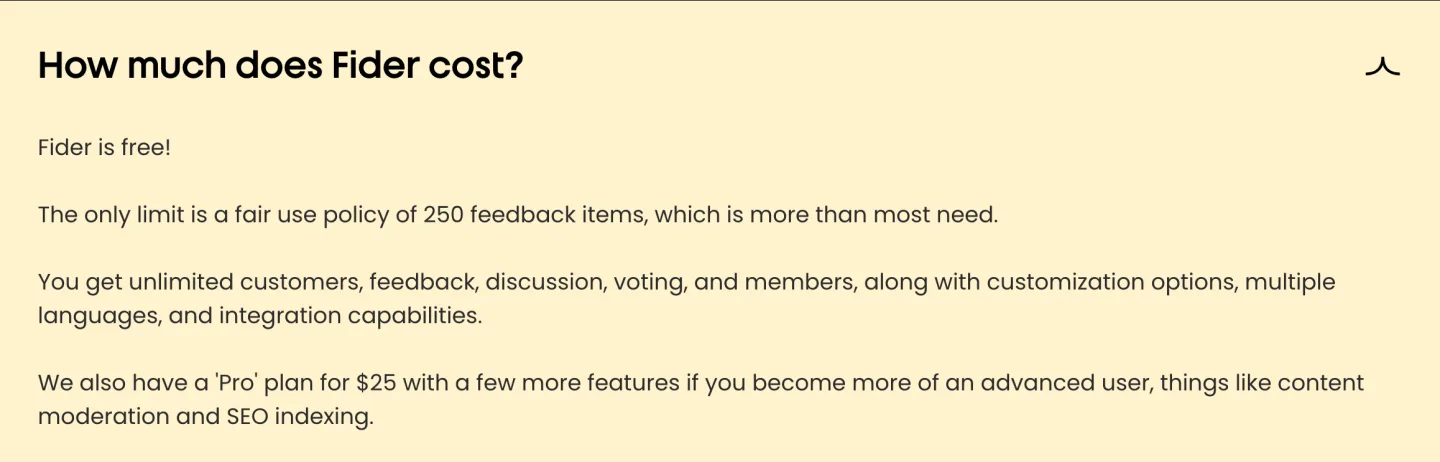
There is no charge per seat and no charge per board on their pricing page, and no annual price is published. The fair use limit their own FAQ states is written out here.
For a category where the normal shape is a per user meter, that is unusually simple, and you can see how the other sixteen tools bill beside it.
If you would rather try the alternative than read about it, a trial runs 14 days and asks for a card at signup, and it is $9 or $39 a month after that.
What this costs
Lite
$9 /mo
Pro
$39 /mo
Lifetime
$999 once
Fourteen day trial of Pro, card asked for at signup. Nothing here counts the people who vote, so the bill does not move when the board starts working. The long version, with what happens if you stop paying.
Is every feature really free when you self host?
Yes, and it is provable rather than promised. Their code sets the Pro flag to true for any instance that is not running in multi host mode, and the routes file labels the gated group as available to self hosters and to paid hosted customers alike.
This is worth checking because it was briefly untrue. Fider tried an open core model in early 2026, where self hosters would have paid for Pro features, and then reversed it. The maintainer wrote this in the public discussion.
I think perhaps we should undo this decision, and make everything fully OSS again, including the pro features. We can then make the pro version something that only applies to the hosted version.
The pull request that removed it was titled "Remove open core licensing model" and it merged on 14 April 2026. Any comparison page still telling you Fider paywalls self hosters is working from information that expired months ago.
What does it take to run Fider yourself?
Docker, a PostgreSQL database you operate, and an email sending path that actually delivers. That is the real bill.
Their documentation is direct about the first one.
As we don't distribute Linux or Windows specific binaries, Docker is a must to host Fider.
The database is the part people underestimate. Fider requires PostgreSQL 12 or newer, and their sample compose file runs Postgres in a container with a volume on the host machine. That means the database is yours.
You patch it, you monitor it, you back it up, and one day you do a major version upgrade on it. None of that is hard if you already do it for something else. All of it is a second product to run if you do not.
Email is the quiet one. A feedback board that cannot send is a feedback board nobody comes back to, and getting mail delivered from a new server to inboxes rather than spam folders is its own afternoon.
One thing is genuinely easier than you would expect, and leaving it out would make this page a hatchet job. Fider integrates with Let's Encrypt directly, so setting one environment variable on a directly exposed instance gets you a certificate that issues and renews itself with nothing else installed.
The honest summary is that Fider self hosted costs nothing in licence and something every month in a server, a database you operate, a delivery path that works, a backup regime nobody wrote for you, and the hour you spend the day an upgrade does not go smoothly.
For a team already running Docker and Postgres in production, that is a very good deal. For a team that is not, it is a new thing to be responsible for.
Is Fider still being maintained?
Yes, with a quiet stretch. They merged 269 commits to the default branch through the first seven months of 2026, the latest release is v0.36.1 from 3 July 2026, and the most recent commit on the default branch is from 27 July 2026.
At the time of writing that is about six weeks of quiet, alongside 31 open issues and 26 open pull requests.
On a project with 4,511 stars, 850 forks and 67 contributors, a six week gap after a heavy year is a quiet period rather than an ending, and we are not going to dress it up as one.
Check the dates yourself before you decide, because they will have moved by the time you read this.
Can Fider weight a vote by what the customer pays?
No. Every vote on Fider counts as one, from every signed in person.
That is a design decision rather than a missing feature. Fider is a community voting tool and one person one vote is what a community voting tool means. It works exactly as intended when your voters are peers.
It stops working when they are not. If one customer pays you forty times what another does, and both cast one vote, your board is telling you what the most people wanted rather than what the people paying you wanted.
Those are different questions, and on a board where every vote is equal you cannot tell them apart, because the information was never recorded.
That is the whole of what VoteFirst does differently.
14 days, a card at signup, then $9 or $39 a month.
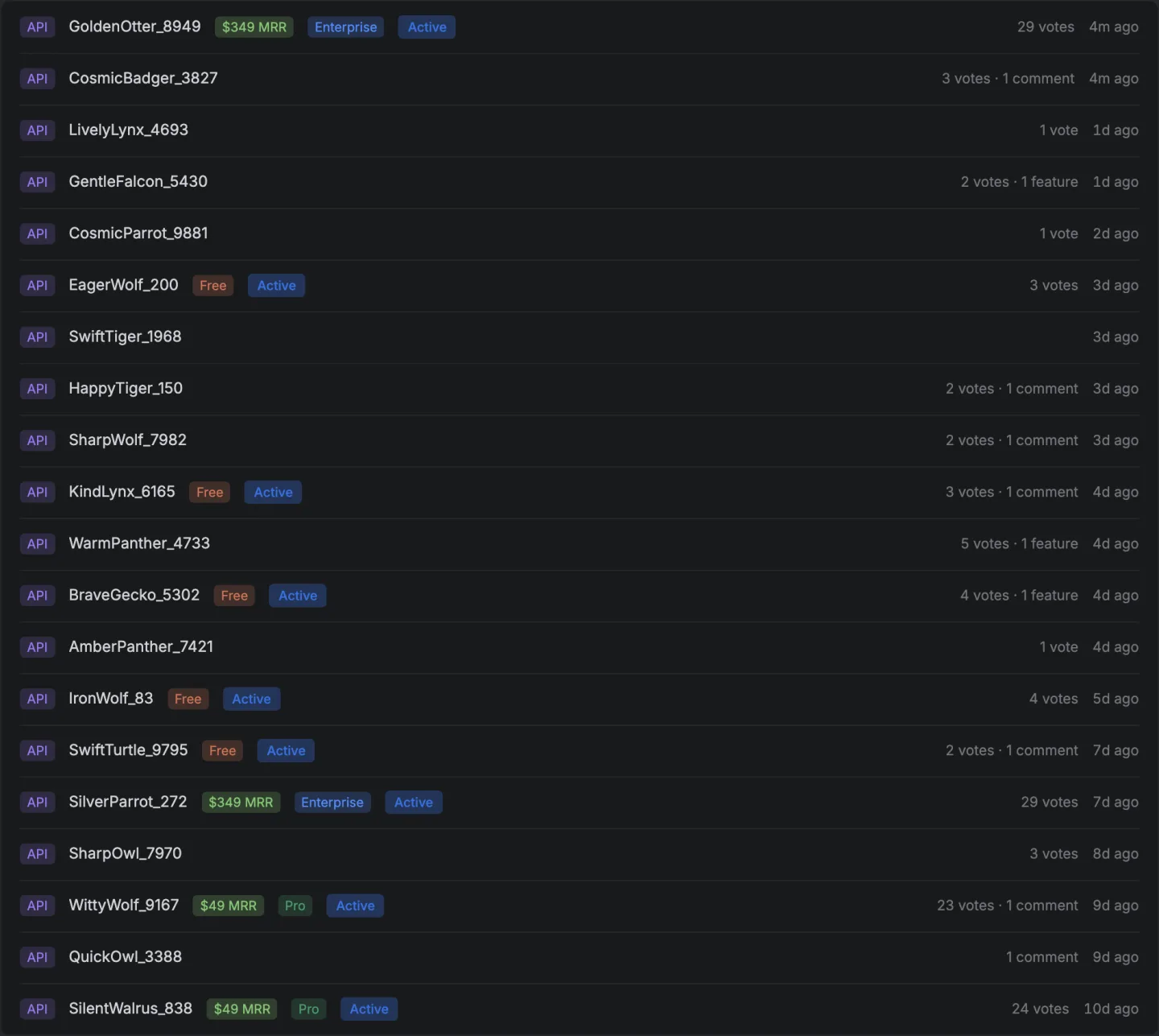
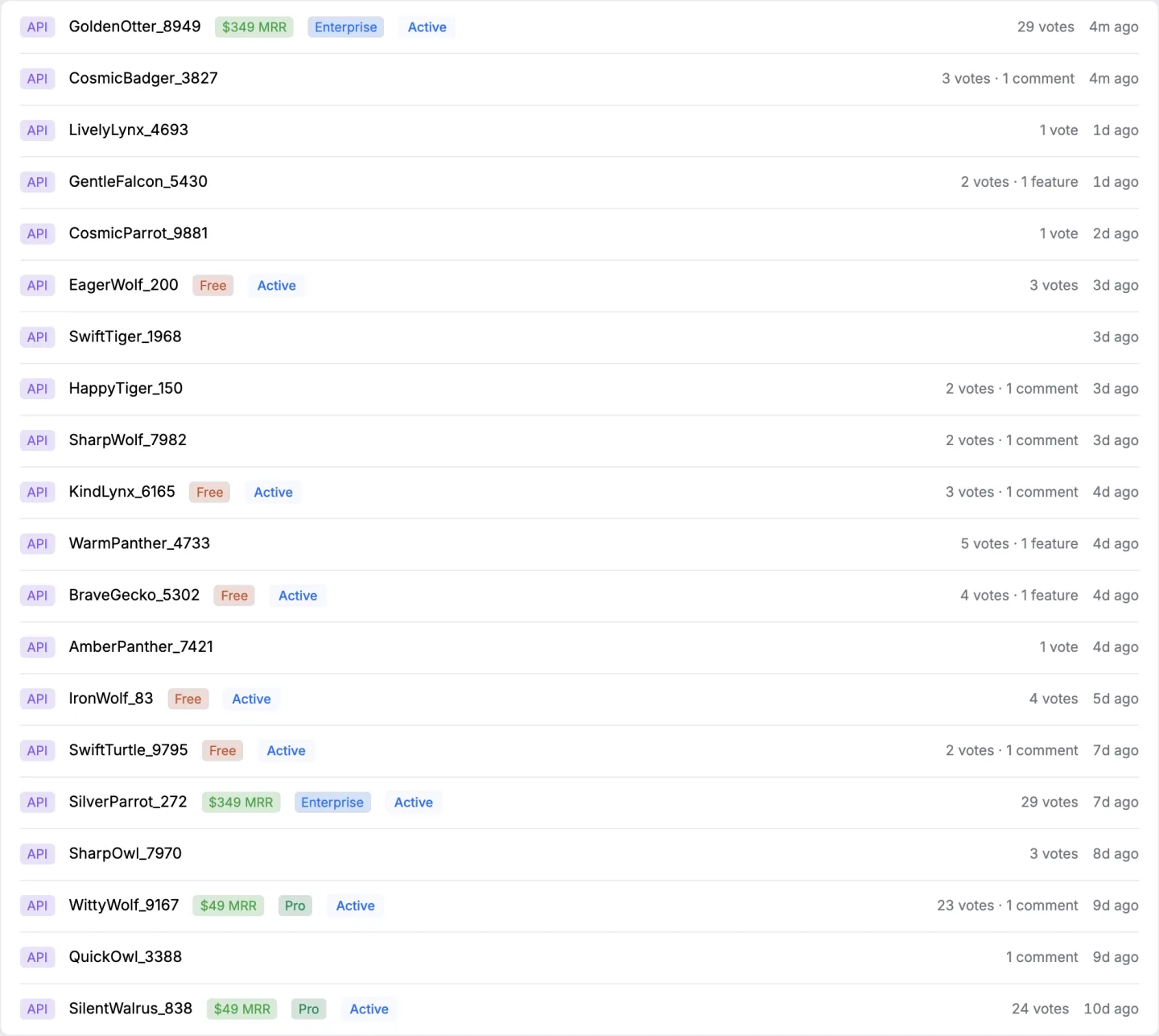
Does Fider have a public roadmap and single sign on?
Fider's own page read on 14 September 2026 never uses the word roadmap, which means nobody could read about one rather than that none exists. Single sign on is not published anywhere on Fider's own page read on 14 September 2026, so nobody could read whether it exists.
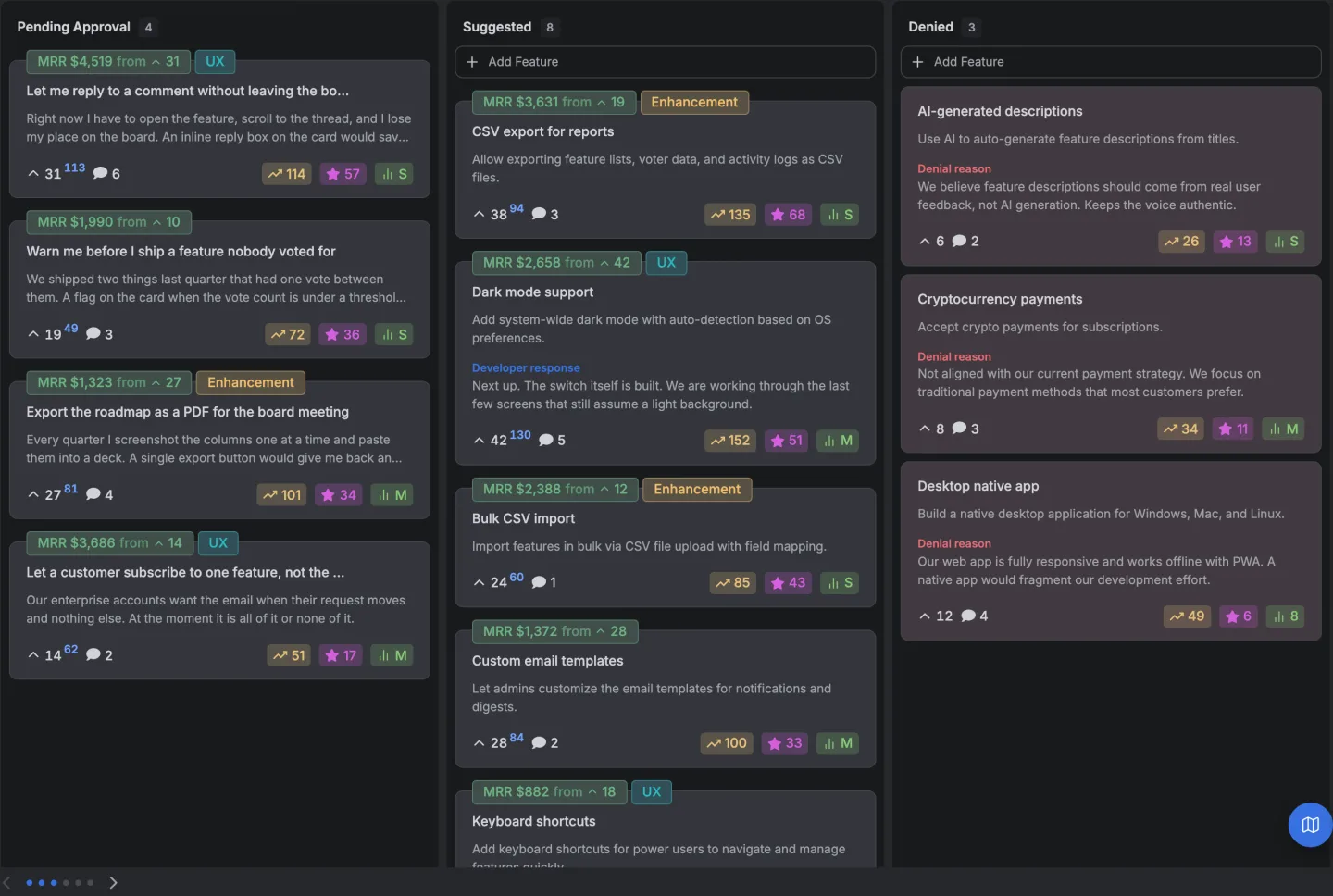
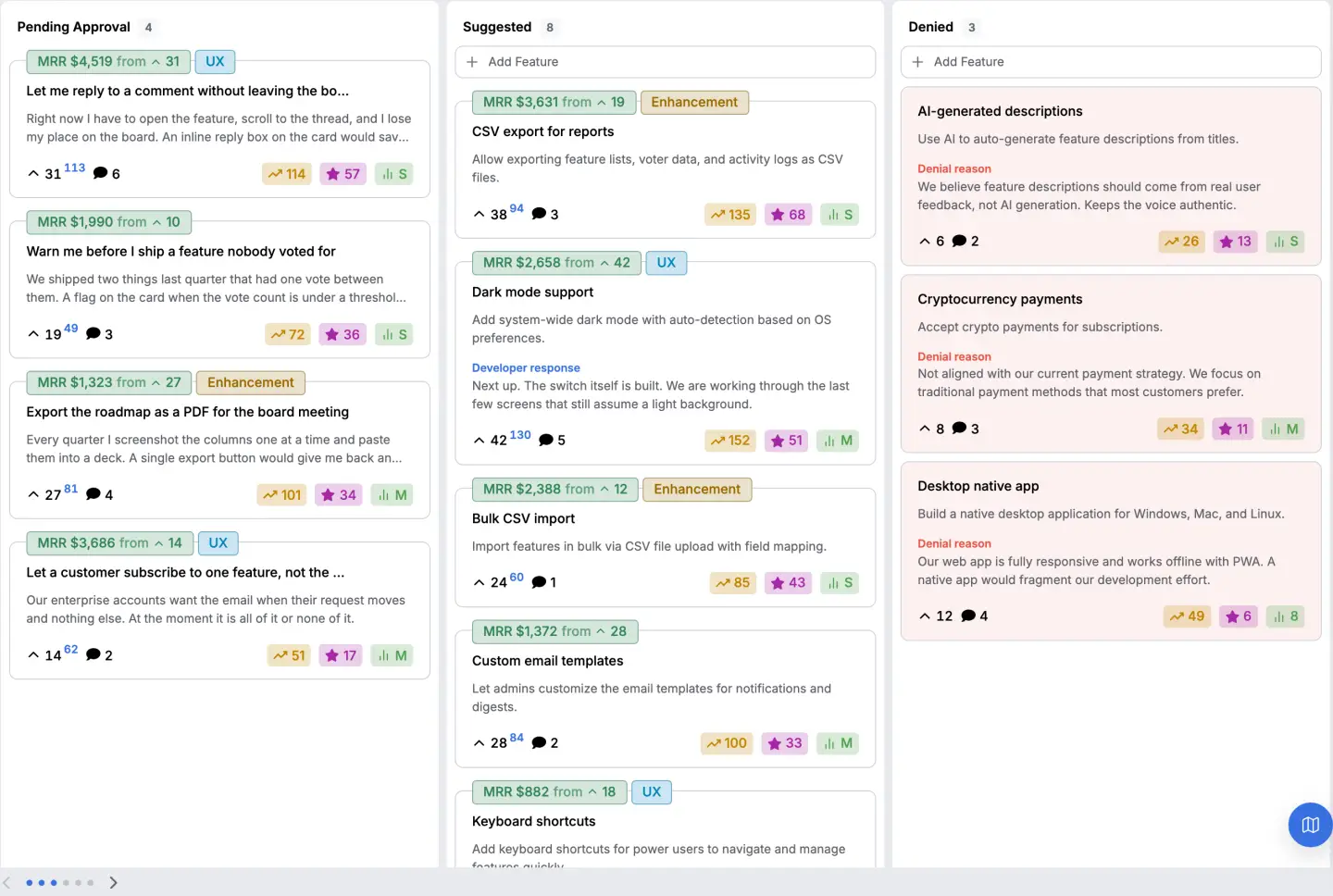
Ours publishes a public roadmap with a Denied column on every plan, and signs a voter in with a token from your own application on the thirty nine dollar plan rather than with SAML.
Is there a free Fider alternative?
Yes, and Fider is one of them, which is why this page is about what its free tier does not cover rather than about price.
The other open source boards are listed with their licences and their last commit dates. Fider is the free one to know about, because it is open source and its hosted tier runs to two hundred and fifty feedback items.
UserJot gives two boards and three admin roles, Supahub gives one board and one admin, Featurebase gives one seat, and Sleekplan's Indie tier is a single admin workspace that does not expire.
All five were read on their own pages on 14 September 2026. This product is not one of them. There is no free plan here, only a fourteen day trial that asks for a card at signup.
Is Fider worth it, and when is it the better answer?
When you already run Docker and Postgres in production and adding one more service is a Tuesday rather than a project.
When you need the board on your own infrastructure because a policy or a contract says the data stays where you control it. Self hosting is the clean answer to that and nothing hosted is, ours included.
When one person one vote is the model you actually want, which is most community boards, open source projects and internal tools.
When you want to never be repriced. Nobody can change the terms of software you run yourself, and your export is a database dump you already own.
If that is you, their documentation is good and you should go and read it rather than reading more of this page.
What moving actually involves
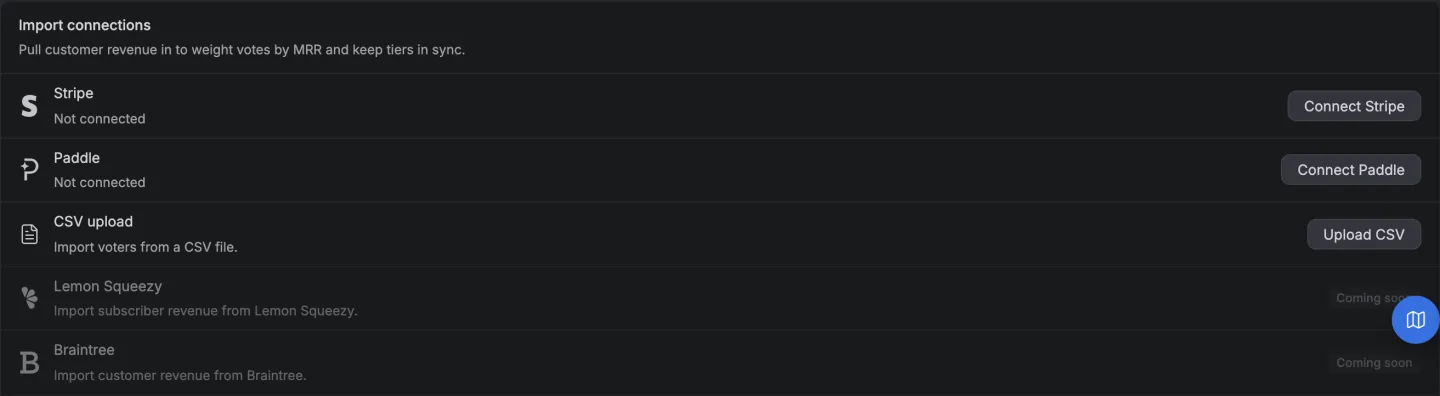
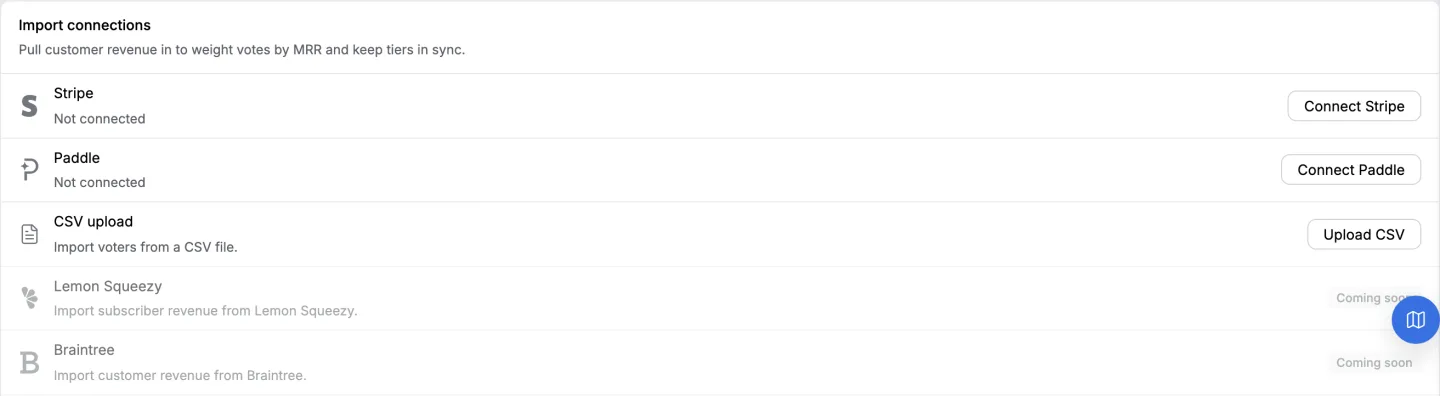
More work than a button, and the honest version is short. There is no importer for Fider on our side; the board import reads only Canny and Featurebase.
Voters and the revenue behind them come in from a CSV or from a billing connection, which is the part the weighting needs. The requests themselves are rebuilt by hand or by a script against the API, and the vote counts start again.
That is a real cost and it is worth naming before anybody moves. The five steps, with the endpoint each one uses, are written out in full, and they are the same five whatever you are leaving.
When it is not
When nobody on the team wants to be responsible for a Postgres instance at eleven at night.
When your voters are customers on different plans paying very different amounts, and you need to tell the loudest group and the largest account apart on the same screen. That distinction cannot be added to a board that never recorded it.
VoteFirst is nine dollars a month on LITE for one project with weighted voting included, and thirty nine on PRO. There is a fourteen day trial on whichever plan you pick, and a card is required to start it.
It is hosted, so the server, the database, the delivery and the backups are ours rather than yours, and that is most of what you are paying for.
Fider against the others, one at a time
Four pages here take Fider and one rival at a time, working out where the two bills cross and what each one does with a vote from a paying customer.