Every roundup in this category lists Fider as the free open source option and stops there. Their own frequently asked questions carry a number that none of those pages mentions, and it is the number that decides whether free is enough for you.
Everything below was read on Fider's own site on 14 September 2026.
How much does Fider cost?
Nothing, up to a point, and their own answer names the point.
| How you run it | Price | What it adds or limits |
|---|---|---|
| Fider hosted, free | Free | 250 feedback items |
| Fider hosted, Pro | $25/mo | Moderation and search indexing |
| Self hosted | Your own server | None |
Their answer to how much Fider costs is that Fider is free, with the only limit being a fair use policy of two hundred and fifty feedback items, which is more than most need, and that unlimited customers, feedback, discussion, voting and members come with it along with customisation, multiple languages and integrations.
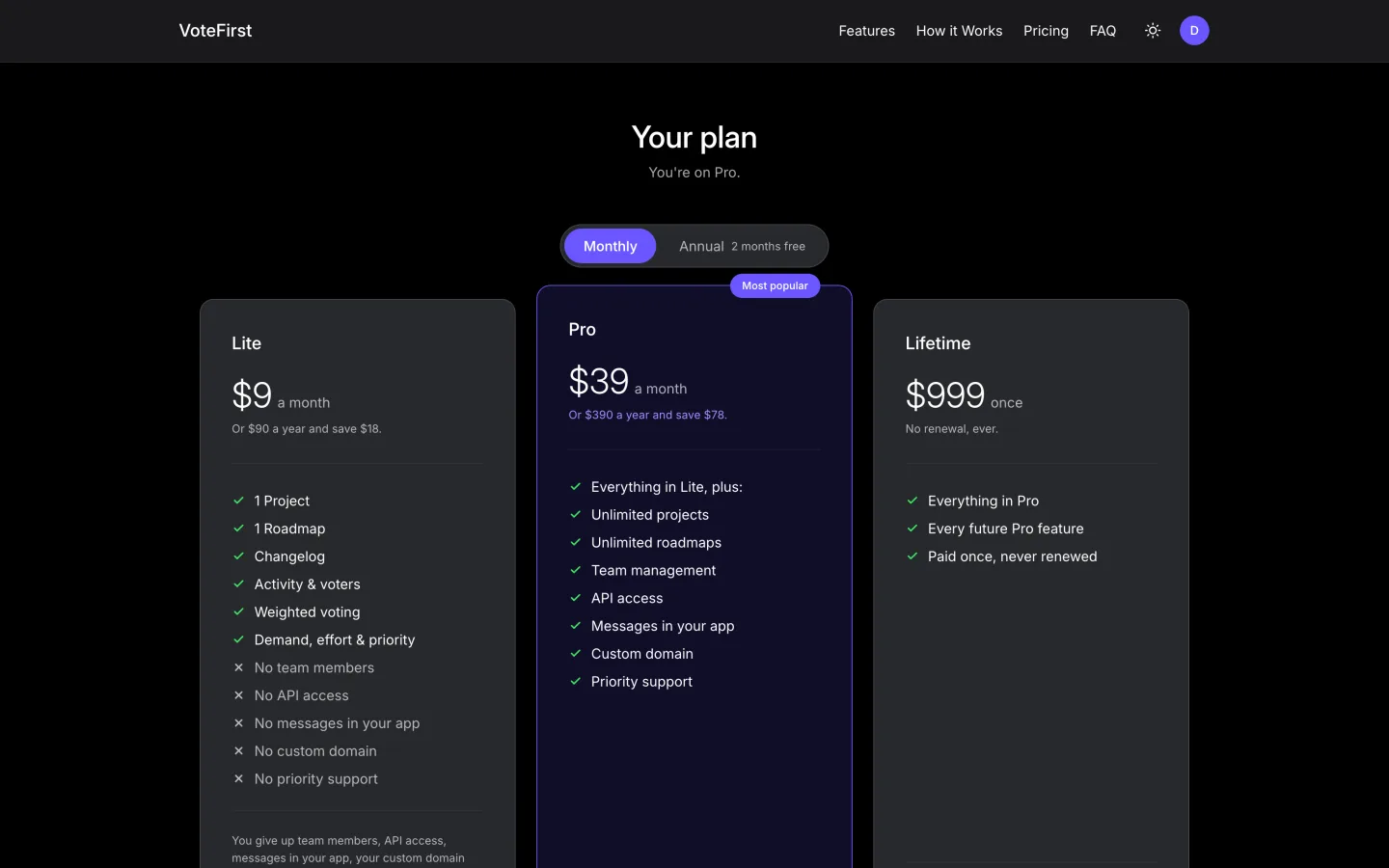
If two hundred and fifty is not more than you need, a trial here is 14 days with a card at signup and the bill after it is $9 or $39 a month with no item limit.
Does Fider have a free plan?
Yes, and it is the reason most people arrive at this page. Their site read on 14 September 2026 gives a free hosted tier under a fair use policy of two hundred and fifty feedback items, and the source is open if you would rather run it yourself.
What does two hundred and fifty items actually mean?
Requests, not votes and not people.
A board that collects two feedback items a week reaches the limit in two and a half years. A board attached to a product with real traffic can reach it in a quarter.
The number does not care how many people vote, which is the right design, and it does care how much gets posted, which is the thing a public board is for.
So the honest read is that Fider's free plan is generous for a small or new board and becomes a decision on a busy one. It is not written down on their own page, and it is the first thing a person evaluating Fider should know.
What does the twenty five dollar plan add?
Content moderation and being indexed by search engines, in their own words, plus a few more features for an advanced user.
Search engine indexing is the row worth pausing on, because a public board that search engines can read is a real asset.
Every request on it is a page about a problem somebody has, written by the person who has it, and a board with two hundred of those is two hundred pages of long tail. Putting that behind a paid tier is a defensible decision and it is not obvious from the outside.
What does self hosting cost?
Your own server, and the software is free.
Fider is open source and their site links the self hosting documentation directly. If you already run Docker and Postgres, the software costs nothing and the running cost is a small instance and a database.
If you do not, the cost is the time to learn both and the responsibility for backups and upgrades, which is the trade every self hosted tool asks you to make.
What does this cost on VoteFirst?
Nine dollars a month for one project with no item limit.
Against free, nine dollars has to earn its place and there is one thing it buys here. Fider counts votes.
Ours puts each voter in a tier with a whole number multiplier and shows the weighted total beside the plain count, so a request from four large accounts can outrank one from thirty free signups. The mechanism is here.
If your voters all pay you roughly the same, weighting has nothing to weigh and Fider is the better answer. The alternative page says that at more length.
The whole category table puts this beside every other price we read.
14 days, a card at signup, then $9 or $39 a month.