Feedback tool pricing has one page per vendor here, thirty two of them, each read on the vendor's own site on the day it was written. They are grouped below by what their pricing page actually does, because that turns out to matter more than the number on it.
Every figure on these pages is also published as one CSV, with the date and the address each row was read at. Six of these vendors publish no figure a reader can see. One shows a different set of plans on different loads. How central each of these domains is on the web's link graph is published as a second file. Three charge for the people who read the board rather than the people who run it. None of that is visible from a price comparison, and all of it changes the bill.
Which ones publish a flat number you can plan around?
Thirteen, and these are the pages where the figure on the card is close to the figure on the invoice.
- Features.Vote, nine or twenty nine and no meter at all.
- LoopedIn, free, twelve, twenty four or forty, with unlimited tracked users on every plan.
- Sleekplan, thirteen dollars a month with single sign on, an API and webhooks on that tier.
- Upvoty, fifteen dollars a month, and three lines on the cheapest card are crossed out.
- Supahub, nothing for one board and one admin, then fifteen.
- FeedBear, nineteen for one board and one team member, and no free tier.
- ProductLift, nineteen for two admins and forty nine for the plan that reads Stripe.
- Frill, from twenty two, with colleagues and tracked users both unlimited on the cheapest plan.
- UserJot, nothing for two boards, then twenty nine.
- Nolt, flat per board with unlimited users, and there are two Nolts at two addresses.
- Rapidr, forty nine for five colleagues, and an MRR filter their own table marks coming soon.
- Feature Upvote, forty nine dollars a board with every feature on both tiers.
- Gleap, forty nine for one seat and one project, and a hundred and forty nine for a second of either.
Which ones meter something that grows?
Ten, and this is the group where the second year costs more than the first without you changing anything.
- Featurebase, per seat, with one switch inside the plan card deciding which of two numbers you see.
- Savio, per paid user, with free users unlimited.
- Aha!, per user with a three seat minimum on Ideas, and viewers are charged.
- Beamer, on monthly active users, with the feedback board a separate add on.
- FeatureOS, an allowance of five boards and five seats, then fifteen for each extra.
- AnnounceKit, per project, with feature requests on a higher tier than the changelog.
- Jira Product Discovery, per creator, where a contributor is free and a creator is not.
- Roadmunk, two meters on one list, with editors and reviewers priced separately.
- LaunchNotes, per page, with the second page and the third user both unpriced.
- Olvy, on how much feedback you may analyse, at a hundred items on the sixty dollar plan.
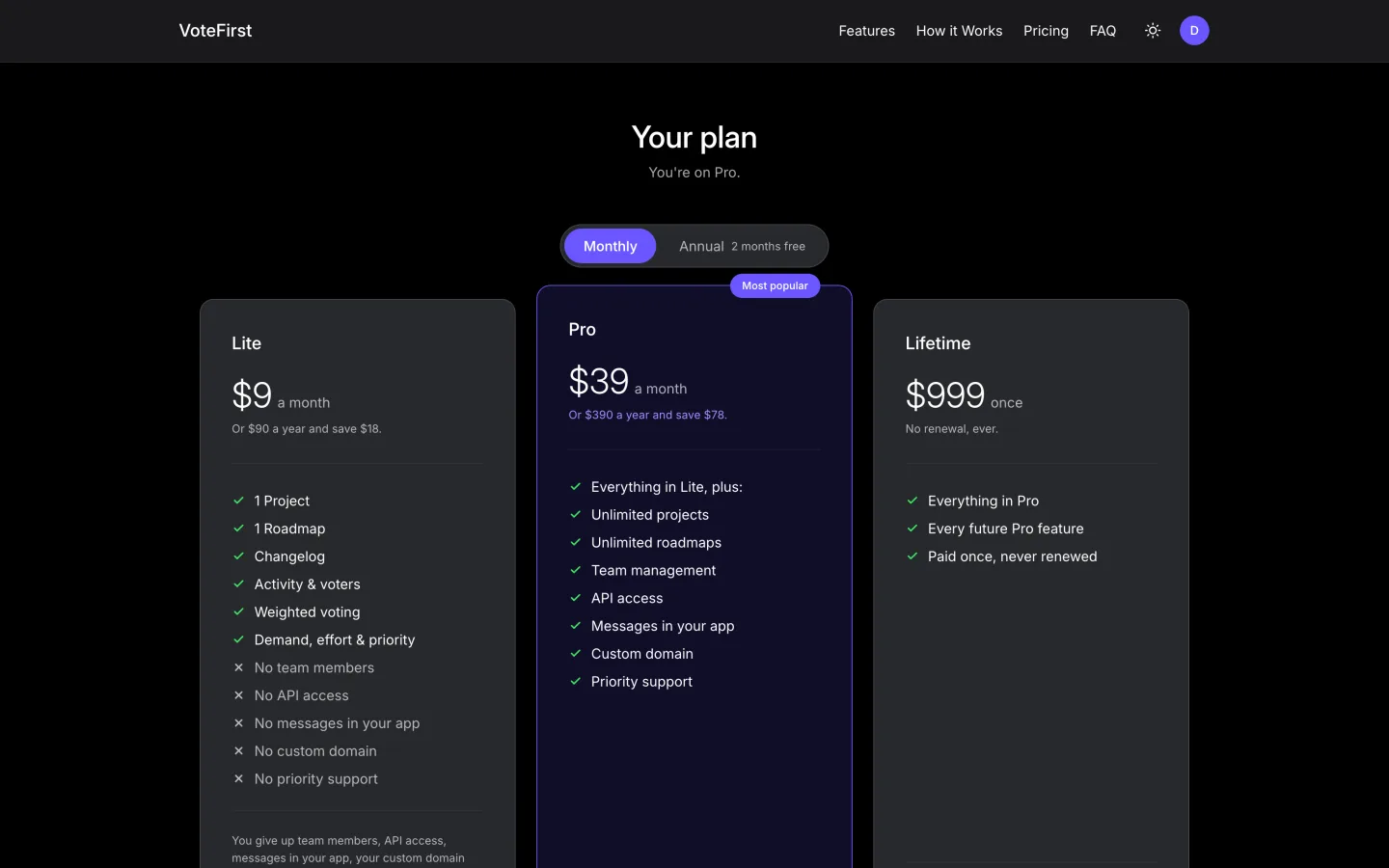
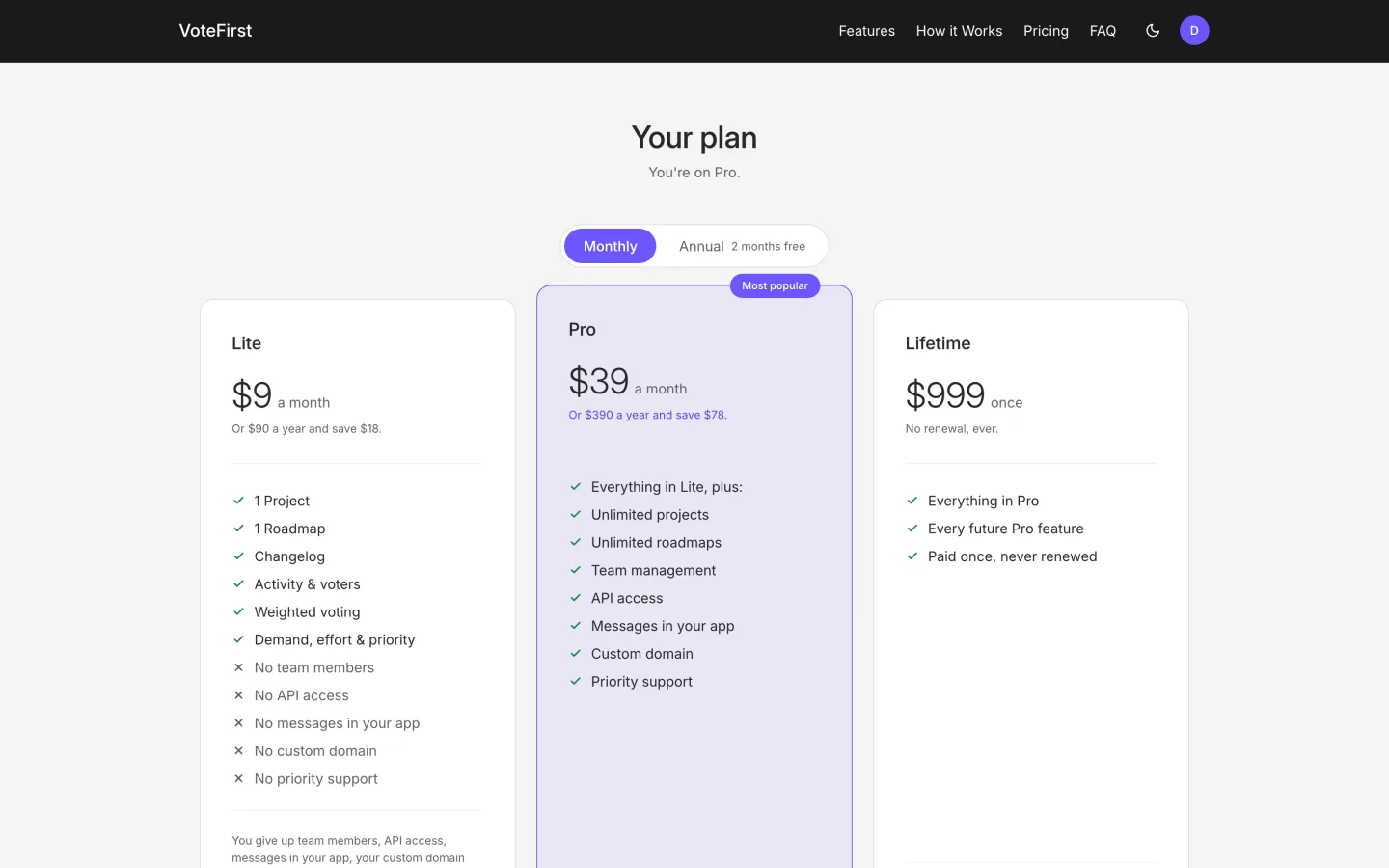
14 days, a card at signup, then $9 or $39 a month.
Which ones publish no number at all?
Six, and each page says what is knowable instead of guessing at a figure.
- airfocus, two plans that both read request pricing, with no free trial.
- Pendo, custom on every paid plan, metered on monthly active users in your app.
- ProdPad, a module builder that renders the figure in the browser, so a crawler sees nothing.
- ProductPlan, one plan with everything in it and no figure anywhere.
- UserVoice, a billing basis, a four to six week onboarding and a thirty day trial, and no number.
- Ducalis, whose pricing page serves a calculator and no figure, while its home page prices six competitors.
Which one is different on every load?
One, and it is the only page in the set we had to open repeatedly to describe.
Productboard shows a different set of plans on different loads. On eight tries we saw a free plan twice and a fifty nine dollar figure that was not there the other six times. The page records what was on the screen each time rather than picking the load that suited us.
Which one is free without a catch?
One, with a limit stated in the vendor's own words.
Fider is free, and the limit is a fair use policy of two hundred and fifty feedback items. Pro is twenty five dollars a month, or you host it yourself and pay for a server instead. That is the honest version and our own Fider alternative page says most people reading it should stay.
Which one is free with a catch worth reading twice?
One, and the catch is on the reading rather than on the writing.
WishKit caps what a visitor can see rather than how much you can collect, so the board keeps taking requests and the fifth one is where a reader stops. That is an unusual place to put a wall and it is the whole of what the free plan decides.
Do any of these vendors offer a discount?
Yes, and almost all of it is the same discount, being two months free for paying a year up front.
Annual billing is the only published discount across this set. Nobody in it publishes a startup rate, a non profit rate or an education rate on the page a visitor reads, and where a discount exists beyond the annual one it arrives through a sales conversation rather than through a price list.
Feature Upvote asks for a thousand dollars a year before it will take a bank transfer, which is a minimum rather than a discount and is worth knowing in the same breath.
This product does the same ordinary thing. Ninety dollars a year instead of nine dollars a month, and three hundred and ninety instead of thirty nine, which is two months free on both plans and both figures are on one page.
What payment methods do these tools accept?
A card, on every one of them, and an invoice once the number gets large enough.
Every vendor in this set sells by card through a checkout. Payment by invoice or bank transfer appears on the enterprise tier of the ones that have an enterprise tier, and the threshold is usually a sales conversation rather than a published figure.
This product takes a card. The checkout names no other payment method and there is no purchase order flow and no bank transfer at any plan, which is a real limit for a buyer whose finance team will not use one.
Do you need a credit card to try any of these?
It varies, and this product asks for one.
Several vendors in this set start a trial without a card. This one does not. The trial runs fourteen days, a card is taken at signup, and the charge begins when the trial ends unless it is cancelled first.
That is stated here rather than buried, because a reader who finds out at the checkout has been misled by omission.
The reason is not a secret. A trial that asks for nothing fills up with accounts that were never going to buy, and this is a two person product with no sales team to sort them out afterwards.
Where is the table with all the numbers in it?
On the alternatives hub, and there is exactly one of it.
Every price and every billing unit lives in one table on that page, rendered from one file, so the hub and the twenty five pages under this one cannot disagree. Repeating those numbers here would be a second copy that drifts the first time a vendor changes a plan.
If what you want is the arithmetic rather than the list, the tracked user pricing calculator runs it on your own size across the whole field.