Upvoty has three plans, one meter, and a detail on the cheapest card that most write ups of their pricing get wrong.
Each card lists its features in one continuous list, and the lines a plan does not include are crossed out in a lighter grey with a cross where the tick would be.
Anybody looking at the page sees this immediately. Anybody reading a copy of the page as text does not, because the words are still there.
What does Upvoty cost?
Three plans, and the toggle above the cards decides which column you are reading.
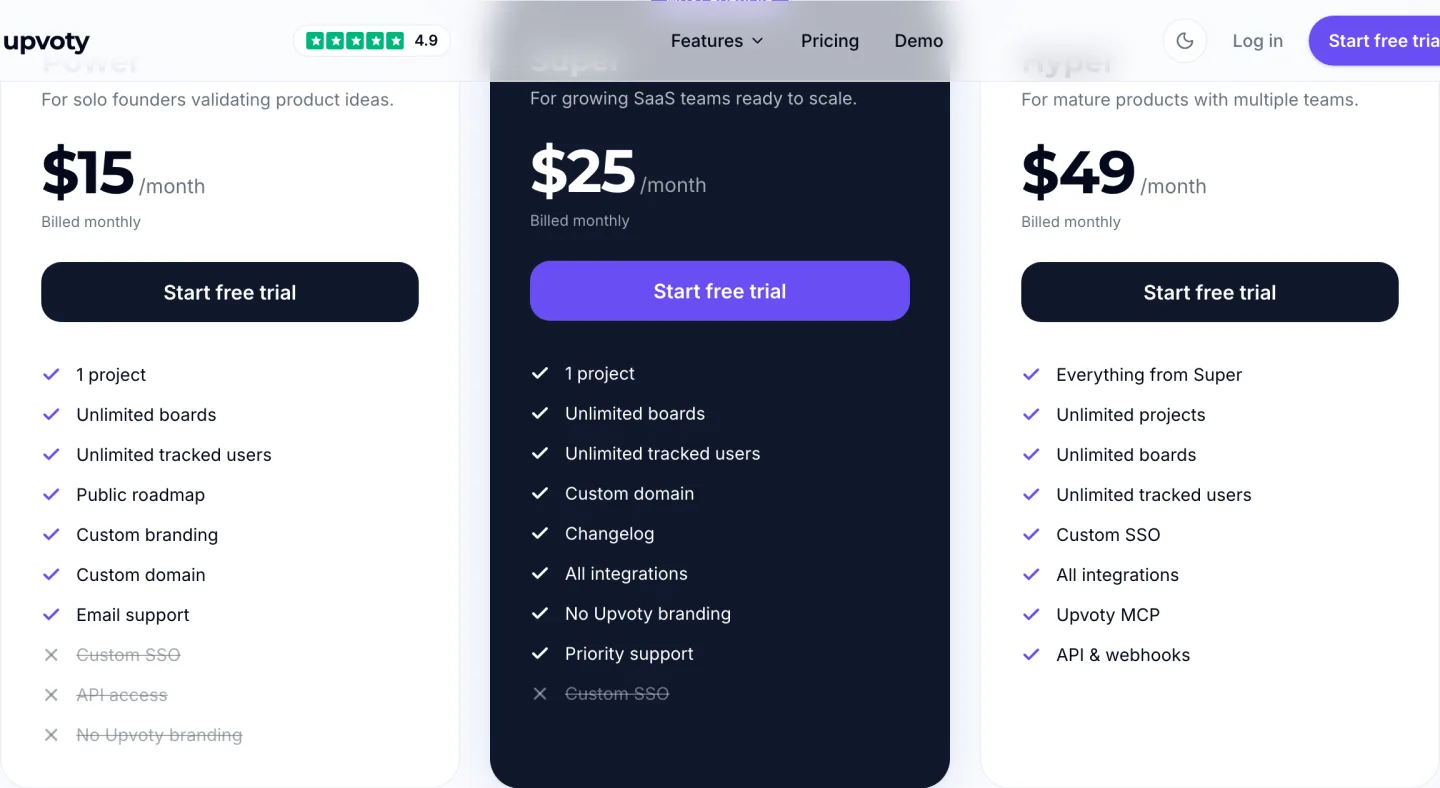
| Plan | Paid monthly | Paid yearly | Projects |
|---|---|---|---|
| Power | $15/mo | $13.50/mo | 1 |
| Super | $25/mo | $22.50/mo | 1 |
| Hyper | $49/mo | $44.10/mo | Unlimited |
The toggle sits above the cards, arrives on monthly, and carries a badge reading save ten percent. That is exactly what it saves. Fifteen becomes 13.50, twenty five becomes 22.50 and forty nine becomes 44.10, and there is no rounding anywhere in it.
Above Hyper there is an enterprise line offering unlimited everything, SAML single sign on, a custom data processing agreement and a dedicated success manager, with an email address rather than a price. Their trial is fourteen days on every plan and their page says it does not ask for a card.
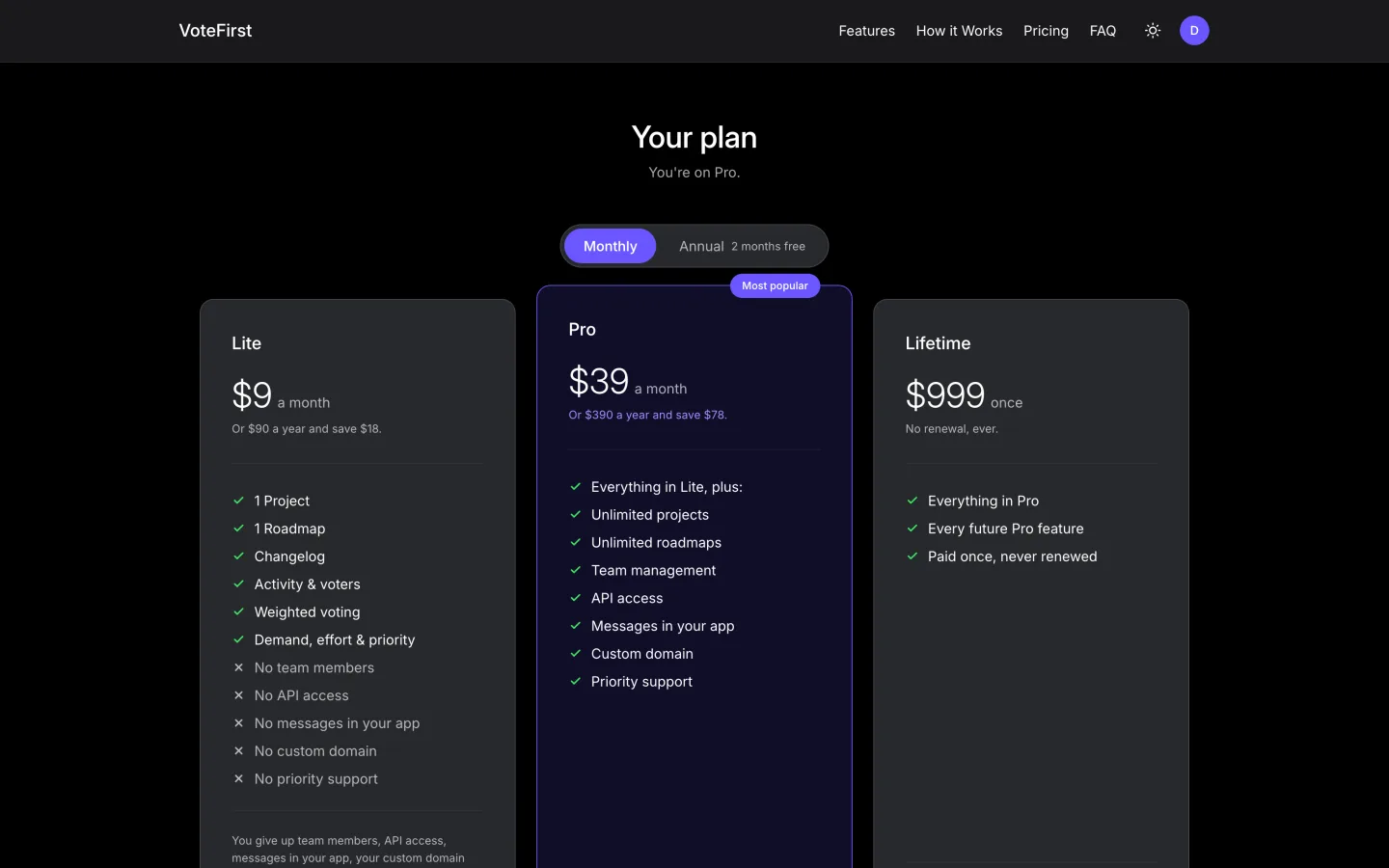
You can put your own numbers against it. The trial is 14 days, a card at signup, then $9 or $39 a month.
Does Upvoty have a free plan?
No. Their pricing page read on 14 September 2026 carries a fourteen day trial that asks for no card, and the fifteen dollar plan is the cheapest thing you can keep.
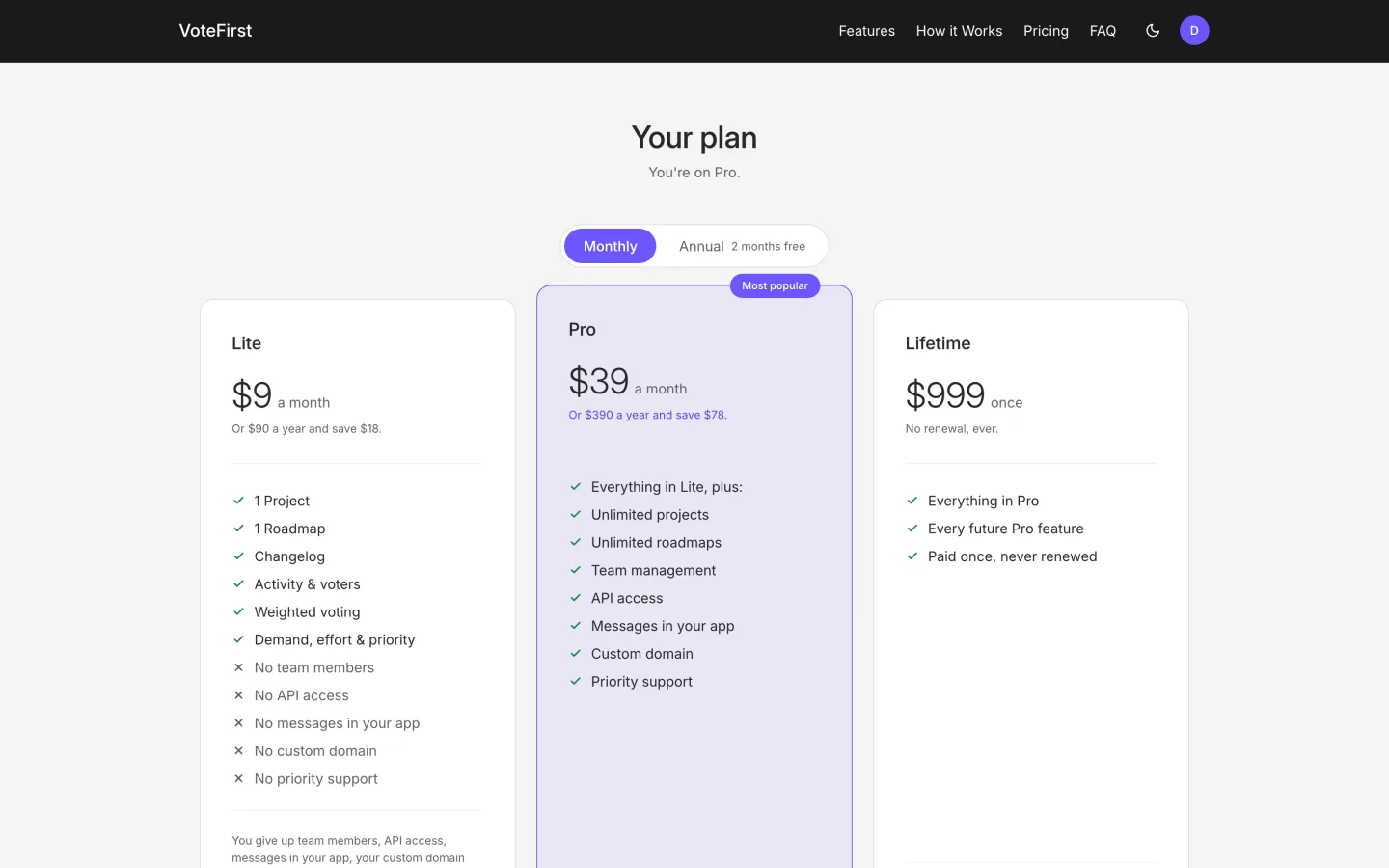
What is crossed out on the cheapest plan?
Three lines on Power and one on Super, and they are the three lines a small team is most likely to be shopping for.
On Power, custom single sign on, API access and removing the Upvoty badge are all crossed out. On Super, custom single sign on is crossed out. Everything on Hyper is included.
We did not take that from the picture alone. We read the computed style of every line on the page. The included ones render at full opacity with a tick beside them, and those four render at sixty percent opacity with a cross. Both readings agree, and the screenshot agrees with both.
This matters because the words are still in the text of the page. A summary built from a text copy, whether by a person in a hurry or by a language model, will list single sign on and API access as things fifteen dollars buys. They are not.
This is the fourth different way we have found a pricing page in this category to be unreadable as plain text, after a product tab that changes which plans are shown, a billing switch that sits inside the plan card, and a vendor who renders prices as an animation.
Every figure on our comparison table was re read in a browser for exactly this reason.
None of that is a criticism of Upvoty. A crossed out line with a cross next to it is a clear and ordinary way to show an exclusion to a person. The problem belongs to the reading, not to their page.
When does the Upvoty badge come off?
At twenty two fifty dollars a month, because badge removal starts on Super.
Power carries the Upvoty badge and cannot remove it at any price without changing plan. Super and Hyper both include removal.
Ours comes off at nine dollars, and not because it is a plan feature. The badge is shown only when the account has no active plan, so the moment you are paying anything at all, it is gone.
That is one condition in api_v3_board.go rather than a row on a pricing table, and there is nothing to buy to switch it off.
So if a clean board with your own name on it is the actual requirement, their ladder starts at 22.50 and ours starts at nine.
Do they charge for the people who vote?
No. Tracked users are unlimited on all three plans, and so are boards.
The meter is projects. One on Power, one on Super, unlimited on Hyper. So the thing that moves you up their ladder is running a second product, not your first product getting popular.
That puts them in the better half of this category. Two of the twenty one tools we priced bill by the number of people who vote and Upvoty is not one of them. Ours does not either, at any plan, which is the one row where the two of us are simply the same.
14 days, a card at signup, then $9 or $39 a month.
What does a team of four cost a year?
$162 on the cheapest plan, and the number of colleagues does not change it.
Power is $15 a month, or $13.50 billed annually. That is $162 a year. Super is $25 a month or $22.50 billed annually, which is $270 a year. Hyper is $49 a month or $44.10 billed annually. That is $529.20 a year.
The wall is the project count rather than the headcount. Power and Super each give one project, and Hyper is where that becomes unlimited, so a second product is what moves you up this list rather than a fourth colleague or a thousandth voter.
Which one is right for you?
The fair comparison is not our nine against their fifteen. It is our thirty nine against their 44.10.
Their Hyper gives you unlimited projects, single sign on, all integrations, webhooks, their MCP server and priority support. Our PRO gives you unlimited projects, single sign on, the API, a custom domain and team members. Those are close enough that the decision comes down to what each product does with the votes once they arrive.
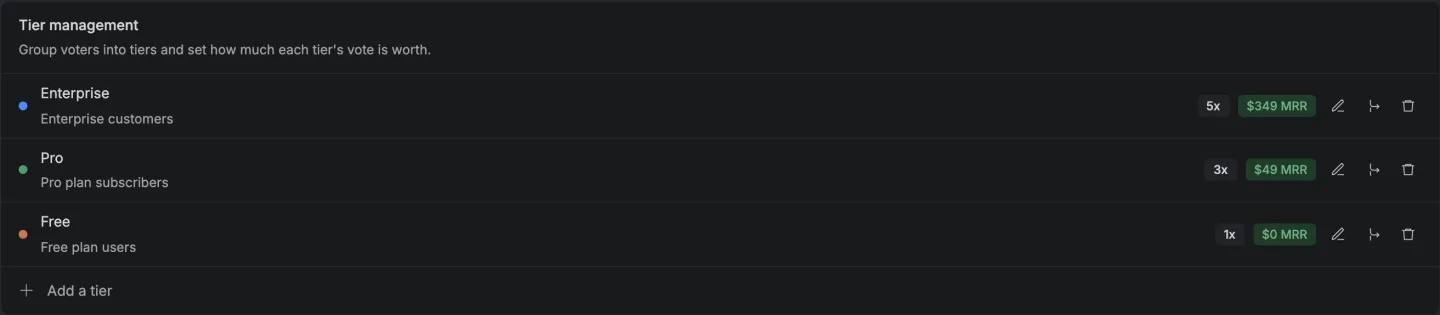
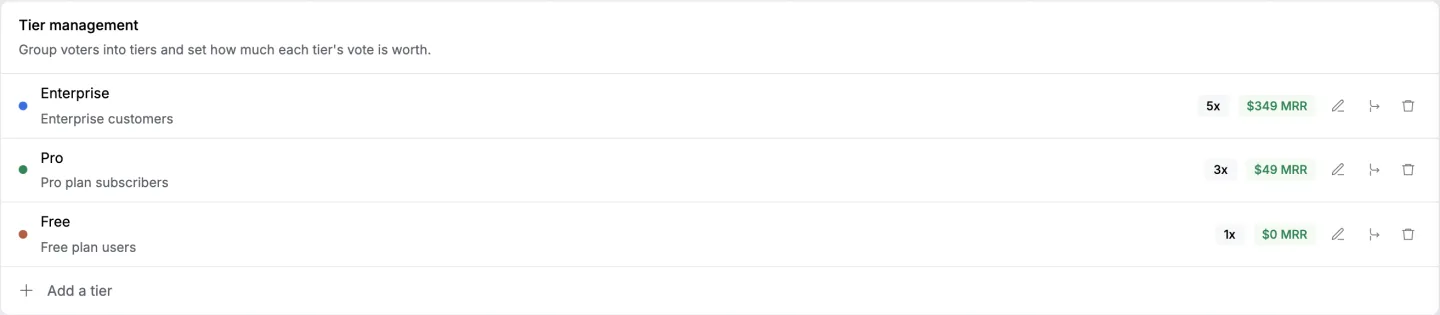
Theirs orders the board by count. Ours orders it by what the people voting pay you, with each vote carrying the multiplier of the tier its customer sits in, and the tiers filled from Stripe, so the request from your largest account does not get outvoted by a crowd of trials.
If you want one board, your own branding on it and the list sorted by revenue, ours is nine dollars and a card is required for the fourteen day trial.
If you want several products under one login with an MCP server attached, theirs is the better fit and we would rather say that than pretend otherwise.
The product comparison rather than the price one is here. Every figure above was read on their own pricing page on the date at the top of this page, in both positions of the billing toggle, and every crossed out line was confirmed twice.