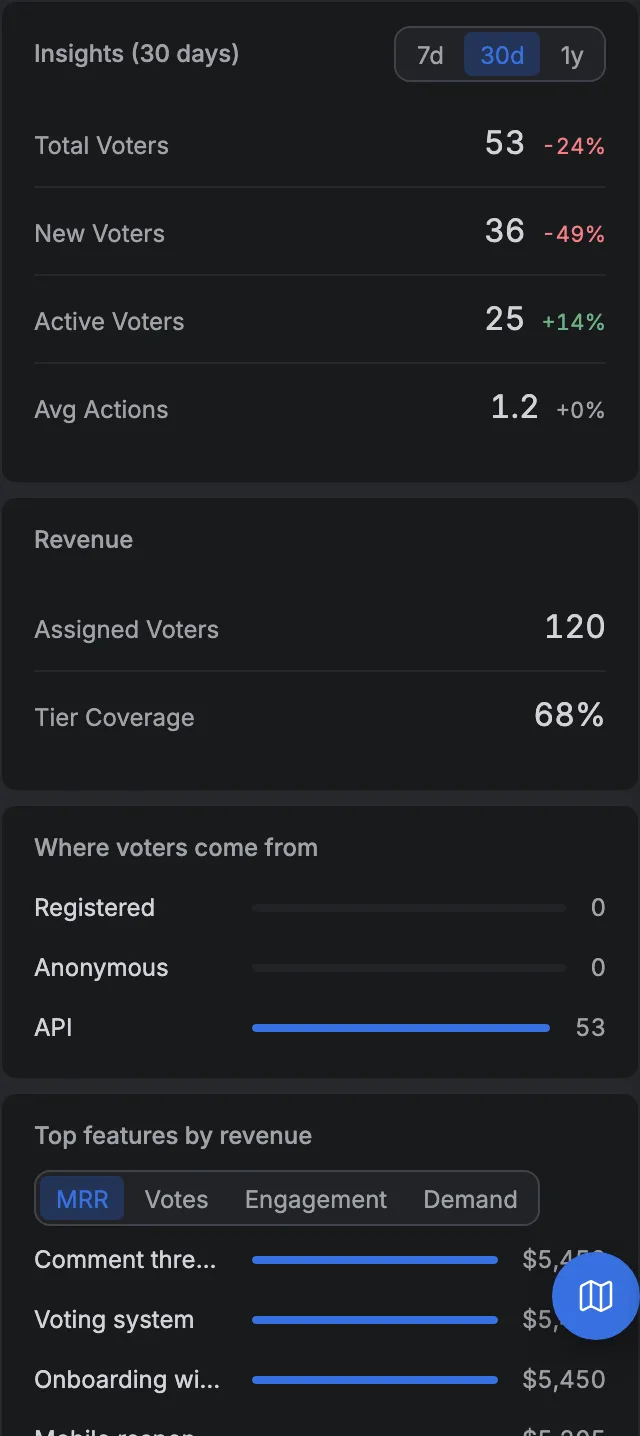
Frill has four plans, and the number that decides which one you need is how many ideas are open on your board rather than how many people are looking at it.
We priced twenty one tools in this category on the same day and read every plan comparison table each one publishes.
Frill and Noora are the two that say unlimited on both rows at once, the row for colleagues and the row for customers, on their cheapest paid plan. That is the whole reason this page is worth reading, so it is in the second section rather than the last.
What does Frill cost?
Four plans, and the toggle above the cards decides whether you are looking at the monthly rate or the yearly one.
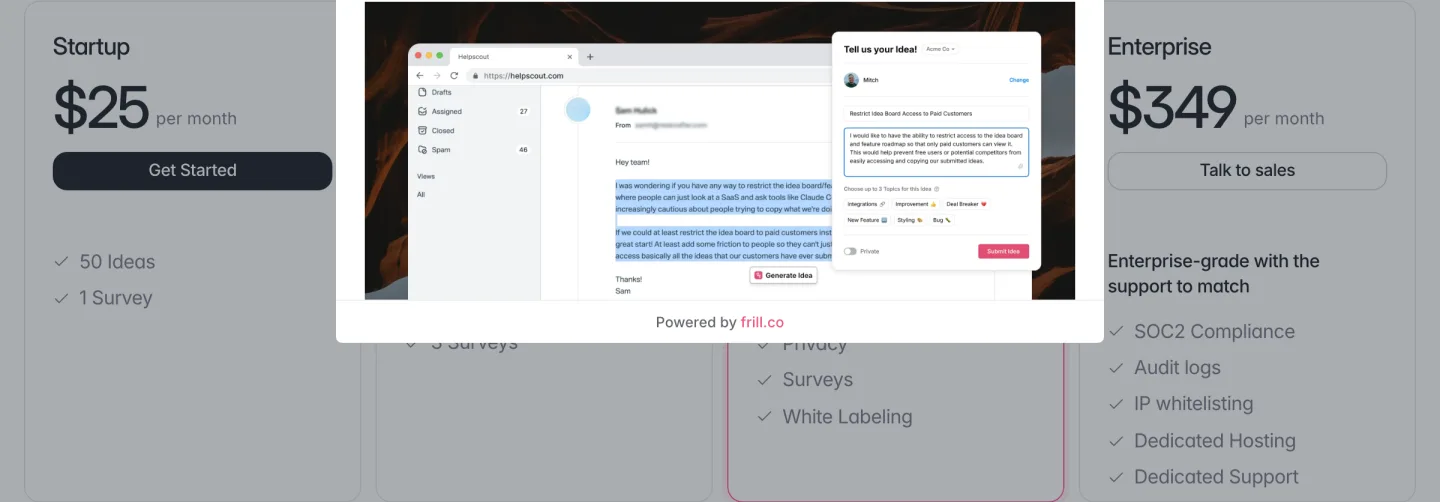
| Plan | Paid monthly | Paid yearly | Active ideas |
|---|---|---|---|
| Startup | $25/mo | $22/mo | 50 |
| Business | $49/mo | $44/mo | Unlimited |
| Growth | $149/mo | $136/mo | Unlimited |
| Enterprise | $349/mo | $319/mo | Unlimited |
The toggle sits above the plan cards and arrives on billed monthly, so the first figure a visitor sees is the higher one. That is worth pointing out because it is the opposite of what two other vendors in this category do.
Featurebase puts the switch inside each plan card and arrives on the annual rate, and Savio arrives on annual as well. Frill shows you the more expensive number first and lets you find the discount, which is the harder way to sell and the fairer one.
There is no free plan. The trial runs fourteen days and their banner says it does not ask for a card.
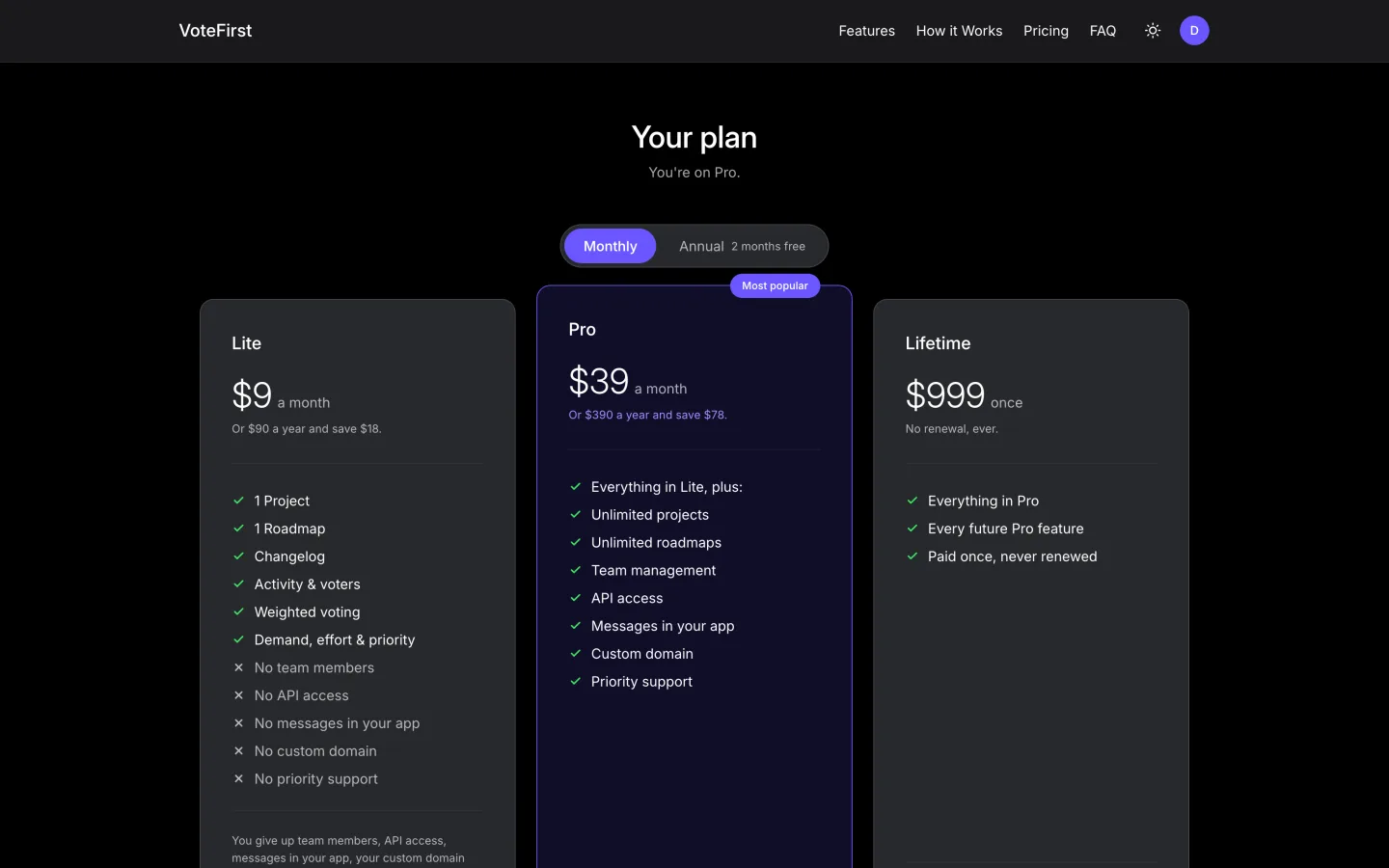
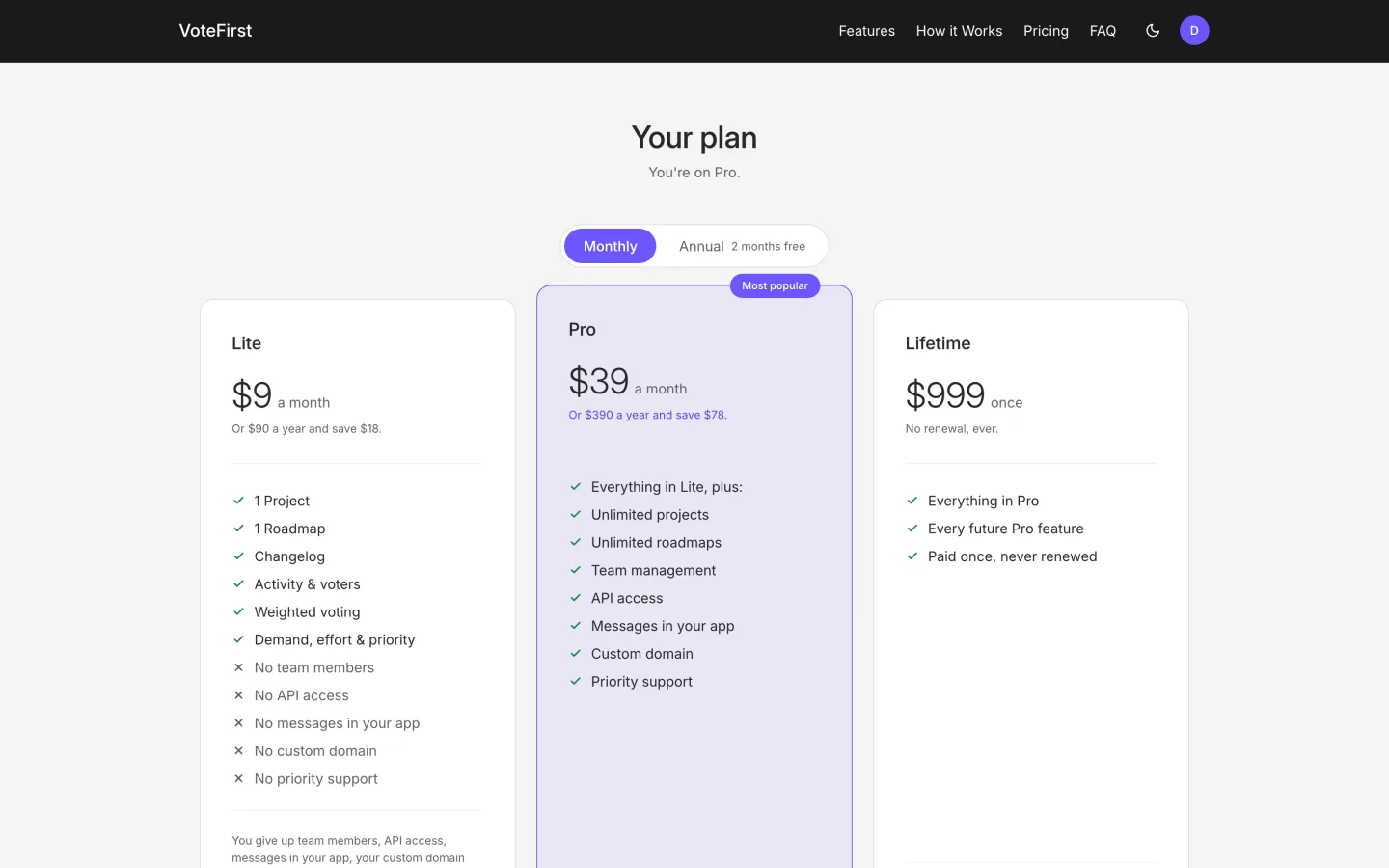
You can put your own numbers against it. The trial is 14 days, a card at signup, then $9 or $39 a month.
Does Frill have a free plan?
No, not any more. Their pricing page read on 14 September 2026 carries a fourteen day trial that asks for no card and no free tier under it.
What does the price actually meter?
Active ideas, and nothing else that grows with your success.
Fifty on Startup, then unlimited on all three plans above it. So the thing that moves you off the cheapest plan is your own backlog getting long, which is a number you control and can see.
Now the two rows this page exists for. On their plan comparison table, teammates and managers reads unlimited on all four plans, and tracked users reads unlimited on all four plans. Both of those are unlimited on the twenty two dollar plan.
Only one other tool we priced can print that pair, and it is Noora. Two of the twenty one tools we priced charge by the number of people who vote and nine of them count colleagues in some form, either as the price itself or as the cap on the cheap plan.
Frill does neither. Your tenth colleague costs nothing and your ten thousandth customer costs nothing.
The feature rows go the same way. Single sign on, webhooks, the developer API, a custom domain, translations, custom statuses and topics, the priority matrix, voting on behalf of a customer, smart merge, bulk CSV import and export and a Canny importer are all ticked on the twenty two dollar plan.
So is removing their tagline. For a small team that wants one board done properly, the cheapest plan is close to the whole product.
14 days, a card at signup, then $9 or $39 a month.
What is the privacy add on?
The one thing on their pricing page with no number next to it.
Pre approving ideas and pre approving users are marked privacy add on on Startup and Business, and included on Growth. Their add on panel describes it as keeping your board private, pre approving ideas and users, private ideas and invite only. No price appears beside any of the three add ons anywhere on the page.
We are not going to guess what it costs, because guessing a competitor's unpublished number is the thing this site exists not to do. What we can tell you is what it means for planning.
If a private board is a requirement rather than a preference, the twenty two dollar plan is not your plan, and the two published routes to it are the add on at a price you get by asking or Growth at one hundred and thirty six dollars a month.
We have nothing equivalent, at any price. A board of ours is published to everybody or to nobody, with no password and no invite list, so there is no way to admit one named customer.
What we can do on the thirty nine dollar plan is keep a second board unpublished, and that is not the same thing.
How many surveys do you get?
One of each on Startup, three of each on Business, and unlimited on Growth and Enterprise.
Their five survey types are net promoter score, customer satisfaction, open feedback, quick polls and idea polls. The ladder applies to each of them separately, so Startup gives you one live survey of each kind rather than one survey in total.
If you are running a quarterly net promoter score programme alongside a feedback board, that ladder is the thing to check first, and it will decide your plan before the idea count does. We do not sell surveys at all, so this is a row where they simply have a product and we do not.
What does a team of four cost a year?
The same as a team of one, which is the useful thing to know about this price list.
Frill meters the workspace rather than the people in it, so Startup is $25 a month or $22 a month billed yearly, being $264 a year, however many colleagues open it. Business is $49 or $44, being $528 a year.
What runs out is not seats. Startup carries 50 active ideas, and Business is the first plan where that limit is gone, so the question to ask yourself is how many open requests your board will hold rather than how many people you employ.
So why would you pick us instead?
One reason, and it is worth being this narrow about it.
Frill orders a board by votes and by a priority matrix you configure. We order it by a multiplier you attach to the tier each customer sits in.
Every vote carries that multiplier, and you can fill the tiers from Stripe by writing revenue bands rather than sorting customers one at a time, so the request from your largest account is not outranked by ten trial users.
That is nine dollars a month with one project, one board, one roadmap and a changelog, and a card is required for the fourteen day trial. Their twenty two is a larger product with surveys, announcements, a Canny importer and a comparison table that says unlimited where most of this category says a number.
So pick them if you want the wider product and a board that never charges you for being popular. Pick us if the ranking of the list is the thing you actually care about and you want it done by revenue from the first day.
The product comparison rather than the price one is here, and what every tool in the category bills on is here. Every figure above was read on their own pricing page on the date at the top of this page, in both positions of the billing toggle.