Noora is the closest tool to VoteFirst. Flat price, no meter on voters, anonymous feedback with no account, and a product that asks you to look at revenue rather than raw vote counts.
If you came here expecting an explanation for why they are the wrong choice, you are going to be disappointed.
What follows is what each one costs, what the cheap plan actually withholds, and the one difference that decides it for most people.
Everything about Noora below was read on their own pages on 9 September 2026.
What are the alternatives to Noora?
Noora is fourteen dollars a month flat with unlimited seats, which is one of the better deals in this table until you want their badge gone, which needs the sixty four dollar plan. The free plan column below says what each tool holds back.
| Vendor | From | Billed per | Free plan | Trial |
|---|---|---|---|---|
| Trello | $5/user/mo | user | Yes | – |
| VoteFirst | $7.50/mo | plan | – | 14 days, card |
| Features.Vote | $7.50/mo | project | – | 14 days |
| Jira Product Discovery | $10/creator/mo | creator | 3 creators | – |
| LoopedIn | $12/mo | plan | 1 of each | – |
| WishKit | $12.50/mo | project | 5 requests | – |
| Sleekplan | $13/mo | workspace | 1 admin | 30 days, no card |
| Upvoty | $13.50/mo | project | – | 14 days |
| Noora | $14/mo | workspace | – | 7 days |
| Convas | $15/mo | tracked user | 25 users | – |
| FeedBear | $15/mo | project | – | 14 days |
| Supahub | $15/mo | workspace | 1 board | 10 days |
| ProductLift | $19/mo | workspace | – | 14 days |
| Productboard | $19/maker/mo | maker | 500 notes | – |
| Roadmunk | $19/creator/mo | creator | – | 14 days |
| Ducalis | $20/mo | changelog subscriber | 500 subs | – |
| Frill | $22/mo | workspace | – | 14 days |
| Fider | $25/mo | workspace | 250 items | – |
| Featurebase | $29/seat/mo | seat | 1 seat | – |
| Headway | $29/mo | plan | Yes | – |
| Nolt | $29/mo | board | – | – |
| UserJot | $29/mo | workspace | 2 boards | 14 days |
| Aha! Ideas | $39/user/mo | user | – | Yes |
| Savio | $39/mo | paid user | – | 14 days |
| Beamer | $49/mo | monthly active user | 1,000 MAU | – |
| Feature Upvote | $49/board/mo | board | – | 30 days |
| Rapidr | $49/mo | workspace | – | 14 days |
| Suggested | $49/mo | plan | – | 15 days |
| Gleap | $49/mo | plan | – | 14 days |
| FeatureOS | $50/mo | plan | – | 30 days, no card |
| Olvy | $60/mo | plan | 25 items | – |
| AnnounceKit | $39/mo | module | – | 15 days, no card |
| Canny | $79/mo | tracked user | 25 users | – |
| LaunchNotes | $249/mo | plan | – | 14 days |
| Pendo | Not published | monthly active user | Beta | – |
| ProdPad | Not published | module | – | 7 days |
| UserVoice | Not published | quoted | – | 30 days |
| airfocus | Not published | quoted | – | – |
| ProductPlan | Not published | quoted | – | – |
| Productroad | $9/mo | plan | 50 users | 14 days, no card |
| Quackback | $29/mo | plan | 1 board, 50 posts | 14 days, no card |
| ProdCamp | $99/mo | plan | 2 admins, 1 product | – |
| Harvestr | $65/editor/mo | editor | – | 14 days |
| Productlane | $29/user/mo | user | – | Yes |
| Ideanote | $6/user/mo | user | 10 users, 250 ideas | – |
| Craft.io | $19/editor/mo | editor | – | 14 days, no card |
| HYPE Boards | €79/mo | plan | – | 14 days, no card |
| Noticeable | $24/mo | plan | 1 project, watermarked | 14 days, no card |
Read on each vendor's own pricing page, with the billing switch on the yearly side wherever one is published. From is the cheapest paid rate per month. What each one includes, as well as what it costs, is on one page.
The same two products, line by line
Read on each vendor's own pages on the date in the row above. Not published means nobody could read it on the pages opened that day, never that the feature is absent.
What is Noora?
Noora is a feedback board with a roadmap and a changelog, priced flat rather than by the number of people who vote. It also asks you to look at the revenue behind a request rather than at the raw count, which is the same idea VoteFirst is built on.
What does Noora cost?
Three plans. The page opens on yearly billing, and its switch shows the monthly prices, about twice as much.
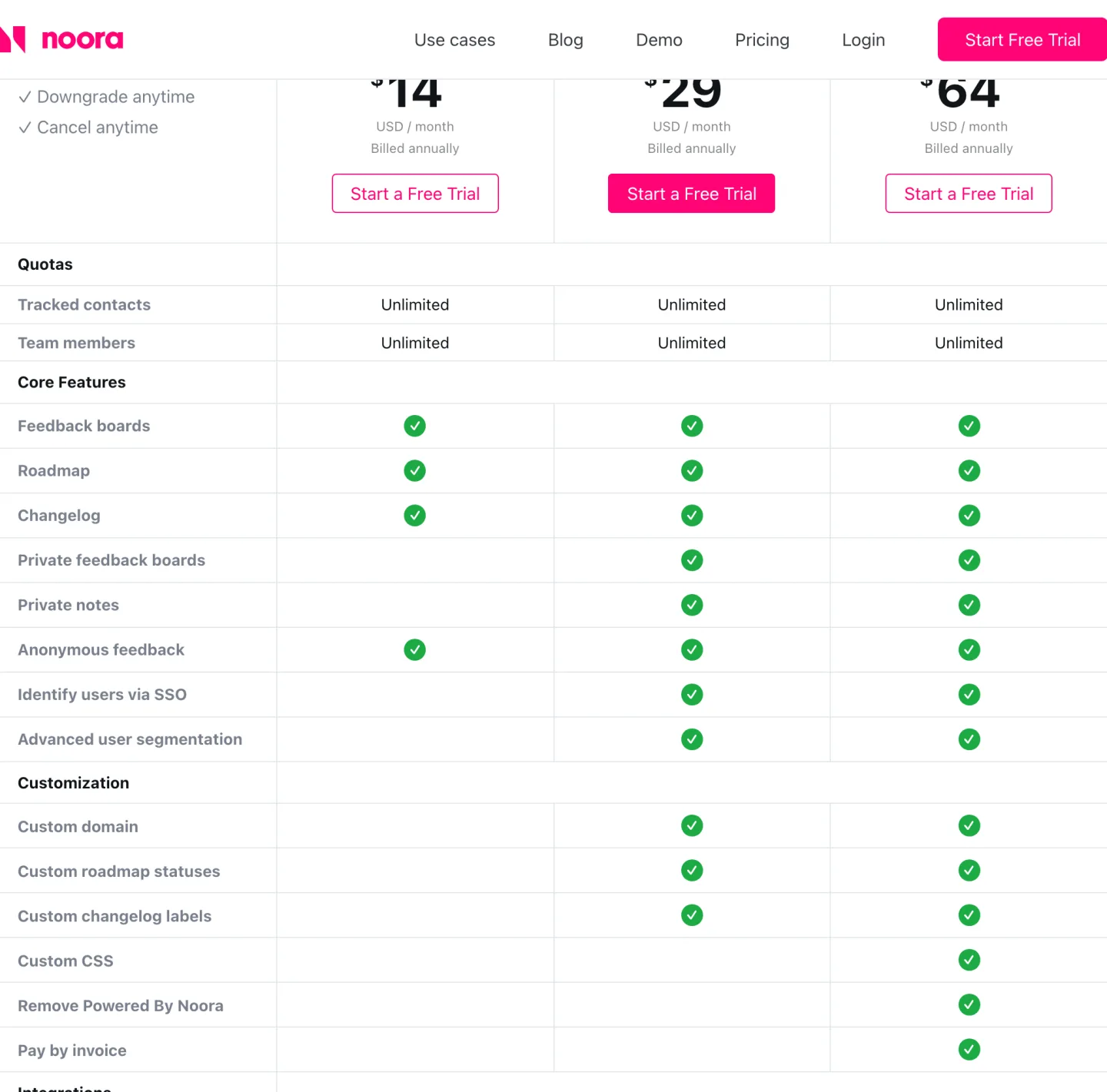
| Plan | Billed yearly | Billed monthly |
|---|---|---|
| Startup | $14 USD a month | $29 USD a month |
| Growth | $29 USD a month | $59 USD a month |
| Enterprise | $64 USD a month | $129 USD a month |
The page sells the yearly price as six months free. What each plan includes, and how Noora's price has changed since 2020, is on its own page.
The pricing page lists no free plan. The trial runs seven days and their page states plainly that it does not ask for a card and can be cancelled at any time.
That is a genuine advantage over VoteFirst, worth saying plainly. VoteFirst asks for a card before a trial starts. They do not.
You can check this on a board of your own rather than take the table's word for it, and a trial is 14 days with a card at signup.
What this costs
Lite
$9 /mo
Pro
$39 /mo
Lifetime
$999 once
Fourteen day trial of Pro, card asked for at signup. Nothing here counts the people who vote, so the bill does not move when the board starts working. The long version, with what happens if you stop paying.
What do you get on the fourteen dollar plan?
Feedback boards, a roadmap, a changelog, anonymous feedback, and their Zapier, Slack and Intercom integrations. Unlimited team members and unlimited tracked contacts on every plan including this one, which is not something VoteFirst offers at nine dollars.
Here is the list of what the fourteen dollar plan does not include, taken from their own feature matrix.
- Private boards and private notes
- Identifying users through single sign on
- A custom domain
- The developer API
- Advanced user segmentation
- The Segment and Jira integrations
All of those start at Growth, which is twenty nine dollars a month billed annually. Two more sit higher still. Custom CSS and removing the "Powered By Noora" badge are Enterprise only, at sixty four dollars a month.
So the shape of their ladder is that the entry plan is a complete public board and the things that make it look like your own product are two steps up.
Does Noora charge for the number of voters?
No, and this is the most important thing to understand about them, because it is what separates them from the tools that will surprise you later.
Their pricing page defines the term. "A tracked contact is a user that takes an action on your feedback portal, such as commenting, voting, or posting."
That is almost word for word the definition Canny bills you on. The difference is that Noora publishes it and then gives you unlimited tracked contacts on all three plans.
Same word, opposite consequence. On Canny that definition is the meter, and a board that gets popular gets expensive. On Noora it is a description of who shows up, and the price does not move. VoteFirst does the same, and so do most of the category.
The full table of what every tool bills on is here, and only two of the thirty two checked charge you for participation at all, with a third charging by how many people see your changelog.
Can people vote without an account?
Yes, on both.
Noora's own feature page says "Anonymous feedback. Allow users to add feedback without leaving their contact email or creating an account." Its changelog adds that the switch is turned on board by board and covers posting, voting and commenting, with each anonymous visitor given a random name. A VoteFirst board takes a vote with no account from the first page load, so the difference is the default rather than the capability.
It is worth mentioning because a lot of comparison pages in this category present anonymous voting as a rare feature. It is not rare, and that costs VoteFirst a talking point.

Does Noora weight votes by revenue?
Yes, in their own way, and it is closer to what VoteFirst does than anything else at this price.
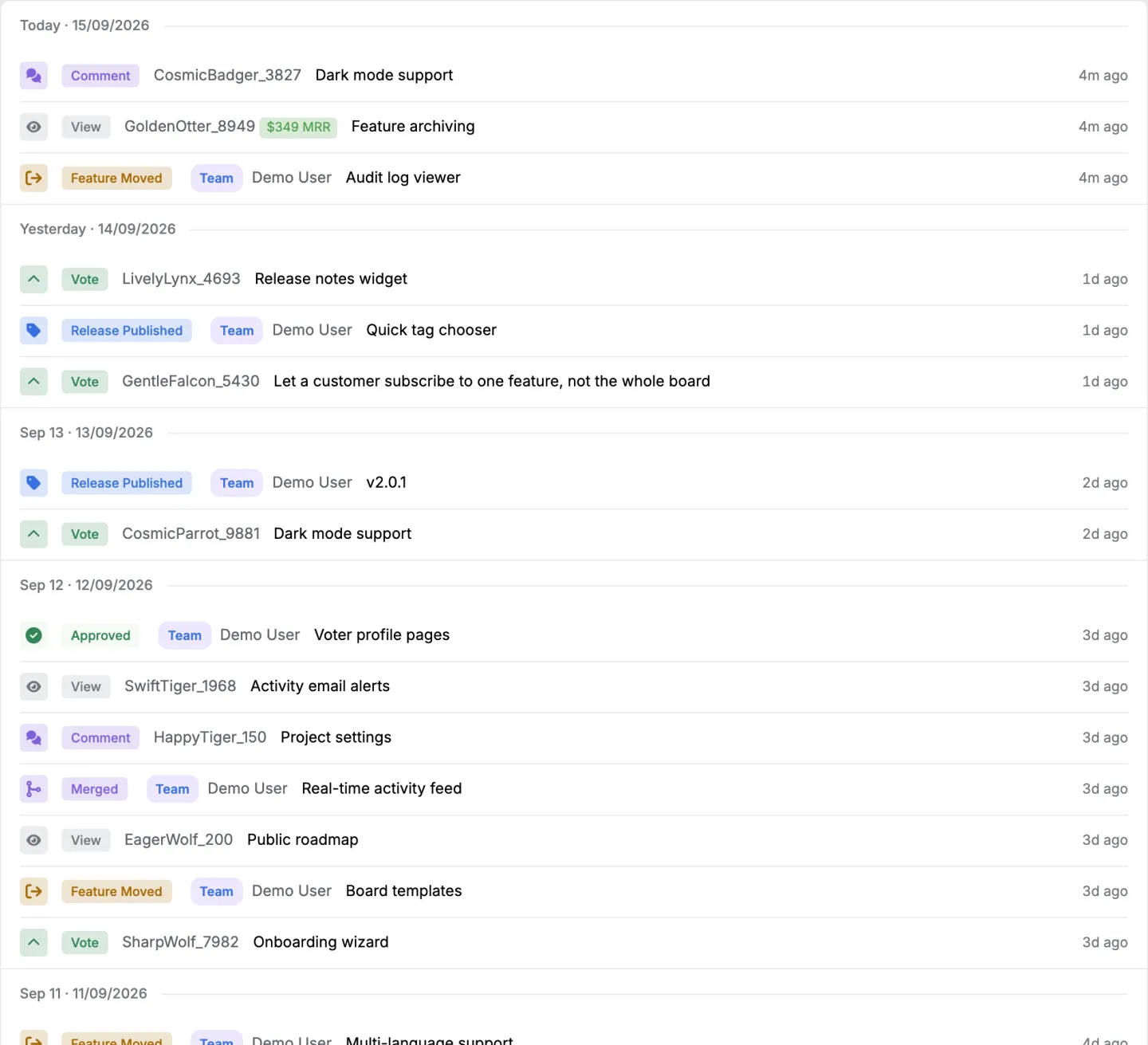
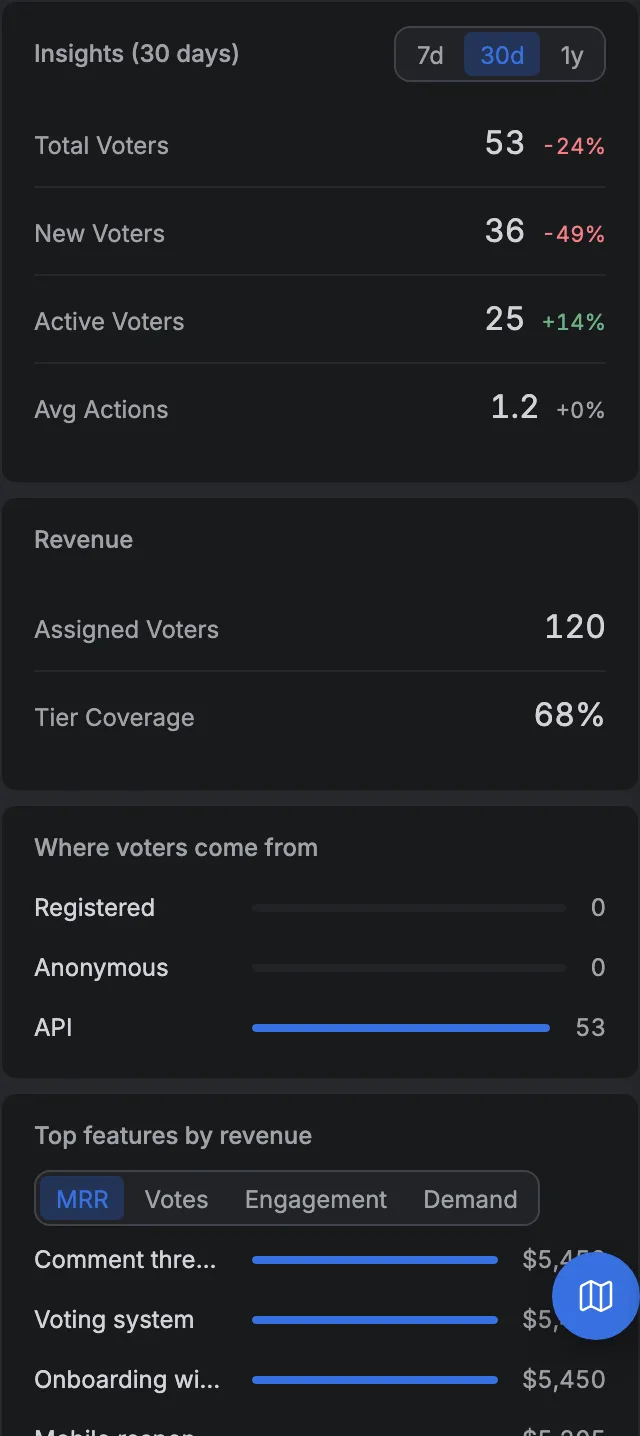
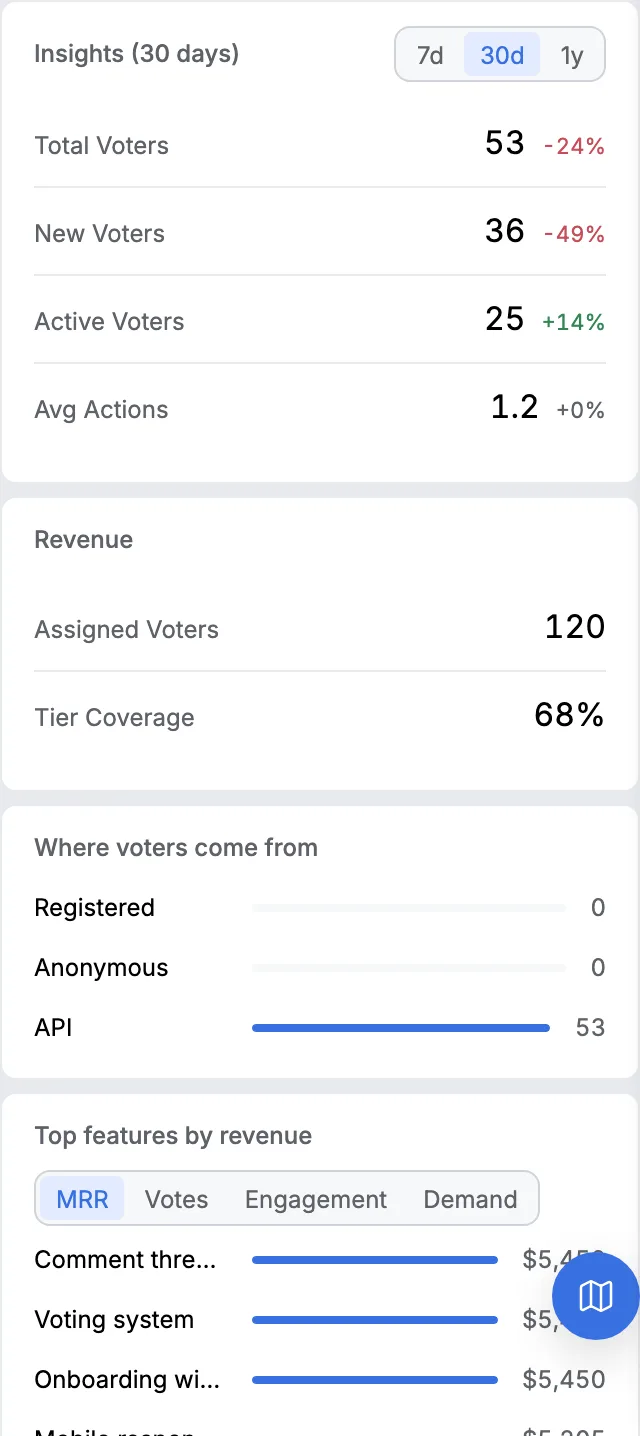
Their feature page says "Measure revenue impact, not just votes." and "You can combine company and MRR data with the feedback from your users to determine which features are the most valuable to build next". They also show the total MRR behind each request.
That is a revenue view laid over your votes. Every vote still counts as one, and the money is something you read alongside the count and sort by.
VoteFirst changes the vote. You put each voter in a tier, give the tier a whole number multiplier, and the vote carries that multiplier from the moment it is cast.
A card shows both numbers at once, so fourteen weighted votes from six voters tells you immediately that a large account is behind it. The full mechanism, including what it deliberately will not do, is here.
Which of those you want is a real question with no obvious answer. A sortable revenue column is easier to reason about. A multiplied vote changes the order of the board itself, which is the point if the board is what your team looks at every week.
What will not be claimed here is that Noora cannot weight a vote. Only their marketing pages were read, not their software. Eight of the thirty two tools checked ship some form of revenue prioritization and Noora is one of them.
14 days, a card at signup, then $9 or $39 a month.
What happened to Noora.io?
Nothing bad. They moved.
If you follow an old link to noora.io today you get a password prompt, and every other path on that domain returns a 404. That looks like a company that has gone under and it is not one. Noora is at noorahq.com and is trading normally.
If you are comparing tools from a list somebody wrote a year ago, that is the sort of thing that makes you cross a live product off for no reason.
Does Noora have a free plan?
No. Their pricing page read on 14 September 2026 carries a seven day trial that asks for no card.
Does Noora have a public roadmap, single sign on and an API?
Noora carries a roadmap with custom statuses on it. Noora puts single sign on on Growth. Noora opens its developer API on the same plan, at twenty nine dollars a month billed annually.
VoteFirst publishes a public roadmap with a Denied column on every plan, and signs a voter in with a token from your own application on the thirty nine dollar plan rather than with SAML.
Is there a free Noora alternative?
Yes, several, and none of them is Noora. Fider is the free one to know about, because it is open source and its hosted tier runs to two hundred and fifty feedback items.
UserJot gives two boards and three admin roles, Supahub gives one board and one admin, Featurebase gives one seat, and Sleekplan's Indie tier is a single admin workspace that does not expire.
All five were read on their own pages on 14 September 2026. VoteFirst is not one of them. There is no free plan here, only a fourteen day trial that asks for a card at signup.
Is Noora worth it, and when is it the better answer?
Three cases, and the first one is not close.
You have a team. Noora gives unlimited team members on the fourteen dollar plan, and VoteFirst's nine dollar plan does not give you any. Team members are on its thirty nine dollar plan. If three colleagues need to answer feedback, Noora is cheaper than VoteFirst and it is not a near thing.
You want to try it without handing over a card. Their trial asks for nothing at all. VoteFirst asks for a card before it starts.
You need private boards without paying enterprise money. Theirs are twenty nine dollars a month. VoteFirst has nothing equivalent, because a VoteFirst board is published to everybody or to nobody and there is no way to admit one named customer.
What VoteFirst costs
Nine dollars a month for one project, with weighted voting included and no meter on voters.
The badge is the difference worth checking before you decide. Removing "Powered By Noora" is on their sixty four dollar plan. There is no VoteFirst badge on a paid plan, so at nine dollars your board carries your name, not Noora's.
Thirty nine dollars adds team members, the API and a custom domain, which lands close to their Growth plan on price with a different set of things inside it.
VoteFirst does not have a free tier and its trial wants a card. If those two things matter more to you than the badge or the price, their seven days will tell you more than reading about it can.
What moving actually involves
There is no importer for Noora on VoteFirst's side; the board import reads only Canny and Featurebase.
Voters and the revenue behind them come in from a CSV or from a billing connection, which is the part the weighting needs. The requests themselves are rebuilt by hand or by a script against the API, and the vote counts start again.
The five steps, with the endpoint each one uses, are written out in full, and they are the same five whatever you are leaving.
Noora against the others, one at a time
One page here puts Noora against a single rival and works out which bill is smaller at each size.