Convas is one of only two tools out of the thirty two checked that bills you for the number of people who use your board. That single fact matters more than any feature comparison, because it decides whether a board that works costs you more than a board that does not.
The numbers below do the arithmetic their pricing page leaves you to do, using only their own published rate.
Everything about Convas below was read on their own pricing page on 2 October 2026.
What are the alternatives to Convas?
Convas is free to twenty five tracked users and fifteen dollars a month at a hundred, which is generous until the board works. Only two tools below meter tracked users at all, and the rest charge the same whether ten people vote or ten thousand.
| Vendor | From | Billed per | Free plan | Trial |
|---|---|---|---|---|
| Trello | $5/user/mo | user | Yes | – |
| VoteFirst | $7.50/mo | plan | – | 14 days, card |
| Features.Vote | $7.50/mo | project | – | 14 days |
| Jira Product Discovery | $10/creator/mo | creator | 3 creators | – |
| LoopedIn | $12/mo | plan | 1 of each | – |
| WishKit | $12.50/mo | project | 5 requests | – |
| Sleekplan | $13/mo | workspace | 1 admin | 30 days, no card |
| Upvoty | $13.50/mo | project | – | 14 days |
| Noora | $14/mo | workspace | – | 7 days |
| Convas | $15/mo | tracked user | 25 users | – |
| FeedBear | $15/mo | project | – | 14 days |
| Supahub | $15/mo | workspace | 1 board | 10 days |
| ProductLift | $19/mo | workspace | – | 14 days |
| Productboard | $19/maker/mo | maker | 500 notes | – |
| Roadmunk | $19/creator/mo | creator | – | 14 days |
| Ducalis | $20/mo | changelog subscriber | 500 subs | – |
| Frill | $22/mo | workspace | – | 14 days |
| Fider | $25/mo | workspace | 250 items | – |
| Featurebase | $29/seat/mo | seat | 1 seat | – |
| Headway | $29/mo | plan | Yes | – |
| Nolt | $29/mo | board | – | – |
| UserJot | $29/mo | workspace | 2 boards | 14 days |
| Aha! Ideas | $39/user/mo | user | – | Yes |
| Savio | $39/mo | paid user | – | 14 days |
| Beamer | $49/mo | monthly active user | 1,000 MAU | – |
| Feature Upvote | $49/board/mo | board | – | 30 days |
| Rapidr | $49/mo | workspace | – | 14 days |
| Suggested | $49/mo | plan | – | 15 days |
| Gleap | $49/mo | plan | – | 14 days |
| FeatureOS | $50/mo | plan | – | 30 days, no card |
| Olvy | $60/mo | plan | 25 items | – |
| AnnounceKit | $39/mo | module | – | 15 days, no card |
| Canny | $79/mo | tracked user | 25 users | – |
| LaunchNotes | $249/mo | plan | – | 14 days |
| Pendo | Not published | monthly active user | Beta | – |
| ProdPad | Not published | module | – | 7 days |
| UserVoice | Not published | quoted | – | 30 days |
| airfocus | Not published | quoted | – | – |
| ProductPlan | Not published | quoted | – | – |
| Productroad | $9/mo | plan | 50 users | 14 days, no card |
| Quackback | $29/mo | plan | 1 board, 50 posts | 14 days, no card |
| ProdCamp | $99/mo | plan | 2 admins, 1 product | – |
| Harvestr | $65/editor/mo | editor | – | 14 days |
| Productlane | $29/user/mo | user | – | Yes |
| Ideanote | $6/user/mo | user | 10 users, 250 ideas | – |
| Craft.io | $19/editor/mo | editor | – | 14 days, no card |
| HYPE Boards | €79/mo | plan | – | 14 days, no card |
| Noticeable | $24/mo | plan | 1 project, watermarked | 14 days, no card |
Read on each vendor's own pricing page, with the billing switch on the yearly side wherever one is published. From is the cheapest paid rate per month. What each one includes, as well as what it costs, is on one page.
The same two products, line by line
Read on each vendor's own pages on the date in the row above. Not published means nobody could read it on the pages opened that day, never that the feature is absent.
What does Convas cost?
Four plans, and only one of them has a moving part.
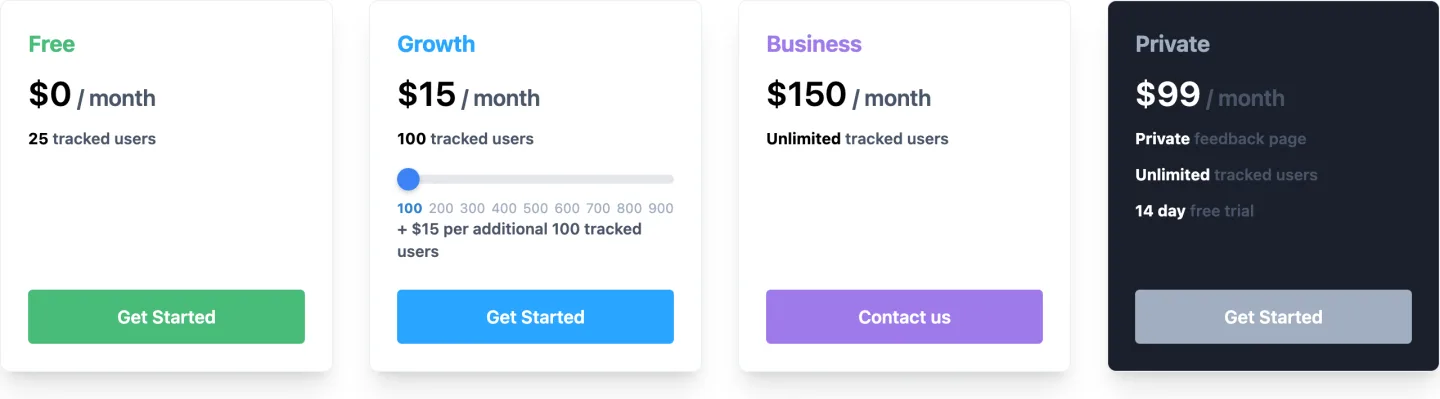
| Plan | Price |
|---|---|
| Free | $0/mo |
| Growth | $15/mo |
| Business | $150/mo |
| Private | $99/mo |
- Free gives you 25 tracked users.
- Growth gives you 100 tracked users, then $15 for each additional 100.
- Business gives you unlimited tracked users.
- Private gives you their private option.
Every plan includes unlimited team members, unlimited boards and all integrations, which is not something VoteFirst matches at nine dollars. That is genuinely generous and it is the opposite of how most of this category is laddered, where the second colleague or the second board is what pushes you upward.
There is no annual option published anywhere on the page. The free plan and the fourteen day trial both start without a card.
If you would rather try the alternative than read about it, a trial runs 14 days and asks for a card at signup, and it is $9 or $39 a month after that.
What does it cost as the board grows?
Fifteen dollars for the first hundred tracked users, and fifteen more for every hundred after that, until the flat hundred and fifty of Business becomes the cheaper of the two.
The arithmetic is simple and it is theirs, not VoteFirst's. Their page gives you everything you need to work it out before you buy.
| Tracked users | Growth | Business |
|---|---|---|
| 100 | $15 | $150 |
| 300 | $45 | $150 |
| 500 | $75 | $150 |
| 900 | $135 | $150 |
| 1,000 | $150 | $150 |
| 1,500 | $225 | $150 |
The two plans meet at one thousand tracked users. Below that Growth is cheaper. Above it Business is, and Business does not move again no matter how popular the board gets.
Their own slider stops at nine hundred, so the rows past that point are their published rate carried forward rather than a figure printed on their page. If you expect to pass a thousand participants, Business is the plan to compare against, not Growth.
How has Convas's price changed?
The Internet Archive holds copies of the pricing page from June 2020, and Convas has been priced three different ways since.
| Archive copy | Plans and prices |
|---|---|
| June 2020 | Hobby $49 a month for one user, Startup $99 for up to 5, Business $249 for up to 25 with a custom domain and "Powered by Convas" removed, and Enterprise on request |
| August to November 2020 | One flat rate of $49 a month with unlimited users, boards and integrations, and a 14 day trial |
| January and April 2021 | Free for 50 tracked users, Growth $15 a month for 100 and $15 for each further 100, Business $150, and "Powered by Convas" removed for $200 a month on top of Business |
| March 2023, and the live page on 4 October 2026 | Free for 25 tracked users, Growth and Business unchanged, a Private plan at $99 for a password protected or invite only page, and no line for removing the Convas name |
The meter on tracked users arrived between the copies of November 2020 and January 2021. The archive holds no copy between April 2021 and March 2023, so the cut from 50 free tracked users to 25 and the arrival of the Private plan can only be placed somewhere in those two years.
What is a tracked user here?
A tracked user here is somebody who takes an action on your board rather than somebody who pays you.
That is the same shape of definition the other metered tools use, and it is the thing people misread. A tracked user is not a customer.
It is anybody who left a footprint, and on a metered plan every one of them is on the invoice. The calculator sets out the whole thing because it is the single most misunderstood number in this category.
The consequence is worth stating plainly rather than as a scare. A metered plan aligns what you pay with how much the product is doing for you, which is a defensible way to build a business.
It also means the bill grows when the board succeeds, and that is a different risk from the one most people think they are taking.


Does Convas weight votes by revenue?
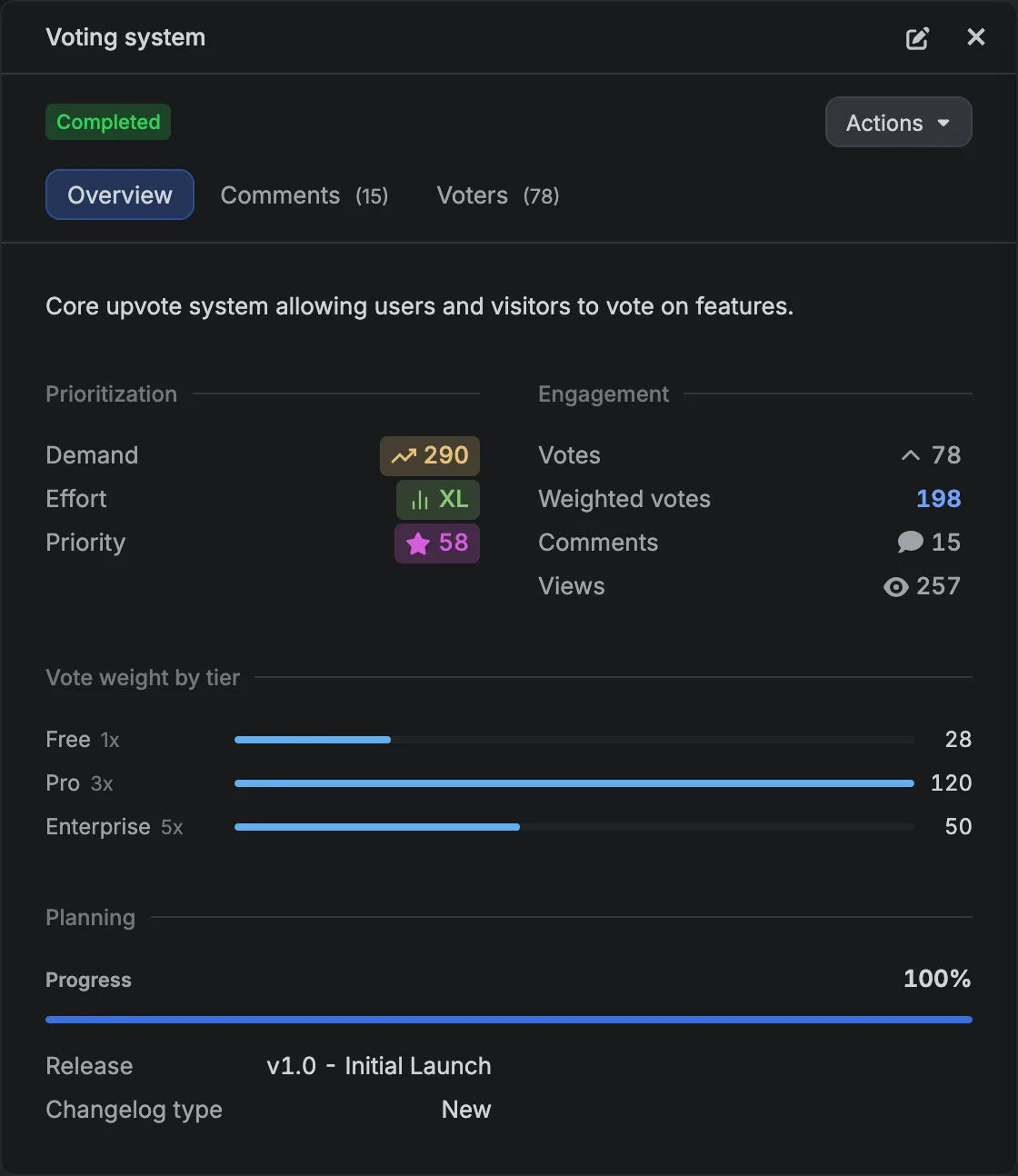
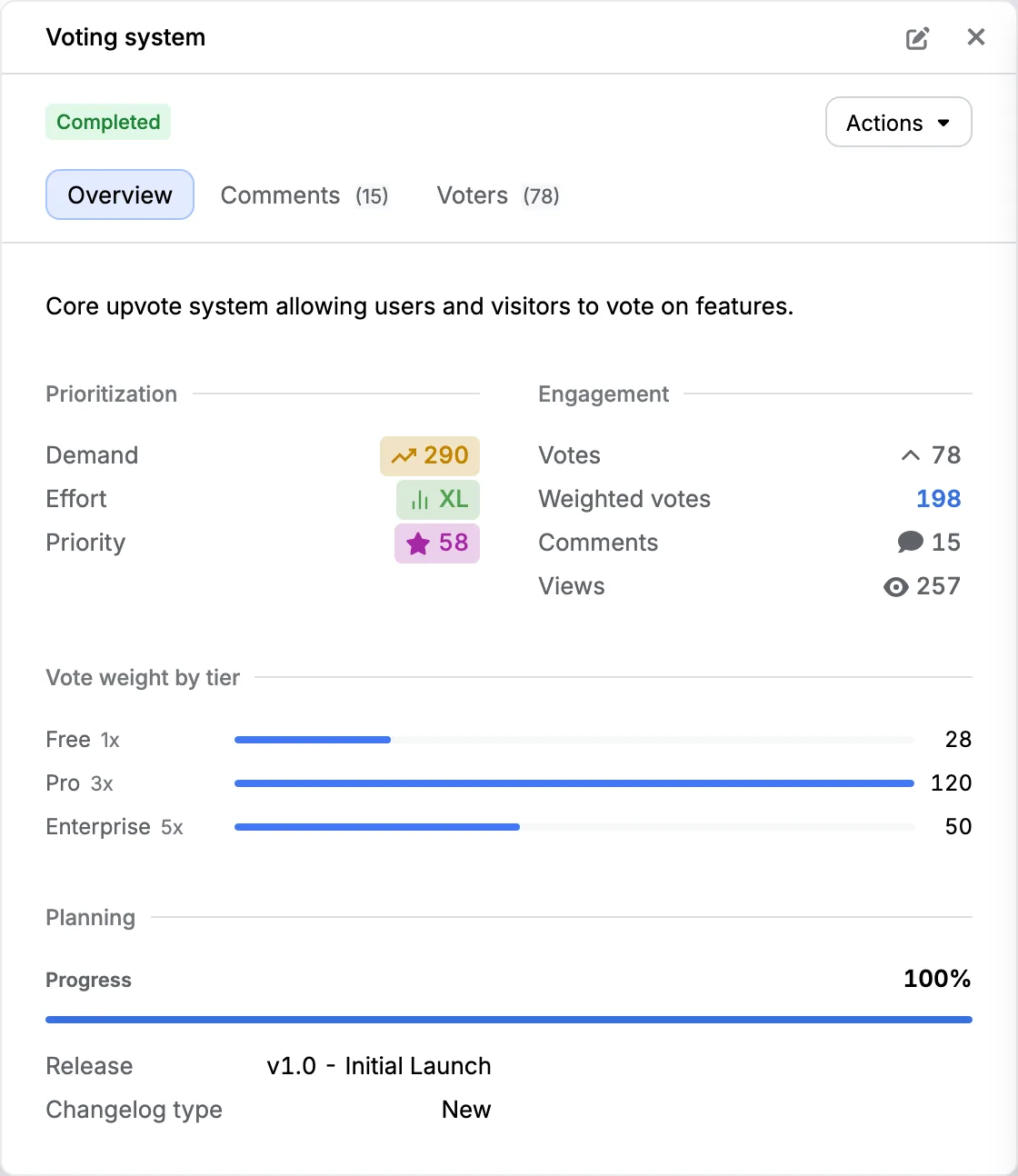
No. Nothing on the pages read on 2 October 2026 mentions vote weight, MRR or customer tier.
That is an absence on their marketing pages rather than proof about their software, and every page here says it that way. What can be said is that it is not something they sell on.
Eight of the thirty two tools checked do ship some form of revenue weighting, so this is a difference between VoteFirst and Convas specifically and not a thing only VoteFirst has.
14 days, a card at signup, then $9 or $39 a month.
Can people vote without an account?
The pages read do not establish this, so it is left unanswered here.
That is an unsatisfying sentence and it is better than a guess. If it matters to your decision, their board is public and you can test it in a minute, which is a faster answer than any comparison page can give you.
Does Convas have a free plan?
Yes, twenty five tracked users on their pricing page read on 2 October 2026, and free for non commercial open source projects. The open source exemption is unusual in this category and it is worth knowing about if that is what you run.
What this costs
Lite
$9 /mo
Pro
$39 /mo
Lifetime
$999 once
Fourteen day trial of Pro, card asked for at signup. Nothing here counts the people who vote, so the bill does not move when the board starts working. The long version, with what happens if you stop paying.
Does Convas have a public roadmap and single sign on?
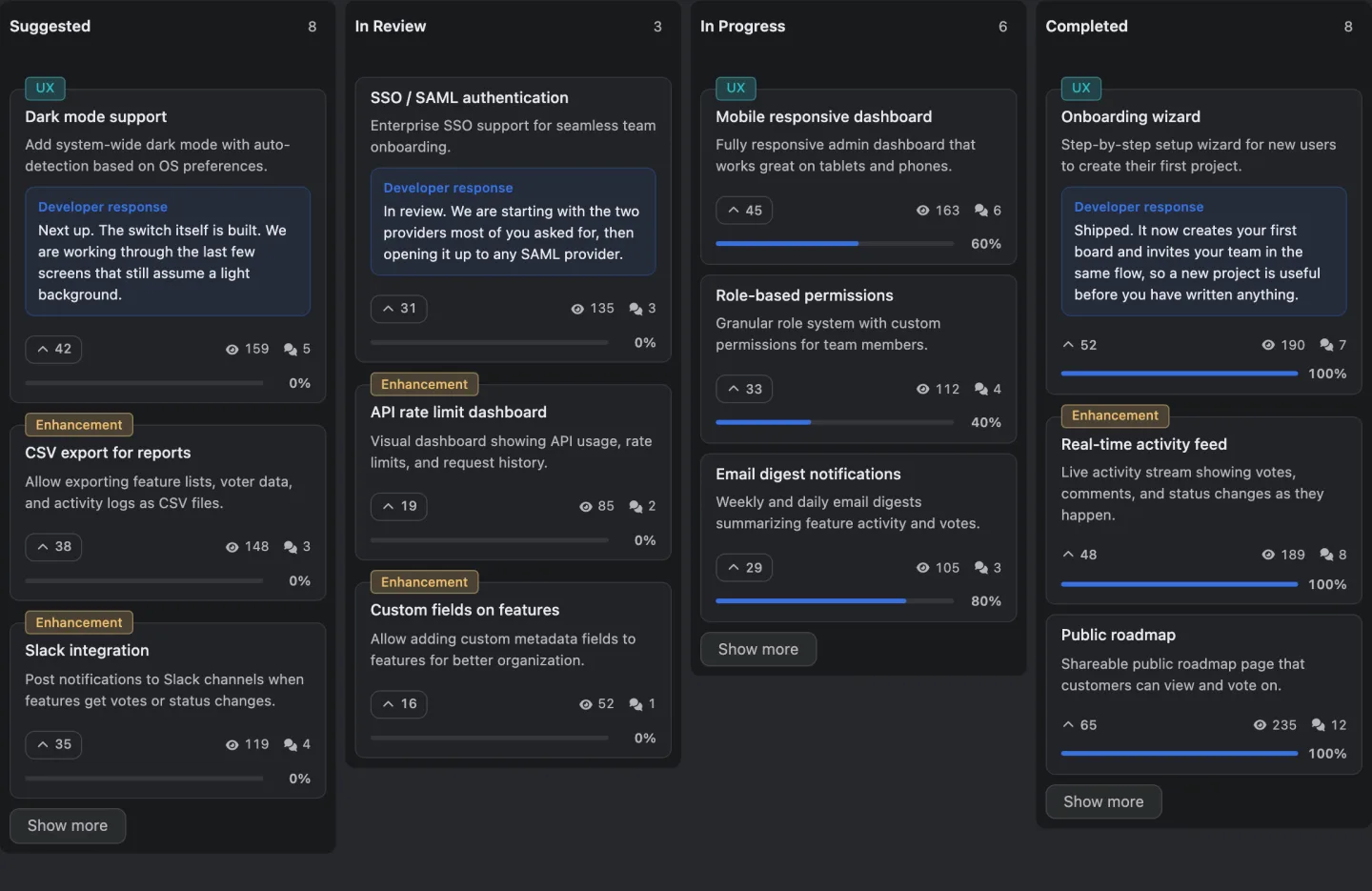
Convas publishes a feedback page and a public product roadmap together. Single sign on is not published anywhere on Convas's own pages read on 2 October 2026, so nobody could read whether it exists.
VoteFirst publishes a public roadmap with a Denied column on every plan, and signs a voter in with a token from your own application on the thirty nine dollar plan rather than with SAML.
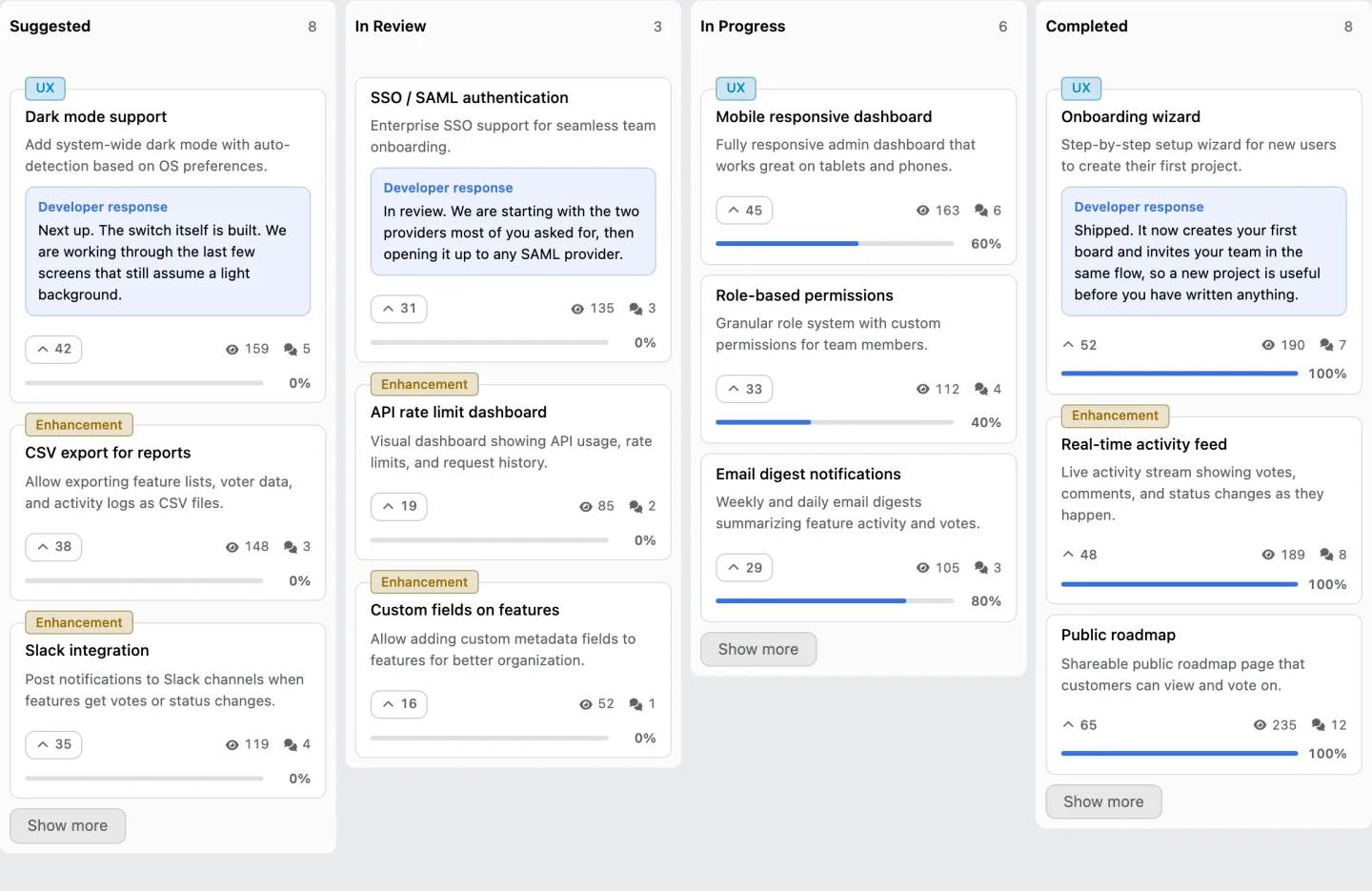
Is there a free Convas alternative?
Yes, several, and none of them is Convas. Fider is the free one to know about, because it is open source and its hosted tier runs to two hundred and fifty feedback items.
UserJot gives two boards and three admin roles, Supahub gives one board and one admin, Featurebase gives one seat, and Sleekplan's Indie tier is a single admin workspace that does not expire.
All five were read on their own pages on 14 September 2026. VoteFirst is not one of them. There is no free plan here, only a fourteen day trial that asks for a card at signup.
Is Convas worth it, and when is it the better answer?
Two cases, and both are real.
Your board will stay small. Twenty five tracked users free, then fifteen dollars for a hundred, is cheaper than VoteFirst at the bottom of the range, and VoteFirst has no free tier at all. For a side project or a first product, they win on price outright.
You have colleagues. Unlimited team members on every plan including the free one, where VoteFirst's nine dollar plan does not give you any. Team members are on its thirty nine dollar plan. If three people need to answer feedback, Convas is cheaper until the board gets busy.
What does VoteFirst cost?
Nine dollars a month, at any number of voters.
There is no meter of any kind in its billing, so a board with fifty voters and a board with fifty thousand cost the same. Against Convas that matters only above their free tier, and the crossover is somewhere in the low hundreds of participants depending on how many colleagues you need.
That plan is one project, one roadmap and every widget, with weighted voting included, and no API, no custom domain and no team members. Thirty nine dollars adds those.
VoteFirst has no free plan. If your board will stay under twenty five participants, theirs is free and VoteFirst is nine dollars, and no amount of feature comparison changes that arithmetic. The whole category on one page names everyone who beats it at the bottom of the range.
What moving actually involves
There is no importer for Convas on VoteFirst's side; the board import reads only Canny and Featurebase.
Voters and the revenue behind them come in from a CSV or from a billing connection, which is the part the weighting needs. The requests themselves are rebuilt by hand or by a script against the API, and the vote counts start again.
The five steps, with the endpoint each one uses, are written out in full, and they are the same five whatever you are leaving.