Pendo is a far bigger product than ours and it is sold to a different buyer, so most of this page is about whether you are that buyer rather than about which tool wins.
For a lot of people arriving on this query the honest answer is that Pendo is the right purchase and a board is not what they needed.
There is one sentence in their own documentation that decides it for everybody else, and it is in the second section below.
Everything here was read on Pendo's own pages on 9 September 2026.
What does Pendo cost?
Nobody outside Pendo can tell you, and their pricing page is straightforward about that in one sense and awkward in another.
Four plans are on the page. Free, Base, Core and Ultimate. Free is free. The other three each say custom pricing, and each has a request a demo button in the place where a number would be.
The meter is monthly active users. Their own FAQ defines that as unique visitors who were active in your app over the last thirty calendar days. Not seats, not boards, not projects.
So the bill grows with how many people use your product, and not with how many people at your company touch the tool. That is a genuinely different bet from most of this category and it is worth understanding before you compare anything.
Free carries five hundred monthly active users, product analytics, in app guides, roadmaps and NPS surveys, with the roadmaps and the surveys carrying Pendo's own branding.
Two parts of that page are worth reading next to each other. Their pricing philosophy section says the pricing is clear upfront and that there is no bait and switch. The plan cards say custom pricing three times.
Both of those can be true at once, because clear upfront plausibly means clear in the quote you are handed rather than clear on the website. It is still worth knowing that you cannot compare Pendo against anything without a sales conversation first.
The same philosophy section says you get full functionality with no gated features. The comparison table further down the same page marks product discovery and sentiment as paid add ons on two of the four plans.
The resolution is the word module. You get all of a module you have bought, and the modules are bought separately. That is a coherent position and it is not what the sentence sounds like on first reading.
The whole table, the monthly active user meter and what happens when you exceed it are written out separately, because the meter is the part that decides your bill and it deserves more room than a paragraph.
The version of this argument worth having is the one you run yourself, and a trial takes 14 days and a card.
Can your customers see a Pendo roadmap?
Not today, and that answer is theirs rather than ours.
The frequently asked questions on their roadmap product page include whether a roadmap can be made visible to customers. The answer says it cannot right now, that roadmaps created there are private or visible only to internal teams, and that they plan to add external sharing later.
If a public roadmap is what you are shopping for, that is the most important thing on this page, because it is the capability most people assume every tool in this category has.
There is a customer facing surface elsewhere in the product. An Ideas Portal is named once, on the Listen page, as a way to share where you are heading. It is a different thing from the roadmap module, and one bullet is all the detail their marketing gives it.
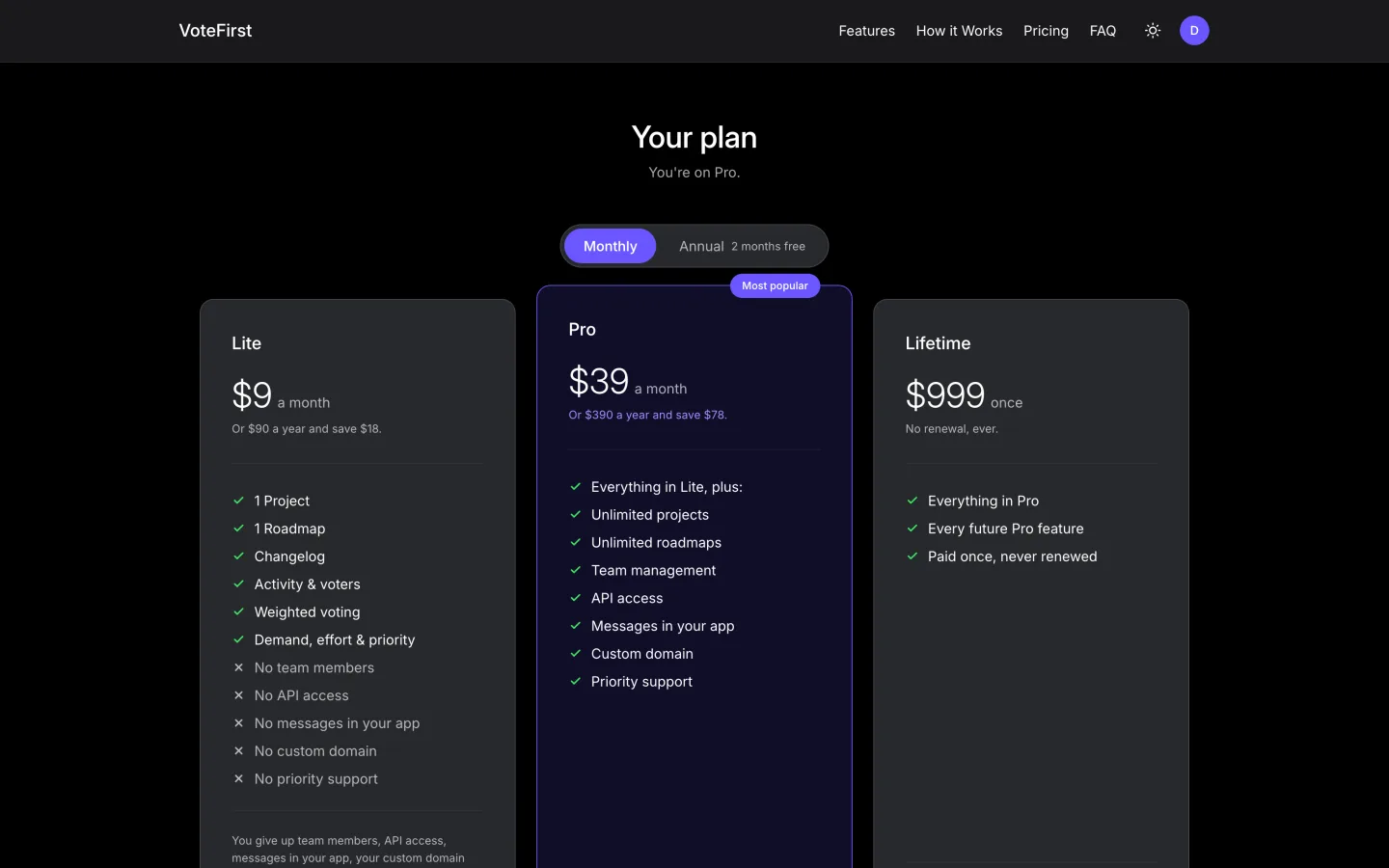
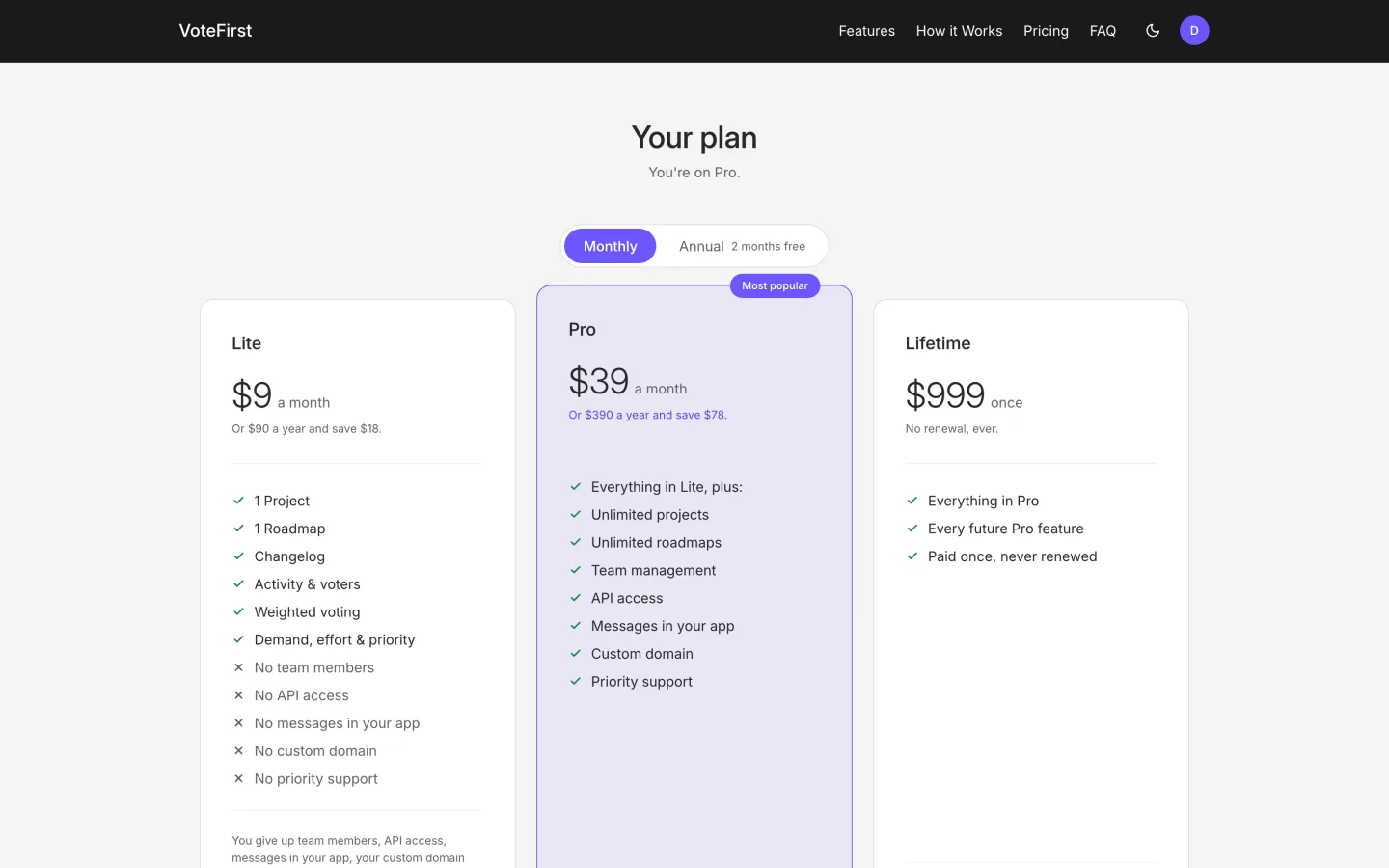
14 days, a card at signup, then $9 or $39 a month.
Is Pendo a feedback board?
No, and the clearest evidence is what their own feedback page does not say.
We searched the Pendo Feedback product page for the words portal, public, vote, voting and upvote. It contains none of them. What it does contain is capture, centralise, integrate, categorise and synthesise.
Their feedback product exists to pull in what customers said somewhere else and make sense of it, rather than to run a page where customers post and vote in the open.
Votes do exist in the platform, just not there. The roadmap page says a roadmap can show total votes and dollar values against an initiative.
The Validate page says an idea test can be analysed by votes, accounts, ARR, impact and effort. So the voting lives inside the internal planning tools, attached to a roadmap the customers cannot see.
That is a coherent design. It is a product for a product department, and the customer is a research subject rather than a participant.
Whether that is right for you depends on something quite specific, which is whether you want your users to be able to read the list and argue with each other on it.
Does Pendo have a free plan?
Yes, in the form of the Novus beta on their pricing page read on 14 September 2026, which asks for no card. It is a beta rather than a standing tier, so it is worth checking what it still includes before you plan around it.
Does Pendo have a public roadmap and single sign on?
Pendo carries Pendo branded roadmaps as part of the wider product. Single sign on is not published anywhere on Pendo's own pages read on 14 September 2026, so nobody could read whether it exists.
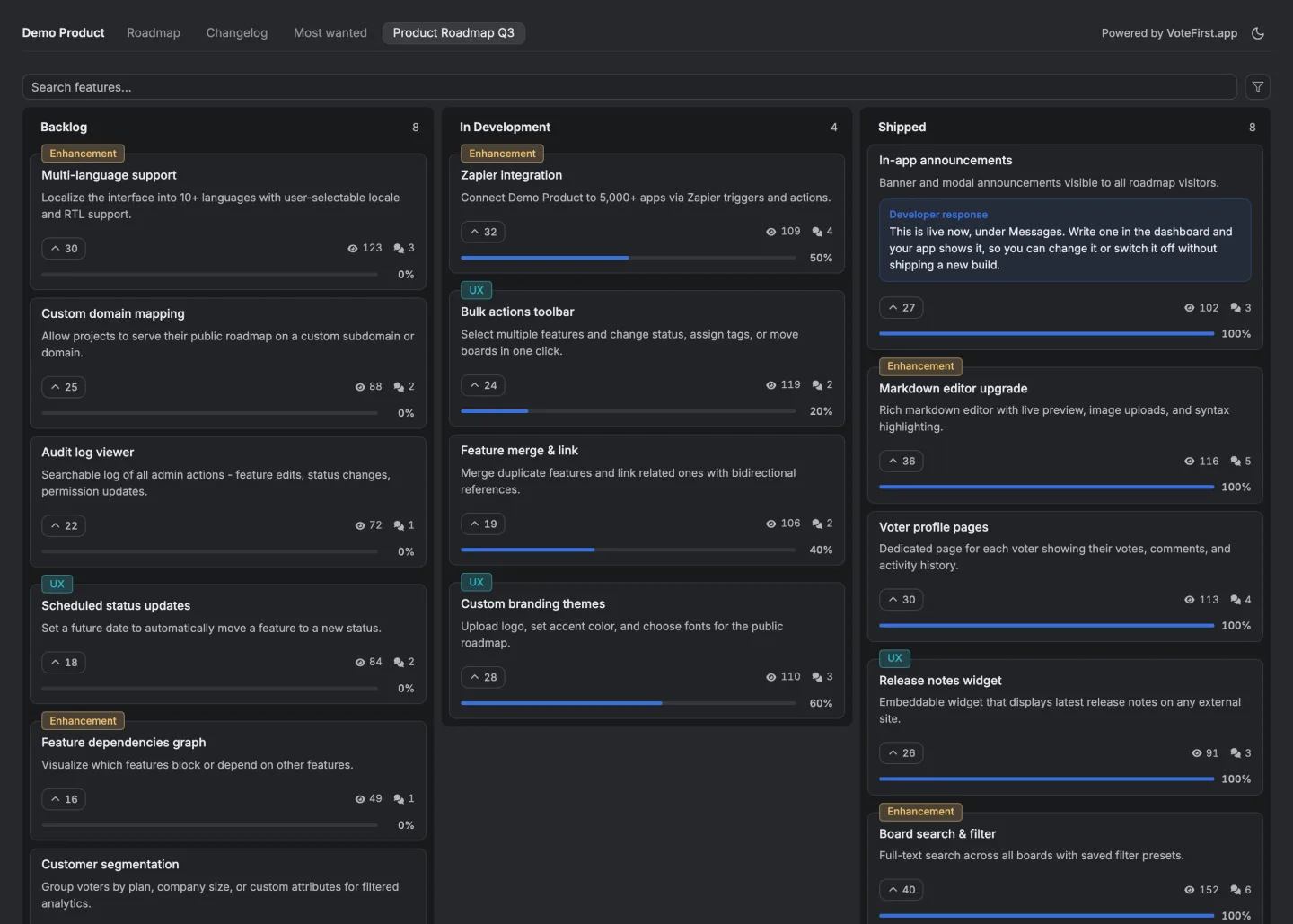
Ours publishes a public roadmap with a Denied column on every plan, and signs a voter in with a token from your own application on the thirty nine dollar plan rather than with SAML.
Is there a free Pendo alternative?
Yes, several, and none of them is Pendo. Jira Product Discovery is free forever for three creators, and Productboard's free plan carries five hundred feedback notes with one teamspace and one portal.
Both were read on their own pricing pages on 14 September 2026. This product is not one of them. There is no free plan here, only a fourteen day trial that asks for a card at signup.
Is Pendo worth it, and what is it genuinely better at?
Several things, and pretending otherwise would waste your afternoon.
Product analytics, session replay and in app guides. That is the core of the company. We do none of it and have no plans to.
Feedback that arrives somewhere other than a board. They ingest support tickets, call transcripts and survey responses, and integrate with Salesforce, Zendesk, Gong, Teams, Zoom and Jira. Their pricing page counts more than eighty five integrations across the platform. If your feedback is scattered across four systems and nobody has read it in a month, that is a real problem and it is not one we solve.
Analysis of that pile. Their product summarises feedback, surfaces trends and flags duplicate ideas, and they describe all of it as AI. We have no AI features in ours and we are not adding any, so if that analysis is the thing you are buying, buy it from them and be happy.
Scale. Pendo is sold to enterprises with compliance requirements, and their page names SOC2, GDPR and HIPAA. We are a nine dollar board.
Who should not move to ours?
Anybody whose actual problem is one of the four things above.
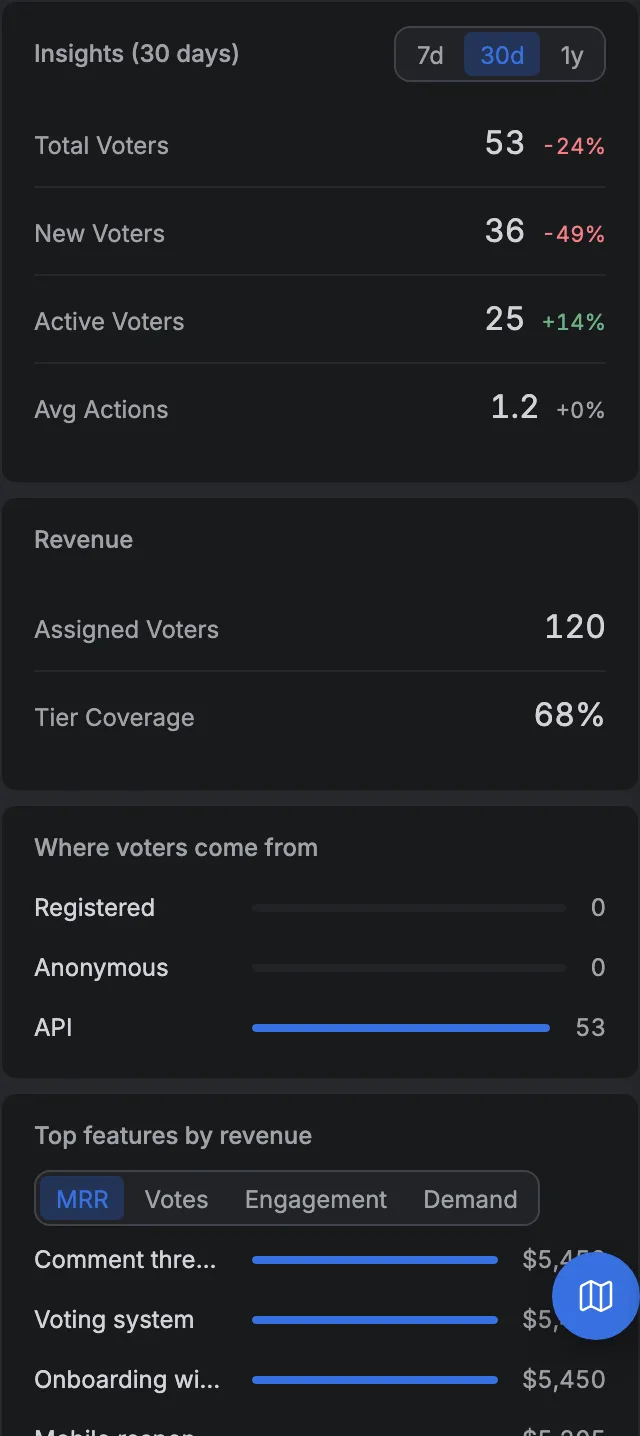
If you need to know which features get used, we cannot tell you. If your feedback lives in Zendesk and Gong, we do not read either.
If a procurement process requires a vendor questionnaire and a named account team, we are not that. And if you are already paying for Pendo for the analytics, adding their feedback module is a smaller decision than adding a second vendor.
The overlap between the two products is narrower than the query suggests. It is one thing, which is the list of what customers are asking for.
What does ours do instead?
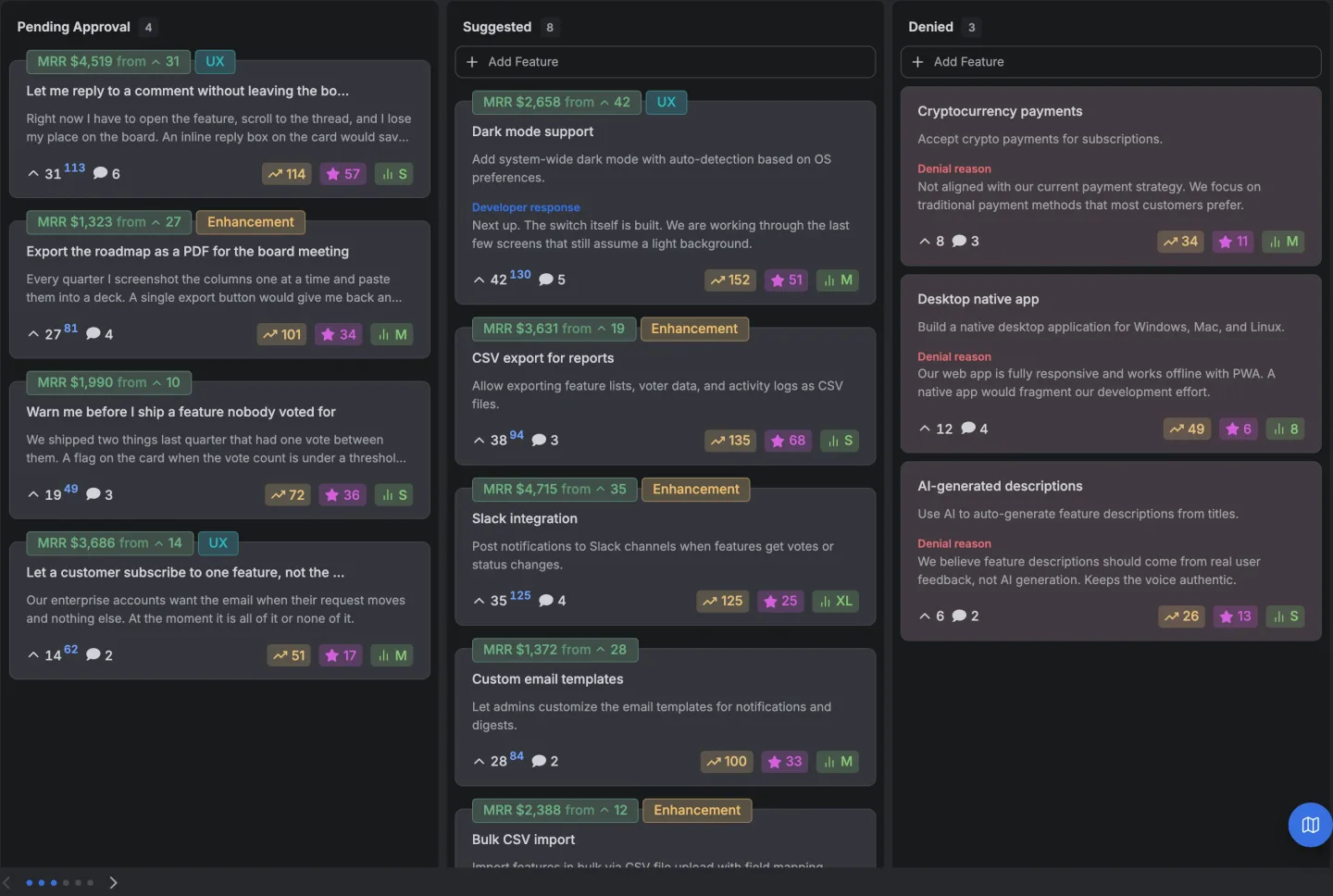
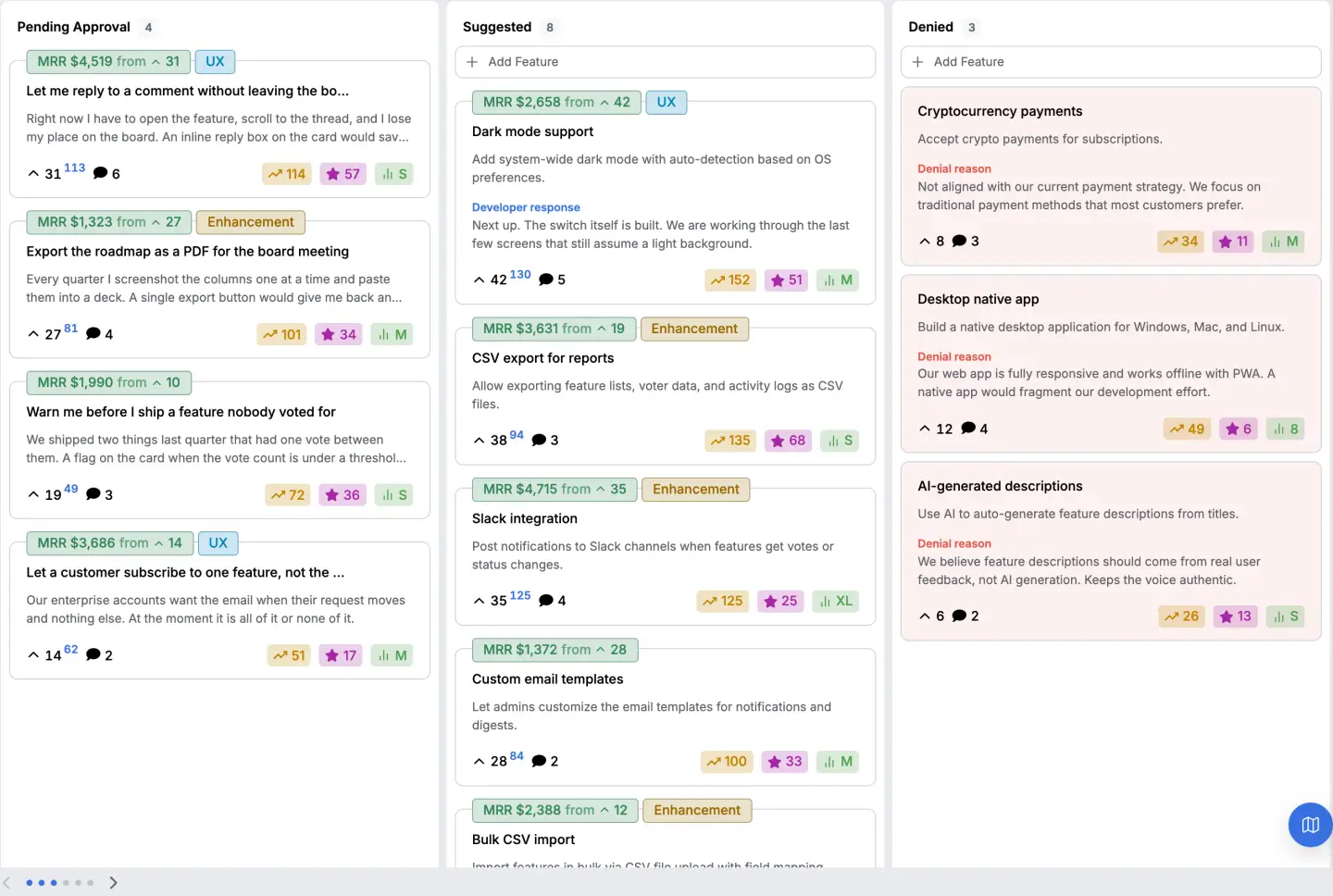
One public page where your customers post, vote and see the answer.
The board is a public page and voting works without an account, so the number under a request is what people actually wanted rather than what people were willing to sign up in order to say.
The board is the whole product, and the roadmap is a page you can send somebody a link to, which is the specific thing Pendo says it does not do yet.
A vote can carry the weight of the customer who cast it, so a request from three customers paying you can outrank one from thirty who are not.
That mechanism is the closest thing we have to the ARR mapping on their side, and the difference is that ours is visible on a page rather than in an internal planning view.
When something ships, the people who asked for it get told. Publishing a release emails the voters on the requests it contains, which is a different message from a general announcement because it is about the thing that person specifically asked for.
The price is published, which after the section above feels worth stating plainly. Nine dollars a month for one project, and thirty nine for the plan that adds more projects, the API and a custom domain.
Both numbers are on the pricing page and there is no call. A card is required for the fourteen day trial.
If you are still comparing, every tool in this category with its real billing unit is on one page, and Productboard is the closest thing to Pendo that does publish a number.