Productboard is a bigger product than ours and it is aimed at a different buyer, so most of this page is about whether you are that buyer rather than about which tool wins.
There is one thing on their pricing page worth your attention before anything else, because it changes the entry price of their middle plan by a factor of two and a half depending on which sentence you happen to read.
Everything below was read on their own pricing page on 9 September 2026, and the entry price was read again on 15 September 2026.
What are the alternatives to Productboard?
Productboard is nineteen dollars a maker billed annually, and the minimum on the plan above it is stated three different ways on the same page. The table below gives one figure and one unit per tool, which is all a comparison needs.
| Vendor | From | Billed per | Free plan | Trial |
|---|---|---|---|---|
| Trello | $5/user/mo | user | Yes | – |
| VoteFirst | $7.50/mo | plan | – | 14 days, card |
| Features.Vote | $7.50/mo | project | – | 14 days |
| Jira Product Discovery | $10/creator/mo | creator | 3 creators | – |
| LoopedIn | $12/mo | plan | 1 of each | – |
| WishKit | $12.50/mo | project | 5 requests | – |
| Sleekplan | $13/mo | workspace | 1 admin | 30 days, no card |
| Upvoty | $13.50/mo | project | – | 14 days |
| Noora | $14/mo | workspace | – | 7 days |
| Convas | $15/mo | tracked user | 25 users | – |
| FeedBear | $15/mo | project | – | 14 days |
| Supahub | $15/mo | workspace | 1 board | 10 days |
| ProductLift | $19/mo | workspace | – | 14 days |
| Productboard | $19/maker/mo | maker | 500 notes | – |
| Roadmunk | $19/creator/mo | creator | – | 14 days |
| Ducalis | $20/mo | changelog subscriber | 500 subs | – |
| Frill | $22/mo | workspace | – | 14 days |
| Fider | $25/mo | workspace | 250 items | – |
| Featurebase | $29/seat/mo | seat | 1 seat | – |
| Headway | $29/mo | plan | Yes | – |
| Nolt | $29/mo | board | – | – |
| UserJot | $29/mo | workspace | 2 boards | 14 days |
| Aha! Ideas | $39/user/mo | user | – | Yes |
| Savio | $39/mo | paid user | – | 14 days |
| Beamer | $49/mo | monthly active user | 1,000 MAU | – |
| Feature Upvote | $49/board/mo | board | – | 30 days |
| Rapidr | $49/mo | workspace | – | 14 days |
| Suggested | $49/mo | plan | – | 15 days |
| Gleap | $49/mo | plan | – | 14 days |
| FeatureOS | $50/mo | plan | – | 30 days, no card |
| Olvy | $60/mo | plan | 25 items | – |
| AnnounceKit | $39/mo | module | – | 15 days, no card |
| Canny | $79/mo | tracked user | 25 users | – |
| LaunchNotes | $249/mo | plan | – | 14 days |
| Pendo | Not published | monthly active user | Beta | – |
| ProdPad | Not published | module | – | 7 days |
| UserVoice | Not published | quoted | – | 30 days |
| airfocus | Not published | quoted | – | – |
| ProductPlan | Not published | quoted | – | – |
| Productroad | $9/mo | plan | 50 users | 14 days, no card |
| Quackback | $29/mo | plan | 1 board, 50 posts | 14 days, no card |
| ProdCamp | $99/mo | plan | 2 admins, 1 product | – |
| Harvestr | $65/editor/mo | editor | – | 14 days |
| Productlane | $29/user/mo | user | – | Yes |
| Ideanote | $6/user/mo | user | 10 users, 250 ideas | – |
| Craft.io | $19/editor/mo | editor | – | 14 days, no card |
| HYPE Boards | €79/mo | plan | – | 14 days, no card |
| Noticeable | $24/mo | plan | 1 project, watermarked | 14 days, no card |
Read on each vendor's own pricing page, with the billing switch on the yearly side wherever one is published. From is the cheapest paid rate per month. What each one includes, as well as what it costs, is on one page.
What does Productboard cost?
The same two products, line by line
Read on each vendor's own pages on the date in the row above. Not published means nobody could read it on the pages opened that day, never that the feature is absent.
Per maker, which is their word for a seat.
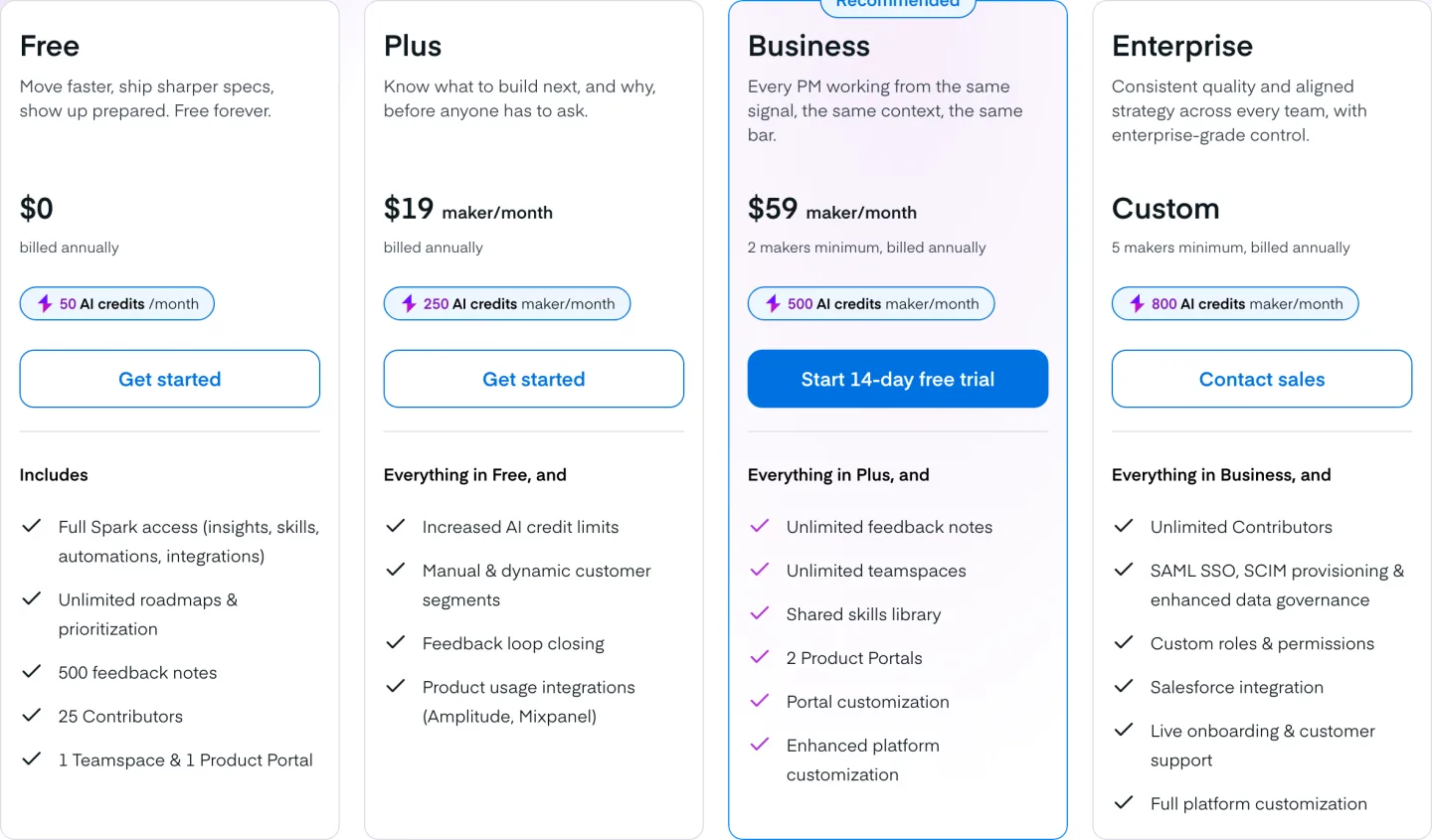
| Plan | Paid yearly | Paid monthly |
|---|---|---|
| Free | $0 | $0 |
| Plus | $19/maker/mo | $25/maker/mo |
| Business | $59/maker/mo | $75/maker/mo |
| Enterprise | Custom | Custom |
So the price is your team size multiplied by the rate. That is the whole model and it is the opposite of ours, where the number of people who can look at the feedback does not appear in the bill at all.
The free plan is real. It carries five hundred feedback notes, twenty five contributors, one teamspace and one product portal. Their fourteen day trial does not ask for a card, and their page says so in as many words.
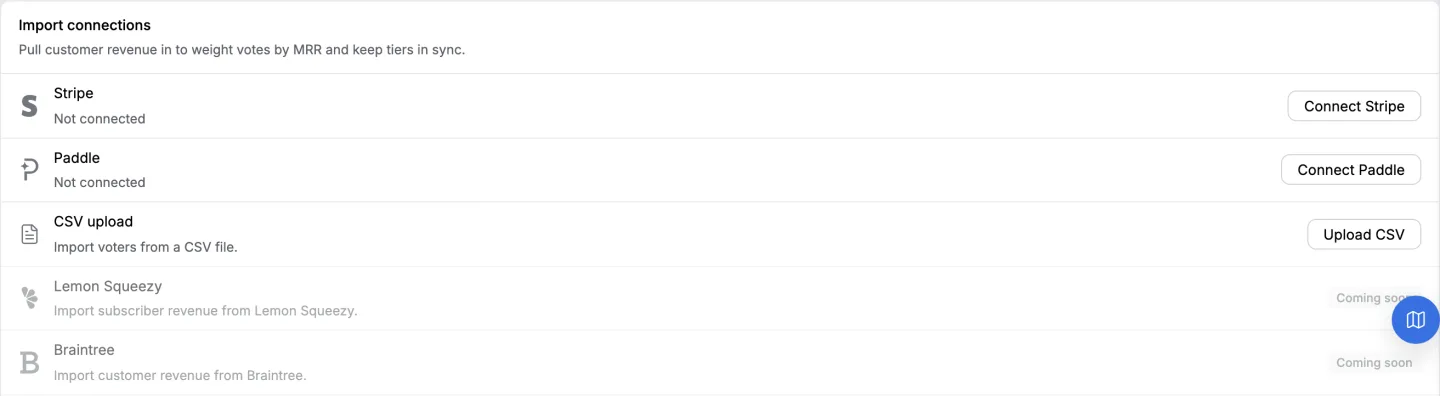
If you would rather try the alternative than read about it, a trial runs 14 days and asks for a card at signup, and it is $9 or $39 a month after that.
How many makers do you have to buy?
Their page answers this three different ways, and the answers do not agree.
On one plan card, Business reads five makers minimum, billed annually. On another rendering of the same card, Business reads two makers minimum, billed annually.
In their full feature comparison table, the row headed Minimum makers reads Free one, Plus one, Business two online and five on contract, Enterprise five. We loaded that page eight times and counted which shape came back, because a price that changes between loads is worth measuring rather than describing.
The arithmetic is why it matters.
| Reading | Business, billed annually |
|---|---|
| Two makers at $59 | $118/mo |
| Five makers at $59 | $295/mo |
That is a hundred and seventy seven dollars a month between two sentences on the same page.
We are not going to tell you which one is right, because we do not know and guessing would be worse than saying so. What we would do in your position is get the minimum in writing before signing anything.
Plus has a minimum of one maker in the feature table, so the nineteen dollar figure is reachable for a single person on that plan.
Is Productboard a feedback board like ours?
Not really, and this is the honest heart of the comparison.
Ours is a public page where your users vote on requests. Theirs is a product management system, where the feedback repository is one part of a larger thing that also holds strategy, roadmaps, teamspaces and prioritization for a whole department. They describe it as built for product makers and that is accurate.
They do have customer boards and a product portal, so a public facing surface exists. But you would not buy Productboard to get a voting board, any more than you would buy a car to get a radio.
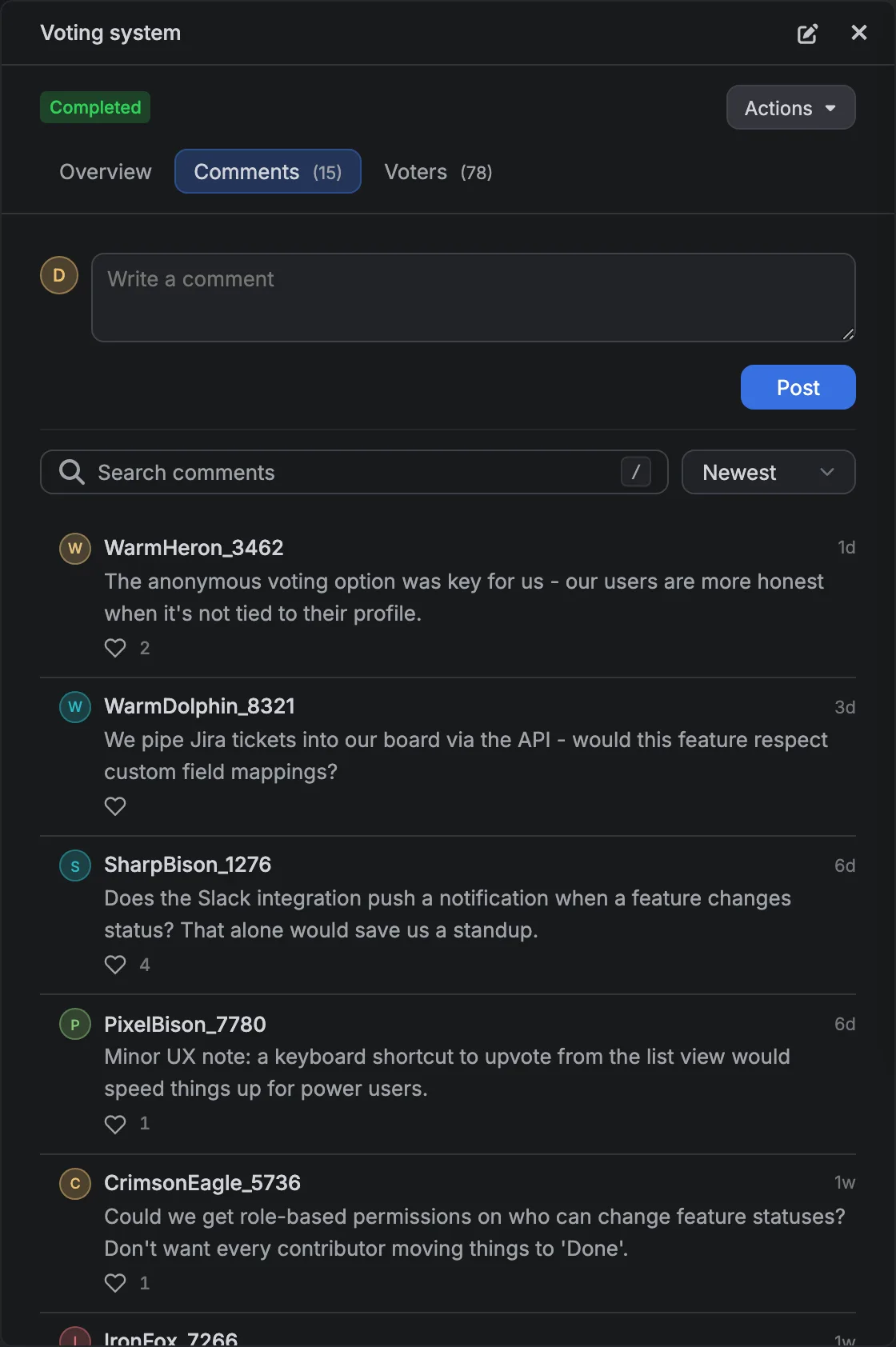
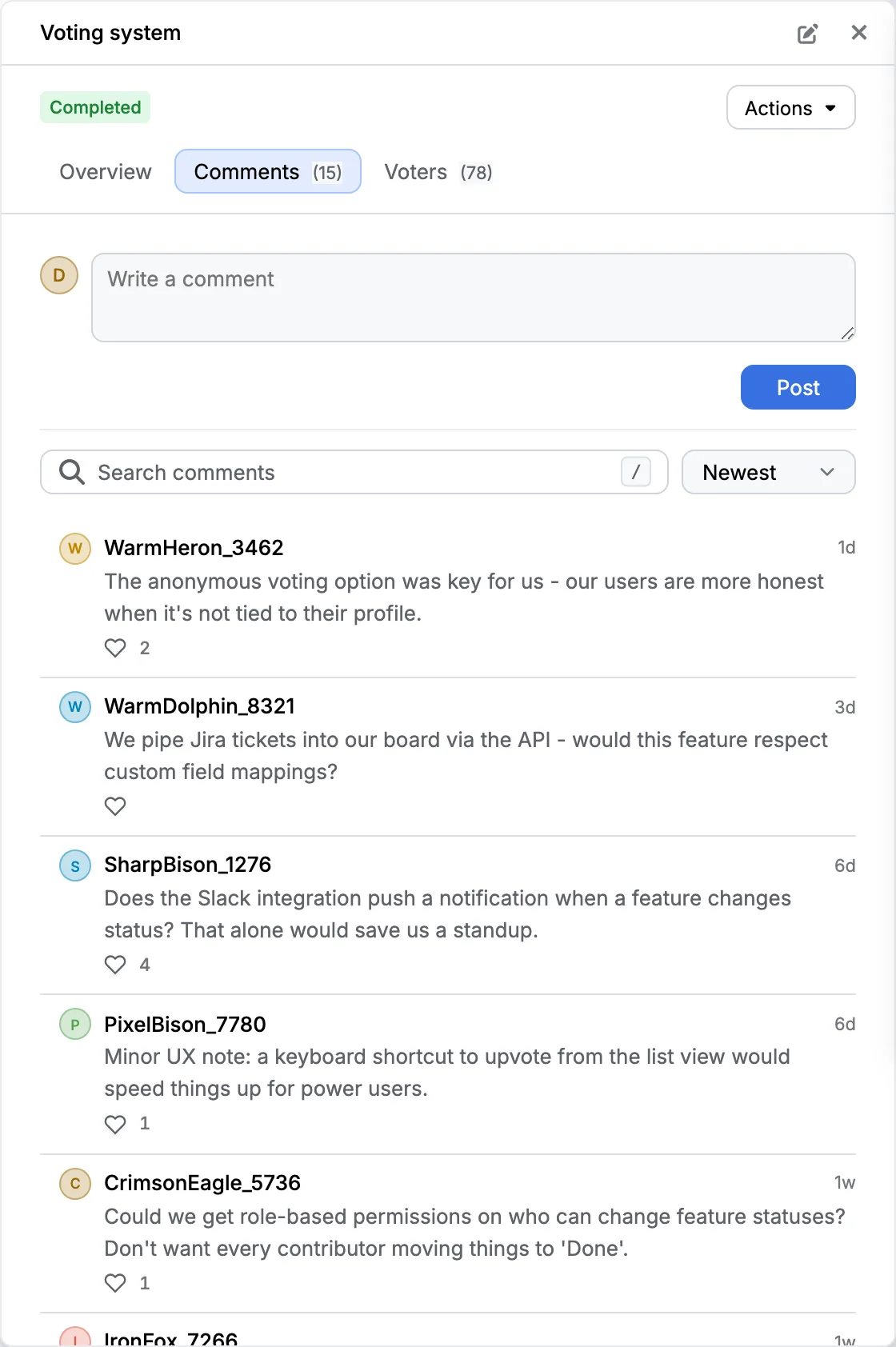
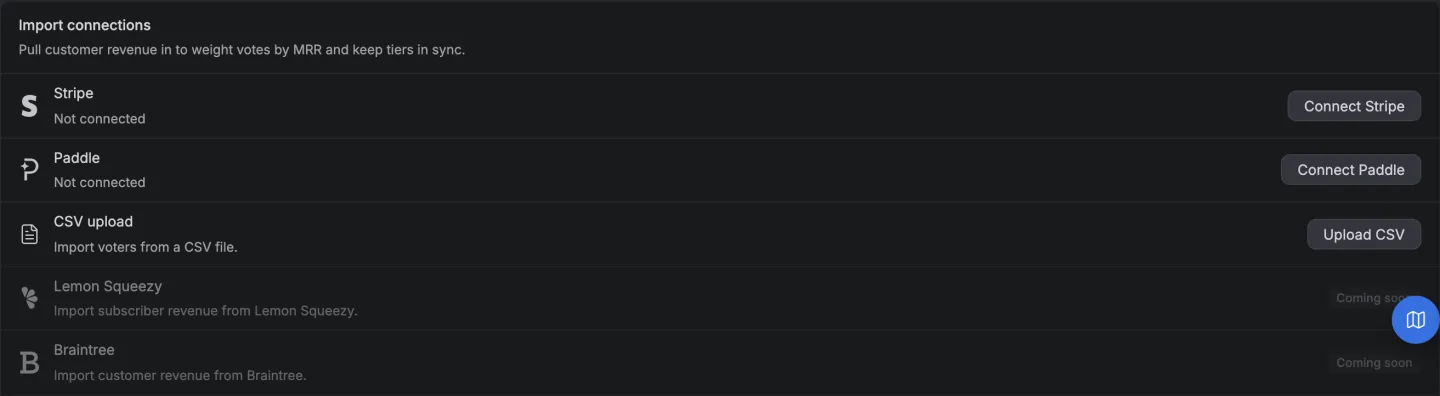
Do they weight votes by revenue?
Not on the pages we read on 9 September 2026.
Their prioritization language is about customer value and business outcomes, with no revenue or MRR wording that we could find. That is an absence on their marketing pages rather than proof about their software, and with a product this large the sensible assumption is that it can do more than its pricing page says.
Eight of the thirty two tools we checked do ship a form of revenue weighting, so this is not a thing only we have.
14 days, a card at signup, then $9 or $39 a month.
What is the free plan actually good for?
The free plan is good for evaluating, and running something small.
Five hundred feedback notes is a real cap and it is a cap on content rather than on people, which is easy to miss when comparing plans. Twenty five contributors is generous. One teamspace and one product portal means one product.
If you are one person with one product and you want to try the category's most established tool without paying, their free plan is a better offer than anything we have, because we do not have a free tier at all.
What this costs
Lite
$9 /mo
Pro
$39 /mo
Lifetime
$999 once
Fourteen day trial of Pro, card asked for at signup. Nothing here counts the people who vote, so the bill does not move when the board starts working. The long version, with what happens if you stop paying.
Does Productboard have a public roadmap, single sign on, an API and a CSV export?
Productboard carries unlimited interactive roadmaps. Productboard carries single sign on for its portal, and SAML with SCIM on its top tier. Productboard publishes an API, and the CSV Productboard exports is the list of feature requesters rather than the whole board.
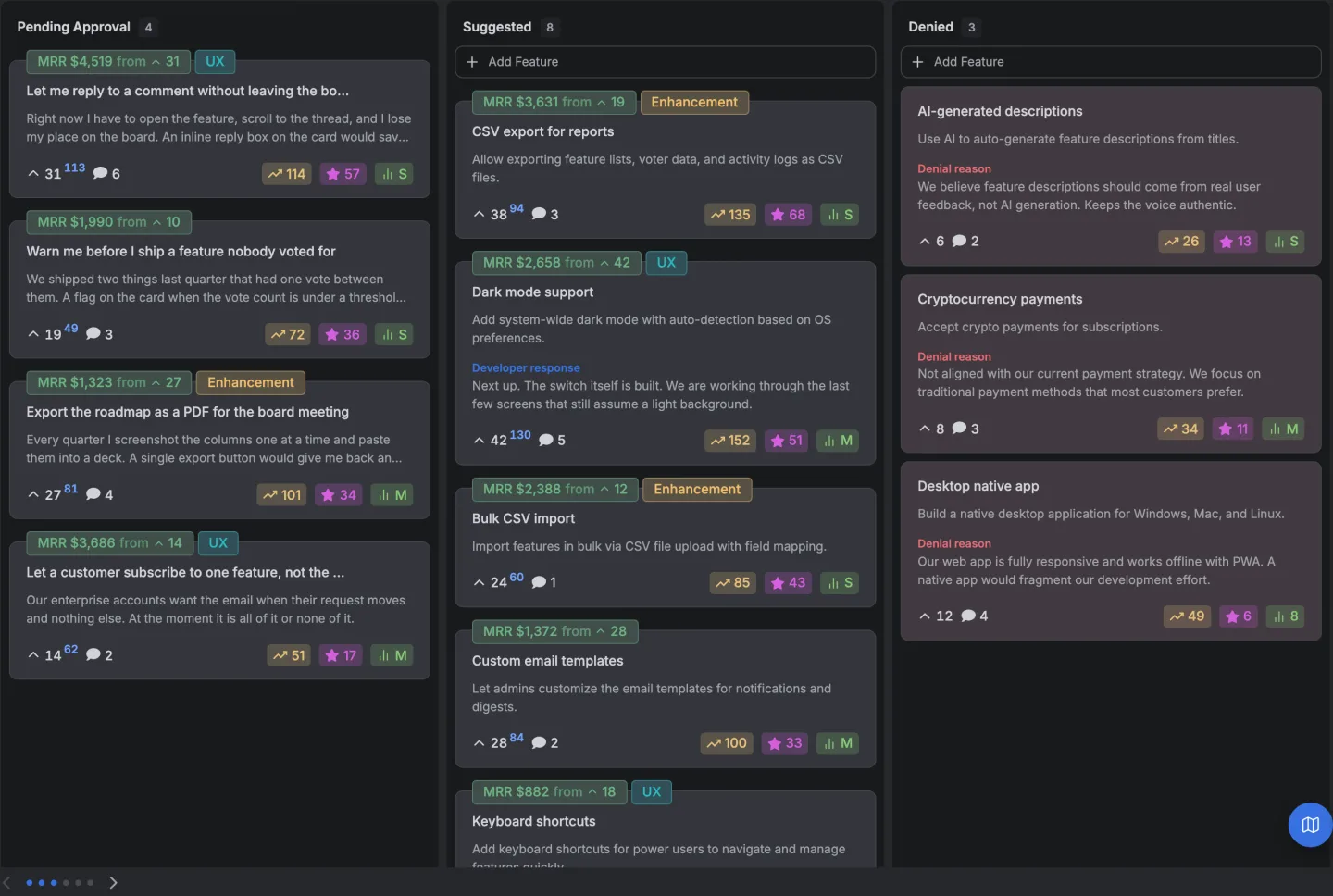
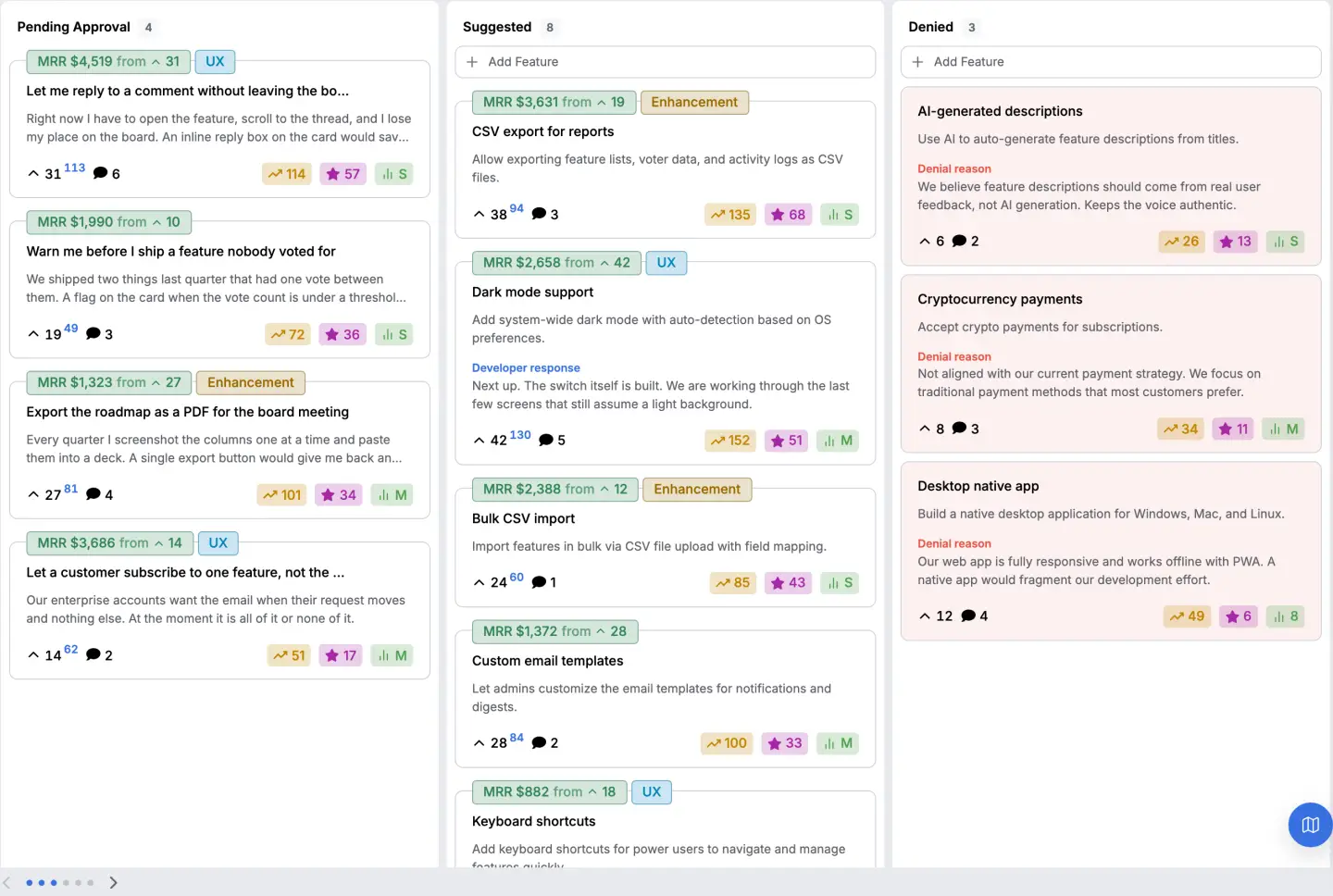
Ours publishes a public roadmap with a Denied column on every plan, and signs a voter in with a token from your own application on the thirty nine dollar plan rather than with SAML.
Is there a free Productboard alternative?
Yes, several, and none of them is Productboard. Jira Product Discovery is free forever for three creators, and Productboard's free plan carries five hundred feedback notes with one teamspace and one portal.
Both were read on their own pricing pages on 14 September 2026. This product is not one of them. There is no free plan here, only a fourteen day trial that asks for a card at signup.
Is Productboard worth it, and when is it the better answer?
Three cases, and they are all about size.
You have a product team rather than a founder. Teamspaces, a shared strategy layer and per maker access exist because several product managers need to work in the same system. We have none of that and are not building it.
You need product usage data alongside feedback. Their Plus plan connects Amplitude and Mixpanel. We connect to neither, and what we do connect to is listed here.
You want the safest choice. They are the largest and most established name in this comparison, and for some buyers that is the deciding factor on its own. It is a legitimate reason and we will not pretend otherwise.
What does ours cost?
Nine dollars a month for one project, and the number of people looking at the board never changes it.
That plan is one project, one roadmap and every widget, with weighted voting included, and no API, no custom domain and no team members. Thirty nine dollars adds those. So if you need colleagues in the tool, compare their per maker rate against our thirty nine rather than against our nine.
The real difference is scope. They sell a system for running product management across a department. This is a public board that sorts requests by what the customer pays.
If the second one is the problem you have, the first one is a lot of software to buy to solve it. Every price and unit in the category is on one page.
Productboard against the others, one at a time
Ten pages here take Productboard and one rival at a time, working out where the two bills cross and what each one does with a vote from a paying customer.
- Canny vs Productboard, priced on the same day
- Featurebase vs Productboard, a seat against a maker
- Jira Product Discovery vs Productboard, priced per seat
- ProdPad vs Productboard, one price you can read
- ProductPlan vs Productboard, one prices in public
- Productboard prices a seat, UserVoice prices nothing
- Productboard vs Aha, and the seat with a floor of three
- Productboard vs Nolt, maker seats against a flat board
- Productboard vs Pendo, a rate against no rate
- airfocus vs Productboard, a call against a rate
- Productboard vs Roadmunk, two seat meters, two names