Most comparison pages put a number next to UserVoice. Their plans page was read on 9 September 2026 and again on 14 September 2026, and there is not one on it, anywhere, so this page does not have a number to give you either.
That sounds like a dead end and it is actually the most useful thing anybody can tell you about them. A vendor who prices by conversation is telling you what kind of buyer they are built for, and it is worth knowing that before you spend a week on a trial.
What are the alternatives to UserVoice?
UserVoice publishes no price anywhere on its plans page and the only button is Talk to an Expert. Almost every tool below prints a figure you can read today without speaking to anybody.
| Vendor | From | Billed per | Free plan | Trial |
|---|---|---|---|---|
| Trello | $5/user/mo | user | Yes | – |
| VoteFirst | $7.50/mo | plan | – | 14 days, card |
| Features.Vote | $7.50/mo | project | – | 14 days |
| Jira Product Discovery | $10/creator/mo | creator | 3 creators | – |
| LoopedIn | $12/mo | plan | 1 of each | – |
| WishKit | $12.50/mo | project | 5 requests | – |
| Sleekplan | $13/mo | workspace | 1 admin | 30 days, no card |
| Upvoty | $13.50/mo | project | – | 14 days |
| Noora | $14/mo | workspace | – | 7 days |
| Convas | $15/mo | tracked user | 25 users | – |
| FeedBear | $15/mo | project | – | 14 days |
| Supahub | $15/mo | workspace | 1 board | 10 days |
| ProductLift | $19/mo | workspace | – | 14 days |
| Productboard | $19/maker/mo | maker | 500 notes | – |
| Roadmunk | $19/creator/mo | creator | – | 14 days |
| Ducalis | $20/mo | changelog subscriber | 500 subs | – |
| Frill | $22/mo | workspace | – | 14 days |
| Fider | $25/mo | workspace | 250 items | – |
| Featurebase | $29/seat/mo | seat | 1 seat | – |
| Headway | $29/mo | plan | Yes | – |
| Nolt | $29/mo | board | – | – |
| UserJot | $29/mo | workspace | 2 boards | 14 days |
| Aha! Ideas | $39/user/mo | user | – | Yes |
| Savio | $39/mo | paid user | – | 14 days |
| Beamer | $49/mo | monthly active user | 1,000 MAU | – |
| Feature Upvote | $49/board/mo | board | – | 30 days |
| Rapidr | $49/mo | workspace | – | 14 days |
| Suggested | $49/mo | plan | – | 15 days |
| Gleap | $49/mo | plan | – | 14 days |
| FeatureOS | $50/mo | plan | – | 30 days, no card |
| Olvy | $60/mo | plan | 25 items | – |
| AnnounceKit | $39/mo | module | – | 15 days, no card |
| Canny | $79/mo | tracked user | 25 users | – |
| LaunchNotes | $249/mo | plan | – | 14 days |
| Pendo | Not published | monthly active user | Beta | – |
| ProdPad | Not published | module | – | 7 days |
| UserVoice | Not published | quoted | – | 30 days |
| airfocus | Not published | quoted | – | – |
| ProductPlan | Not published | quoted | – | – |
| Productroad | $9/mo | plan | 50 users | 14 days, no card |
| Quackback | $29/mo | plan | 1 board, 50 posts | 14 days, no card |
| ProdCamp | $99/mo | plan | 2 admins, 1 product | – |
| Harvestr | $65/editor/mo | editor | – | 14 days |
| Productlane | $29/user/mo | user | – | Yes |
| Ideanote | $6/user/mo | user | 10 users, 250 ideas | – |
| Craft.io | $19/editor/mo | editor | – | 14 days, no card |
| HYPE Boards | €79/mo | plan | – | 14 days, no card |
| Noticeable | $24/mo | plan | 1 project, watermarked | 14 days, no card |
Read on each vendor's own pricing page, with the billing switch on the yearly side wherever one is published. From is the cheapest paid rate per month. What each one includes, as well as what it costs, is on one page.
What is UserVoice?
The same two products, line by line
Read on each vendor's own pages on the date in the row above. Not published means nobody could read it on the pages opened that day, never that the feature is absent.
UserVoice is an enterprise feedback and idea management product sold through a sales process. It ties feedback to accounts across sales, support and product, and it publishes no price on its plans page.
What does UserVoice cost?
Nothing is published. The only call to action on their plans page is to talk to an expert.
We are not going to fill that gap with a figure from a review site or from memory. A price we cannot open on their own page is a price we do not know, and printing one would be exactly the sort of thing this site exists not to do.
What they do publish is what the price depends on. Their own page says the plan is based on feedback volume, the tools you use and the integrations you connect, and never on seats.
That last part is a real commitment and it is unusual. Most of this category charges per seat, so the person who wants to look at the feedback is a cost.
UserVoice is explicit that yours is not, and their reasoning is that every team should be able to act on the same customer signal without access being held back by cost.
The version of this argument worth having is the one you run yourself, and a trial takes 14 days and a card.
What this costs
Lite
$9 /mo
Pro
$39 /mo
Lifetime
$999 once
Fourteen day trial of Pro, card asked for at signup. Nothing here counts the people who vote, so the bill does not move when the board starts working. The long version, with what happens if you stop paying.
What does that mean for a small team?
Probably that you are not the buyer, and that is not a criticism of either of you.
A sales conversation costs a vendor real money, so a vendor who requires one has a floor below which a customer is not worth signing. Nobody publishes that floor and we are not going to guess at it.
The practical read is that if you are one person with a side project, a product priced this way is unlikely to be aimed at you.
There is a second consequence that matters more than the money. Buying takes weeks rather than minutes. If your problem is that you need a board up before a release next Tuesday, that alone decides it.
Do they weight votes by revenue?
Yes, and it is their headline rather than a feature buried on a sub page.
Their own words are that UserVoice gives every function the same revenue weighted view so priorities stop changing. They also describe weighting signals by revenue impact rather than tallying votes.
Of the thirty two tools we checked, eight ship some form of revenue weighting, and theirs is the most prominent claim of the group.
If you have read anywhere that this mechanism is unique to us, that page is selling you something. It is not unique to us, and on this particular axis UserVoice is the most direct competitor in the category.
14 days, a card at signup, then $9 or $39 a month.

How is theirs different from ours?
Theirs is built for an organisation. Ours is built for one person with a board.
UserVoice ties feedback to accounts and to annual revenue, and the point of it is that sales, success and product all read the same picture. That is an answer to a coordination problem between departments.
Ours is a whole number multiplier on a voting tier, assigned by you, written onto the vote when it is cast, with the plain count still visible beside the weighted one.
The full mechanism is here. It answers a much smaller question, which is which of these two cards actually matters, and it does it on a nine dollar plan.
Neither is a better version of the other. They are different sizes of the same idea.
What does a vote look like on their board?
Not like a vote, and this came from opening their own forum rather than from reading their marketing.
The feedback board UserVoice runs on UserVoice was read on 9 September 2026. Each idea carries a vote count and a vote button, which is what you would expect. Underneath it sits a question asking how important this is to you, with three answers. Not at all, important, and critical.
So their signal is not a tally of people who pressed a button. It is a tally of people who said how much they cared, on a three point scale, per idea. That is a genuinely different instrument from an upvote and it is not mentioned on the pages selling the product.
It deserves thought rather than dismissal. A three point scale asks the person to rank their own need, which is information a binary vote throws away, and it costs the respondent almost nothing.
What it does not do is tell you what that person is worth, because somebody on a free plan can press critical just as easily as your largest account can.
Ours goes the other way. We do not ask how much you care, we look up what you pay, and the multiplier comes from the tier rather than from the answer.
One asks the customer to rate themselves and one reads the invoice, and if you know which of those you trust more, you know which tool you want.
Their board is also translated. There is a control that turns on machine translation of ideas and comments into a language you pick, and the interface around it had already switched to the language our browser asked for.
We have neither. Our board is English only and that is a real gap on a forum with a global audience.
We did not press the vote button or any of the three importance buttons, because writing to somebody else's live feedback board to see what happens is not a thing we will do. So whether pressing one asks a signed out visitor for an email, we cannot tell you.
Is there a free trial?
They say free trials are available. Whether a card is required is not stated on the page we read.
We would rather write that sentence than a cleaner one that is not true.
Does UserVoice have a public roadmap, single sign on and an API?
UserVoice carries roadmap planning tied to the revenue behind the demand. Single sign on is not published anywhere on UserVoice's own plans page read on 14 September 2026, so nobody could read whether it exists.
UserVoice publishes an API, read on their own site the same day, with no plan named against it. Ours publishes a public roadmap with a Denied column on every plan, and signs a voter in with a token from your own application on the thirty nine dollar plan rather than with SAML.
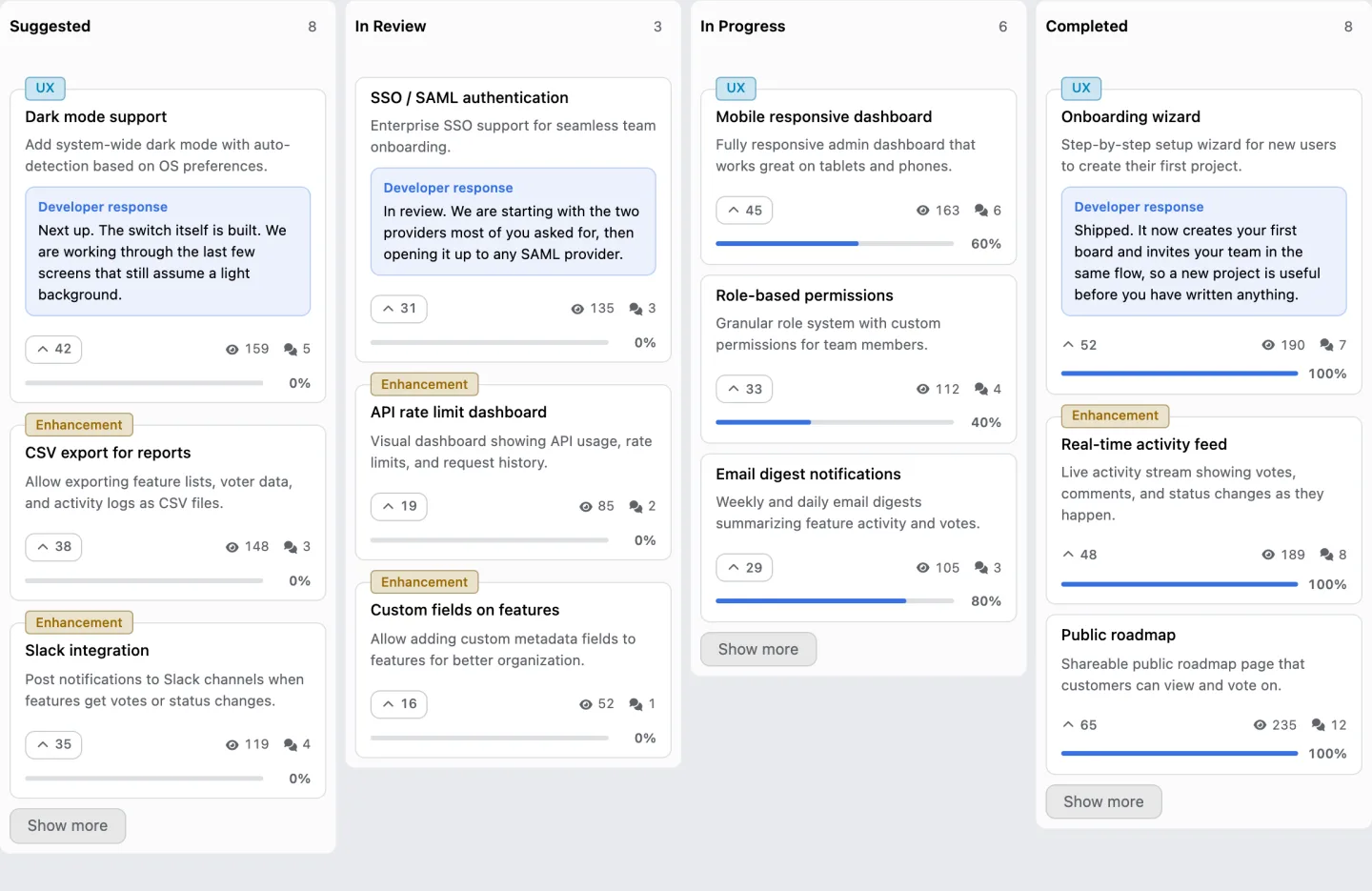
Is there a free UserVoice alternative?
Yes, several, and none of them is UserVoice. Fider is the free one to know about, because it is open source and its hosted tier runs to two hundred and fifty feedback items.
UserJot gives two boards and three admin roles, Supahub gives one board and one admin, Featurebase gives one seat, and Sleekplan's Indie tier is a single admin workspace that does not expire.
All five were read on their own pages on 14 September 2026. This product is not one of them. There is no free plan here, only a fourteen day trial that asks for a card at signup.
Is UserVoice worth it, and when is it the better answer?
Three cases, and they are the same buyer seen from three sides.
You have departments. If sales, customer success and product all need to see the same feedback tied to the same accounts, that is what they built and it is not what this is.
Your revenue data lives in a CRM. They connect to it. We ask you to set voting tiers by hand, which does not scale to hundreds of accounts moving between plans.
Procurement expects a contract and a conversation. Some organisations cannot buy a nine dollar subscription on a card even when it would do the job. If that is yours, a published price is not an advantage.
What does ours cost?
Nine dollars a month, published, on a card, in about a minute.
That is one project, one roadmap and every widget, with weighted voting included, and no API, no custom domain and no team members. Thirty nine dollars adds those.
The comparison is not really about features. It is that one of these two products tells you the price on a web page and the other one asks you to book a call, and those are two different ways of buying software rather than two grades of the same product.
Every price and unit we could open is on one page, and UserVoice is the row that says not published, because that is what their page says.
What moving actually involves
More work than a button, and the honest version is short. There is no importer for UserVoice on our side; the board import reads only Canny and Featurebase.
Voters and the revenue behind them come in from a CSV or from a billing connection, which is the part the weighting needs. The requests themselves are rebuilt by hand or by a script against the API, and the vote counts start again.
That is a real cost and it is worth naming before anybody moves. The five steps, with the endpoint each one uses, are written out in full, and they are the same five whatever you are leaving.
UserVoice against the others, one at a time
Five pages here take UserVoice and one rival at a time, working out where the two bills cross and what each one does with a vote from a paying customer.