One of these two vendors will tell you the price on the page you land on. Jira Product Discovery names ten dollars a creator a month, free below four of them. UserVoice names nothing, on any tier, and the only button underneath reads talk to an expert.
Everything below comes from each vendor's own pages, read on 15 September 2026.
What does each one charge?
Jira Product Discovery charges nothing until a fourth creator joins, then ten dollars a creator on Standard and twenty five on Premium. UserVoice's own plans page carries no figure at all, on any tier.
| Vendor | From | Billed per | Free plan | Trial |
|---|---|---|---|---|
| VoteFirst | $7.50/mo | plan | – | 14 days, card |
| Jira Product Discovery | $10/creator/mo | creator | 3 creators | – |
| UserVoice | Not published | quoted | – | 30 days |
Read on each vendor's own pricing page on 2026-09-15.
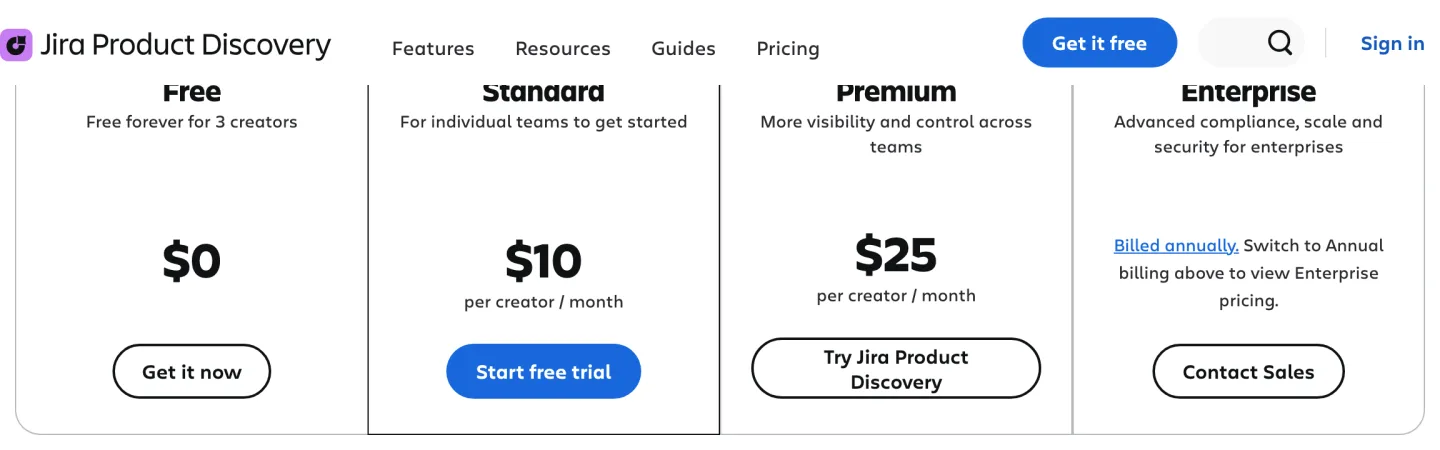
There is no proof figure for UserVoice on this site, because their plans page carries no number of any kind to photograph. What it names instead is what sets the quote: feedback volume, how much of the platform you switch on, and the integrations you connect, never a seat count.
Jira Product Discovery's own definition of a creator is a paid person who builds and manages projects, ideas, fields and views. A contributor, meaning anybody else with an Atlassian login, costs nothing on every plan including the free one.
How much does Jira Product Discovery cost compared to UserVoice?
Jira Product Discovery scales with how many people build a view. UserVoice's three sizes below land on the identical unpublished answer, since not one of the inputs it names is a person count.
| Your situation | Jira Product Discovery | UserVoice |
|---|---|---|
| 5 people, 4 of them build views, 1 only reads | $40/mo, 4 creators on Standard | Not published, the quote turns on feedback volume instead |
| 12 people, 6 build views, 6 only vote | $60/mo, 6 creators on Standard | Not published |
| 40 people spread over three departments, 10 build views | $100/mo, 10 creators on Standard | Not published |
UserVoice's column reads the same at every row on purpose, and that is what their own page states rather than a gap in this table. A company of five and a company of forty are quoted through the same three questions, none of which is how many of your people touch the board.
Jira Product Discovery's number only ever counts the people who build a view. The other thirty five people in that last row, the ones who read and vote, are contributors, and a contributor costs nothing on any plan Jira Product Discovery sells.
Which one should you choose?
They are built for different sized decisions, and naming both fairly matters more than picking a winner.
UserVoice's refusal to charge for a seat holds up even for a support team of thirty who only ever read the board, and that is worth crediting. Jira Product Discovery's free ride stops the moment a fourth person needs to edit.
Jira Product Discovery's willingness to show a number on the page you land on, floor or not, beats a vendor that shows none at all. You can work out your own bill today without booking anything.
Choose Jira Product Discovery if your ideas already need to land as Jira tickets and your team of editors is small. Choose UserVoice if the reason you are shopping is that your current tool charges every colleague who wants to look.
Why choose Jira Product Discovery over UserVoice, or UserVoice over Jira Product Discovery?
Because one of them lets you sign up and start today, and the other makes you book a call first.
Choose Jira Product Discovery when you want the price in front of you before you type anything, and when the people shaping ideas already carry an Atlassian login.
Choose UserVoice when your feedback programme has a named owner and a budget, and several departments, not just product, need the same account level picture. Their own page names four to six weeks to get a team running, with a named customer success manager guiding it.
The number matters less here than the buying motion. Signing yourself up suits one kind of team, and waiting for a guided setup suits the other.
Nothing here counts the people who vote, so a busy board costs the same.
Is there a cheaper alternative to both?
Against Jira Product Discovery's creator rate, yes, the moment your team of editors grows past three. Against UserVoice there is nothing printed to undercut, so the comparison is against a form rather than a figure.
Our nine dollar plan does not count creators, contributors or seats of any kind. The whole field, with the unit each vendor bills on, is one page, and the calculator works the arithmetic at a size you pick, naming our own price once rather than repeating it.
What does each do with a vote from a big customer?
One of the two writes about this on the page and the other stays quiet on it.
| Vendor | Weighting by revenue | Single sign on | API | Roadmap |
|---|---|---|---|---|
| Jira Product Discovery | – | – | – | Yes, embeds in Confluence |
| UserVoice | Named as their headline | – | Yes, no plan named | Yes, tied to account revenue |
| VoteFirst | All plans | Pro, no SAML | Pro | Yes |
Read on each vendor's own pages on 2026-09-15. A dash means nobody could read it on the pages opened that day, never that the capability is absent.
Jira Product Discovery does carry custom fields, so a team can type a revenue figure onto an idea and sort by it. That is a field somebody fills in and a sort somebody runs, not a weight written onto the vote itself, and neither page we read states it as a feature.
UserVoice's own wording is that its revenue weighted view stops priorities from shifting depending on which department is asking, and the site leads with that claim rather than tucking it into a spec sheet.
Can I move from one to the other?
UserVoice is the clearer answer here. Their own pricing page names two routes in, a CSV upload or a call to their API, and says their staff will handle whatever does not fit either route.
Jira Product Discovery's own pages, as we read them, never say whether a creator can pull ideas back out at all. Confirm that in writing before betting a migration plan on it.
Whatever two tools sit on either end of a switch, a plain vote count rarely keeps the identity of who cast it, the replies stacked under a request, or a bookmarked board address.
Where we fit, and where we do not
Nobody building this got to skip the harder work either of these two vendors already did. There is no field to score an idea against, no epic to link it to, and no account record anywhere in our own database.
The two products above each hook the board into something larger than itself. Jira Product Discovery pushes a kept idea onto a Jira epic and drops the roadmap into Confluence.
UserVoice attaches the same request to the paying account behind it, letting sales, success and product argue over one shared number, with a customer success manager sent along to set it up.
They also share a quieter habit: letting a colleague read or vote for nothing. Jira Product Discovery's route there is a named role, the contributor, that never gets a bill.
UserVoice's route is not billing seats at all, so a support desk of thirty costs the account exactly as much as a support desk of three.
We copy neither habit. Instead a tier carries a multiplier, that multiplier lands on the vote the second somebody casts it, and the nine dollar plan gets the same mechanism as the thirty nine dollar one.
What is Jira Product Discovery, and what is UserVoice?
Jira Product Discovery is Atlassian's idea tool, built to sit next to Jira rather than replace it. Feedback becomes an idea, the idea gets scored against fields your team invents, and the ones worth building link straight to the epic that will ship them.
Only the person building that link pays, on a plan sized to how many of your people do the building.
UserVoice sells the same broad job, an ideas list a customer can post to, but wraps it in a sales process rather than a checkout page. The distinguishing move is tying every request to the paying account behind it, and refusing to say what any of that costs until somebody calls.
Does either one have a free plan?
Jira Product Discovery does and UserVoice does not. Read on their pricing page on 14 September 2026, three people can build views, an unlimited number can only look, and two gigabytes of storage comes with it, free for as long as you stay under that ceiling.
UserVoice's plans page, read on 15 September 2026, offers a thirty day trial arranged by booking a demo, with no self serve tier under it at any price.
What this costs
Lite
$9 /mo
Pro
$39 /mo
Lifetime
$999 once
Fourteen day trial of Pro, card asked for at signup. Nothing here counts the people who vote, so the bill does not move when the board starts working. The long version, with what happens if you stop paying.
The honest summary
Jira Product Discovery will show you a number today, and the number stays small as long as your editors do. UserVoice will not show you a number at all, on any day, at any size, because it is pricing a rollout rather than a login.
Neither silence is a trick. Jira Product Discovery's contributors cost nothing because the software only counts who builds. UserVoice's seats cost nothing because the plan is priced on volume and integrations instead, and pricing a company that way, rather than a person, is a fair way to run a sales led product.
The Jira Product Discovery alternative page and the UserVoice one carry each side on its own.
14 days, a card at signup, then $9 or $39 a month.