Productboard and UserVoice are both aimed at a product organisation rather than at one person with a board, and neither is priced the way most of this category is.
Productboard charges by the maker, which is their word for a product manager. UserVoice charges nothing you can read on its own page. Everything below was read on each vendor's own pages, and the dates are named where they differ.
What does each one charge?
| Vendor | From | Billed per | Free plan | Trial |
|---|---|---|---|---|
| VoteFirst | $7.50/mo | plan | – | 14 days, card |
| Productboard | $19/maker/mo | maker | 500 notes | – |
| UserVoice | Not published | quoted | – | 30 days |
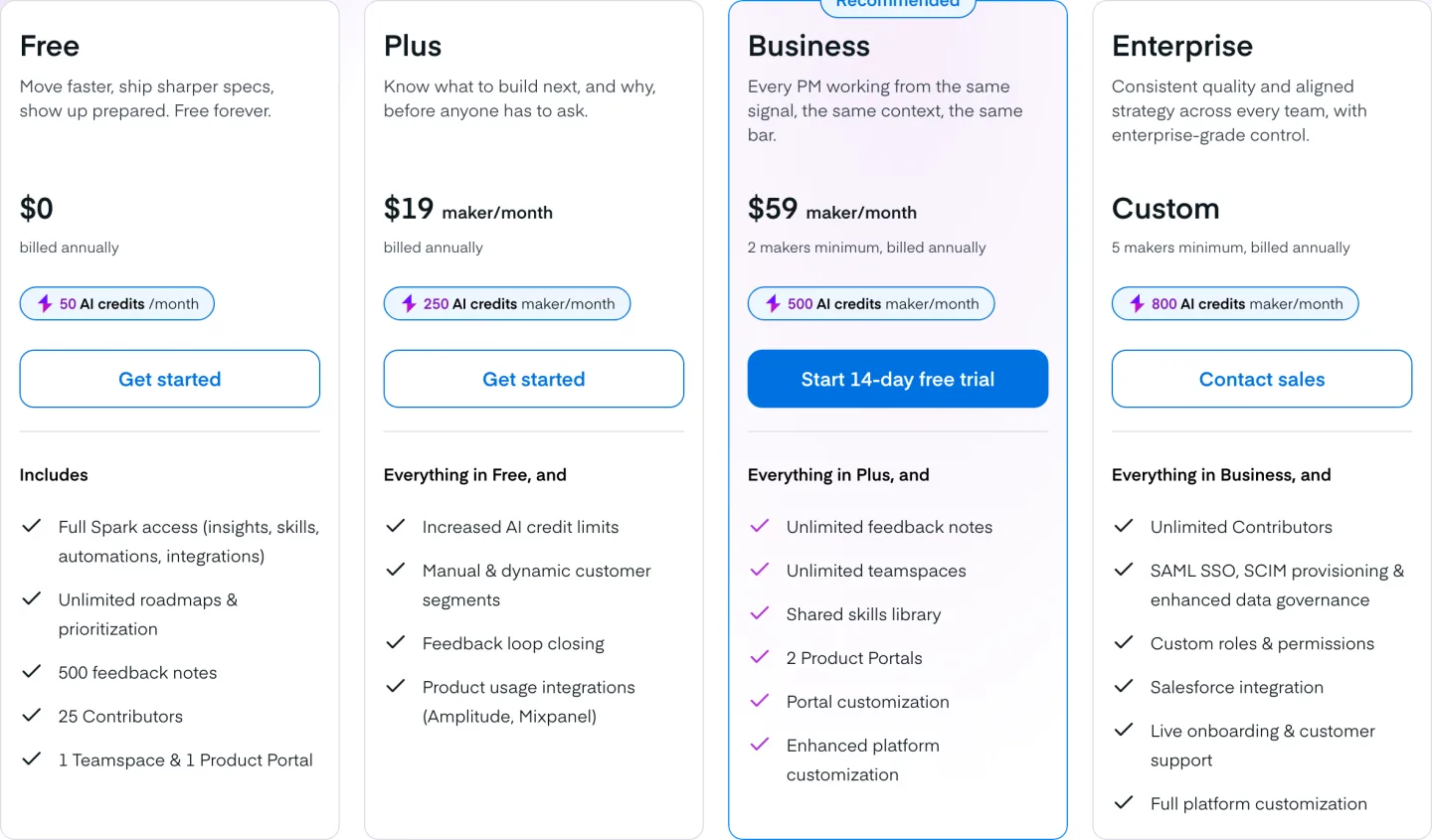
Productboard's own pricing page loaded eight times on 9 September 2026, signed out, from one machine, showed two different price lists. Two of the eight loads carried a free plan and a plan starting at nineteen dollars a maker a month, billed yearly.
Six of the eight loads carried no free plan and a floor of fifty nine dollars a maker a month, billed yearly. The figure above is the first reading, the one with the free plan and the nineteen dollar floor.
UserVoice has no pricing proof figure on this site, because there is nothing to photograph. Their plans page, read on 9 September 2026 and again on 14 September 2026, carries no number of any kind, on either visit. The only button on it is to talk to an expert.
How much does Productboard cost compared to UserVoice?
Productboard's bill moves with your team, not with your customers. UserVoice's page names three inputs, feedback volume, the tools you use and the integrations you connect, and states plainly that seats are never one of them. So there is no team size at which a UserVoice number appears.
| Your situation | Productboard | UserVoice |
|---|---|---|
| 1 maker, evaluating | $19/maker/mo billed yearly, on Plus, one maker minimum | Unpublished |
| 4 makers | $236/mo billed yearly, or $295/mo if the five maker minimum on Business applies to you, both printed on their own page | Unpublished |
| 8 makers | $472/mo billed yearly on Business, above every minimum they quote | Unpublished |
The ambiguity in the four maker row is not a rounding error. Productboard's own feature table gives the Business plan a minimum of two makers in one place and five in another, and four people fall on different sides of those two numbers.
UserVoice does not move in this table at all, because the axis it prices on is not the one this table is built for. A team of one and a team of forty are quoted the same way, by their own account, which is unusual in this category and is explained further below.
Which one should you choose?
They are built for the same kind of buyer, a product organisation, but they answer different questions inside it.
Productboard is the better tool if the job is coordinating several product managers around one roadmap. Teamspaces, a strategy layer, prioritization frameworks and connections to Amplitude and Mixpanel exist because more than one person is planning the same product.
UserVoice's revenue weighted view is the most direct claim of its kind in this whole category, and it is not faint praise.
Their own words are that every function gets the same revenue weighted picture so priorities stop shifting between departments. Of the thirty two tools read for this site, theirs is the most prominent version of that idea.
Productboard is the more finished feedback board of the two. It has a public portal, a free plan and a documented feature list you can read today without a call.
Nine dollars a month for one project, with weighted voting on it.
Why choose Productboard over UserVoice, or UserVoice over Productboard?
Choose Productboard when you want to see the price and the feature list before anyone from either company talks to you. Their pricing page, whichever version loads, is open right now, and their free plan lets you run something small at no cost.
Choose UserVoice when the reason you are comparing tools is that your current one charges every colleague who wants to look. UserVoice states outright that its plan is based on feedback volume, tools and integrations, never on seats, so sales and success teams reading the same feedback cost nothing extra.
Choose UserVoice as well if the buyer in your company expects a sales conversation and a contract rather than a signup form, since that is the only way to get a number from them at all.
Is there a cheaper alternative to both?
Almost anything with a flat, published price is cheaper to compare than a vendor with no number to compare against, and Productboard's own floor starts at nineteen dollars a maker before a second person joins.
The full field, with the unit each vendor bills on, is one page, and the calculator works the arithmetic at a team size you choose. This product is nine dollars a month for one project, with no maker count and no seat minimum in the bill.
What does each do with a vote from a big customer?
A dash below means nobody could read that capability on the pages opened, not that it is absent.
| Vendor | Weighting by revenue | Single sign on | API | Custom domain |
|---|---|---|---|---|
| Productboard | – | Yes, portal SSO, SAML with SCIM on the top tier | Yes | Yes, a whitelabelled portal |
| UserVoice | Yes, revenue weighted insights, in their own words | – | Yes | – |
| VoteFirst | All plans | Pro, no SAML | Pro | Pro |
Productboard's own marketing describes prioritizing by customer value and business outcomes, with no revenue or MRR wording found on the pages read. That is an absence on the pages, not proof the software cannot do it. UserVoice's is the opposite case, a named claim rather than a silence.
Can I move from one to the other?
UserVoice's own page says feedback moves in by CSV or by their API, and that their team will handle the difficult cases by hand. That is a real commitment to migration and it is stated plainly.
Productboard's pages read for this site describe an API and a CSV export, but the export named is the list of feature requesters rather than the whole board, so what leaves is a contact list rather than a history of requests and votes.
Neither page describes moving data in the other direction, from UserVoice into Productboard or back, so that step is not sourced here and is not claimed.
Where we fit, and where we do not
Both of these are built to sit above a single feedback board, and that is the part we do not have.
Productboard gives a product organisation teamspaces, a shared strategy layer and connections to usage data in Amplitude and Mixpanel. UserVoice ties the same feedback to account revenue across sales, success and product, with a four to six week onboarding and a named customer success manager to run it.
Neither of those exists here. There is no strategy layer, no teamspace, no usage data integration and no guided onboarding of any kind. A project starts the moment the trial does.
There is also no free plan on this product, no private board at any price, and no AI feature anywhere, and none is planned. Productboard's free plan and UserVoice's account tying are both real advantages for the buyer either one is built for.
What this product does instead is put a multiplier on a voting tier and write that weight onto the vote when it is cast, on every plan including the nine dollar one.
Revenue weighting exists at both of these vendors in some form, so it is a difference in scope rather than something we alone have.
What is Productboard, and what is UserVoice?
Productboard is a product management platform, priced per maker, where the feedback portal is one surface among roadmaps, insights, prioritization and a document layer for several product managers working together.
UserVoice is an enterprise feedback and idea management product sold through a sales process. It ties feedback to accounts across sales, support and product, and its plans page publishes no price.
Does either one have a free plan?
Productboard does. Its pricing page, on the reading with a free tier, gives five hundred feedback notes, one teamspace and one product portal, and the cap is on the volume of feedback rather than on people. Six of the eight loads taken on 9 September 2026 did not show this plan at all.
UserVoice does not. Its plans page read on 14 September 2026 offers a thirty day trial arranged by booking a demo, and there is no self serve tier at any price.
What this costs
Lite
$9 /mo
Pro
$39 /mo
Lifetime
$999 once
Fourteen day trial of Pro, card asked for at signup. Nothing here counts the people who vote, so the bill does not move when the board starts working. The long version, with what happens if you stop paying.
The honest summary
Productboard is a maker priced platform with a real free plan and a page that sometimes shows you a different price than it showed the last person.
UserVoice is a sales led platform with a genuine no seat commitment and no number anywhere on the page that is supposed to have one. Read Productboard's page more than once before you trust the figure on it, and do not expect a figure from UserVoice's page at all.
The Productboard alternative page and the UserVoice one carry each side on its own.
14 days, a card at signup, then $9 or $39 a month.