Canny and Productboard both show a monthly figure and the two figures are not comparable, because one counts your customers and the other counts your colleagues. Everything below was read on each vendor's own pricing page on 14 September 2026.
What does each one charge?
Seventy nine dollars a month, nineteen dollars a maker, and nine, and only the first of the three grows with how many people use the board.
| Vendor | From | Billed per | Free plan | Trial |
|---|---|---|---|---|
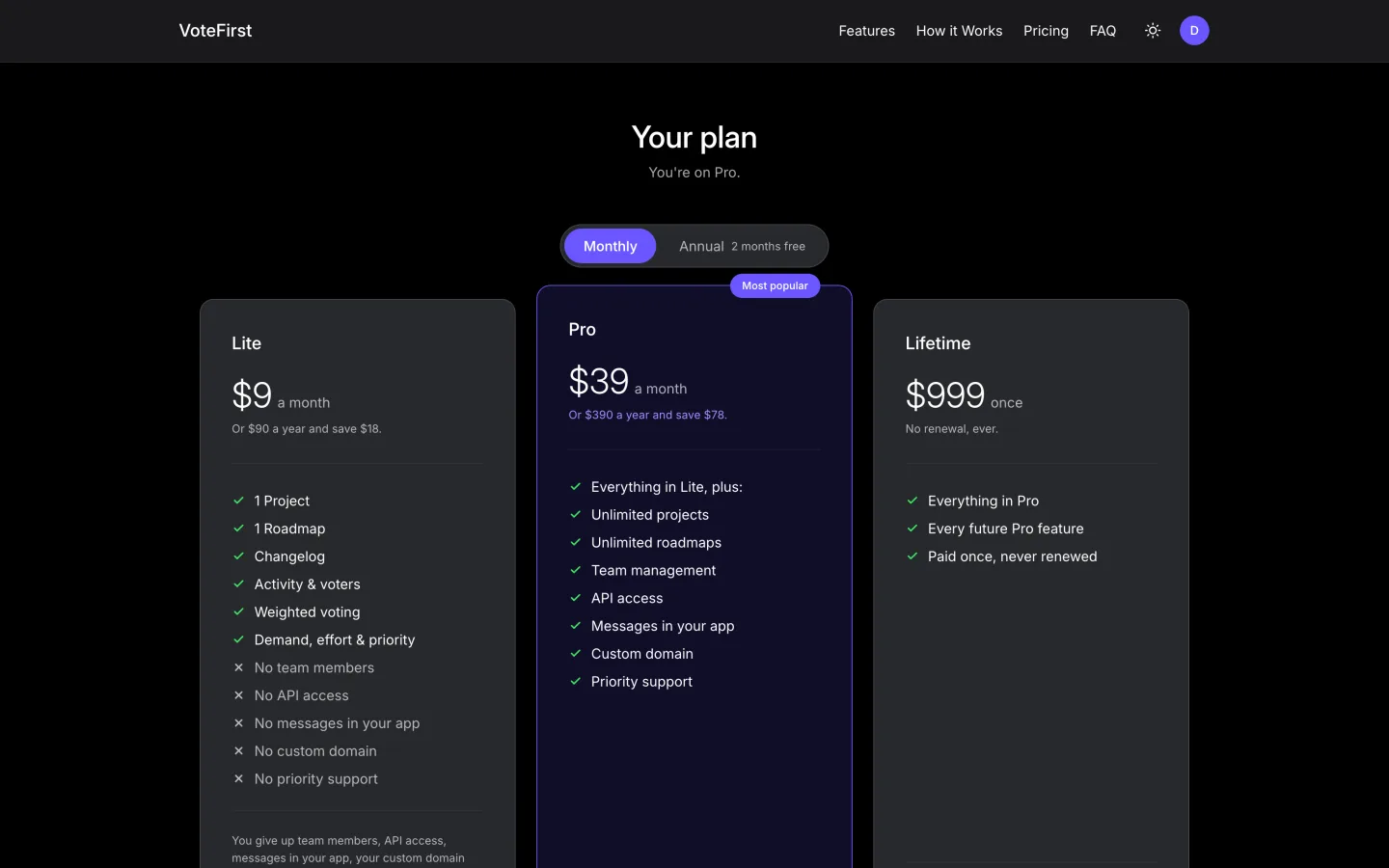
| VoteFirst | $9/mo | plan | – | 14 days, card |
| Productboard | $19/maker/mo | maker | 500 notes | – |
| Canny | $79/mo | tracked user | 25 users | – |
Read on each vendor's own pricing page on 2026-09-14.
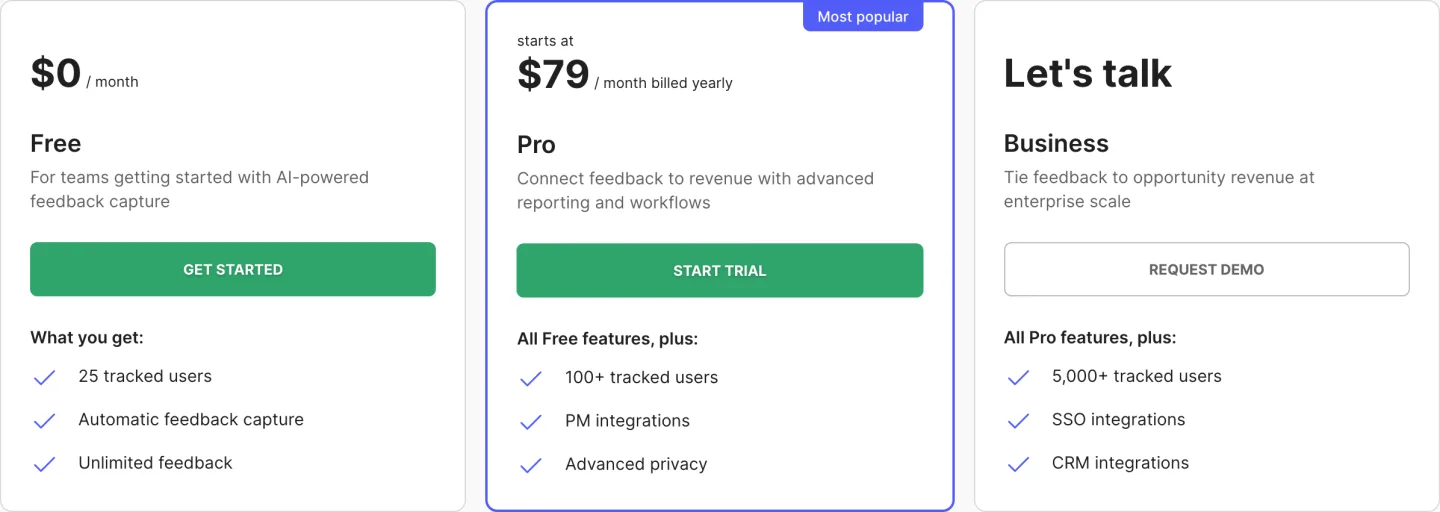
Canny's own definition of a tracked user is any user associated with feedback, so the meter runs on the people you are trying to hear from. Productboard's maker is a person on your side who edits, and viewers are not makers.
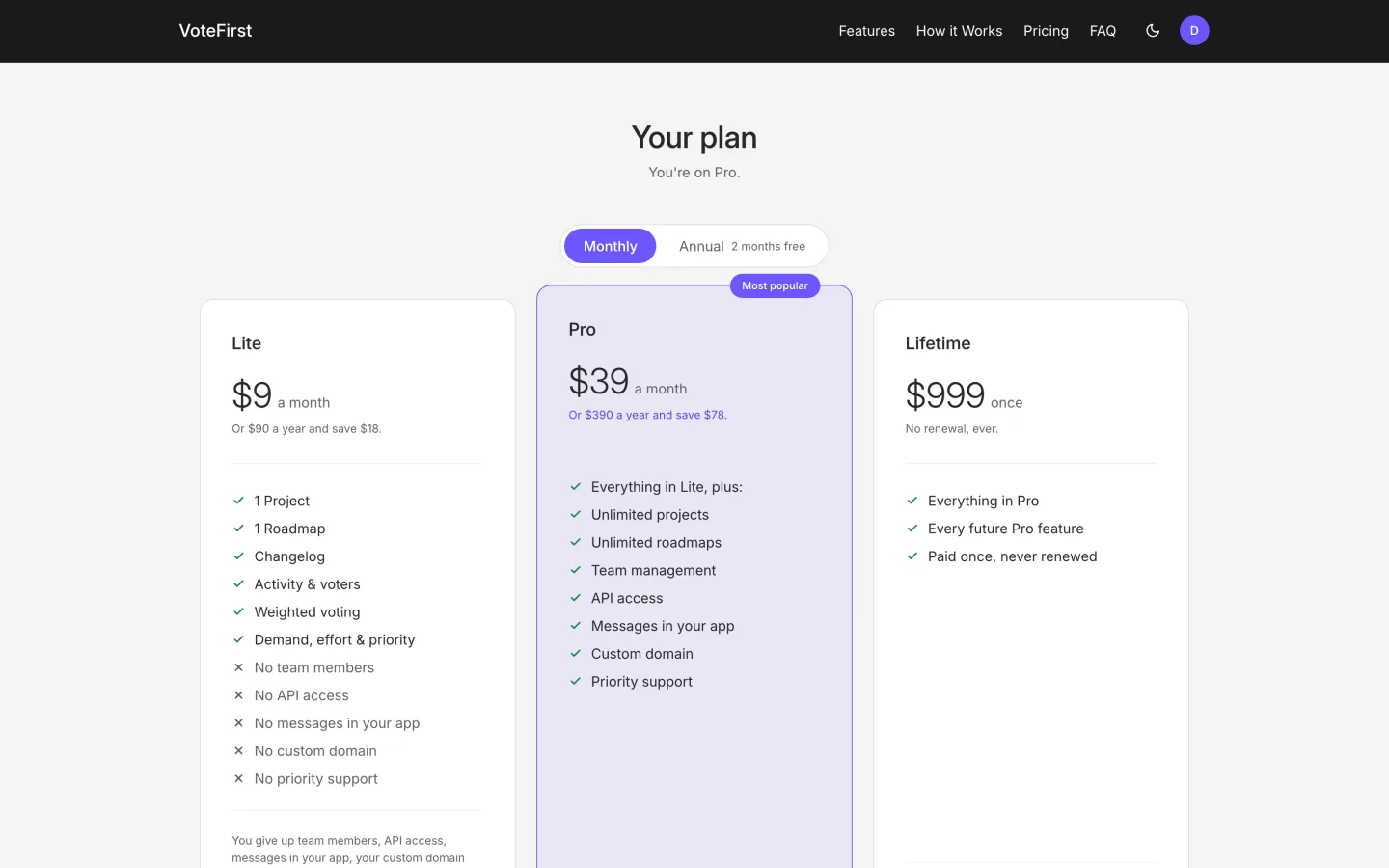
This site sells a third thing, which is a plan, and it belongs here rather than at the end, because the comparison is the point of the page and hiding one unit would make the table worth less.
How much does Canny cost compared to Productboard?
It depends entirely on the shape of your company, and here is the arithmetic at three of them.
| Your situation | Canny | Productboard |
|---|---|---|
| 3 people on the team, 80 customers vote | Free, under the 25 tracked user line is unlikely at 80 voters, so $79/mo | $57/mo at $19 a maker |
| 8 people on the team, 400 customers vote | $79/mo and upward, the rate above 100 tracked users is not published | $152/mo at $19 a maker |
| 30 people on the team, 120 customers vote | $79/mo and upward | $570/mo at $19 a maker |
The crossover is roughly where your team stops being smaller than your engaged customer base. A four person company with a busy board pays Canny more. A thirty person company with a quiet board pays Productboard more, by a lot.
Canny does not publish the rate above 100 tracked users. Their page says the Pro plan starts at $79 a month billed yearly and scales with usage, with a slider from 25 to 5,000 and an optional spend limit, and no printed figure for the steps in between. That is the single most important thing on this page and neither vendor's own comparison mentions it.
If you would rather look at a board than read about billing, the demo is open without an account.
Which one should you choose?
They are aimed at different jobs and the honest answer names both.
Productboard is the better product management tool, and it is not close. It is a suite of insights, prioritisation, roadmaps, portals and a documented integration surface, built for a product organisation with several teams. If what you need is a place for product managers to do product management, buy it and stop reading.
Canny is the better public feedback board. It is simpler, the portal is what the product is, and a customer landing on it understands it in five seconds. Canny also ships an AI capture layer that reads support and sales conversations and deduplicates what it finds, which is a real capability and one we do not have.
Why choose Canny over Productboard, or Productboard over Canny?
Because one of them is a portal with a product behind it and the other is a product with a portal on the side.
Choose Canny when the board itself is the thing your customers will look at every week, because the portal is what the product is and a visitor understands it without being told.
Choose Productboard when several teams inside your company have to agree on what gets built, because the insights, the prioritisation and the roadmaps are where that argument is settled and a board alone will not settle it.
The price follows from that and does not lead it. A tool bought for the wrong one of those two jobs is expensive at any figure.
Is there a cheaper alternative to both?
Several, and the cheapest depends on whether you are counting seats or voters.
Against Productboard's per maker rate, anything with a flat price is cheaper the moment you have three colleagues. Against Canny's tracked user meter, anything flat is cheaper the moment the board starts working, and the calculator runs both comparisons on a size you choose.
The whole field with the unit each vendor bills on is one page, and the honest caveat is that cheaper is the easiest axis to win on and the least likely to be the one that matters.
What does each do with a vote from a big customer?
Canny sorts by the revenue a feature affects, Productboard's pages read that day never say, and ours multiplies the vote itself.
| Vendor | Weighting by revenue | API | Export | Custom domain |
|---|---|---|---|---|
| Canny | Orders by revenue | Pro | – | Yes |
| Productboard | – | Yes | Requesters only | Yes |
| VoteFirst | All plans | Pro | CSV | Pro |
Read on each vendor's own pricing page on 2026-09-14.
A dash means nobody could read it on the pages opened that day, never that the capability is absent. An empty search is not proof.
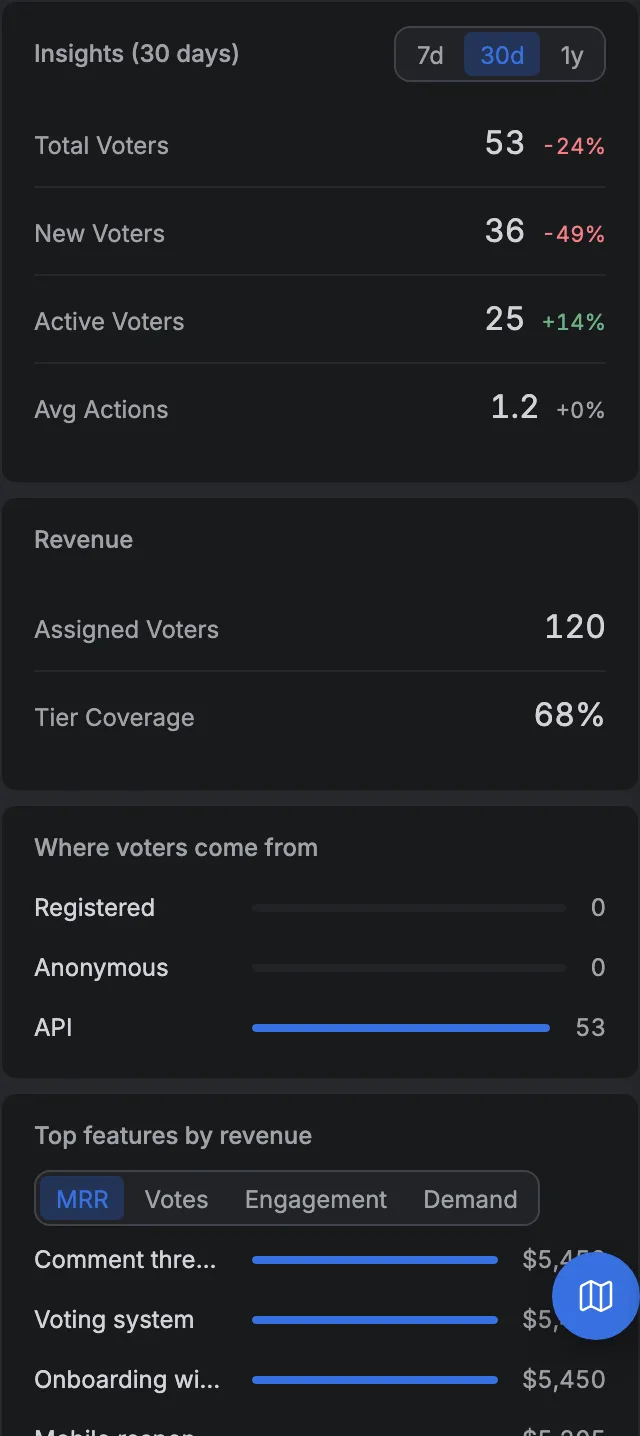
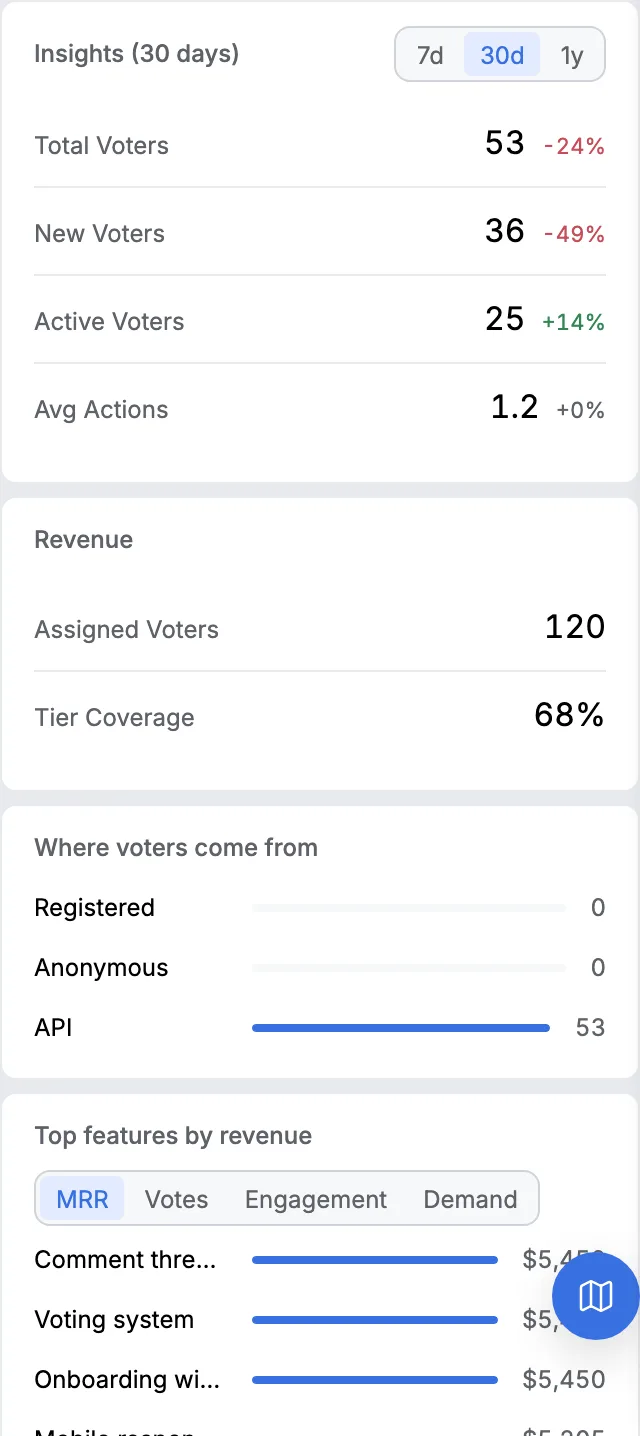
Canny's own feature page describes Sort by MRR Impact as keeping track of the revenue a feature affects. That orders a list. It is not the same as multiplying one person's vote, and the difference matters when a request has four votes from your four largest accounts and thirty from a free tier.
Can I move from one to the other?
Both export, and what an export loses is the part nobody writes down.
Four things usually do not survive a move between any two tools in this category. Who cast each vote rather than the total, the threading on comments, the original timestamps, and every board URL anybody has ever shared.
What a Canny export actually contains is written up separately, from the file rather than from their documentation.
Where we fit, and where we do not
We are not a product management suite and we are not trying to be. There is no insights layer, no teamspace, no portfolio view, and no AI reading your support inbox.
What this product does is put a multiplier on a tier, write that weight onto the vote when it is cast, and show the plain count beside the weighted total on the same card.
Two of the twenty eight products we read on 14 September describe weighting a vote by customer revenue in their own words, Frill and ProductLift, and four more describe ordering by revenue without weighting the vote. It is a difference rather than something we alone have.
The price does not move with how many customers vote. That is the whole of the billing argument and it is worth exactly as much as the tracked user problem costs you, which for a small board is nothing.
What is Canny, and what is Productboard?
Canny is a feedback board with a roadmap and a changelog, billed by the customers who take part. Productboard is a product management suite, with an insights layer, prioritisation, roadmaps and a customer portal, billed by the people on your own team.
Does either one have a free plan?
Both do, and they cap different things. Canny's pricing page read on 14 September 2026 gives twenty five tracked users. Productboard's, read the same day, gives five hundred feedback notes with one teamspace and one product portal, so the ceiling there is the volume of feedback rather than the number of customers who sent it.
The honest summary
Two different units, two different jobs, and one unpublished rate that decides the answer for anybody whose board actually works. Productboard for a product organisation. Canny for a public board with an AI capture layer. Ours if you want the vote itself to carry what the voter pays, at nine dollars flat.
The Canny alternative page and the Productboard one carry each side on its own.
14 days, a card at signup, then $9 or $39 a month.