UserVoice pricing is not a number you can read anywhere, and every page that gives you one is guessing. We read their pricing page on 9 September 2026 and it carries no figure of any kind.
That is not a dead end though, because the page carries several things that decide the cost anyway, and those are worth more than a number somebody made up.
What does uservoice cost?
Nothing is published. Their page says the plan is based on feedback volume, the tools you use and the integrations you connect, and never by seat.
That last clause is a real commitment and it is worth taking seriously.
In a category where nine of the twenty one tools we priced count colleagues in some form, either as the price itself or as the cap on the cheap plan, a vendor stating plainly that your sales and success teams do not cost extra is making the expensive part of most competitors disappear.
If the reason you are shopping is that your current tool charges for every colleague who wants to look, this is the page in the category that answers you.
What we cannot tell you is what any of it comes to, and we are not going to estimate it. Every other vendor's real figure is on one page and this is the one row on it that reads not published, because that is what their own page says.
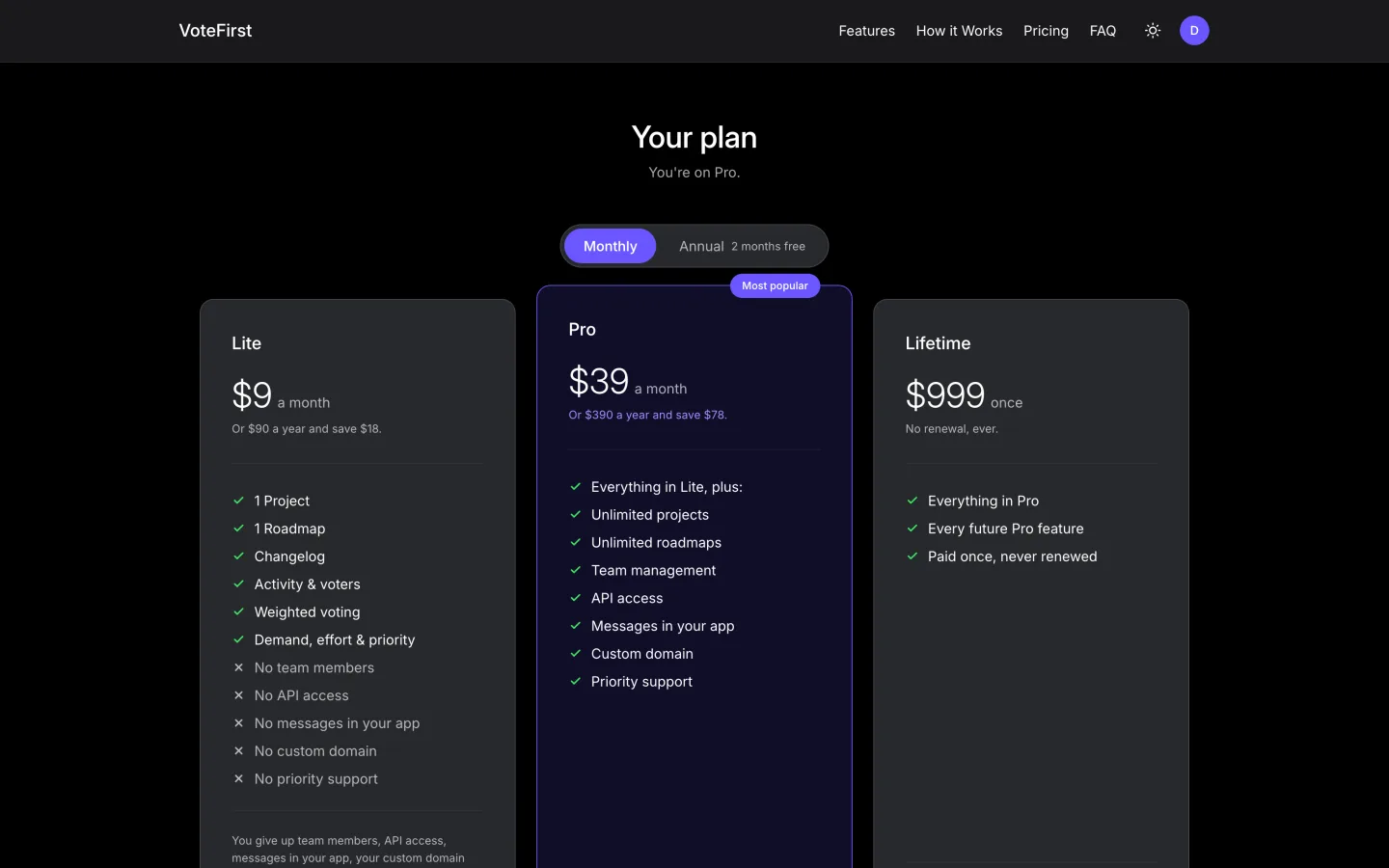
If that arithmetic came out badly, a trial here is 14 days with a card at signup and the bill after it is $9 or $39 a month whatever the vote count does.
Does UserVoice have a free plan?
No. Their plans page read on 14 September 2026 offers a thirty day trial arranged through a demo, and there is no self serve tier at any price.
What actually decides the quote?
Three things by their own account, and none of them is the number of people on your board.
Feedback volume is the first, which is how much is arriving rather than how many people it arrived from. The tools you use is the second, meaning how much of the platform you turn on. Integrations connected is the third.
So the shape of the bill grows with how much you put through it rather than with how many colleagues open it. That is a defensible way to price an enterprise platform and it is the opposite of the seat model most of this category runs.
How long does it take to get started?
Four to six weeks for most teams, by their own figure, with one to two weeks of that being technical setup.
This is the single most useful fact on their pricing page and almost nobody puts it in a comparison. The rest of the window is a success plan, fitting the tool into how your team already works, and training, guided by a named customer success manager.
If you are a founder who wants a board up this afternoon, that timeline is the answer to whether this is your tool, and it is a clearer answer than any price would have been.
If you are a product organisation running a feedback programme across several teams, a guided six week rollout is a feature rather than a cost, and you should read it that way.
Ours takes about as long as it takes to type a project name. The demo board is open right now with no form in front of it, which is the same product a trial gives you.
Is there a trial?
Thirty days, and you get it by booking a demo rather than by signing up.
Their page says free trials are available and that booking a call gets your team a workspace to try hands on for thirty days. That is a longer window than ours and a slower door than ours, and which of those matters more depends entirely on whether you want somebody to walk you through it.
Ours is fourteen days, it starts from a signup form, and it asks for a card. We would rather write that here than have you discover it later.
14 days, a card at signup, then $9 or $39 a month.
One thing their pricing page does not tell you, and it changes what you are buying. Their portal asks a voter how important each idea is on a three point scale rather than counting a single upvote. Their own board was opened and what a vote there actually is written down.
Can you move your existing feedback in?
Yes, by CSV or by their API, and their own team will do the difficult ones.
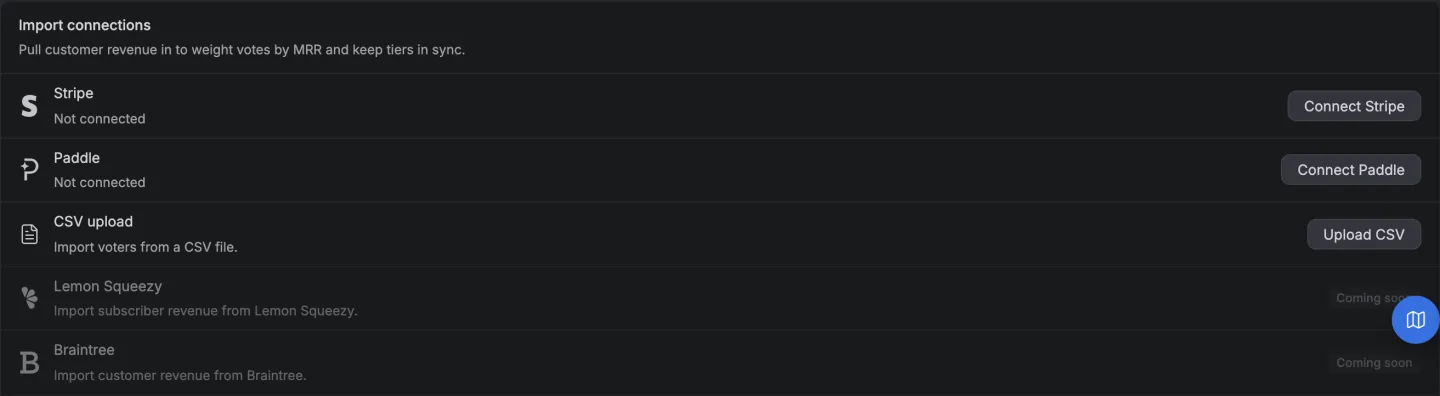
That is a genuinely good answer and better than ours in one direction. We import voters and what they pay, and we do not import posts or votes, so a board rebuilt on us starts empty of history.
If carrying the history of an existing forum matters more to you than anything else on this page, that is a real reason to choose them and we would rather say so than bury it.
What does a team of four cost a year?
Unknown, and the missing figure is the rate rather than anything about your team.
Their page names what the quote is based on, being feedback volume, the tools you use and the integrations you connect, and it is explicit that seats are not part of it.
So a team of four and a team of forty are quoted the same way, which is unusual in this category and genuinely in a buyer's favour.
What is not published is any rate to multiply those inputs by. There is no figure on the page to put in a sum, so this section stops here rather than borrowing one from somewhere else.
Who is uservoice for?
Companies where the feedback programme has a named owner and a budget, which is a different reader from ours.
Twenty years of doing this, a dedicated success manager, professional services available, an enterprise security and compliance page, and a sales conversation before a price.
Everything about the shape says a large organisation with a process to run, and the four to six week onboarding is not an accident, it is what serving that customer looks like.
We are nine dollars a month for one project, one board, one roadmap and a changelog, with votes weighted by what the customer pays and no call to book.
Those are not competing answers to one question. They are answers to two different questions, and the honest thing is to say which one you are asking.
The product comparison rather than the price one is here, and what every tool in the category actually bills on is here.