Canny's pricing page and UserVoice's pricing page were both read on 15 September 2026, and one of them has a figure on it. Canny shows seventy nine dollars a month. UserVoice shows nothing, anywhere, at any tier.
That is not a gap in this page. It is the actual difference between the two products, and the rest of this page is about what you can find out before either of them takes your card or your calendar.
What does each one charge?
Canny prints a figure. UserVoice prints a button.
| Vendor | From | Billed per | Free plan | Trial |
|---|---|---|---|---|
| VoteFirst | $7.50/mo | plan | – | 14 days, card |
| Canny | $79/mo | tracked user | 25 users | – |
| UserVoice | Not published | quoted | – | 30 days |
Read on each vendor's own pricing page on 15 September 2026.
UserVoice has no pricing proof image in this table, because there is no price on their page to photograph. Their plans page carries no figure of any kind and the only call to action on it is to talk to an expert.
What their page does say is what the number depends on. Their own words are that the plan is based on feedback volume, the tools you use and the integrations you connect, and never on seats.
Canny's own page says the Pro plan starts at seventy nine dollars a month billed yearly, at a hundred tracked users, with a slider running from twenty five to five thousand and no printed figure for the steps in between. That much at least is a number, even if it stops early.
How much does Canny cost compared to UserVoice?
Canny has an answer at three sizes. UserVoice has an answer at none of them, because nothing about its own team size changes what it asks you to type into a quote form.
| Your situation | Canny | UserVoice |
|---|---|---|
| 3 people on the team, 80 customers vote | Free, under 25 tracked users is unlikely at 80 voters, so $79/mo | Unpublished, a call decides it |
| 8 people on the team, 400 customers vote | $79/mo and upward, the rate above 100 tracked users is not published | Unpublished, and their own page says seats never move the number |
| 30 people on the team, 400 customers vote | $79/mo and upward | Unpublished |
The UserVoice column reads the same at every size on purpose. Their own page says the quote is set by feedback volume, the tools you turn on and the integrations you connect, not by how many people are on your team or your board.
Canny does not publish the rate above 100 tracked users. UserVoice does not publish a rate at any point. One vendor is missing a middle. The other is missing the whole thing.
If you would rather look at a board than read about billing, the demo is open without an account.
Which one should you choose?
They are built for different buyers, and naming both fairly matters more than picking a winner.
UserVoice is the more serious tool for an organisation with departments. It ties feedback to accounts across sales, support and product, so a company where several teams need to read the same customer signal gets something Canny does not build.
Canny is the faster tool to actually start using. You can read a price, put in a card and have a board today. UserVoice asks for a conversation first, and their own page names four to six weeks to get a team running.
Why choose Canny over UserVoice, or UserVoice over Canny?
Because one of them sells you a board this afternoon and the other sells you a rollout.
Choose Canny when you want to see the price before you talk to anybody, because their page has a number on it and a self serve signup underneath it.
Choose UserVoice when your revenue data lives in a CRM and several departments need the same feedback tied to the same accounts, because that coordination problem is what their onboarding is built to solve, and their own page names a named customer success manager as part of it.
A four to six week onboarding is not a flaw if the thing being onboarded is a whole company. It is only a flaw if what you wanted was a board by Tuesday.
The demo board is open and it asks for no account.
Is there a cheaper alternative to both?
Cheaper is easy to find against a vendor that will not tell you the number, because almost anything printed is cheaper than nothing you can read.
Against UserVoice, any tool with a figure on its own page beats it on this one axis by default, since there is no published rate to compare against. Against Canny, anything billed flat rather than by tracked user is cheaper the moment the board starts working.
The whole field with the unit each vendor bills on is one page, and the honest caveat stands here too. Cheaper is the easiest axis to win on and the least likely to be the one that decides your actual choice.
What does each do with a vote from a big customer?
Both weight a vote by revenue, and it is the headline claim on UserVoice's own page rather than something buried in a features list.
| Vendor | Weighting by revenue | Single sign on | API |
|---|---|---|---|
| Canny | Orders by revenue | Base features | Pro |
| UserVoice | Named as their headline | – | Published, no plan named |
| VoteFirst | All plans | Pro, no SAML | Pro |
Read on each vendor's own pricing page on 15 September 2026. A dash means nobody could read it on the pages opened that day, never that the capability is absent.
Read on each vendor's own pages on the date in the row above. Not published means nobody could read it on the pages opened that day, never that the feature is absent.
UserVoice's own words are that it gives every function the same revenue weighted view so priorities stop changing, and that it weights signals by revenue impact rather than tallying votes. Canny sorts by monthly revenue impact and counts a company's revenue once per post, however many people from that company vote.
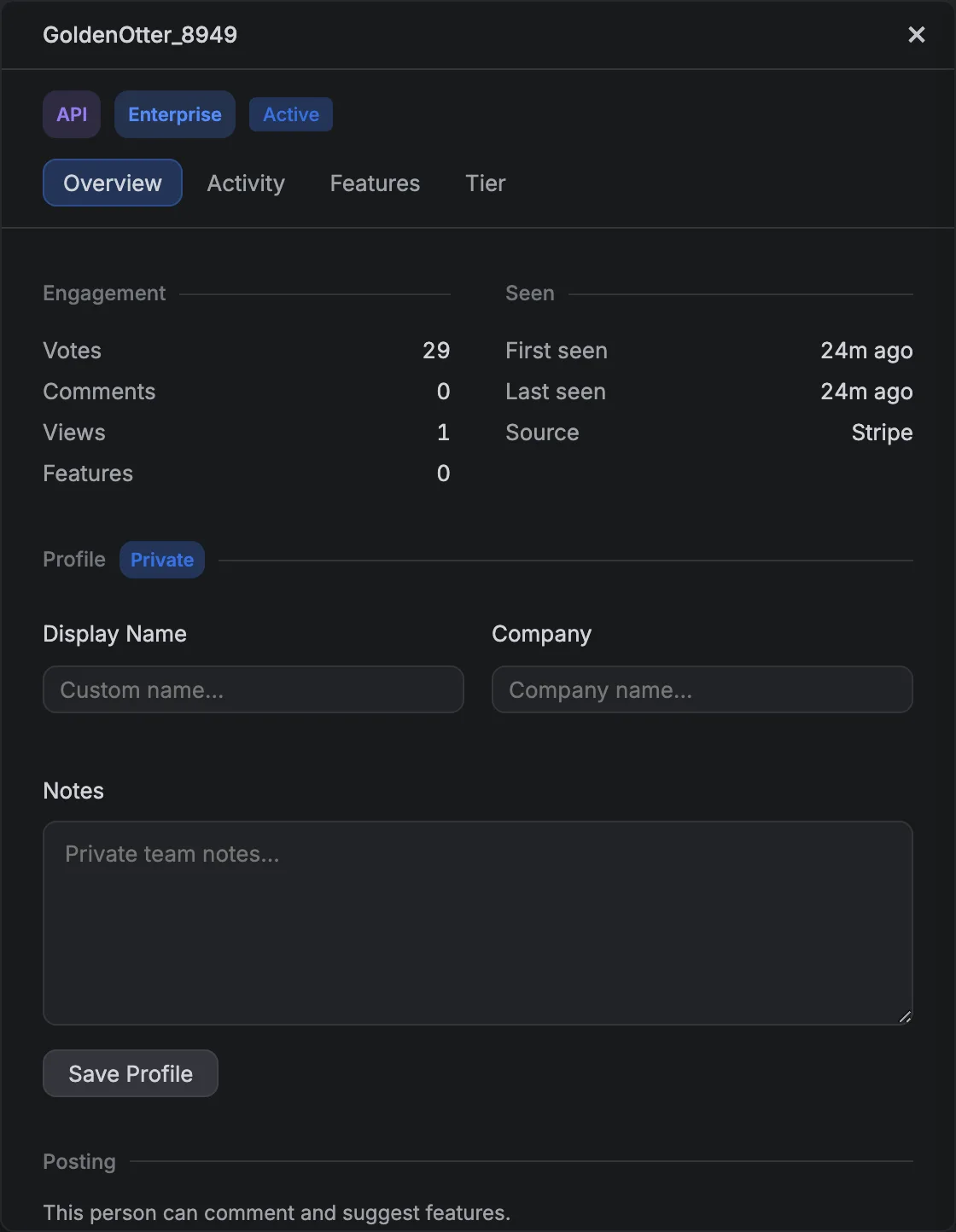
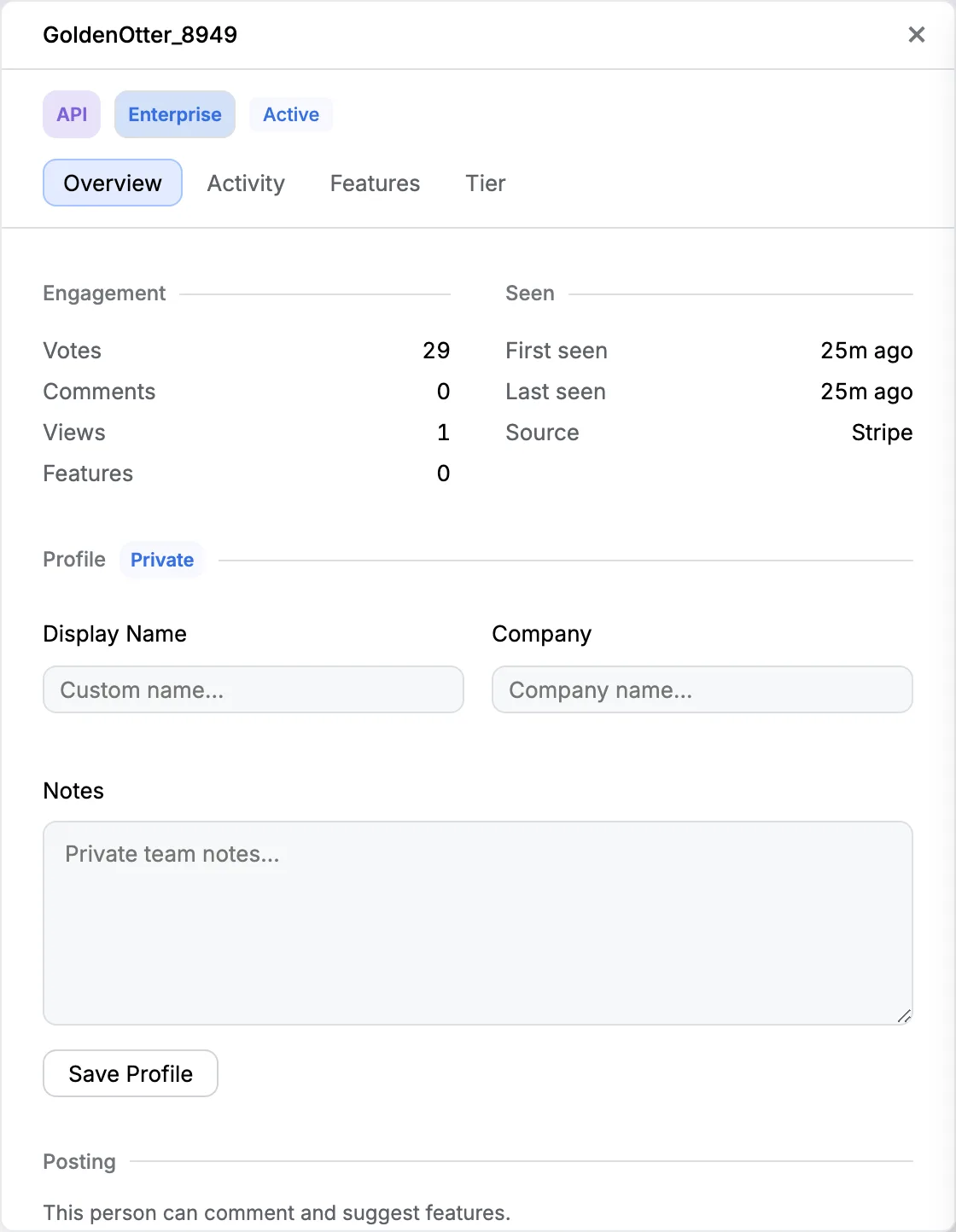
Our own version is a whole number multiplier on a voting tier, set by you and written onto the vote when it is cast, with the plain count still visible beside the weighted one. Neither of the two above works that way.
It is a difference rather than something we alone do. Eight of the thirty two tools read for the UserVoice page describe some form of it in their own words.
Can I move from one to the other?
UserVoice is the better answer here, and it is worth saying plainly.
Their own pricing page states you can move existing feedback in by CSV or by their API, with their own team handling the difficult cases. Canny's export is also real and documented rather than a support ticket.
We import voters and what they pay, and we do not import posts or votes, so a board rebuilt on us starts empty of that history. The five steps, with the endpoint each one uses, are written out in full, and they are the same five whatever you are leaving.
Where we fit, and where we do not
We are not built for a department handoff and we are not trying to be. There is no CRM connection, no sales tools sync, and no six week onboarding with a named success manager, because there is no onboarding at all beyond a signup form.
There is also no private board at any price, no free plan, and no AI feature of any kind reading a support inbox or a sales call. Canny and UserVoice each do at least one of those in their own way, and we do none of them.
What this product does is put a multiplier on a tier, write that weight onto the vote when it is cast, and show the plain count beside the weighted total on the same card, on the nine dollar plan as well as the thirty nine dollar one.
What is Canny, and what is UserVoice?
Canny is a feedback board with a roadmap and a changelog, billed by the tracked users who touch it, with a published starting price of seventy nine dollars a month.
UserVoice is an enterprise feedback and idea management product, tying feedback to accounts across sales, support and product, sold through a sales process with no price published anywhere on its plans page.
Does either one have a free plan?
Canny does. Its pricing page read on 15 September 2026 gives twenty five tracked users at no cost.
UserVoice does not. Its plans page, read the same day, offers a thirty day trial arranged by booking a demo, and there is no self serve tier at any price.
What this costs
Lite
$9 /mo
Pro
$39 /mo
Lifetime
$999 once
Fourteen day trial of Pro, card asked for at signup. Nothing here counts the people who vote, so the bill does not move when the board starts working. The long version, with what happens if you stop paying.
The honest summary
Canny will tell you the price before you have typed anything into a form. UserVoice will not tell you the price at all.
The reason it will not is the same reason it might be the right tool for a company with departments, a CRM full of revenue, and a six week runway to get everybody trained.
Neither absence is a trick. Canny stops printing a number once your board gets big. UserVoice never starts. If you want the arithmetic done for you rather than a conversation booked for you, ours is nine dollars a month, published, on a card, in about a minute.
Seven Canny alternatives of different shapes are on one page. The Canny alternative page and the UserVoice one carry each side on its own.
14 days, a card at signup, then $9 or $39 a month.