Idea management is collecting suggestions from customers and colleagues in one place, sorting them, and deciding which of them become work.
It is also one of those phrases that sounds like a discipline and is usually sold as a box. Collect ideas here, and the managing is implied. The vendors who sell innovation management put idea management inside it as the first stage, and then disagree about every stage after that.
The collecting has never been the hard part. People will give you ideas for free, faster than you can read them, and the second you make it easy they give you the same idea eleven times in different words. What you need from a tool is what it does after that.
This page is about the after. Mostly about duplicates, because how a tool handles the same idea arriving twice tells you more about it than any feature list.
What is idea management?
Idea management is the practice of collecting ideas, deciding between them, and telling people what you decided.
Three parts, and only the first is a technical problem. The second is judgement, which no tool supplies. The third is a habit, which tools can make easier or can quietly make impossible.
The word covers two quite different jobs that share a name, and it is worth separating them before you go shopping.
One is collecting ideas from your own staff, which usually means a submission scheme, a review committee and a reward for the ideas that get used. The other is collecting ideas from the people who use your product, which is feature requests under a broader name.
Software sold for the first is built around workflow and approval chains, because the submitter works for you. Software sold for the second is built around voting and public visibility, because the submitter does not. Buying one for the other is the most common way this goes wrong.
Everything below is about the second.
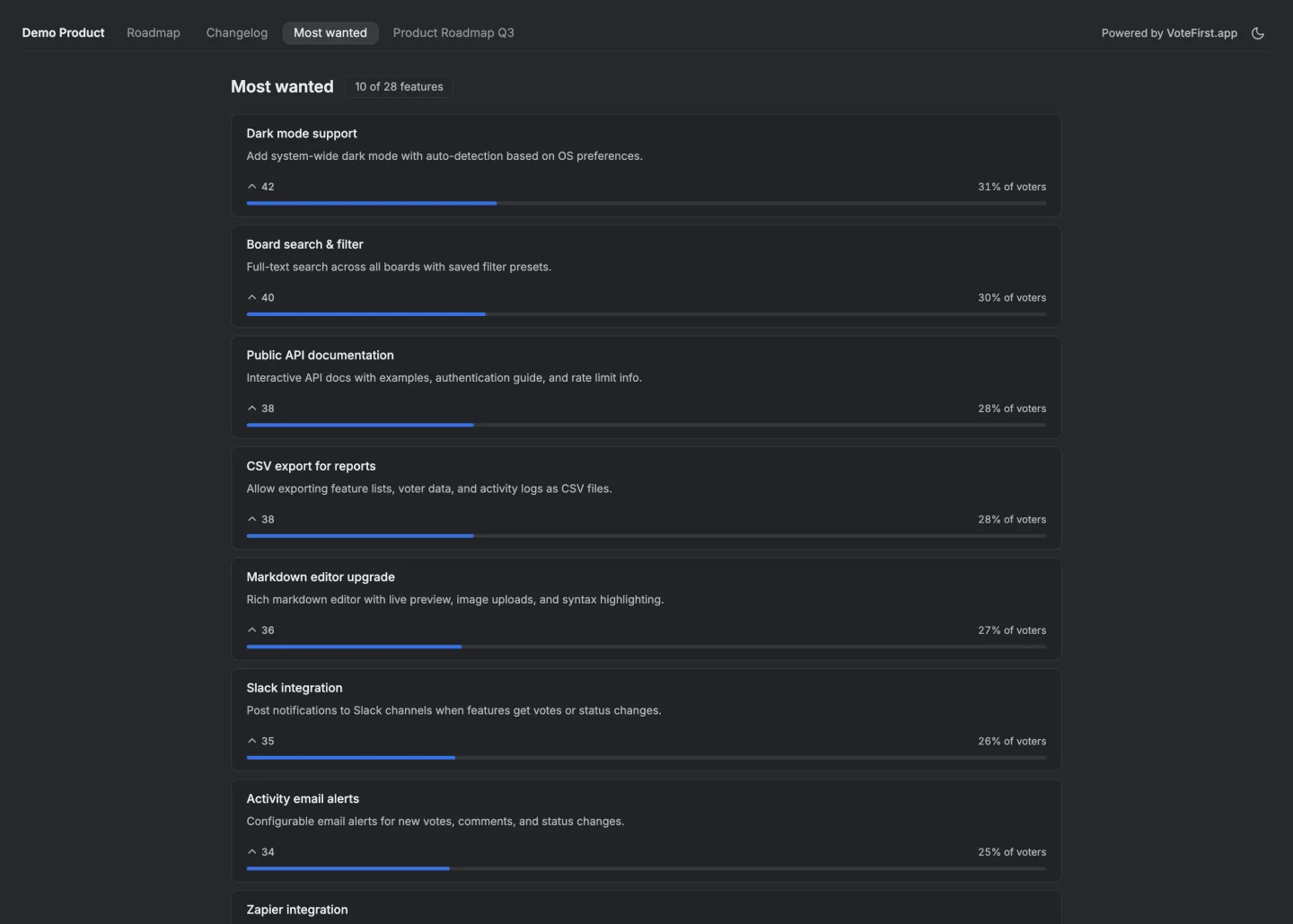
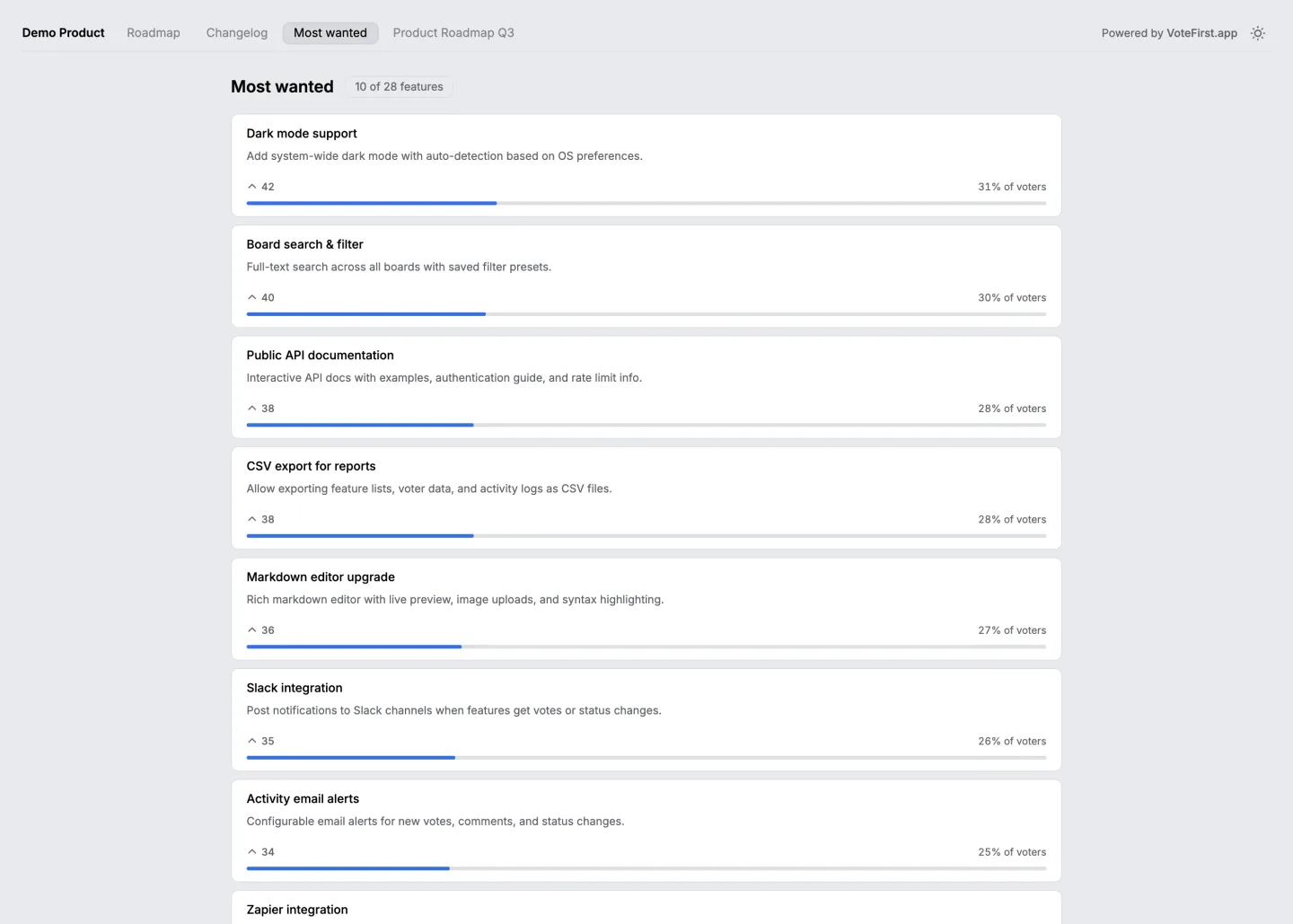
The demo board shows the same idea in use, open with no account.
What happens to duplicate ideas?
They arrive constantly, and the honest answer from most tools is that somebody closes one of them and hopes nobody notices.
That is the test, so here is exactly what ours does. You pick the card to keep and the card to fold into it, and both have to be in the same project. Then, in one transaction because half a merge is worse than none, four things happen.
The votes move. Before they move, anybody who had voted for both cards has their duplicate vote removed, so a person who asked for the same thing twice ends up counted once rather than twice.
This is the part that matters and the part a naive merge gets wrong, because a merge that simply adds two vote counts together inflates the very number you were merging in order to trust.
The comments move too, and both counts are recounted from the rows rather than added up, so the total is what the database actually holds. The view counts are added. The card you kept records which cards were folded into it.
Then the card you folded away is removed from the board. That is a real cost and we would rather write it here. A customer holding a link to the card that lost is holding a link to something they can no longer open.
What survives is on your side of the product, where the detail panel shows every card that was merged in, with its original heading, its description and the vote count it had at the moment it was merged. The record is auditable. The public link is gone.
Nobody is emailed about a merge. It appears in the activity log and that is all.
How do you decide which ideas move forward?
By having a small number of places an idea can be, and by moving cards between them in public.
A stage is not decoration. It is a promise about what you have done with the thing. Ours are Suggested, Denied, In Review, In Progress and Completed, and the useful ones are the middle three, because they are the difference between an idea nobody has looked at and an idea somebody decided about.
The count on the card is the input rather than the answer.
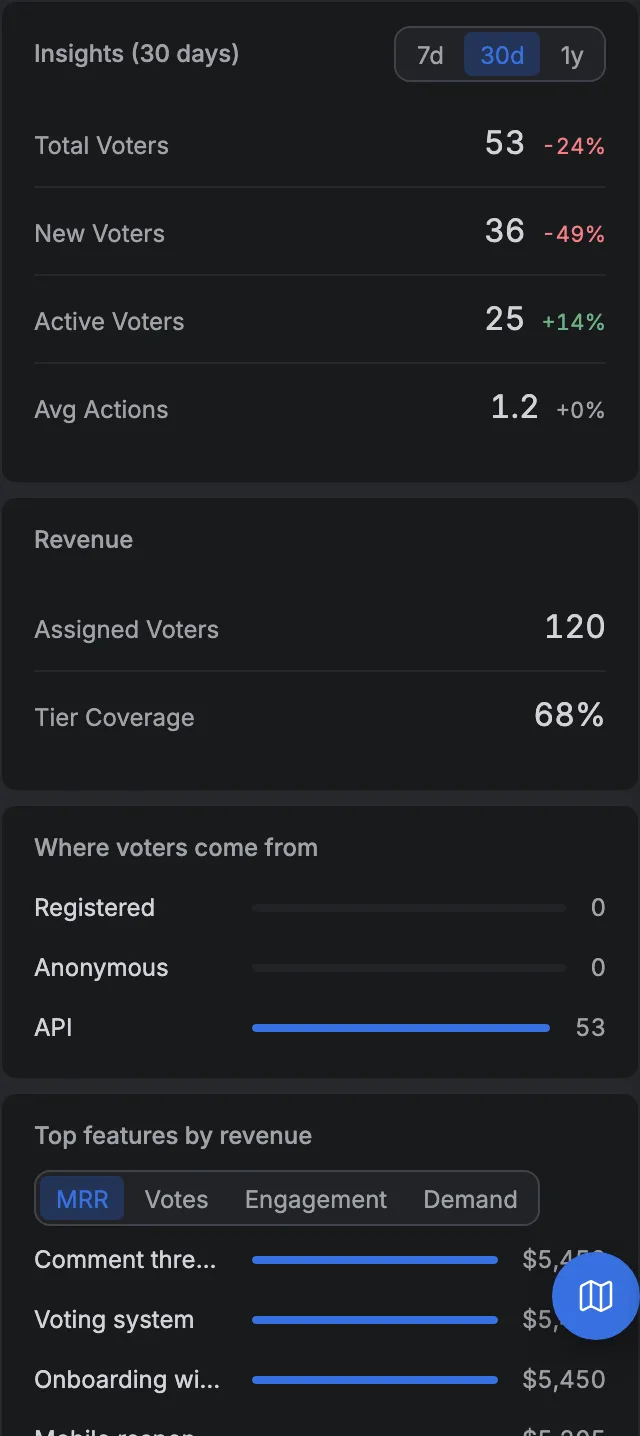
What the count is worth depends on who is doing the counting, and a board where every voter counts for one will always show you the largest group rather than the most important one. That is a solvable problem and it is a separate page.
The thing worth saying here is smaller and less popular. Most ideas should end in Denied, and a board where nothing is ever denied is not a board with unusually good ideas on it.
It is a board where nobody is deciding, and a queue that only grows is the same as no queue at all.
Who is allowed to add an idea?
On our board, anybody who can reach the page, and nothing they add is public until you have seen it.
Every suggestion from a visitor arrives unapproved. It is invisible to everybody else until you approve it, whichever route it came in through, and there is no setting anywhere that turns that off.
So the board a visitor sees is a moderated collection rather than an open inbox, which is the right way round for something with your name on it.
That has a cost you should agree to before you open the board rather than after. The queue is yours. Nothing filters it, because there is no filter of any kind in the product, and the only automatic checks on what somebody wrote are length limits and the removal of control characters.
What does idea management software actually have to do?
Four things, and most of the market does the first one very well.
It has to collect without a barrier, because a form that asks who you are before it asks what you think loses most of what it was built to catch. It has to let you see the same idea as one idea.
It has to record a decision on each one in a way somebody outside can read. And it has to tell the person who asked, when there is a way to reach them.
Judge a tool on the second and the fourth. The first is table stakes and everybody has it. The third is a column on a board and is not hard. The second is where the arithmetic goes wrong quietly, and the fourth is the one that keeps ideas arriving next year.
What is idea management software, and which tools are worth comparing?
Seven of them, and the thing that separates them is what they bill on rather than what they do.
Every one of the seven is listed with its meter and its entry price, read on the vendors' own pricing pages on one day. This entry stays about the practice, and that page is where the software is compared.
14 days, a card at signup, then $9 or $39 a month.
In brief
Idea management is collecting, deciding and answering, and only the collecting is a software problem. Ask any tool what it does when the same idea arrives twice, and whether the person who votes for both ends up counted once. The answer tells you whether the numbers you are about to prioritise on mean anything.
Ours merges in one transaction, drops the duplicate vote, recounts from the rows and keeps the folded cards visible on your side. The board it all sits on is nine dollars a month.