Seven tools that describe themselves as idea management software are below, with what each one bills on and what it costs, read on the vendor's own pricing page on 14 September 2026.
They are in alphabetical order. There is no ranking on this page, no score out of anything and no best overall, because the answer depends entirely on how many people will use the board and whether you can predict that number in advance.
We build one of the seven. It is last because of its name and for no other reason, and it is described in the same shape as the rest.
What is idea management software, and what do idea management tools actually do?
Three things, and the third one is where the tools separate.
They collect ideas from customers and colleagues in one place, usually a board anybody can read. They count, so the same idea arriving eleven times becomes one entry with eleven people behind it rather than eleven entries.
And they answer, which means the person who suggested something finds out what happened to it without anybody keeping a private list.
Everything that happens between collecting and deciding is the definition itself, including the one question worth asking a vendor, which is what their tool does when the same idea arrives twice.
What does each tool bill on, and what does it cost?
Seven vendors, read on their own pricing pages on 14 September 2026.
| Vendor | From | Billed per | Free plan | Trial |
|---|---|---|---|---|
| VoteFirst | $9/mo | plan | – | 14 days, card |
| Convas | $15/mo | tracked user | 25 users | – |
| FeedBear | $15/mo | project | – | 14 days |
| ProductLift | $19/mo | workspace | – | 14 days |
| Frill | $25/mo | workspace | – | 14 days |
| UserJot | $29/mo | workspace | 2 boards | – |
| Canny | $79/mo | tracked user | 25 users | – |
Four different meters across seven tools. Two count the people who take part, one counts projects, one counts admins, one caps the number of live ideas, and two count nothing at all. Until you know which row you are reading, the monthly figures in the first column cannot be compared with each other.
The dangerous one is the tracked user, because the number is not yours to control. A board that works produces more of them, which is the invoice arriving at the moment you were hoping to be pleased. What a tracked user is, and the six vendors who disagree about it, has its own page.
Frill's cap is the other kind of limit worth noticing. Fifty active ideas is a ceiling on the board rather than on the audience, which behaves very differently as the board fills up.
Which is the best idea management software for a small team?
Nobody can answer that without the number of people who will use it, which is the point of the table above.
Under twenty five participants, Canny and Convas are genuinely free and are the cheapest thing here by a distance. Past a few hundred, both meters start climbing and a flat priced tool costs less every month after that.
A workspace price is predictable and a tracked user price is not, and which of those matters more is a question about your own board rather than about the software.
The second question is whether anybody on your team will actually run it. Every tool here collects. None of them decides. A board with four hundred ideas and no denied column is worse than a spreadsheet, because it looks like an answer.
Is an idea management system different from a feedback board?
The words are different and the software is the same.
An idea management system is what the enterprise half of this market calls a feedback board, and the difference is the buyer rather than the product.
A board is sold to a product team who wants to know what to build next. A system is sold to a programme owner who wants stage gates, a portfolio view and a report at the end of the quarter.
Three vendors sell the second thing and none of them is on the table above.
IdeaScale, Ideawake and Viima are enterprise innovation platforms with stage counts, scoring committees and internal campaign tooling, and a team of four buying one of them is buying a programme they will not run. Where that boundary actually sits is written out separately.
What is the best ideation software, and is ideation the same thing?
Ideation is the first ten minutes and idea management is everything after.
Ideation software is whiteboards, sticky notes and workshop facilitation, and it is a genuinely different category with different vendors in it. Nothing on this page runs a workshop. Every tool here starts from the assumption that the ideas already exist and somebody has to decide between them.
If the problem is that nobody has any ideas, none of these seven helps. If the problem is that there are four hundred and no order, all seven do something about it.
Is there a free idea management tool, or idea management software free of charge?
Three of the seven have a real free tier and the other four have trials.
Canny is free to 25 tracked users and Convas is free to 25, plus free entirely for non commercial open source projects. UserJot's free plan gives 2 boards and 3 admin roles with no time limit.
Those are the three places a board can run at no cost, and all three stop being free at the point the board starts working.
The four others run trials rather than free tiers. FeedBear, Frill and ProductLift each publish a 14 day trial that their own pages say needs no card.
Ours is 14 days and asks for a card at signup, which is a worse trial and is written here rather than left for you to discover at the form.
Which tool should you choose?
Start from the meter, not the price.
| If this is true of you | The shape that fits |
|---|---|
| Fewer than 25 people will ever post or vote | Canny or Convas, both free at that size |
| You cannot predict how many people will take part | Anything with a workspace price, being FeedBear, Frill, ProductLift, UserJot or ours |
| You want the board to cost the same every month whatever happens to it | The same five |
| Your customers pay you very different amounts | ProductLift, Frill or ours, the three that weight a vote by revenue |
| You need stage gates and a portfolio view | None of these. The enterprise platforms named above |
| You want it free forever and will accept a ceiling | UserJot, at 2 boards |
Where does VoteFirst fit, and what does it not do?
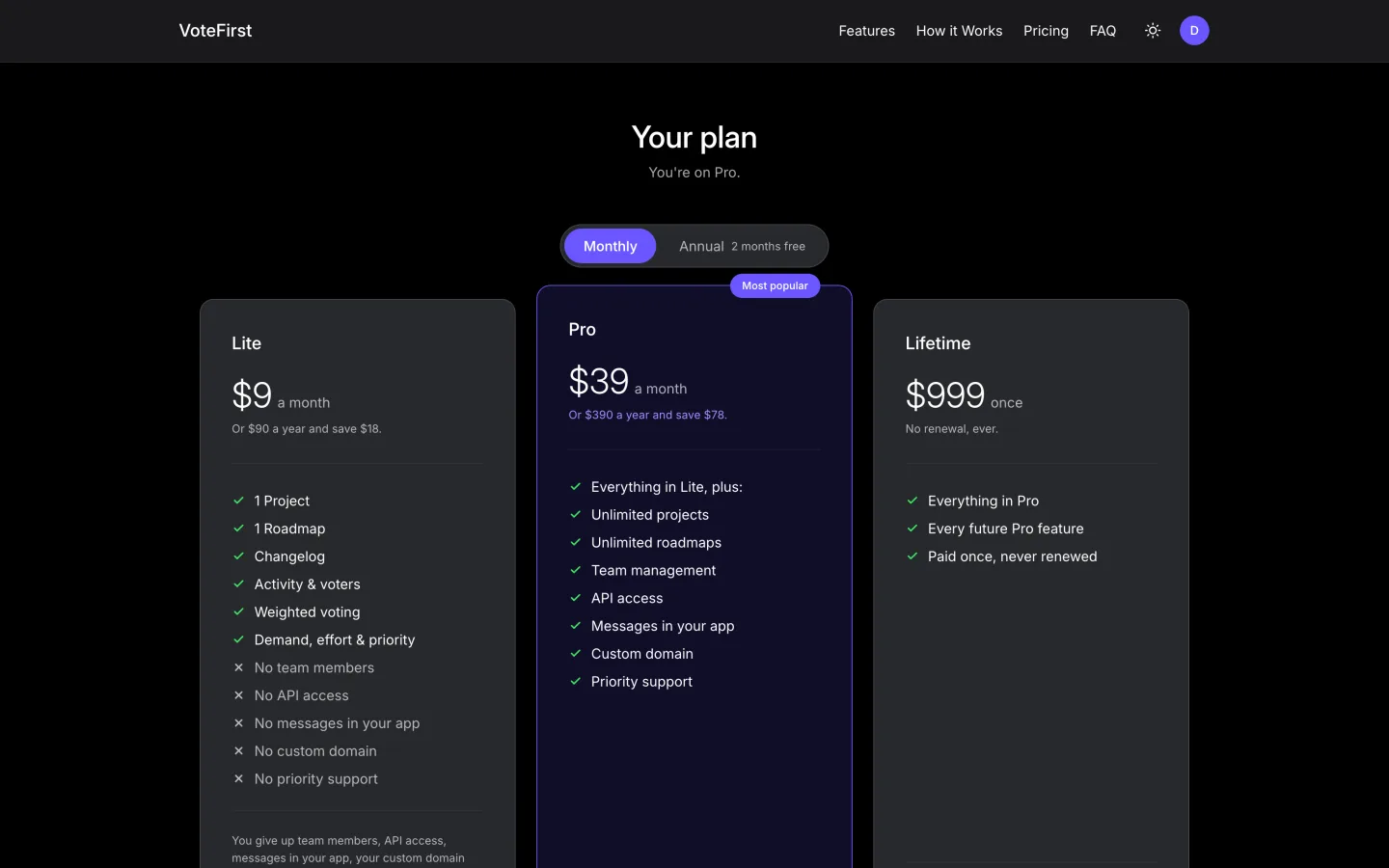
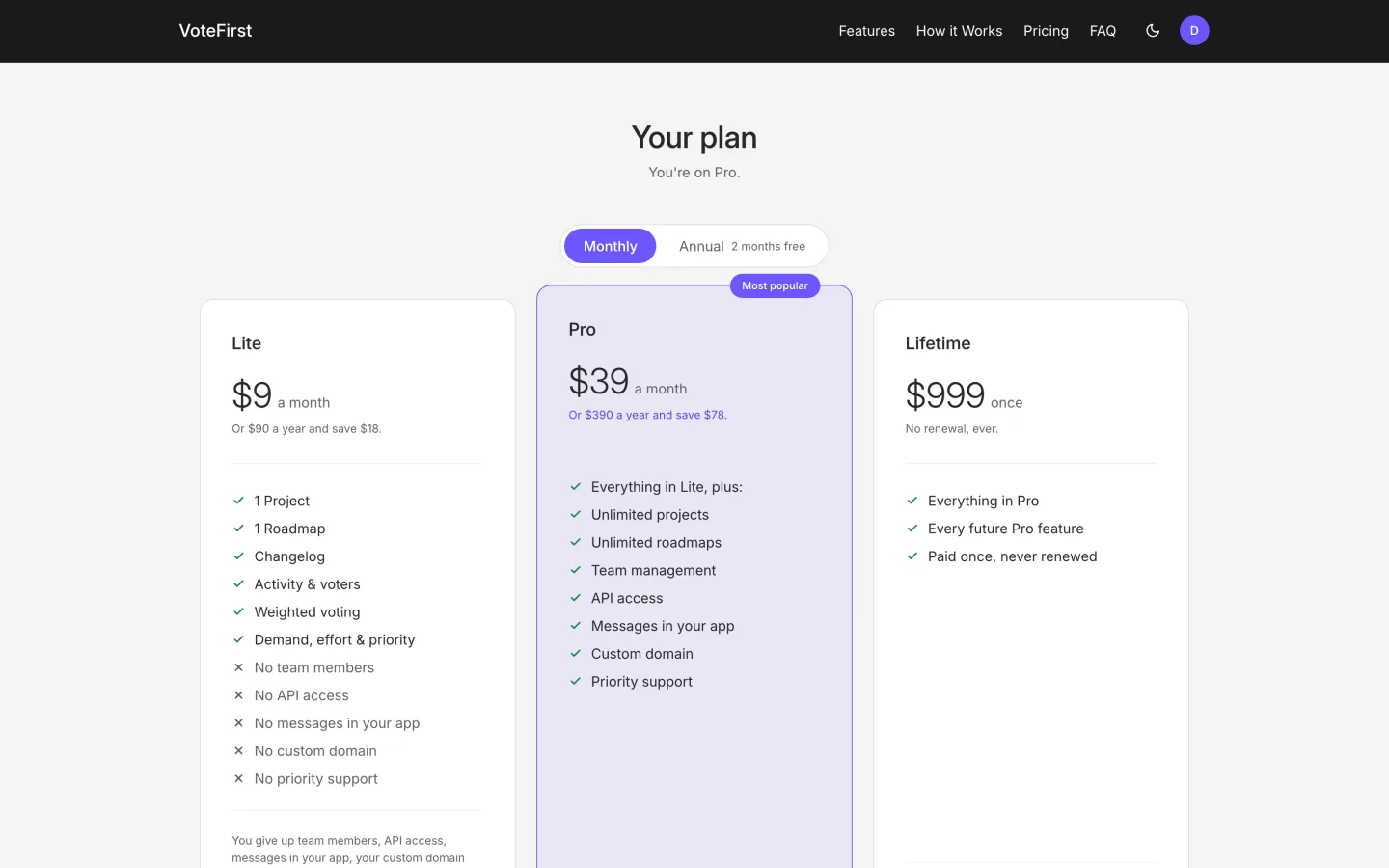
A flat nine dollars a month, weighted voting on that plan rather than an upgrade, and no meter on the people at all.
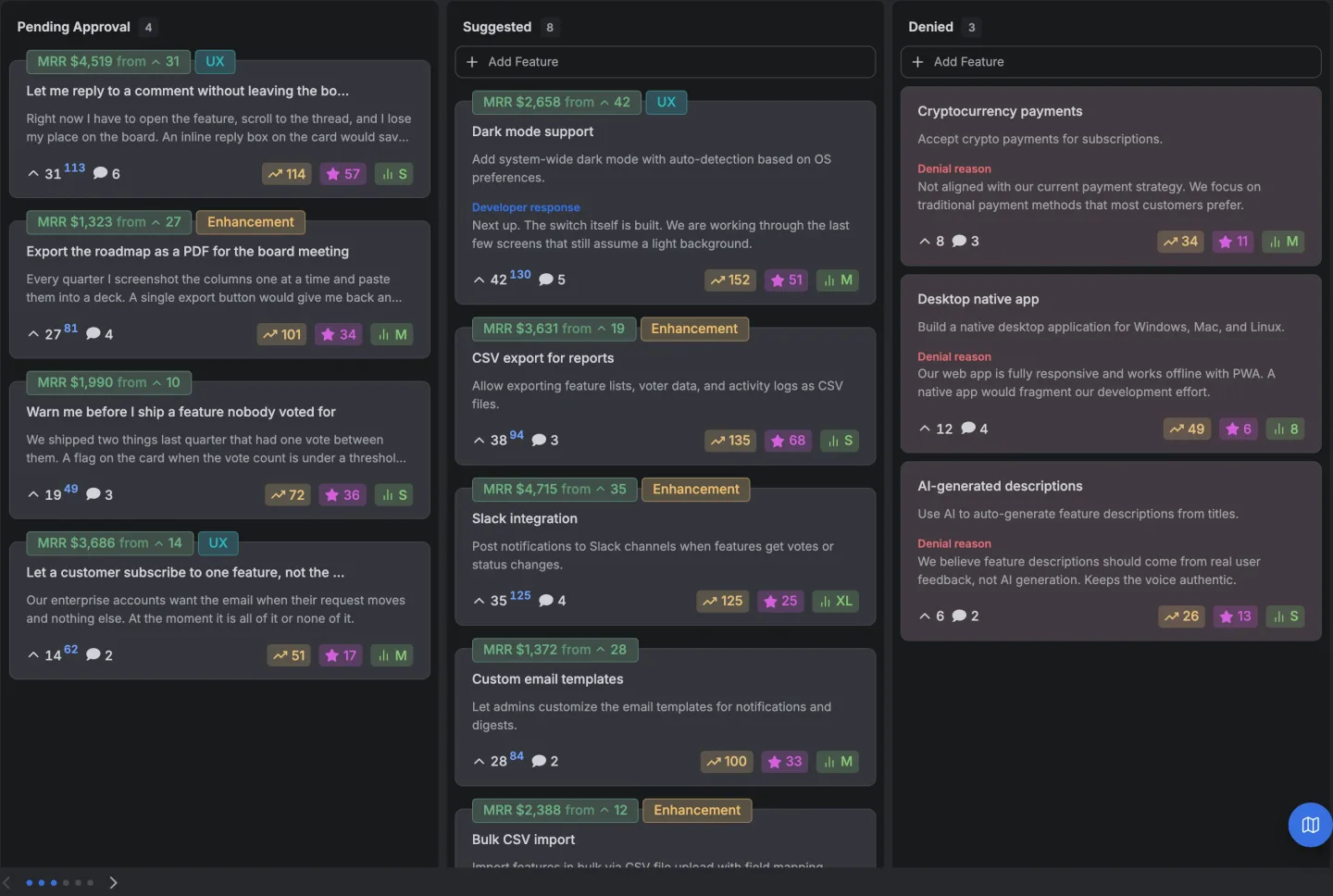
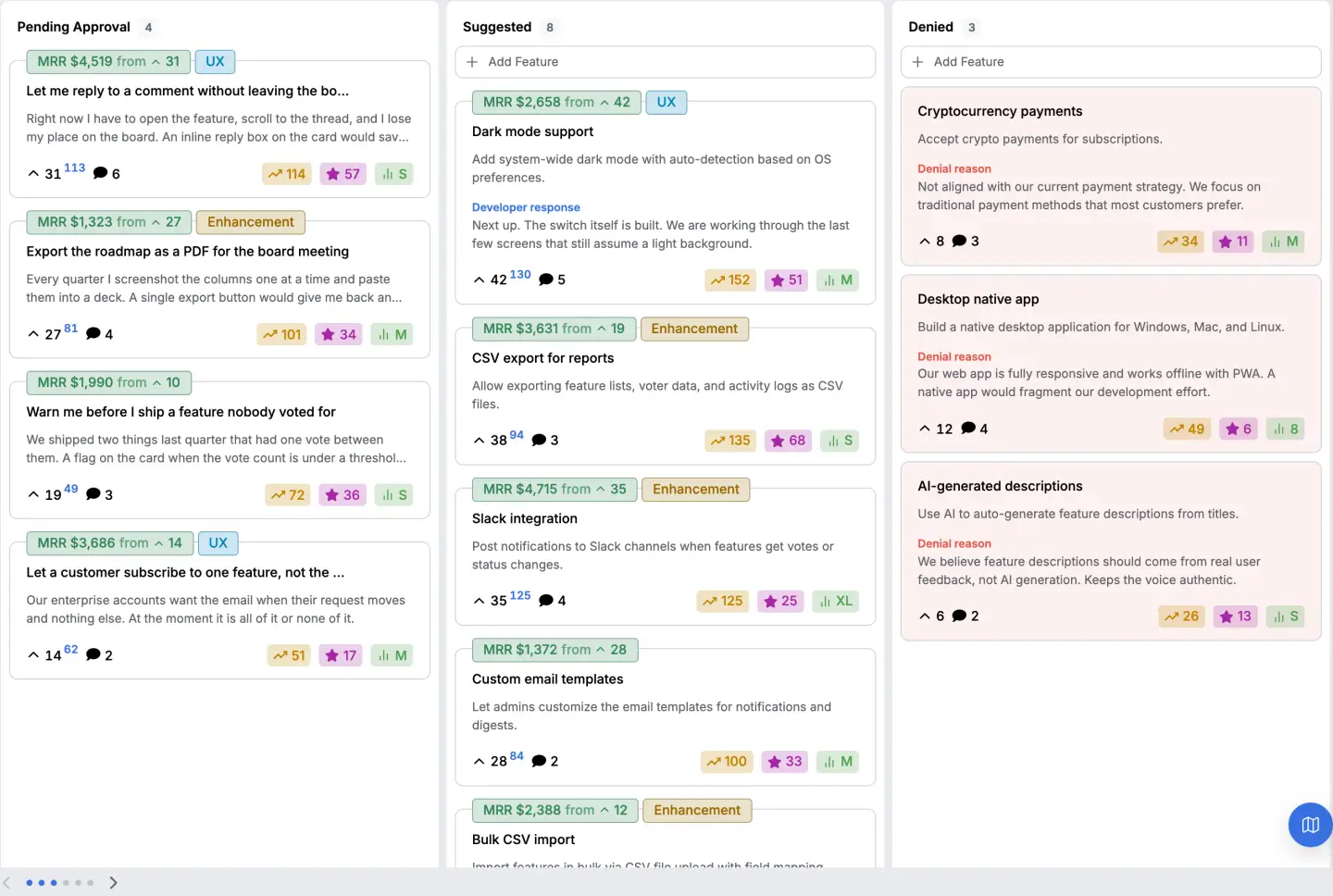
The board holds a Denied column by default, which is the part most boards leave out, and publishing a release emails the voters on every request inside it.
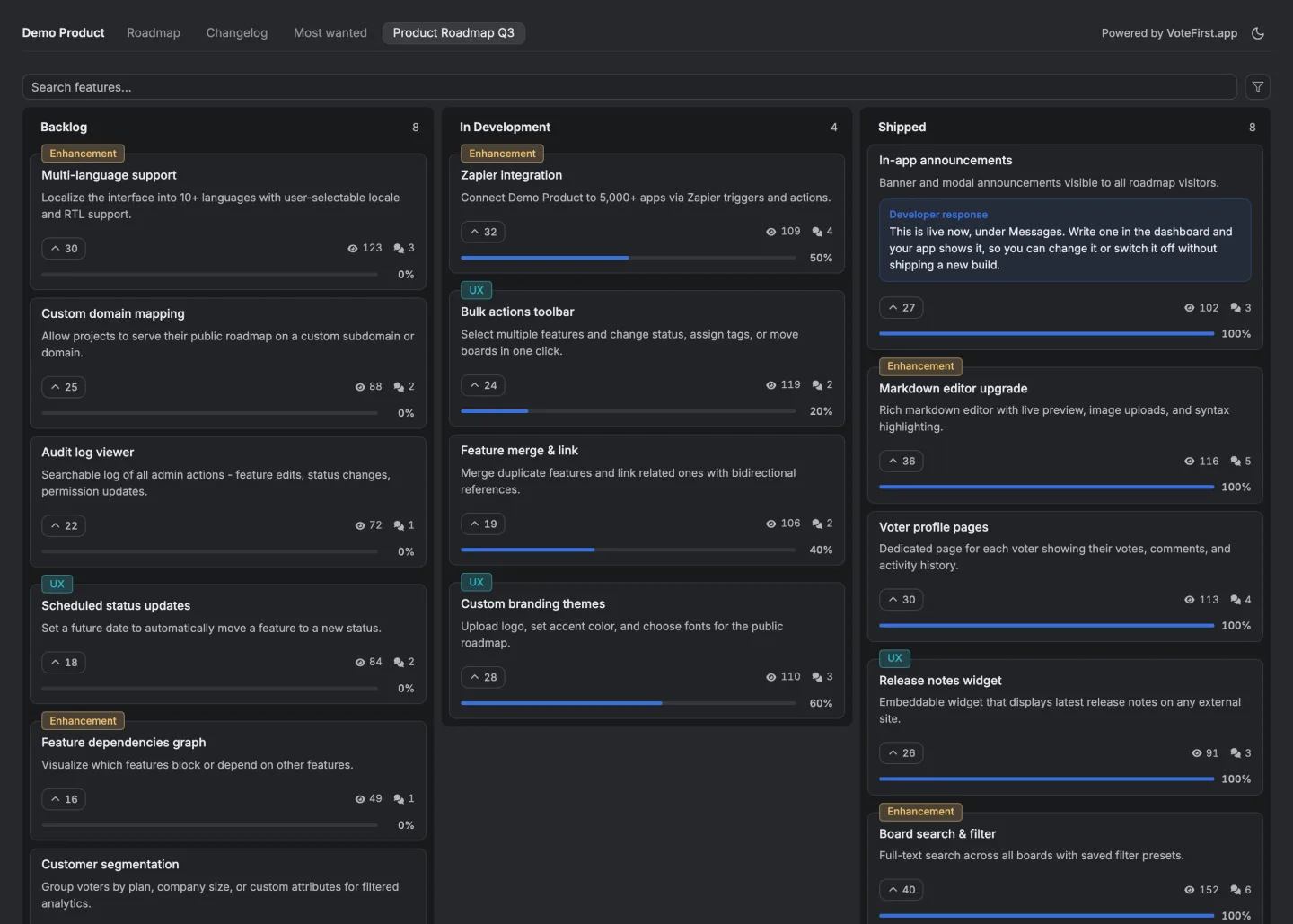
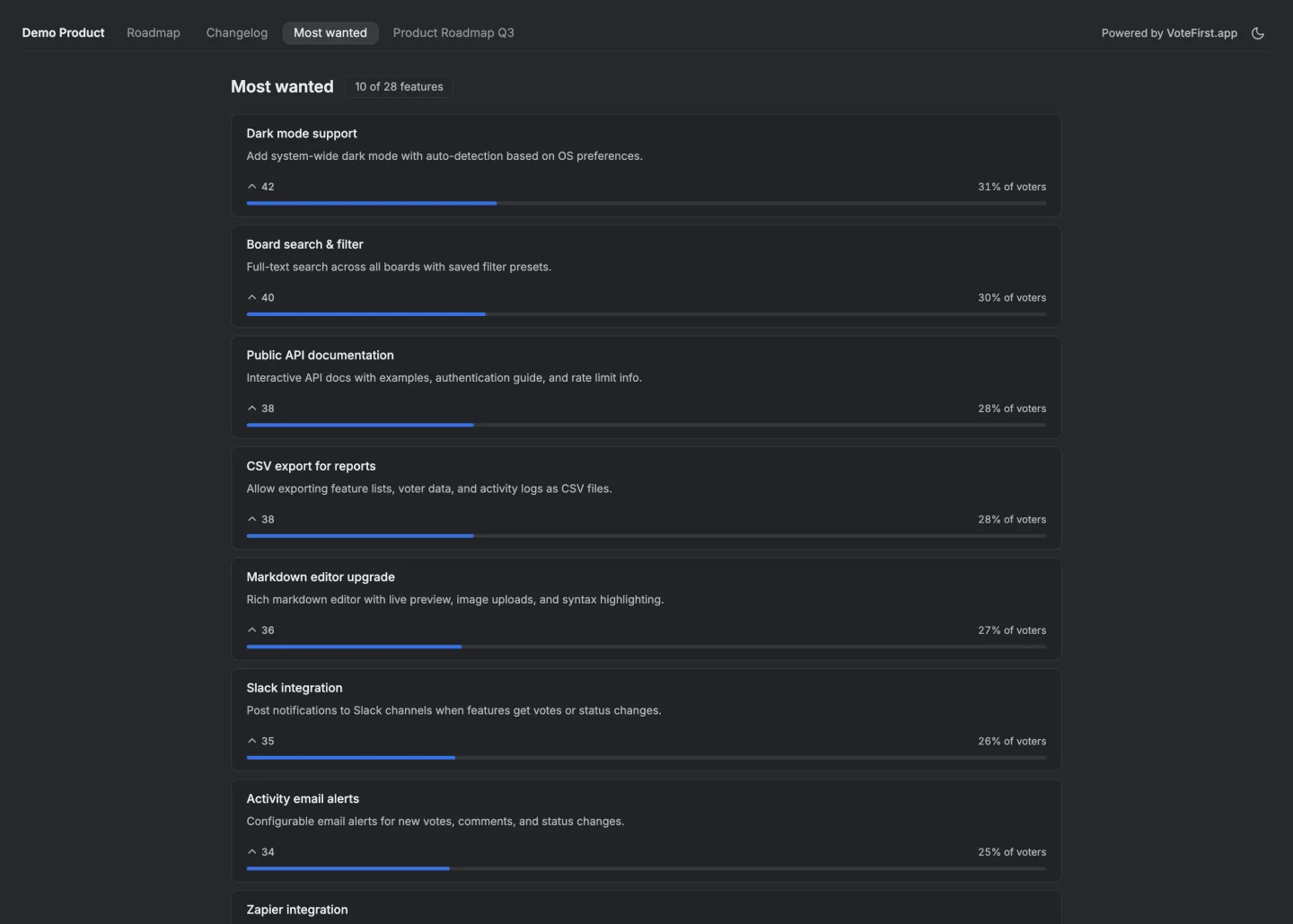
The demo board carries twenty eight requests across five columns on 15 September 2026, three of them denied in public with the reason on the card, and it opens with no account and no email address.
What it does not do, stated where a buyer can read it. There is no private board with a password or an invite list, so a board is published or it is not. There is no self hosting.
Single sign on is a signed handoff from your own application on the 39 dollar plan and there is no SAML. And the trial takes a card, which three of the six others do not.
The board and the roadmap page are nine dollars a month, both figures are published, and a card is required for the fourteen day trial.
14 days, a card at signup, then $9 or $39 a month.