Every list of top changelog tools tells you which ones exist, and almost none of them checks email delivery. Almost none tells you which ones actually put the announcement in front of a person who is not currently looking at your product.
Ten of them were opened on their own sites on one day and checked for three things. Does it send email when you publish. Does it publish a feed. Does it have an in app widget.
Eight confirm email. Four confirm a feed. All ten have a widget, which is why the widget is not a reason to choose any of them.
The table
| Tool | Email on publish | Feed | Widget |
|---|---|---|---|
| AnnounceKit | Yes, as an add-on | RSS, Atom, JSON | Yes |
| Beamer | – | – | Yes |
| Canny | Pro | – | Yes |
| Featurebase | Yes | – | Yes |
| Frill | Yes | – | Yes |
| Headway | – | – | Yes |
| LaunchNotes | Yes | Yes | Yes |
| Noticeable | Yes | Atom, RSS | Yes |
| Olvy | Business | – | Yes |
| Sleekplan | Yes, per post | Yes | Yes |
| VoteFirst | Voters and subscribers | – | Yes |
A dash means the feature could not be found anywhere on that vendor's own site. It does not mean the feature does not exist. A vendor's marketing site is not a specification.
Two entries need their caveats stated rather than buried. AnnounceKit's email and digest are an add-on at $39 a month billed yearly, or $49 month to month, on top of the changelog itself, read on its own pricing page on 2 October 2026.
Olvy's email subscription sits on its $240 a month Business plan, one tier above the $60 Essentials plan, read on the same day.
What Olvy charges for that changelog is a meter no other tool in this table uses, being the number of pieces of feedback you are allowed to analyse.
One of the entries below is VoteFirst's, which you should weigh accordingly, and a trial is 14 days with a card at signup.
Which changelog tools actually send an email when you publish?
Eight of the ten, and two of those are plan gated, with a third priced as an add-on.
Featurebase, Frill, LaunchNotes, Noticeable and Sleekplan confirm it plainly on their own pages, read again on 2 October 2026. AnnounceKit confirms it too, as an add-on at $39 a month billed yearly on top of the changelog itself. Canny confirms it on the Pro plan only, which matters if you were planning to use its free tier for announcements. Olvy confirms it on its $240 a month Business plan, not the plans under it.
Beamer and Headway do not name email delivery anywhere on their own sites.
Whether teams switch it on is a separate count. On 327 public changelogs read on 3 October 2026, Featurebase recorded an email as sent for 60.6 percent of 5,217 entries, and Canny's notify subscribers flag was set on 33.1 percent of 10,843.
Which ones publish a feed?
Four of the ten. AnnounceKit, LaunchNotes, Noticeable and Sleekplan. VoteFirst, the eleventh row, has no feed and sends email instead.
A feed is the cheapest form of low lock in there is. It means somebody can follow your releases without an account with you or with your vendor, and it means the content is readable by anything, including whatever you migrate to next.
What does vendor lock in actually mean for a changelog?
Three questions, and the price is not one of them.
What does the export contain? Not whether there is one. A vendor who publishes the column list of their export is telling you something real. A vendor who says take your data with you and never says in what shape is not.
What happens to the published addresses? Your release notes have been linked from support replies and emails for years. If leaving means those addresses stop resolving, you are not moving a changelog, you are deleting one and starting another.
Can somebody follow you without an account? This is the feed question again. A feed is portable. A subscriber list held by a vendor is not.
What does a changelog tool cost for an indie team?
Entry prices vary by more than the feature sets do.
Sleekplan has a genuinely free tier for one person. Canny's free plan exists but excludes changelog emails. Featurebase is free to start and then per seat. AnnounceKit's changelog starts at $49 a month billed yearly, or $59 month to month, and email delivery is a separate add-on at $39 a month billed yearly, or $49 month to month.
Beamer's changelog is free to a thousand monthly active users and $49 a month billed yearly above that. LaunchNotes starts at $249 a month billed yearly, and Noticeable is aimed higher still.
If you are one person shipping one product, the free tiers are real and you should use one before paying anybody.
Which tool should you choose for a fifty to five hundred person company?
At that size the deciding factors are seats, sign on and delivery rather than the changelog itself.
Ask three questions of any shortlist. Does the price grow with your headcount or with your usage. Does it support the way your company signs in. And does the announcement reach people who are not currently in your product, which is the email column above.
The tools with the most complete answers to those three at that size are LaunchNotes, AnnounceKit and Noticeable. That is not a recommendation of any of them over the others, it is where those three are aimed.
14 days, a card at signup, then $9 or $39 a month.
Is release notes software a different thing?
The same eleven products under two more names, and the table above is the answer to all three.
Release notes software, changelog tool and release notes management tool are the same category described by three different job titles. Somebody writing the notes calls it release notes software. Somebody who has to keep a year of them tidy calls it a management tool.
Somebody thinking about the page a customer reads calls it a changelog tool. Every product in the table does all three jobs and the differences between them are in the three columns rather than in the name.
The best one is the one whose second column says what you need. If the notes have to arrive in an inbox, nine of the eleven say so on their own pages, three of those nine with a caveat, and the other two say nothing about it.
If they have to be readable by a machine, five of the eleven publish a feed, VoteFirst among them.
Is there a free changelog tool worth using?
Yes, two. Headway's free tier carries unlimited changelogs and Beamer's runs to a thousand monthly active users with one teammate, both read on their own pages on 2 October 2026. Neither asks for a card, and for a small product either is enough until the audience outgrows it.

Is there an open source changelog tool?
No widely used project does only changelogs, and two feedback boards carry one.
Quackback's own feature list names a changelog and a status page alongside the board, and it is AGPL-3.0, so running it yourself costs nothing in software. Its license and repository state, read on the day, are on their own page.
If the changelog is the whole job, the open source answer most teams land on is a static site generator with a posts folder, which is free, fast and already installed. What it will not do is the widget inside your product, the email to subscribers or the feed, and those three are what the products in the table above are actually selling.
Is release notes software different for a development team?
The audience changes, so the shape changes, and the tool usually does not.
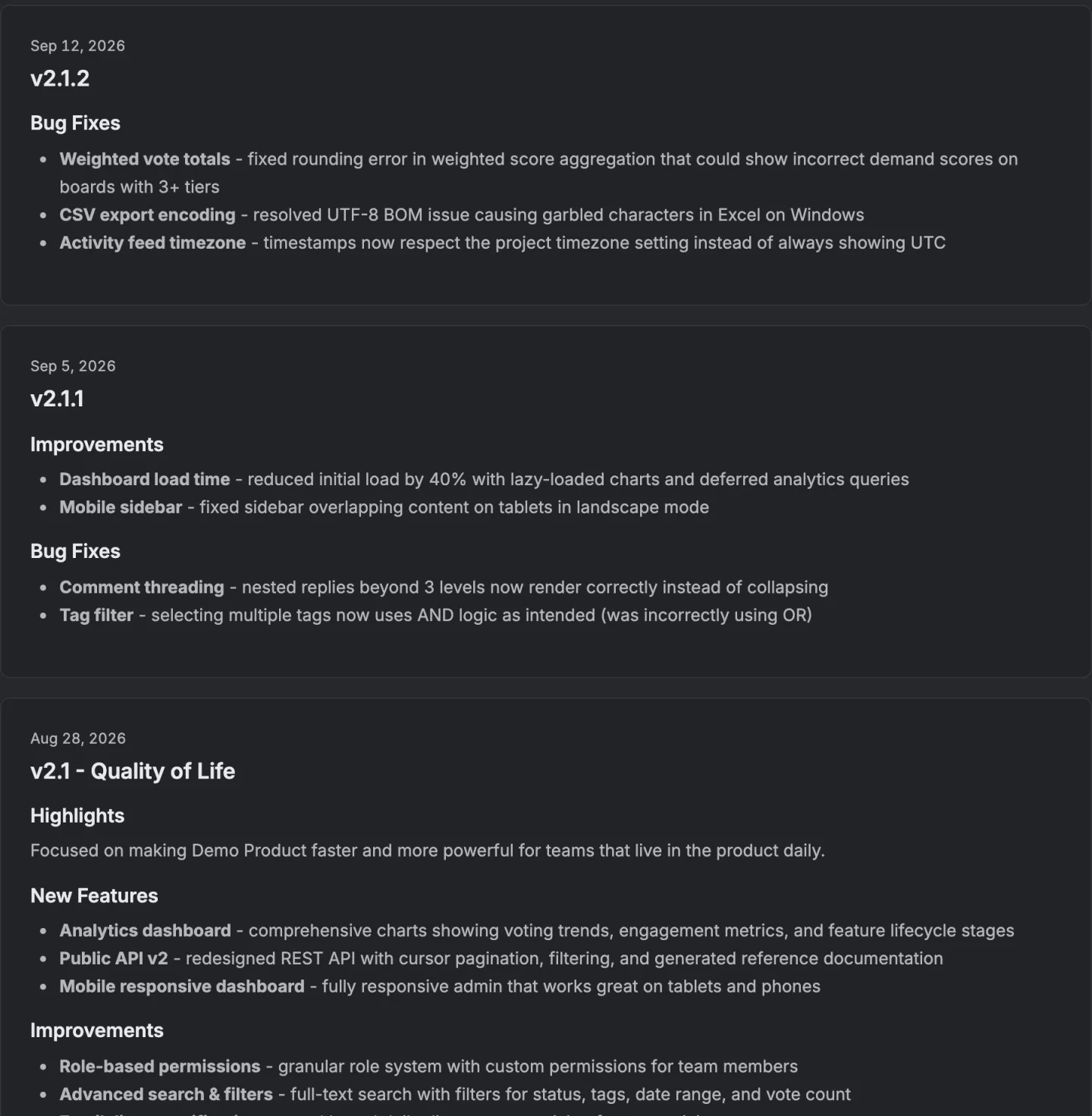
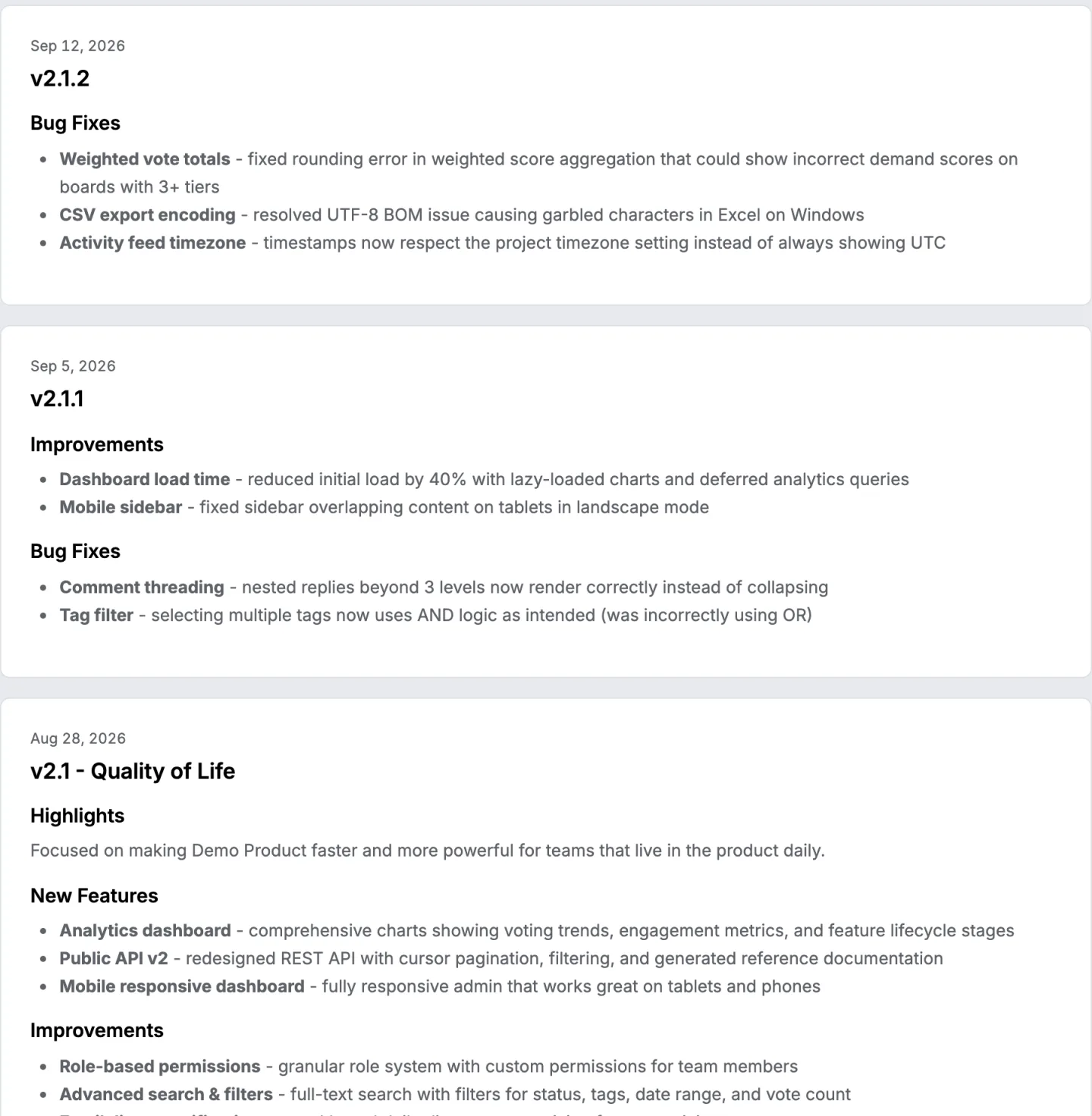
Release notes written for developers can assume the vocabulary, list every fix by identifier and put breaking changes first, because the reader is deciding whether to upgrade. Release notes written for customers have to say what somebody can now do that they could not do before, in a sentence that makes sense to a person who has never opened your settings page.
Every tool in the table can publish either. What decides the outcome is who writes them and for whom, and the commonest failure is one document trying to be both. The template that separates them is free to take.
Which changelog tool produces the best looking output?
That depends on whether you want the design decided for you or not.
The dedicated changelog products ship a designed page and a designed widget, and that is most of what you are buying: somebody has already decided the typography, the spacing and how a release looks on a phone. If nobody on your team wants to make those decisions, that is worth real money.
A changelog attached to a feedback board inherits the board's design, which is usually plainer. What it does instead is the thing a standalone product cannot: a release can close the requests it answered, so the people who asked are told without anybody keeping a list.
So the choice is presentation against the loop. Neither answer is wrong and the two are rarely both available for the same price.
Where VoteFirst fits, stated against its own interest
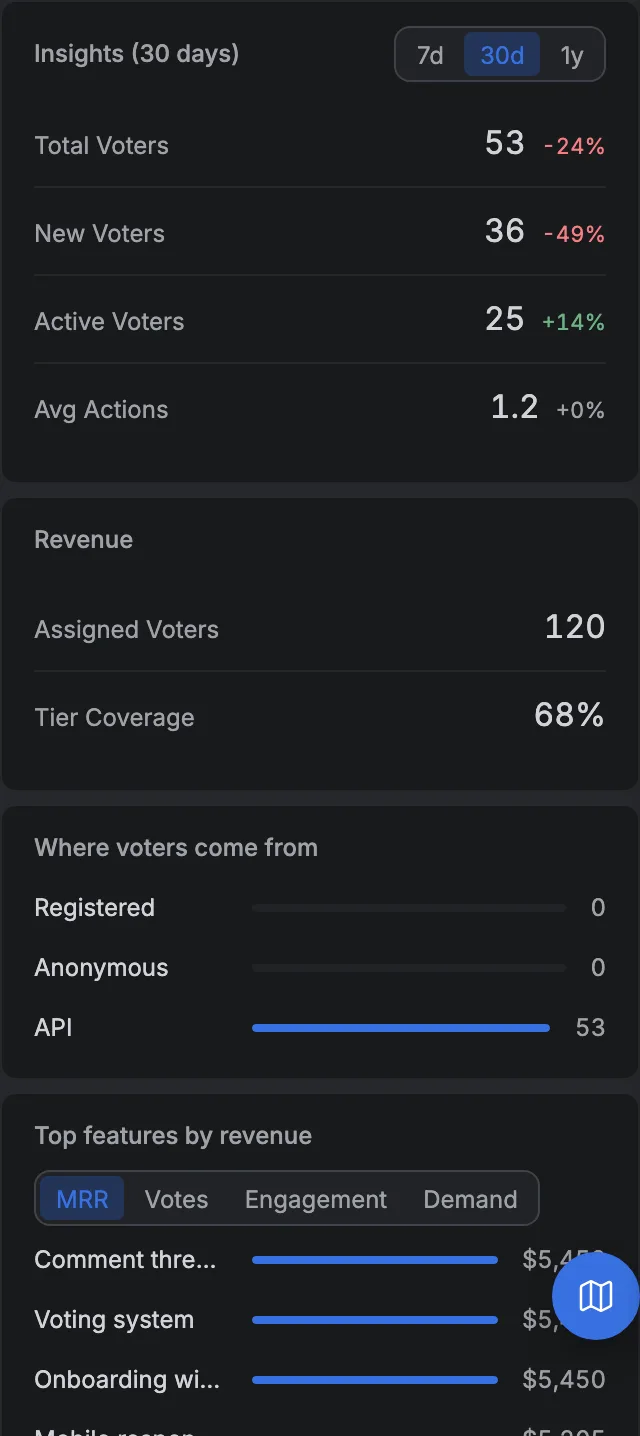
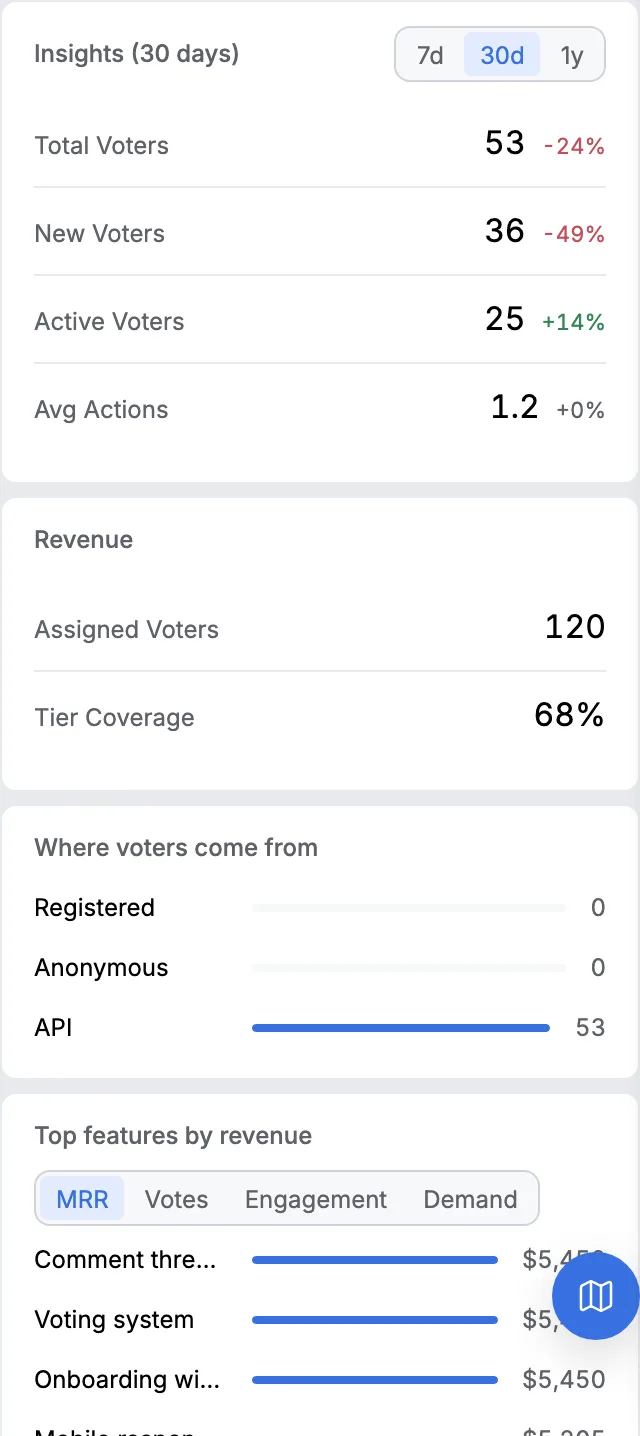
VoteFirst sends email to two groups: signed in voters whose own request is in the release, and readers who subscribed on the public changelog and confirmed their address. A voter sees what they asked for at the top.
It has no feed, no segments and no scheduling. If the requirement is a feed reader or a targeted announcement, one of the tools above is the answer.
If the requirement is telling the people who asked for a thing that it now exists, that is the exact shape of what VoteFirst does, and it is the same board they voted on.
The changelog widget is not held back for the higher plan, so it works on the nine dollar plan.