Most people who type this phrase are not unhappy with the board. They opened an invoice, saw a number bigger than last month's, and want to know what else exists before they renew.
If you want the whole field rather than a shortlist, Canny alternatives with every published price is that page, and this one picks one tool per billing shape out of it.
That is a reasonable thing to want, and it is a narrower question than most roundups answer. This page starts with the meter itself, then prices the field against it, then gives you a shortlist that actually covers different shapes rather than eleven versions of the same one.
Why do people leave Canny?
Because the bill is tied to something they do not control. Canny bills per tracked user, and a tracked user is anybody with a post, a vote or a comment attributed to them, published on their own pricing page.
Three details in that definition are easy to miss and worth reading slowly. An admin who votes on a colleague's behalf still counts. A person their automated discovery finds in a support conversation still counts. Your own team counts too, if anybody on it posts, votes or comments.
So the number driving the invoice is not your customer count. It is everybody who ever touched the board, on either side of it. A board that works, meaning people show up and participate, is the exact event that moves you up a tier.
Canny's own documentation also states what happens if you set a spend cap to protect yourself from that. It stops tracking feedback from new users once the cap is hit, and their automated conversation analysis stops with it.
The cap protects the invoice by turning off the part of the product that collects feedback from people not yet counted.
That is a defensible engineering decision and it is not what most people picture when they set a budget ceiling. It is the single fact that explains this search term.
What is a tracked user, and what does it cost at 100, 1,000 and 5,000 of them?
Anybody with a post, a vote or a comment, and the price rises in steps as that count rises.
Canny's free plan covers 25 tracked users at no cost. At 100 tracked users, Pro starts at 79 dollars a month billed yearly, or 99 dollars billed monthly.
At 1,000 tracked users, Pro is 529 dollars a month billed yearly. At 5,000 tracked users it is 1,079 dollars a month billed yearly. Business has no published price and needs a sales conversation.
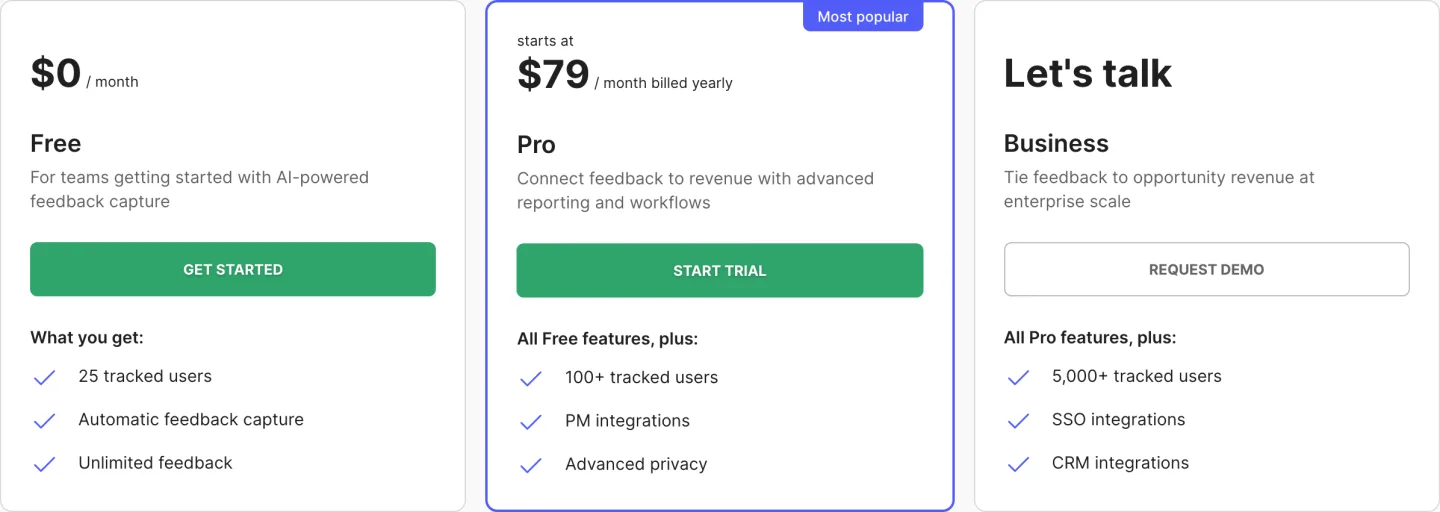
Those five figures are Canny's own numbers, from their own pricing page and help centre, read on 14 September 2026. Nothing here is estimated between the published steps. If you exceed the allowance on your current tier, Canny states plainly that the account moves up automatically rather than being throttled or blocked.
The whole field, priced
| Vendor | From | Billed per | Free plan | Trial |
|---|---|---|---|---|
| Trello | $5/user/mo | user | Yes | – |
| VoteFirst | $7.50/mo | plan | – | 14 days, card |
| Features.Vote | $9/mo | project | – | 14 days |
| Jira Product Discovery | $10/creator/mo | creator | 3 creators | – |
| LoopedIn | $12/mo | plan | 1 of each | – |
| WishKit | $12.50/mo | project | 5 requests | – |
| Sleekplan | $13/mo | workspace | 1 admin | – |
| Upvoty | $13.50/mo | project | – | 14 days |
| Noora | $14/mo | workspace | – | 7 days |
| Convas | $15/mo | tracked user | 25 users | – |
| FeedBear | $15/mo | project | – | 14 days |
| Supahub | $15/mo | workspace | 1 board | – |
| ProductLift | $19/mo | workspace | – | 14 days |
| Productboard | $19/maker/mo | maker | 500 notes | – |
| Roadmunk | $19/creator/mo | creator | – | 14 days |
| Ducalis | $20/mo | changelog subscriber | 500 subs | – |
| Frill | $22/mo | workspace | – | 14 days |
| Fider | $25/mo | workspace | 250 items | – |
| Featurebase | $29/seat/mo | seat | 1 seat | – |
| Headway | $29/mo | plan | Yes | – |
| Nolt | $29/mo | board | – | – |
| UserJot | $29/mo | workspace | 2 boards | – |
| Aha! Ideas | $39/user/mo | user | – | Yes |
| Savio | $39/mo | paid user | – | 14 days |
| Beamer | $49/mo | monthly active user | 1,000 MAU | – |
| Feature Upvote | $49/board/mo | board | – | 30 days |
| Rapidr | $49/mo | workspace | – | 14 days |
| Suggested | $49/mo | plan | – | 15 days |
| Gleap | $49/mo | plan | – | 14 days |
| FeatureOS | $50/mo | plan | – | 30 days |
| Olvy | $60/mo | plan | 25 items | – |
| AnnounceKit | $79/mo | project | – | 15 days |
| Canny | $79/mo | tracked user | 25 users | – |
| LaunchNotes | $249/mo | plan | – | – |
| Pendo | Not published | monthly active user | Beta | – |
| ProdPad | Not published | module | – | 7 days |
| UserVoice | Not published | quoted | – | 30 days |
| airfocus | Not published | quoted | – | – |
| ProductPlan | Not published | quoted | – | – |
| FeatureOS | $60/mo | plan | – | 30 days, no card |
| Productroad | $9/mo | plan | 50 users | 14 days, no card |
| Quackback | $29/mo | plan | 1 board, 50 posts | 14 days, no card |
| ProdCamp | $99/mo | plan | 2 admins, 1 product | – |
| Harvestr | $79/editor/mo | editor | – | 14 days |
| Productlane | $29/user/mo | user | – | Yes |
| Ideanote | $6/user/mo | user | 10 users, 250 ideas | – |
| Craft.io | $19/editor/mo | editor | – | 14 days, no card |
| HYPE Boards | €79/mo | plan | Under 10 users | 14 days, no card |
| Noticeable | $24/mo | plan | 1 project, watermarked | 14 days, no card |
Every price, unit, free plan and trial in that table was read on the vendor's own page. Where a vendor publishes nothing, it says so rather than guessing, and an unpublished cell means nobody could read it on the pages opened that day, not that the capability is absent.
Fourteen days of Pro, a card at signup, then nine or thirty nine a month.
Seven alternatives, chosen to cover different shapes
Most products in this category look alike from the homepage. They stop looking alike once you ask what happens to the bill when your board works, so that is how this list is sorted rather than by feature count.
Fider
Fider is open source under the AGPL, and self hosting it costs nothing in licence fees, with every feature turned on for the instance you run. Their hosted tier is free to a fair use limit of 250 feedback items, then 25 dollars a month with no annual price published.
It bills nobody per participant, because the unit is a workspace or your own server rather than a person.
What it does not do is weight a vote by what a customer pays, because Fider is built as one person, one vote, which is correct for a community board and wrong for a customer base where the amounts differ by an order of magnitude.
Feature Upvote
Feature Upvote bills 49 dollars per board each month billed yearly, or 59 dollars billed monthly, and their entry plan already includes a custom domain, private boards and unlimited team members. There is no free plan and their trial runs 30 days with no card.
The unit is what to watch. Their own pricing page states the price is a flat 99 dollars per board per month on their higher tier, so four boards cost 396 dollars a month rather than one flat number. Nothing on their pages we read mentions vote weight, MRR or customer tier.
Feature Upvote alternatives are priced on their own page.
Sleekplan
Sleekplan's Indie tier is free forever for one admin, with unlimited feedback, a changelog and a roadmap included. Once a second person joins, Starter is 13 dollars a month billed yearly, and the unit is the workspace rather than the seat count on higher tiers.
They do weight votes, describing it as vote weight by plan, by monthly revenue or by segment, and building a customer impact figure from it. Their pricing page does not say which tier the feature needs.
Savio
Savio bills 39 dollars a month for one paid user, then 23 dollars a month for every additional paid user, with unlimited free viewers. There is no free plan, and their trial runs 14 days with no card required.
Savio does not weight a vote itself. It lets you sort and prioritize requests by account MRR or plan pulled from HubSpot or Salesforce, which orders the list rather than changing what a vote is worth, and it is built for feedback arriving through support rather than a public board.
Beamer
Beamer's free plan covers 1,000 monthly active users and one teammate. Starter is 49 dollars a month billed yearly for 5,000 monthly active users, and the feedback board itself is a separate add on priced at 99 dollars a month billed yearly, not included in the headline number.
Its meter is the widest of the metered vendors here, because a monthly active user is anybody who saw the widget rather than anybody who posted, voted or commented. Nothing on their pages we read mentions vote weight, MRR or customer tier.
UserVoice
UserVoice publishes no price anywhere on its plans page, and the only call to action is to talk to an expert. What it does publish is the billing basis, which is feedback volume, the tools you use and the integrations you connect, never seats. Their trial runs 30 days, arranged through a demo.
Revenue weighting is their headline rather than a buried feature. Their own words are that every function gets the same revenue weighted view so priorities stop changing department to department.
VoteFirst
We build this one, so read the rest of this list before taking our place in it at face value.
Lite is 9 dollars a month for one project, Pro is 39 dollars for unlimited projects, a team, the API and a custom domain, paid yearly those are 90 and 390 dollars a year. There is no free plan, and the 14 day trial needs a card.
Weighted voting is on every plan, including the 9 dollar one, as a whole number multiplier you set on a tier rather than a figure pulled from a CRM. Nothing anywhere on the board counts the people who vote, which is the opposite of the meter this whole page is about.
Are there open source Canny alternatives?
Three that are maintained, and the licence is not the part that decides it.
Fider is the closest shape to a feedback board, Astuto and LogChimp are the other two, and all three drop the parts of this category that cost money to run rather than money to build. Every open source option in this category is measured on its own page, with the licence, the star count and the date of the last push read on the same day.
What a self hosted board saves you is the subscription. What it costs you is a server, the upgrades, the backups and the person who notices when the mail stops sending. If nobody on your team wants that job, an open source Canny alternative is a more expensive choice than the paid one, and the bill just arrives as somebody's time instead.
Which one should you choose?
If your board will stay under a few dozen participants and money is the constraint, Fider's free tier or Sleekplan's single admin plan cost nothing and do real work.
If you run one product and want the deepest single board, Feature Upvote's entry plan carries a private board and a custom domain that several cheaper tools charge extra for, as long as you never launch a second product.
If your feedback already arrives through your support inbox rather than a public board, Savio is built for that shape and nobody else on this list is.
If you announce releases to a large logged in audience and feedback is secondary, Beamer is an announcement tool with a voting board bolted on, not the other way round.
If sales, support and product all need to see the same revenue tied feedback and procurement expects a sales conversation, UserVoice and Canny are both built for that organisation, and paying by conversation rather than by page is the trade you are making.
If your voters pay very different amounts and you want that fact on the board without a CRM integration, that is the one thing this page's own product does that the free and flat priced tools do not.
What does each do with a vote from a big customer?
Canny sorts boards by monthly revenue impact and counts a company's revenue once per post, however many of its people vote, which stops a large team looking like a large amount of money.
Sleekplan and UserVoice both weight by revenue, Sleekplan by plan, MRR or segment, and UserVoice as a headline revenue weighted view built to keep departments aligned. Savio orders requests by account MRR or plan pulled from a CRM, which sorts the list rather than multiplying the vote itself.
Fider, Feature Upvote and Beamer publish nothing in this direction on the pages read for this page. That is an absence on their marketing pages rather than proof the capability does not exist somewhere unpublished.
VoteFirst sets a whole number multiplier on a voting tier you create, and every vote that person casts carries it from that point on. The plain headcount stays on the same card, so a request with fourteen weighted votes from six people still shows the six.
Where we fit, and where we do not
We fit the team whose customers pay very different amounts and who want that fact visible on the board itself, without wiring a CRM to get it, on the cheapest plan we sell.
We do not fit everyone else on this page, and naming the gaps plainly is more useful than a features table that hides them in a footnote.
There is no free plan at any size, so a board that will stay small is genuinely cheaper on five of the seven products above. There is no private board at any price, no password and no invite list, so a board here is either open to everybody or open to nobody.
There is no self hosted option, so a policy that requires the data to sit on your own server rules us out the way it does not rule out Fider.
Single sign on here is a signed identity handoff from your own application on the 39 dollar plan, not SAML, so a request to connect through Okta or Azure AD has no answer from us.
And there is no CRM sync of any kind, so the revenue figure on a tier is typed in or imported by CSV rather than pulled live from Stripe, HubSpot or Salesforce the way Savio, Sleekplan and UserVoice can each do in their own way.
If you are moving off Canny specifically rather than just comparing prices, what actually survives the move and what a real Canny export contains is written out column by column here.
The short version is that your customer list moves as a CSV in about ten minutes and your posts, votes and comments do not move on their own.
14 days, a card at signup, then $9 or $39 a month.