Feature Upvote's entry plan is $49 a board a month, rising to $99 on Standard, billed per feedback board rather than per person. Of the 47 other tools this page's table lists, 29 publish a lower entry price than that $49 rate. VoteFirst, the product this site sells, is $9/mo for one project on LITE, with PRO at $39/mo folding every extra project onto the same rate instead of a new board charge. VoteFirst vs Feature Upvote works the two out at one, three and five boards, and the feature voting tool page shows what the board itself does.
Feature Upvote and VoteFirst already agree on the thing most comparison pages in this category argue about. Neither of us makes your visitors create an account to vote. Theirs is one click and cookie based, and so is ours.
So this page is about two other things. What the bill does when you run more than one product, and what happens on a board where every vote counts the same.
Here is the whole comparison on one screen, read on each vendor's own pages on 14 September 2026. Everything under it is the working.
| Feature Upvote | VoteFirst | |
|---|---|---|
| Entry price | $49/board/mo | $9/mo |
| What that buys | one board | one project |
| A second board | $49/board/mo again | included on Pro at $39/mo |
| Voting needs an account | No | No |
| Votes weighted by what a customer pays | Not published | Every plan |
| Public roadmap | Not published | Every plan |
| Changelog | Not published | Every plan |
| Single sign on | SAML 2.0, entry plan | Signed handoff from your app, Pro |
| Private board | Entry plan | No |
| Custom domain | Entry plan | Pro |
| API | Yes, and older comparison pages say otherwise | Yes, Pro |
| Free plan | No | No |
| Trial | 30 days, no card | 14 days, card |
Not published means nobody could read it on the pages opened that day, never that the feature is absent. Two rows there go against us: they include a private board and a custom domain on the plan you start on, and we do not.
Feature Upvote alternatives, compared one at a time
Seven pages here take Feature Upvote and one rival at a time, working out where the two bills cross and what each one does with a vote from a paying customer.
- Canny vs Feature Upvote, and two opposite bills
- Feature Upvote starts at $49, Sleekplan starts at $0
- Feature Upvote vs FeedBear, boards or your team
- Feature Upvote vs Fider, a flat bill and an optional one
- Feature Upvote vs UserJot, free until the third board
- Nolt vs Feature Upvote, both billed by the board
- Upvoty vs Feature Upvote, and what a board costs
What is Feature Upvote?
Feature Upvote is a single public feedback board sold per board. Visitors post and vote without an account, and the product deliberately stops there rather than adding a roadmap, a changelog or an analytics layer.
What does Feature Upvote actually cost?
Their entry plan is 49 dollars per board each month billed yearly, or $59 billed monthly. The next one up is $99 per board each month billed yearly, or $119 monthly.
The unit is the part to read twice. The string printed on their own pricing page is per board, per month, and both tiers and the yearly floor are written out separately.
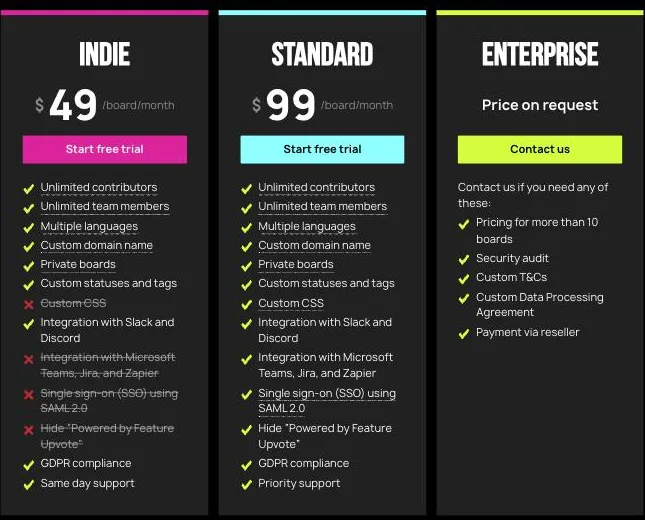
It is not per workspace and it is not per seat.
One small oddity you will notice if you browse for a while. Their pricing page calls the 49 dollar plan Indie, and their feature voting page, live on the same day, calls the identical plan Bootstrapper.
Nothing turns on it, and it is the kind of thing that makes you check you are reading the right row.
The version of this argument worth having is the one you run yourself, and a trial takes 14 days and a card.
What happens to the price with more than one product?
It multiplies. The board is the unit, so a second product costs the same as the first, and a fourth costs the same again.
Run the arithmetic on the 99 dollar tier and four boards is 396 dollars a month on the yearly toggle, or 476 a month if you pay monthly at 119. Nobody is penalising you for growing. That is simply what per board pricing means once you ship more than one thing.
If you ship one product, none of this matters and their entry price is competitive. If you ship four, that multiplication is your invoice.
For comparison, more projects on VoteFirst are on the PRO plan at thirty nine dollars a month, and the plan is what is priced rather than the board count.
What this costs
Lite
$9 /mo
Pro
$39 /mo
Lifetime
$999 once
Fourteen day trial of Pro, card asked for at signup. Nothing here counts the people who vote, so the bill does not move when the board starts working. The long version, with what happens if you stop paying.
What are companies switching to from Feature Upvote?
We do not know, because nobody reports a migration to us and a page inventing that statistic is the sort of thing this site exists not to do. What we can give you is the field and what each one charges.
Here is the whole field, with the column that matters most if you are leaving over the per board bill. Feature Upvote charges per board. Most of these do not, and the ones that also meter you are marked so you do not swap one multiplying invoice for another.
| Vendor | From | Billed per | Free plan | Trial |
|---|---|---|---|---|
| Trello | $5/user/mo | user | Yes | – |
| VoteFirst | $7.50/mo | plan | – | 14 days, card |
| Features.Vote | $7.50/mo | project | – | 14 days |
| Jira Product Discovery | $10/creator/mo | creator | 3 creators | – |
| LoopedIn | $12/mo | plan | 1 of each | – |
| WishKit | $12.50/mo | project | 5 requests | – |
| Sleekplan | $13/mo | workspace | 1 admin | 30 days, no card |
| Upvoty | $13.50/mo | project | – | 14 days |
| Noora | $14/mo | workspace | – | 7 days |
| Convas | $15/mo | tracked user | 25 users | – |
| FeedBear | $15/mo | project | – | 14 days |
| Supahub | $15/mo | workspace | 1 board | 10 days |
| ProductLift | $19/mo | workspace | – | 14 days |
| Productboard | $19/maker/mo | maker | 500 notes | – |
| Roadmunk | $19/creator/mo | creator | – | 14 days |
| Ducalis | $20/mo | changelog subscriber | 500 subs | – |
| Frill | $22/mo | workspace | – | 14 days |
| Fider | $25/mo | workspace | 250 items | – |
| Featurebase | $29/seat/mo | seat | 1 seat | – |
| Headway | $29/mo | plan | Yes | – |
| Nolt | $29/mo | board | – | – |
| UserJot | $29/mo | workspace | 2 boards | 14 days |
| Aha! Ideas | $39/user/mo | user | – | Yes |
| Savio | $39/mo | paid user | – | 14 days |
| Beamer | $49/mo | monthly active user | 1,000 MAU | – |
| Feature Upvote | $49/board/mo | board | – | 30 days |
| Rapidr | $49/mo | workspace | – | 14 days |
| Suggested | $49/mo | plan | – | 15 days |
| Gleap | $49/mo | plan | – | 14 days |
| FeatureOS | $50/mo | plan | – | 30 days, no card |
| Olvy | $60/mo | plan | 25 items | – |
| AnnounceKit | $39/mo | module | – | 15 days, no card |
| Canny | $79/mo | tracked user | 25 users | – |
| LaunchNotes | $249/mo | plan | – | 14 days |
| Pendo | Not published | monthly active user | Beta | – |
| ProdPad | Not published | module | – | 7 days |
| UserVoice | Not published | quoted | – | 30 days |
| airfocus | Not published | quoted | – | – |
| ProductPlan | Not published | quoted | – | – |
| Productroad | $9/mo | plan | 50 users | 14 days, no card |
| Quackback | $29/mo | plan | 1 board, 50 posts | 14 days, no card |
| ProdCamp | $99/mo | plan | 2 admins, 1 product | – |
| Harvestr | $65/editor/mo | editor | – | 14 days |
| Productlane | $29/user/mo | user | – | Yes |
| Ideanote | $6/user/mo | user | 10 users, 250 ideas | – |
| Craft.io | $19/editor/mo | editor | – | 14 days, no card |
| HYPE Boards | €79/mo | plan | – | 14 days, no card |
| Noticeable | $24/mo | plan | 1 project, watermarked | 14 days, no card |
Every figure was read on that vendor's own pricing page on 9 September 2026, and where a vendor publishes nothing we say so rather than estimating. The same table with what each plan includes is here.
Read the third column before the second. Five of these bill by something that multiplies with products or boards, which is the thing you are leaving, and two meter you by how many people use the board, with Beamer's changelog metering everybody who sees it.
That is a different invoice and it grows while you sleep. If the per board bill is what pushed you out, the workspace priced rows are the ones to look at first, and several of them are cheaper than us.
The same two products, line by line
Read on each vendor's own pages on the date in the row above. Not published means nobody could read it on the pages opened that day, never that the feature is absent.
Does Feature Upvote have an API?
Yes. A note taken when their site was still readable to us, on 10 September 2026, records a public REST API opened to every customer in July 2026.
We are putting this near the top because the claim that Feature Upvote has no API was true for years and is still repeated on comparison pages nobody has touched since.
One caution belongs with it. featureupvote.com returns 403 Forbidden to the browser this site checks prices with, so the row above reads not published and this answer rests on that September note rather than on a page we could open today.


Does Feature Upvote weight votes by revenue?
No. Every vote on a Feature Upvote board counts as one.
We checked this rather than assumed it. Their help centre returns nothing at all for a search on weighting, and no page we read mentions vote weight, customer tiers or revenue.
This is the one comparison page in our set where that statement needs no qualification, because unlike several others in this category they ship nothing in this direction at all.
That is a fact about their product and not a boast about ours. Eight of the thirty two tools we checked do offer some form of revenue weighting, so this is a difference between us and them specifically, not something we invented.
What it means in practice is the ordinary problem. A board where every vote is equal tells you what the most people wanted. If one customer pays you forty times another and both cast one vote, the board cannot show you that, because it never recorded it.
On VoteFirst you set an integer multiplier on each voting tier, a vote carries its tier's multiplier, and the plain headcount stays visible next to the weighted total so you can always see when the two disagree.
14 days, a card at signup, then $9 or $39 a month.
What the entry plan actually includes
This is the part this page got wrong the first time, and it is worth saying how.
Read as plain text, their pricing page lists the same thirteen lines under both paid plans. Look at it in a browser and four of the lines under Indie are struck through with a red cross. The text and the picture say different things, and the picture is the one customers see.
So the ladder is real, and here it is.
| On both paid plans | On Standard only |
|---|---|
| Unlimited contributors | Custom CSS |
| Team members with no seat limit | Microsoft Teams, Jira and Zapier |
| Multiple languages | Single sign on with SAML 2.0 |
| Custom domain name | Hiding "Powered by Feature Upvote" |
| Private boards | |
| Custom statuses and tags | |
| Slack and Discord | |
| GDPR compliance |
Two things follow, and they point in opposite directions.
The generous part is real, and it goes against us. Their forty nine dollar entry plan carries a custom domain, private boards and unlimited team members, none of which our nine dollar plan has, and we have no private boards on any plan at any price.
On that row they beat us outright, and several other tools in our table charge for each of those separately.
The expensive part is the last row. Taking their name off your own board is on the ninety nine dollar plan, so the badge costs you fifty dollars a month for each board, every month, forever.
On ours the badge appears only while an account has no active plan, which we can point at in the code rather than assert, so nine dollars removes it.
Does Feature Upvote have a free plan?
No. Their pricing page read on 14 September 2026 carries a thirty day trial that asks for no card, which is the longest published trial in the table, matched by two other vendors, and nothing free after it.
Does Feature Upvote have a changelog, a public roadmap and single sign on?
Feature Upvote's own pages read on 14 September 2026 never offer a public roadmap and never offer a changelog, which means nobody could read about either rather than that neither exists.
The product describes itself as a feedback board and stops there, and several comparison pages elsewhere treat that as a missing feature rather than a decision.
Whether it is missing depends entirely on what you are buying. A board with no changelog is a board, and if you already announce releases somewhere your customers read, a second place to announce them is work rather than value.
Feature Upvote carries SAML 2.0 single sign on on Indie, which is its entry plan and is unusual in this category.
Ours publishes a public roadmap with a Denied column on every plan, and signs a voter in with a token from your own application on the thirty nine dollar plan rather than with SAML.
Can you move a Feature Upvote board to something else?
Some of it, and the parts that do not survive are the same four parts every time.
Who cast each vote rather than the total, the threading on comments, the original timestamps, and every board URL anybody has ever shared. Those four are lost in every move between any two tools in this category, and no vendor's import screen changes it.
What does arrive is the request text, the vote counts and the statuses. Ours takes a CSV and writes twelve columns back out when you leave, which is the part worth checking before you arrive rather than after.
The honest version is that a board full of requests is worth moving once and not twice, so the question to answer before the move is whether the thing that pushed you out is a price or a product.
Is there a free Feature Upvote alternative?
Yes, several, and none of them is Feature Upvote. Fider is the free one to know about, because it is open source and its hosted tier runs to two hundred and fifty feedback items.
UserJot gives two boards and three admin roles, Supahub gives one board and one admin, Featurebase gives one seat, and Sleekplan's Indie tier is a single admin workspace that does not expire.
All five were read on their own pages on 14 September 2026. This product is not one of them. There is no free plan here, only a fourteen day trial that asks for a card at signup.
Is Feature Upvote worth it, and when is it the better answer?
Their support is human. They say so plainly and there is no bot in front of it.
Their moderation is deeper than most. If your board attracts a lot of noise, that is worth more than a lower monthly number.
And private boards, which we have nothing equivalent to. A board of ours is published to everybody or to nobody, with no password and no invite list, so there is no way to admit one named customer. If your feedback has to sit behind a login, buy theirs.
Why are people leaving Feature Upvote?
We are not going to invent a survey. Nobody has told us why they left, and a page that claimed otherwise would be making up the one thing you came here to read.
What we can do is name the two places where the shape of their pricing stops fitting, both of which come off their own published page and neither of which is a fault in the software.
The first is the per board bill arriving for the second and third product, which is the arithmetic in their own quote above. One product and none of it matters. Four products and that sentence is your invoice.
The second is the one this whole page is about. A board that treats every vote as one is the right tool for a community and the wrong one for a customer base where the amounts differ by an order of magnitude.
Neither of those is a complaint about how well their product works. It works. They are questions about whether the shape fits what you are doing.
What ours costs
Nine dollars a month on LITE, one project, weighted voting included. Thirty nine on PRO, which adds more projects, the API and a custom domain.
One price whatever the board does. No per board charge, and no charge per tracked user, so a board that suddenly gets busy costs what it cost last month.
There is a fourteen day trial on whichever plan you pick, and a card is required to start it. Theirs runs thirty days and asks for no card. That is the better offer of the two and saying so costs us nothing.
One more thing you should have before you choose, and it needs stating precisely because the phrase covers two different products.
Theirs is single sign on using SAML 2.0, on the ninety nine dollar plan. That is the enterprise kind. It connects to your company directory so your staff sign in with their work accounts.
Ours is the other kind. We identify the people voting on your board, by verifying a signed token your own application issues against a secret shared with the project, so a customer who is already logged in to your product votes as themselves without creating an account with us. It is on the PRO plan.
The precise mechanism is on the integrations page.
So if what you need is your team signing in through Okta or Azure AD, we have nothing for you and theirs is the answer. There is no SAML anywhere in our product.
If what you need is your customers voting as their real selves rather than as cookies, that is the one this product is.
A note on their yearly discount, since it is the sort of thing worth checking yourself. Their page offers to save you twenty percent.
The two published rates are fifty nine and forty nine, which is a saving of sixteen point nine percent, and one hundred and nineteen against ninety nine, which is sixteen point eight. Yearly is still cheaper.
It is just not quite the number on the button, and you would rather hear that from us than work it out after you have paid.