The short version
- To upvote something is to add your name to it. That's the whole of it.
- A vote count is worth less than its size suggests, and that's measurable.
- Four mistakes people make with counts, starting with reading rank instead of magnitude.
- Weighting turns one bit into a number by multiplying each vote by what the voter pays.
An upvote carries one bit of information, that this person agrees with something somebody else already wrote. That's genuinely useful, because it means forty people who want the same thing produce one request with forty on it instead of forty requests with one each.
Everything people expect an upvote to carry beyond that, it doesn't carry. It doesn't say how much somebody wants the thing, whether they would pay for it, what they would give up to get it, or whether they will still want it next quarter.
How do you define upvote, and what is the meaning of upvote?
To upvote something is to add your name to it. On a feedback board it means you want the thing that was asked for. On a link aggregator it usually means you think the thing is worth other people seeing, which is a different act with the same button.
The word comes from the interface rather than from any theory. There's a count, and pressing the button makes it one larger. The definition is that literal, and most of the confusion about what votes mean comes from reading more into the number than the button ever put there.
There's a board you can press it on without an account.
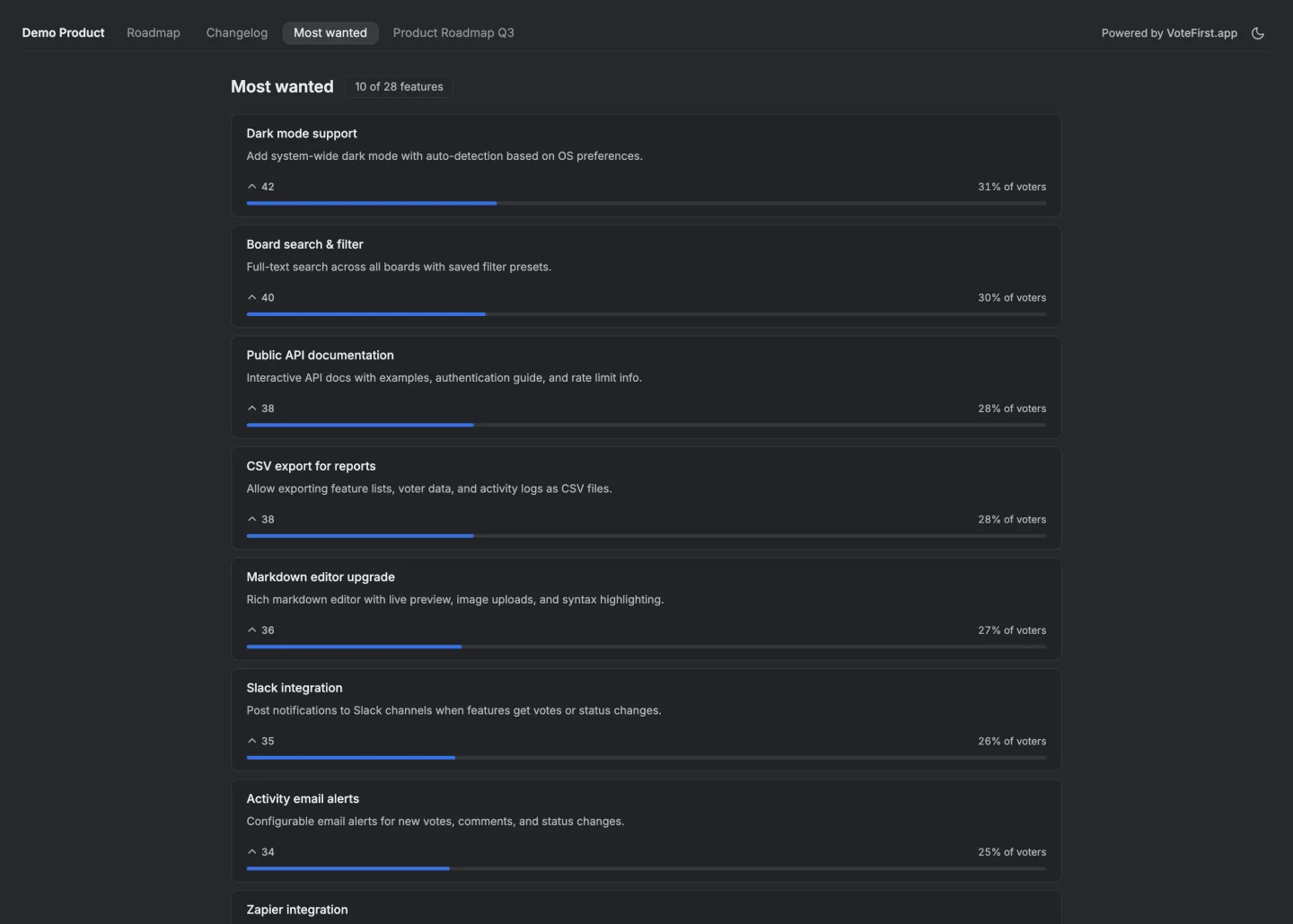
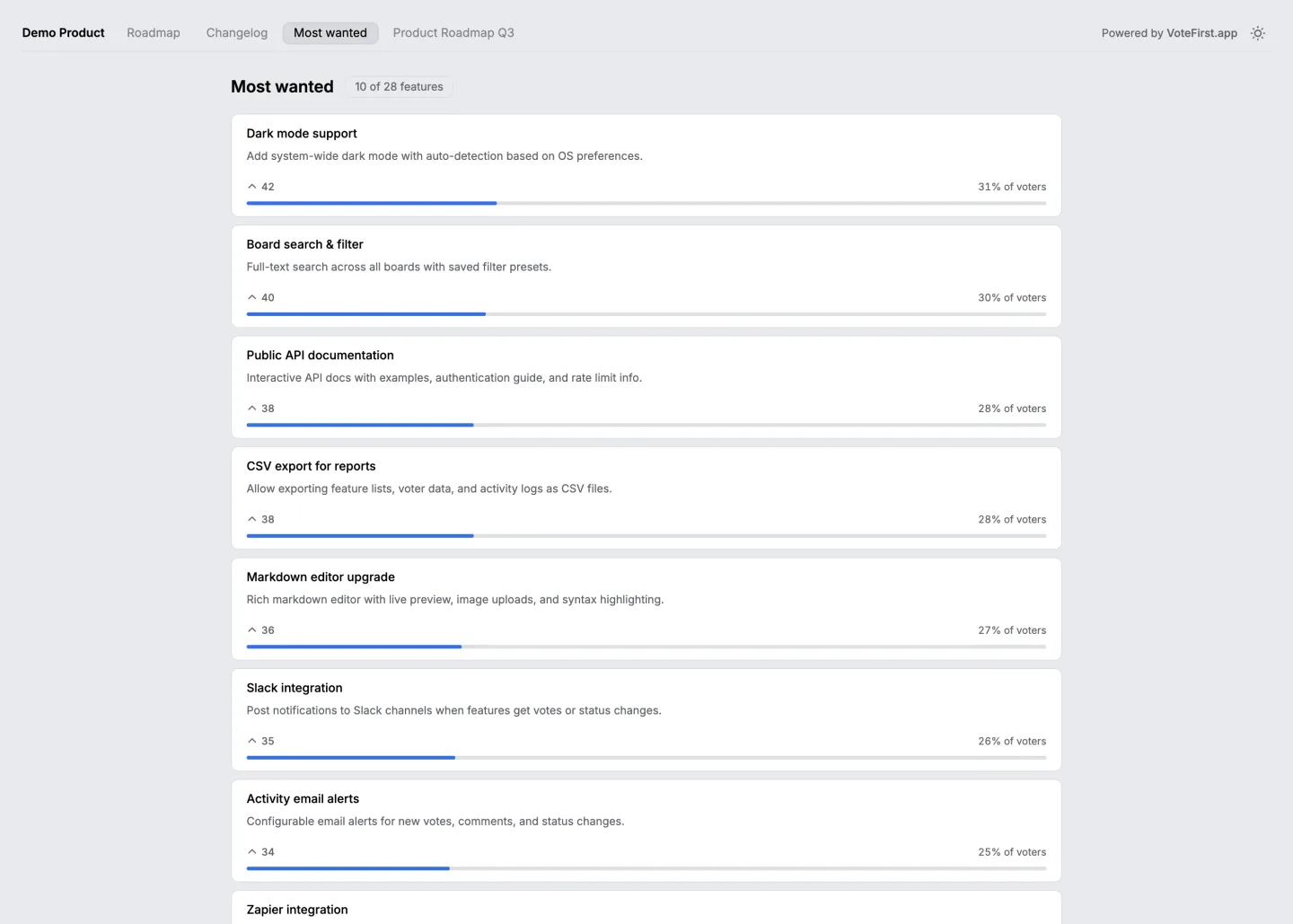
Want a board rather than a list? Seven idea management tools, what each bills on and what it costs.
What is the difference between an upvote and a downvote?
An upvote adds a name to a want. A downvote does three different jobs depending on where it appears, and only one of them belongs on a feedback board.
| What the button means | What the count then measures | Where it works | |
|---|---|---|---|
| Upvote | I want this too | How many people want it | Anywhere |
| Downvote as disagreement | I do not want this | Want minus objection, which cancels out into nothing | Nowhere useful |
| Downvote as moderation | This does not belong here | Whether the community wants it visible | Forums, where the crowd moderates |
| Downvote as quality | This is wrong or badly made | Perceived quality, not demand | Answer sites |
The second row is why most feedback boards have no downvote. Subtracting objections from a want produces a number that means nothing at all.
A request wanted by forty people and disliked by thirty nine shows as one, and is indistinguishable from a request one person asked for. The information both groups gave you is destroyed by the arithmetic.
The third row is a real use, but it's a moderation mechanism dressed as a vote, and on a board with an owner the owner is already doing that job.
What a vote count is actually worth
Less than its size suggests, and this is measurable, not a matter of opinion.
Thirty six public feedback boards belonging to real companies were read on 27 August 2026. On the median one, the median request visible on page one had nine votes.
On nineteen of the thirty six the median request had fewer than ten, and on eight of them fewer than five. On one board the single most voted request in the whole list had two.
The shape matters as much as the size. On the median board the most voted request held sixteen per cent of all the votes on page one, and the five most voted held about half of them. The rest is a long tail of ones and twos.
So a vote count is informative at the top of a board and close to meaningless below it. The first few requests are telling you something real.
The difference between the third and the eighth, at nine votes a piece, is one person having a bad afternoon. The full measurement, with everything it can't tell you, is on its own page.
The four mistakes people make with vote counts
Reading rank instead of magnitude. Position three versus position eight is noise on most boards. Position one versus position thirty isn't. Read the gaps, not the order.
Comparing counts across boards. A request with sixty votes on a board with eight thousand users and a request with sixty on a board with eighty are different facts wearing the same number.
Treating a count as stable. A link from a forum or a newsletter will reorder the top of a board overnight, and nothing about your customers changed.
Assuming a vote is a purchase intent. It's free to press. Agreement costs nothing, and the number of people who will agree that a thing would be nice is always larger than the number who need it.
Can you count votes without a tool?
For a small board, yes, and a spreadsheet is honest about what it is.
One row per request, a column for the count, additions through a form. That works until somebody wants the count to mean more than raw enthusiasm, and then it stops, because a sheet can't tell you who voted.
Without knowing who voted you can't stop one person voting ten times, you can't tell the forty people when their thing ships, and you can't weight anything.
Knowing who voted is the difference between a count and a signal, and it's the thing that's genuinely hard to do by hand.
What weighting a vote changes
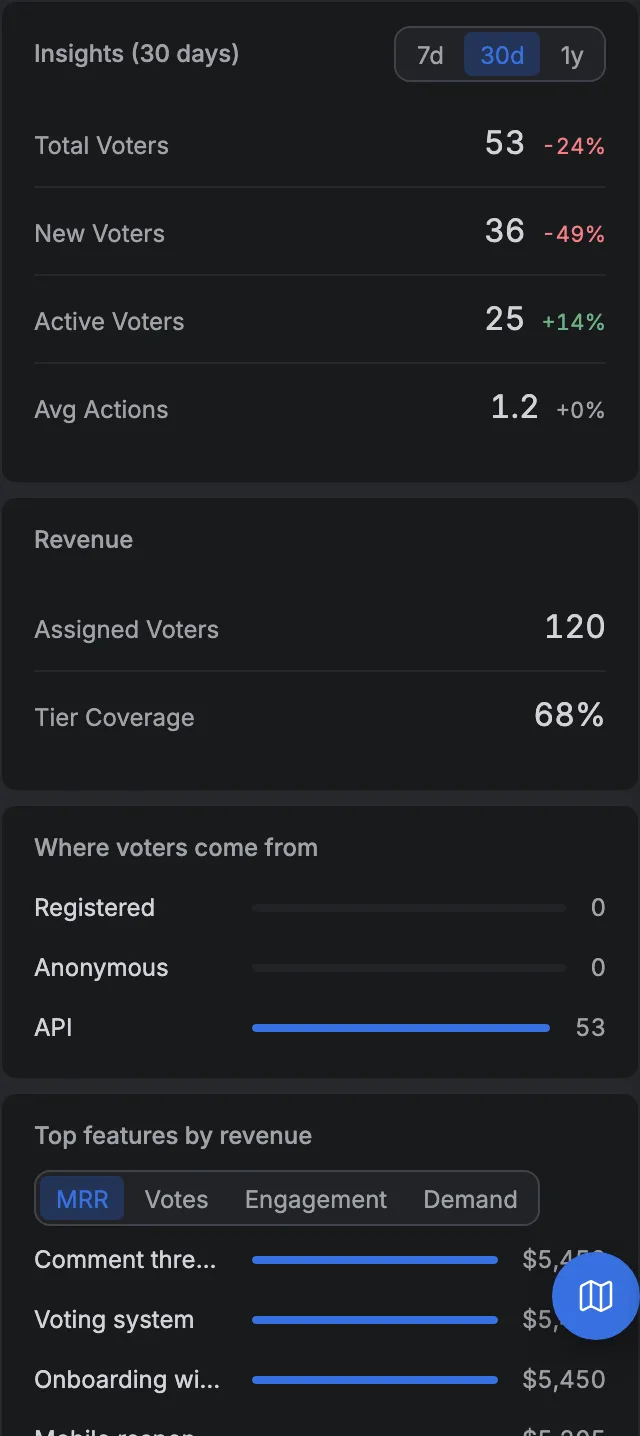
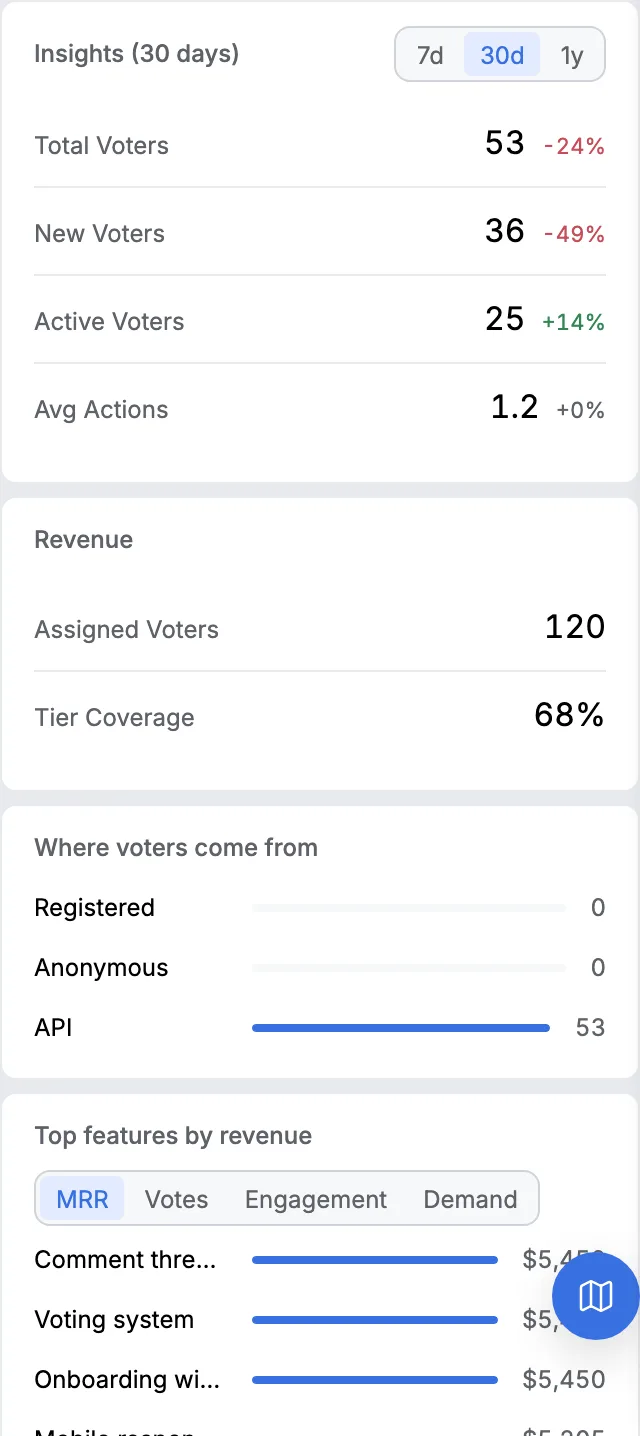
It turns one bit into a number, by multiplying each vote by what the person casting it pays.
Both numbers are on every card in the picture above, the plain vote count and the weighted total beside it in blue. Keeping both is the part that matters, because they answer two different questions and a board showing only one of them can't tell you which you're reading.
The multiplier per tier is set on one screen, and it's the only configuration weighting needs.
The limit deserves to be said as loudly as the feature. Weighting doesn't manufacture a signal out of nine votes. If everybody who votes on your board pays you roughly the same, weighting has nothing to weigh and you're back to the plain count.
What it fixes is a specific, common failure, the board reordering itself every time a link arrives from somewhere with no customers on it.
One more thing an upvote can carry, which almost nothing does with. If you know who voted, the vote becomes an address. When the thing ships, the people who asked for it can be told, by the software, without anybody keeping a list.
How the board is wired is written up here, and what an idea board is, and when it stops working, has its own page.
14 days, a card at signup, then $9 or $39 a month.