The short version
- Four things per idea, and the fourth is what separates a board from a document.
- Two audiences want opposite things from the same board.
- It stops working at about a hundred open ideas, and the failure is always the same one.
- Three real fixes, and two popular ones that only look like fixes.
That last clause is the whole definition. A list of things people want is an inbox. A list of things people want, where the next person can see what's already there and add their name to it instead of writing it again, is an idea board.
Everything else follows from the agreeing. The vote count exists because of it. The moderation exists because of it. The reason the board eventually stops working is that the agreeing gets harder as the list gets longer.
What is on an idea board?
Four things per idea, and the fourth is the one that separates a board from a document.
A title, which is what the idea is called and, on most boards, the only part anybody reads. A body, which is what the person actually wants and why.
A state, which is what has happened to it since. And a count, which is how many other people said the same thing without having to write it out again.
The count isn't a popularity score. It's a deduplication mechanism that happens to produce a number. When forty people want a thing and thirty nine of them can see that the fortieth already asked, you get one idea with forty on it.
When they can't see it, you get forty ideas with one on each, and a list that's unreadable by the second week.
There's a board you can post on without an account if the definition is easier to see than to read.
Want a board rather than a list? Seven idea management tools, what each bills on and what it costs.
Who is an idea board for?
Two audiences, and they want opposite things from it.
The person filing something wants one thing, which is to find out later whether it happened. Everything else on the board is furniture to them. If nothing tells them when their idea moves, they file once and never return, and the board's supply dries up while looking healthy.
The team wants the ordering. They want to open the board on a Monday and have the top of it mean something. That's a harder thing to build than it sounds, because the top of a board is set by whoever arrived recently rather than by whoever matters most.
Those two wants pull in different directions and every design decision on a board is a trade between them. A board optimised for the team, with private notes and internal columns, stops being worth visiting. A board optimised for the filer, with everything public and nothing moderated, stops being usable by the team.
When does an idea board stop working?
At about a hundred open ideas, and the failure is always the same one.
There's no clean measurement of that threshold and this post isn't going to invent one. What there is, is a measurement of what the boards look like on the other side of it. Thirty six public feedback boards belonging to real companies were read on 27 August 2026.
On half of them, page one alone carried thirty seven ideas or more, and on the median board the five most voted ideas held about half of all the votes on that page. Everything else is a long tail of ones and twos.
That's what the failure looks like from outside. A board with a busy head and an unreadable body, where the top five are genuinely informative and the next thirty two are indistinguishable from each other.
Three specific things break at that point.
Duplicates outnumber originals. By the time there are a hundred open ideas nobody reads the list before posting, so the same want arrives under five different titles and the count that should be forty is five counts of eight.
The order stops being real. On the median measured board the median idea had nine votes. A gap of three votes between two ideas, at that scale, is one person having a bad afternoon. Treating the difference between the third and the eighth as a ranking is reading a signal that's not there.
Nothing ever leaves. On twenty six of those thirty six boards, page one still carried an idea posted in 2021 or earlier. The board isn't full of live wants at that point, it's an archive with a posting form attached.
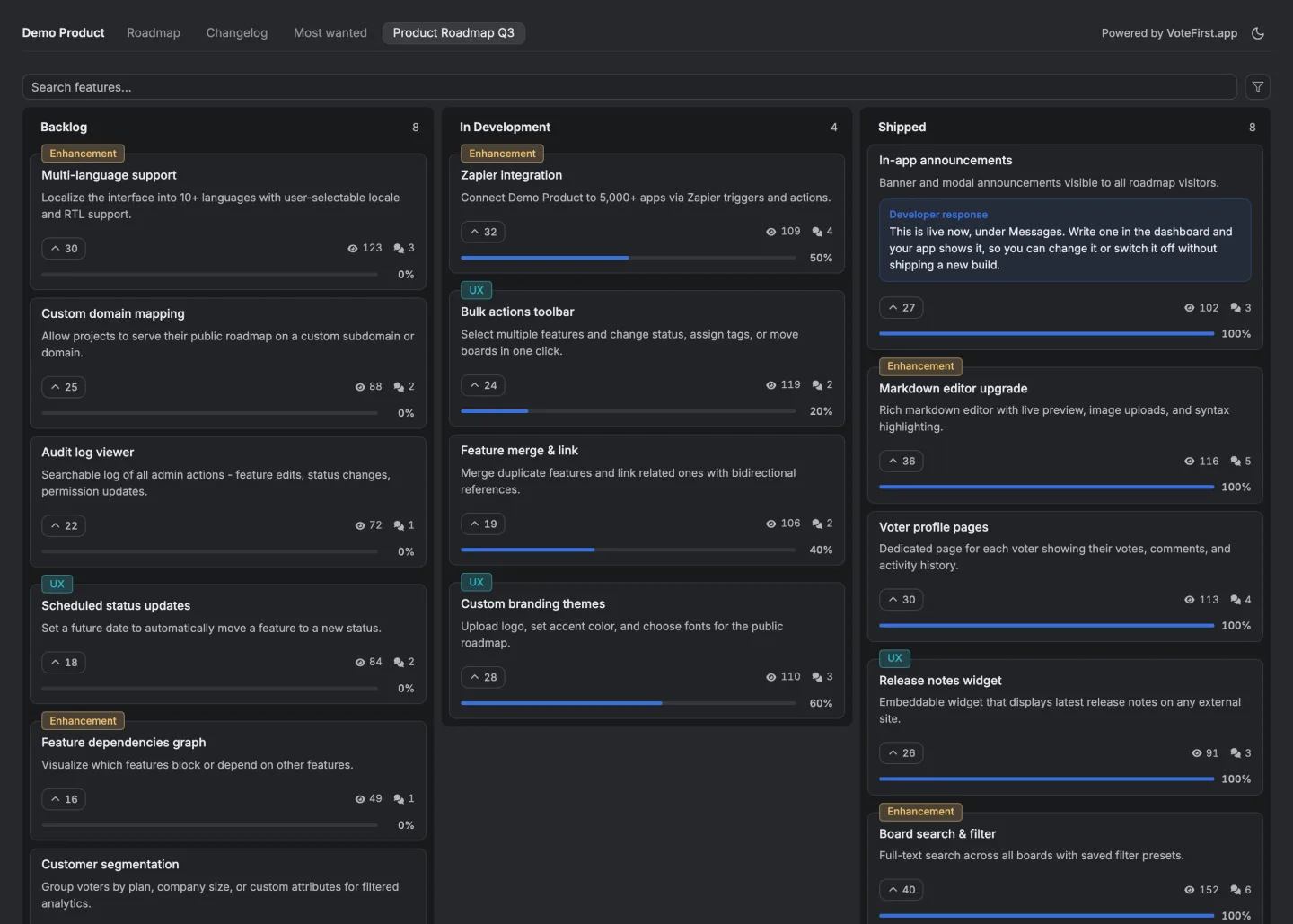
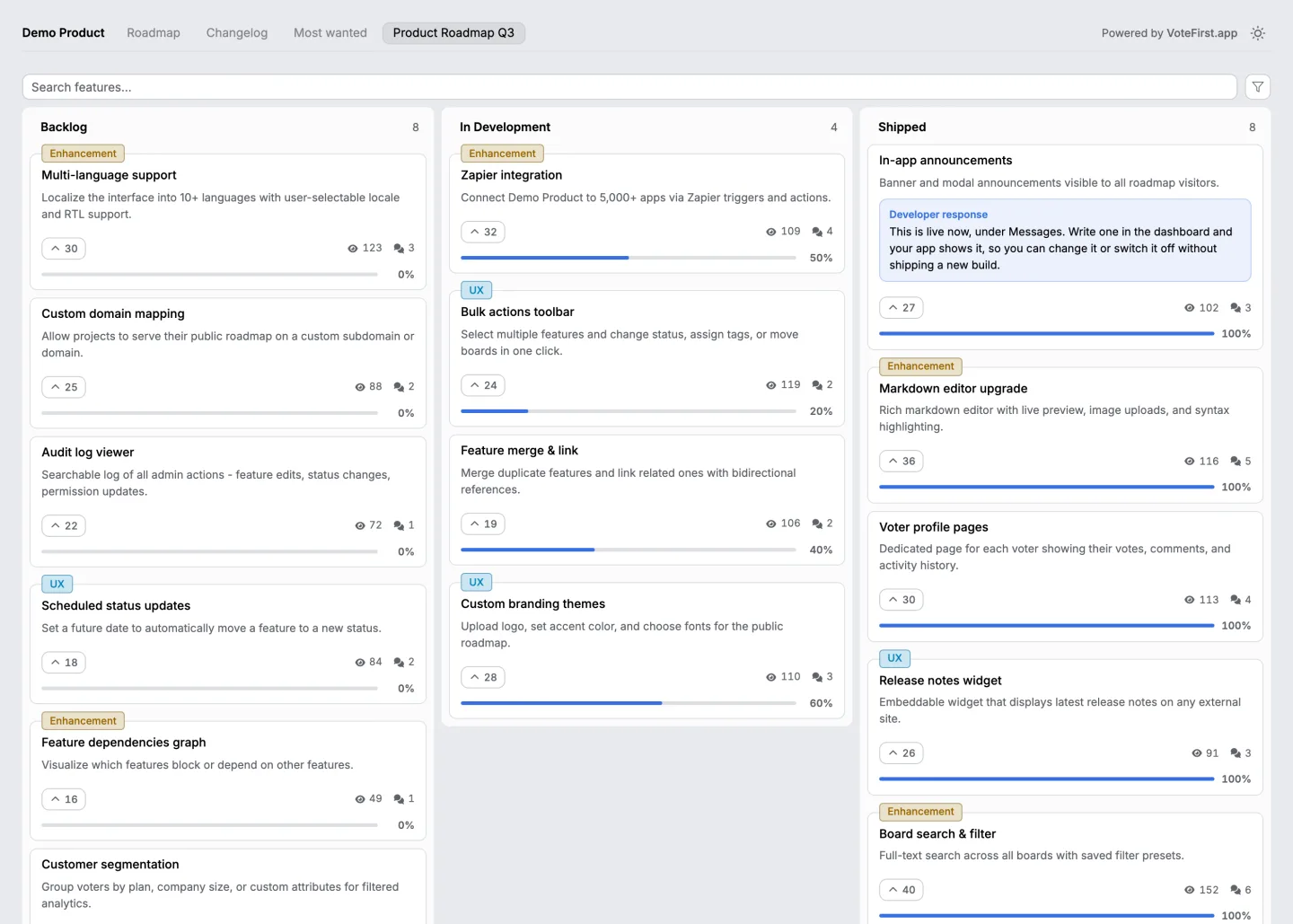
What fixes it, and what only looks like it fixes it
Three real fixes and two popular non fixes.
The real ones are moderation before publication, merging, and closing. Moderation stops the duplicate arriving. Merging repairs the ones that already did, and the merge has to move the votes or it's just a deletion.
Closing is the one nobody does, and it's the one that matters most. An idea that won't be built needs to be marked as such with one sentence saying why, not left open to be polite.
The two non fixes are tags and search. Both are real improvements to a board that already works. Neither does anything for a board whose problem is that it contains four hundred things, because the person about to post a duplicate isn't going to search first and never was.
Can you run one without a tool?
Yes, and for a small board a spreadsheet is genuinely better than most tools.
One row per idea, columns for the title, the body, the state and the count. Take additions through a form so nobody edits the sheet directly. That handles everything on this page except the two hard parts.
The first hard part is the vote, because a spreadsheet can't stop one person voting ten times and can't tell you who voted.
The second is telling people their idea shipped, which means keeping a list of who asked for what and writing to them by hand. Those two are the entire reason boards became software.
How our own board handles the hundred idea problem
Moderation by default, a merge that moves the votes, and a count you can weight.
Nothing a visitor writes appears publicly until somebody approves it, so duplicates are caught before they split a count rather than after. Merging two ideas moves the voters across and recounts both totals, including the weighted one, and a person who voted for both is only counted once afterwards.
Denied is one of the five columns a new project starts with, and the card carries the response explaining the decision, which is what makes closing something a survivable act, not a rude one.
The weighted count is the answer to the nine votes problem, and it's worth stating its limit as plainly as its use. Weighting multiplies each vote by what the person casting it pays, so the ordering stops moving every time a forum links to you.
It doesn't manufacture a signal out of nine votes, and if everybody voting on your board pays you roughly the same, it has nothing to weigh. How the board is wired is written up here, and six worked board shapes are on their own page.
14 days, a card at signup, then $9 or $39 a month.