The short version
- Six boards, each organised around something different.
- A wall with two rules on it beats every shape here for the first three months.
- Four things go wrong with all six, and the first is by far the most common.
- A spreadsheet does five of the six properly.
An idea board is a list of things people want, arranged so that the arrangement itself carries information. The six examples below differ in exactly one way, which is what the columns mean, and that single choice decides everything else about how the board behaves once it's full.
The examples are worked, not named. No company's board is reproduced here, because a board belonging to somebody else is theirs to publish and not ours to repost.
What does an idea board actually look like?
A title, a body, a count, and a column. Everything else is decoration on those four.
The count is the part people get wrong. A vote count only means something in comparison to the other counts on the same board, and on real boards those counts are much smaller than anybody expects.
Thirty six public feedback boards belonging to real companies were read on 27 August 2026, and on the median one the median request visible on page one had nine votes.
Half of them had a median request under ten votes and eight had one under five. The full measurement, including everything it can't tell you, is on the page about whether suggestion boxes work.
That number is the reason the six shapes below differ. A board arranged around votes is arranged around a signal that, on most boards, is nine people. A board arranged around anything else is arranged around something sturdier.
There's a board running without an account if you want to look at one before reading the list.
Want a board rather than a list? Seven idea management tools, what each bills on and what it costs.
The six, and what each is organised around
Best last. The order below is roughly the order a team discovers them in.
| The board | What the columns mean | What it is good at | Where it breaks | |
|---|---|---|---|---|
| 1 | The wall | Nothing. One list, newest first | Getting started in an afternoon, and never losing an idea | The tenth week. Nobody can find anything and the list is read by nobody |
| 2 | The theme board | Area of the product. Billing, reporting, mobile | Routing. Each column has an owner who reads it | Ideas that touch two areas, which is most of the interesting ones |
| 3 | The stage board | How far along the idea is. Suggested, in review, planned, shipped | Telling somebody who asked for a thing where their thing is | It answers the status question and no other, so nothing on it is ever prioritised |
| 4 | The effort and impact grid | Two axes, both estimated | Making a decision visible in one picture | Both axes are guesses, and the position of a card is set by whoever is most confident |
| 5 | The vote board | Demand. The column is fixed and the order is the count | Showing what the loudest part of your audience wants | Nine votes. The order between the third and the eighth request is noise |
| 6 | The revenue weighted board | Demand, multiplied by what the person voting pays | Ordering by something that does not move when a forum links to you | It needs to know what each voter pays, which is a wiring job |
The line falls between five and six, and the reason isn't that money matters more than people. It's that a plain count and a weighted count answer two different questions, and a board with only one of them can't tell you which question you're looking at.
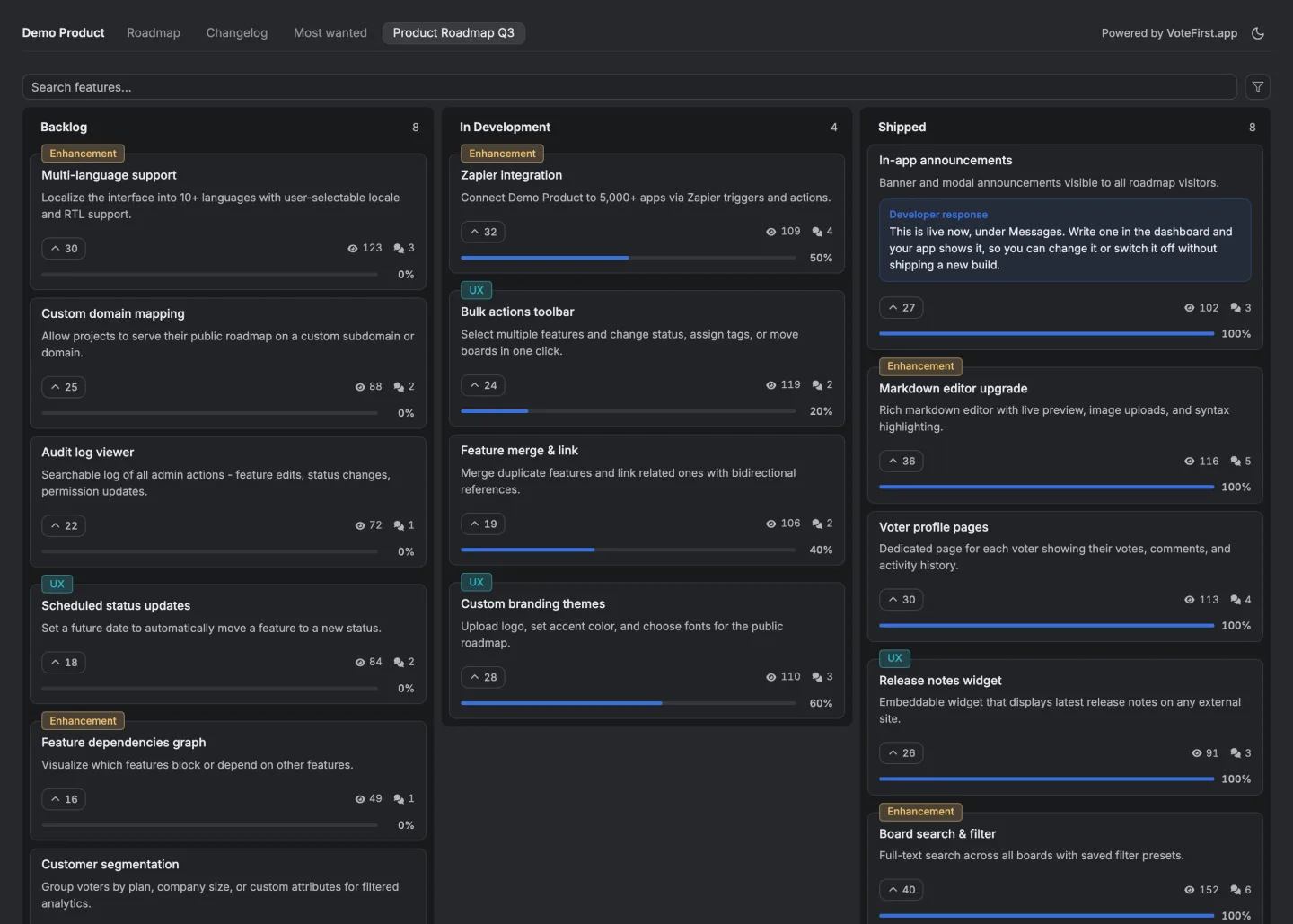
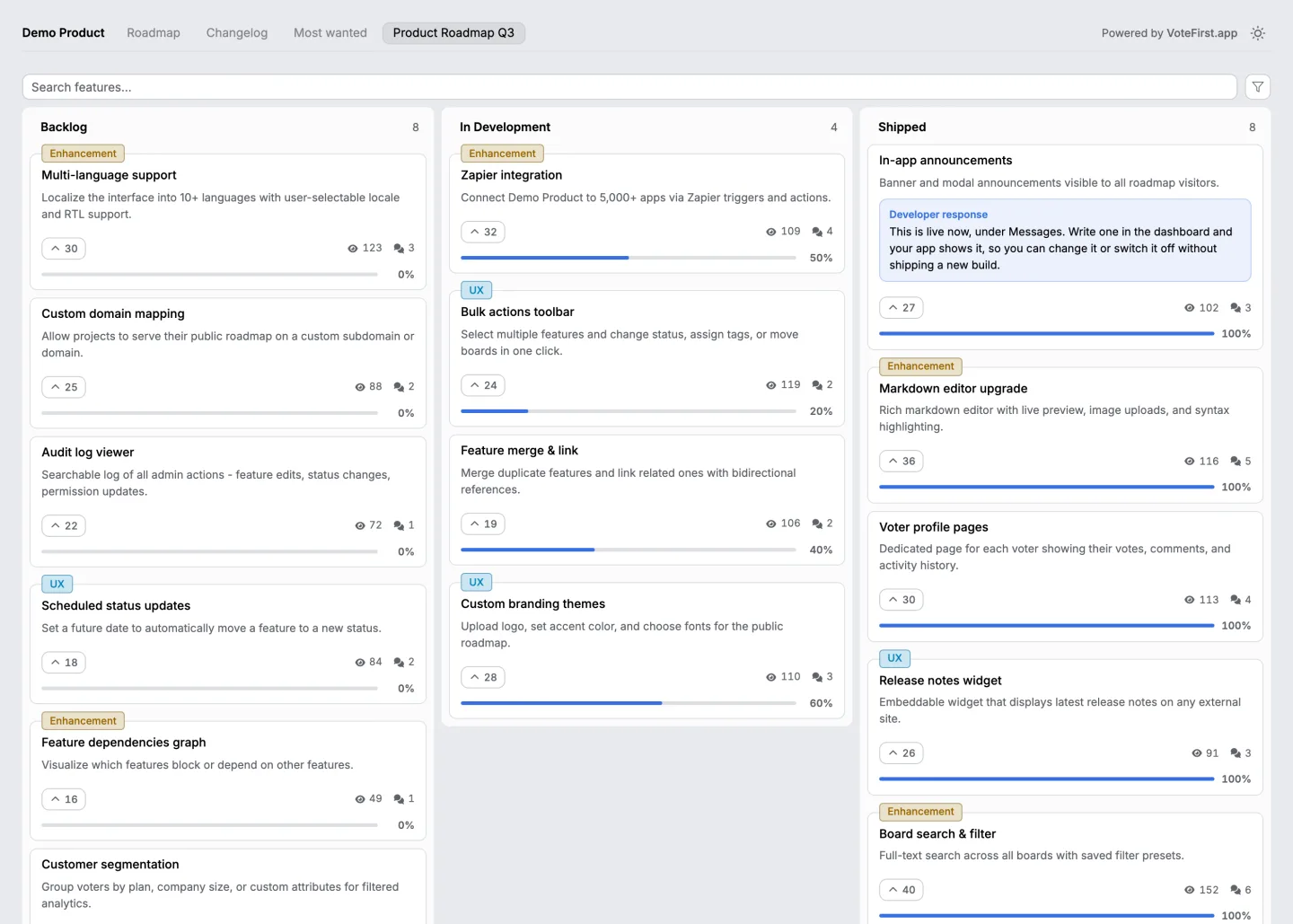
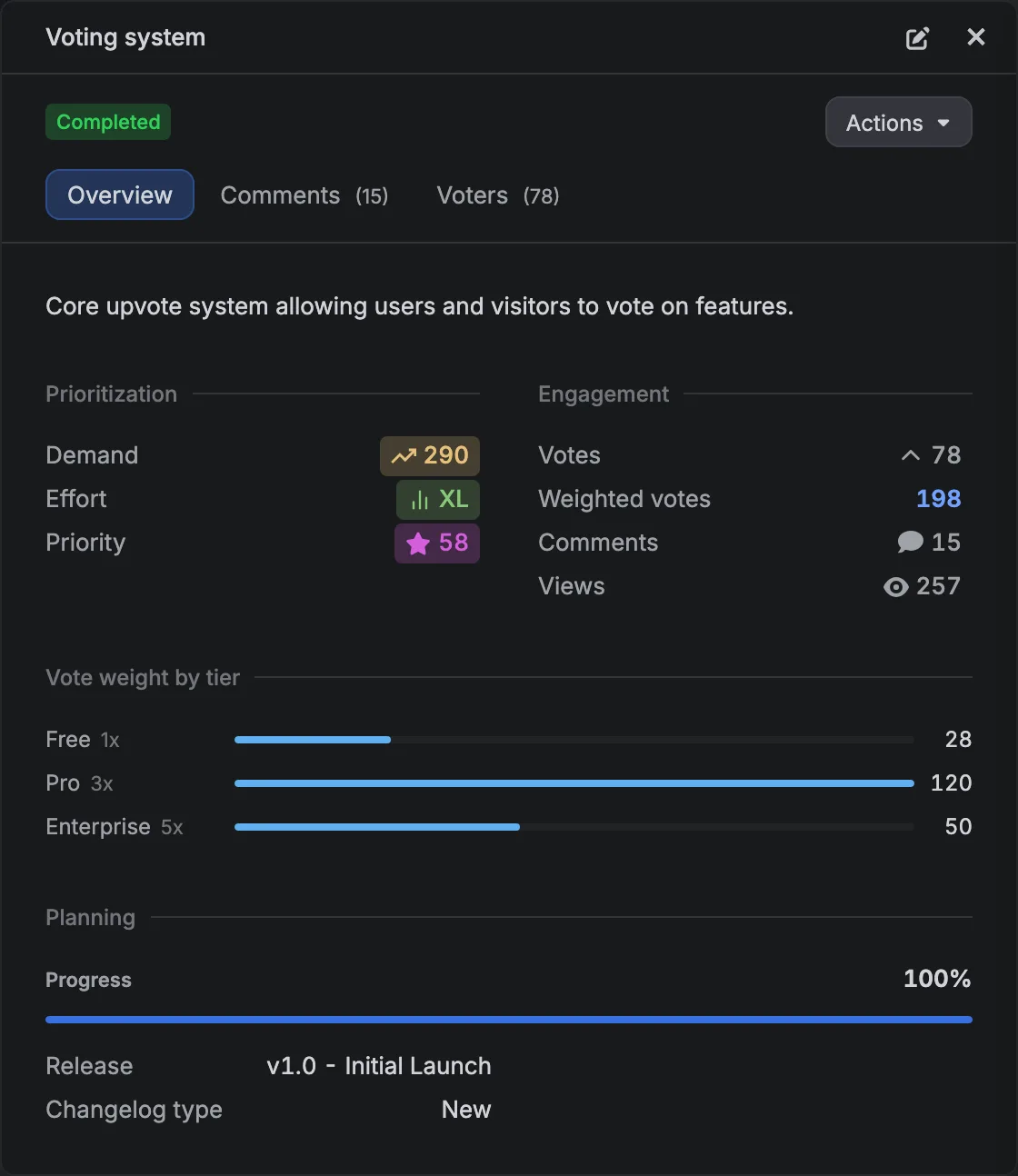
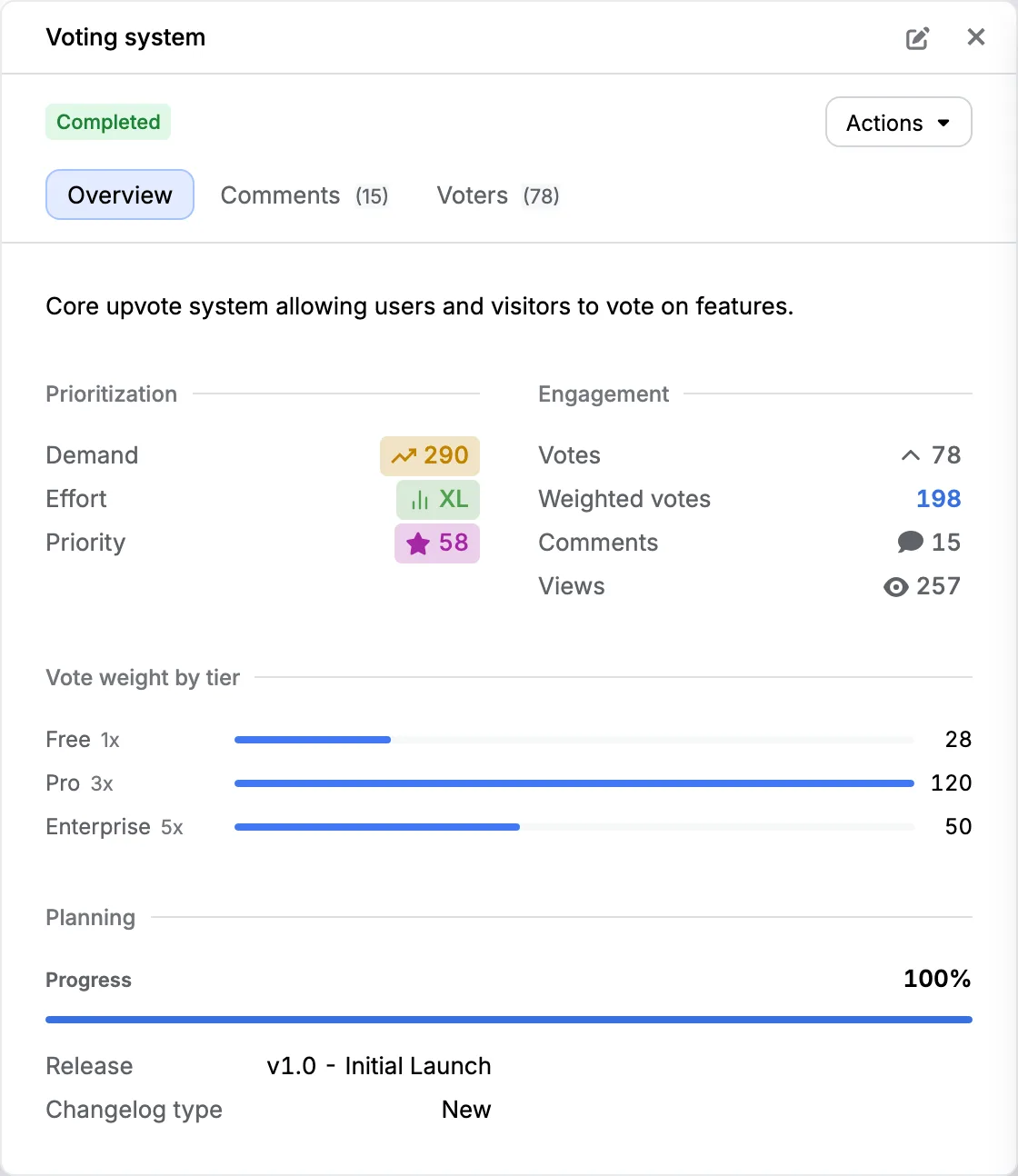
Both counts are on every card in the picture above, the plain vote count and the weighted total beside it in blue. Neither of those numbers is the right one on its own. They're answers to different questions, and a board showing only one of them can't tell you which question you're reading.
A template you can copy today
The wall with two rules on it beats every shape above for the first three months.
The rules are these. One board, four columns, and nobody adds a fifth. The four are suggested, planned, in progress and done, which is the stage board from row three, because the status question is the only one anybody asks in the first three months and answering it costs nothing.
Suggested      Planned        In progress    Done
-----------    -----------    -----------    -----------
Export to CSV  Dark mode      Bulk edit      Search in body
Slack alerts   SSO            API rate limit Saved views
Custom domain
Add the vote count to the suggested column and nowhere else. A count on a planned card invites an argument about whether something should have been planned, and that argument has no end.
Two columns people add and should not. A backlog column, which is where ideas go to be technically not rejected. And a someday column, which is a backlog column that has given up pretending.
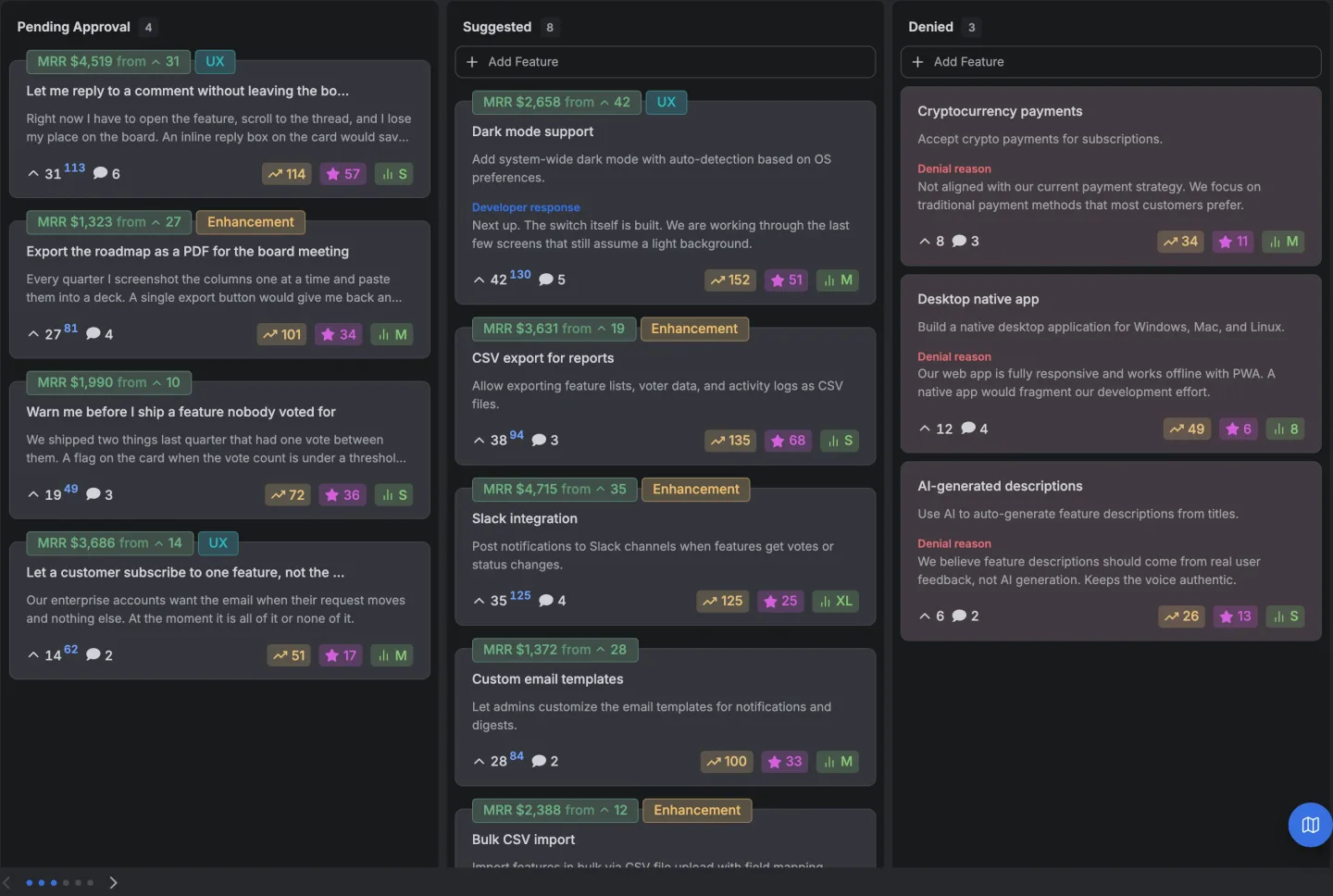
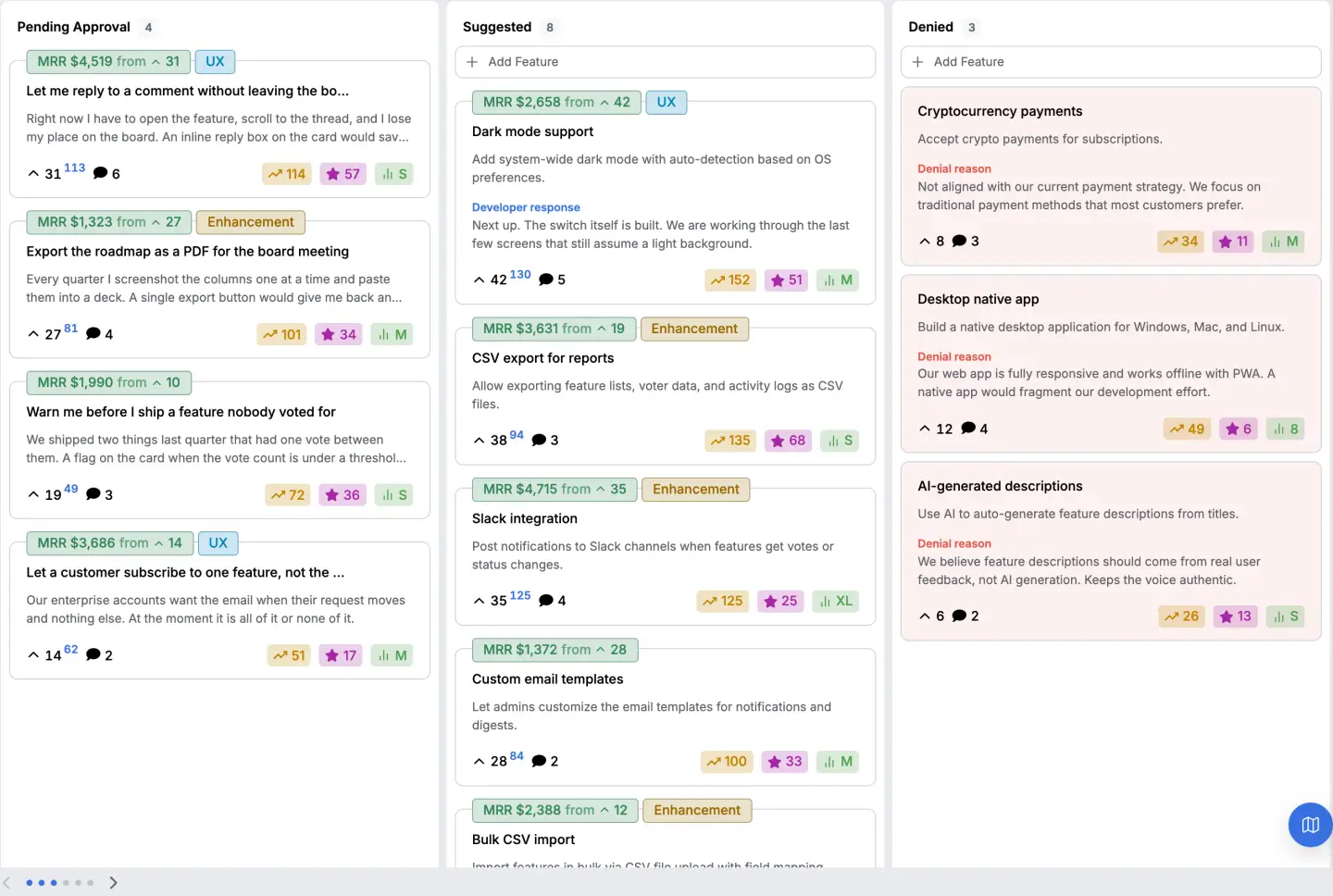
If a thing isn't going to happen, the honest column is the one that says so, with a sentence underneath saying why.
What goes wrong with all six?
Four things, and the first one is by far the most common.
Nobody prunes. On twenty six of those thirty six measured boards, page one still carried a request posted in 2021 or earlier. Page one. Not an archive. A board whose front page is five years old teaches every visitor that posting there does nothing, and it teaches that faster than any amount of good posting teaches the opposite.
The board is a place where feedback goes rather than a place where it's read. The test is whether the person who filed something gets told when it moves. If the answer is no, the board is a suggestion box with better typography.
The columns are about your team. Area names, squad names, quarter names. A visitor can't file anything correctly under those, so everything ends up in the wrong place and the columns stop meaning anything.
Everyone can post and nobody moderates. The first duplicate is fine. The fortieth duplicate splits the count for the thing forty people want into forty counts of one, at which point the board is actively lying about demand.
How do you run one without a tool?
A spreadsheet does five of the six shapes, and it does them properly.
One row per idea, columns for the title, the body, the stage, the count and the date it last moved. Sharing it read only and taking additions through a form is the whole method.
It works, it costs nothing, and the honest limitation is the count. A spreadsheet can't stop one person voting forty times, and it can't tell you who voted, which means it can't ever be sorted by anything other than raw enthusiasm.
The second thing a spreadsheet can't do is tell somebody their idea shipped. That's the loop, and the loop is the entire reason a board outperforms an inbox. Doing it by hand means keeping a list of who asked for what, which is exactly the work a tool exists to remove.
How our own board is arranged
Five columns by default, and the order inside them is a number the board computes.
A new project starts with suggested, denied, in review, in progress and completed. Nothing a visitor writes appears publicly until somebody approves it, which is the moderation rule that stops the duplicate problem above.
Each card carries its plain vote count and its weighted count side by side, so the two questions from row six of the table are both on screen at once, not one replacing the other.
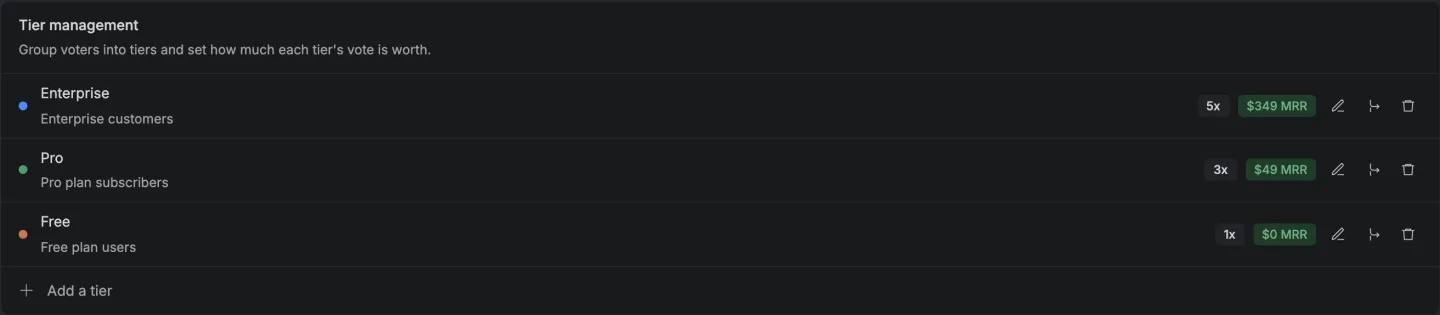
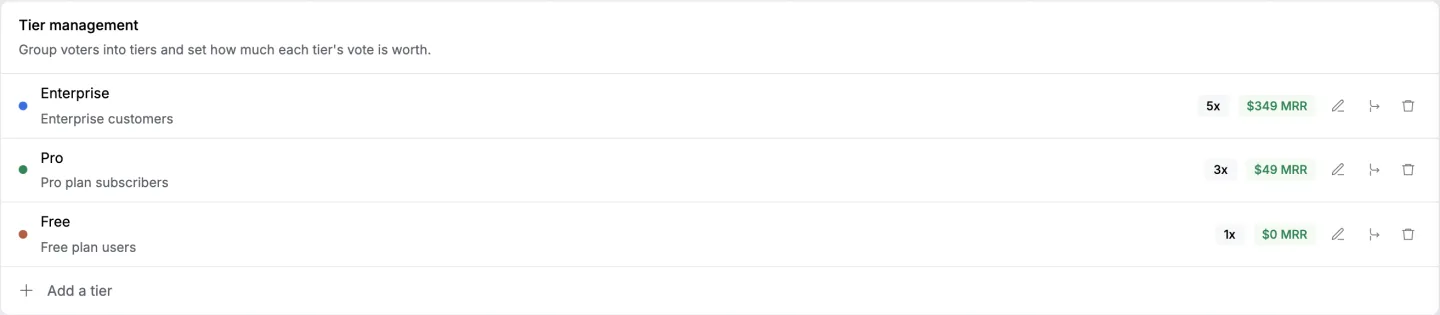
The weighting itself is a multiplier per tier, set on one screen.
The multiplier is the only piece of configuration the weighted board needs, and it's worth being honest about what it buys. If everybody voting on your board pays you roughly the same, weighting has nothing to weigh and row five is the board you want.
How the board is wired is written up here, and what an idea board is and when it stops working has its own page.
14 days, a card at signup, then $9 or $39 a month.