The short version
- Thirty six public boards read in one day, from outside, with no account.
- On the median board, the median request on page one has nine votes behind it.
- Twenty six of the thirty six still show a request from 2021 or earlier on page one.
- Four conditions decide whether a box works, and you need all four.
Suggestion boxes work when somebody answers what goes into them, and thirty six real ones are read further down to show how rarely that happens.
This site sells a feedback board, which is a suggestion box with vote counts on it, so read this with that in mind. It would be easier for us if the answer were a straight yes.
The answer is yes in a narrow sense and no in the sense most people mean when they ask. A suggestion box works when somebody reads it and something visibly happens as a result.
It doesn't work as a way of finding out what to build, and it very rarely works by itself. The arrangements that do work are listed separately, and the free routes for a staff box are compared on their own page.
That could be an opinion, so we went and counted instead. On 27 August 2026 thirty six public feedback boards belonging to real companies were opened, all of them live, and the front page of each was read. This post is what that found and what it appears to mean.
What did we actually measure?
Thirty six boards, one day, from outside, with nothing that needed an account.
They're all hosted on the same platform, which publishes each board's post list inside the page it serves, so counting is a matter of reading what's already public.
For each board we took the number of requests on page one, the votes on each of them, and the dates of the oldest and newest request shown. The script is in our own repository and anybody can rerun it.
Two limits, stated before the numbers rather than after them.
Page one only. Every count below is a floor. A board with forty requests on page one has at least forty and probably more.
The dates describe the sort, not the board. These boards render their default order, which is prominence rather than date, and a sort parameter in the address is ignored. So the newest date on page one is a floor on staleness and never a proof of it. A board can be busy and still put a popular old request first. We were careful about this because getting it backwards would mean calling somebody's active board dead, and that's both rude and wrong.
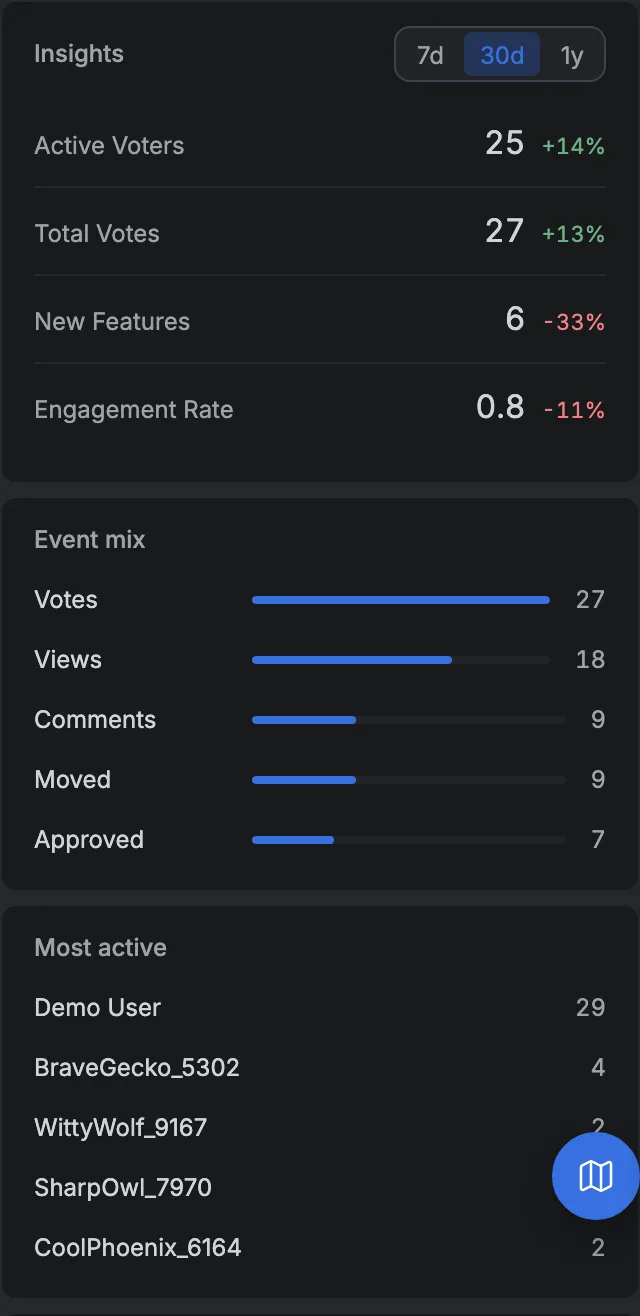
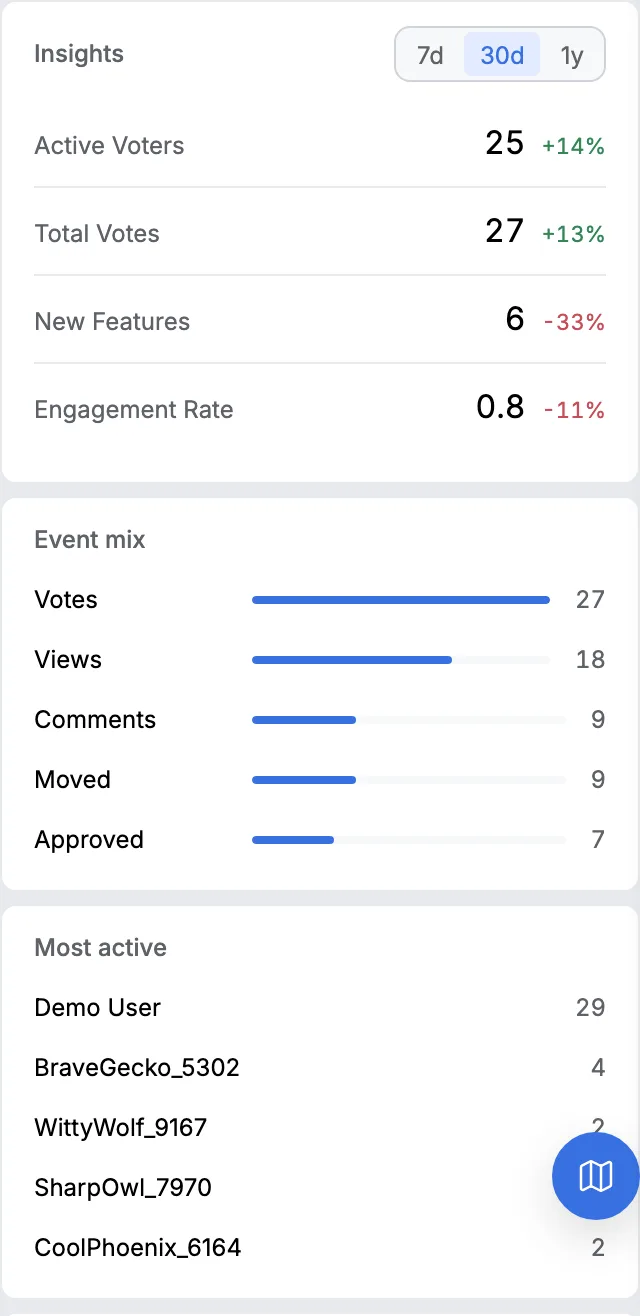
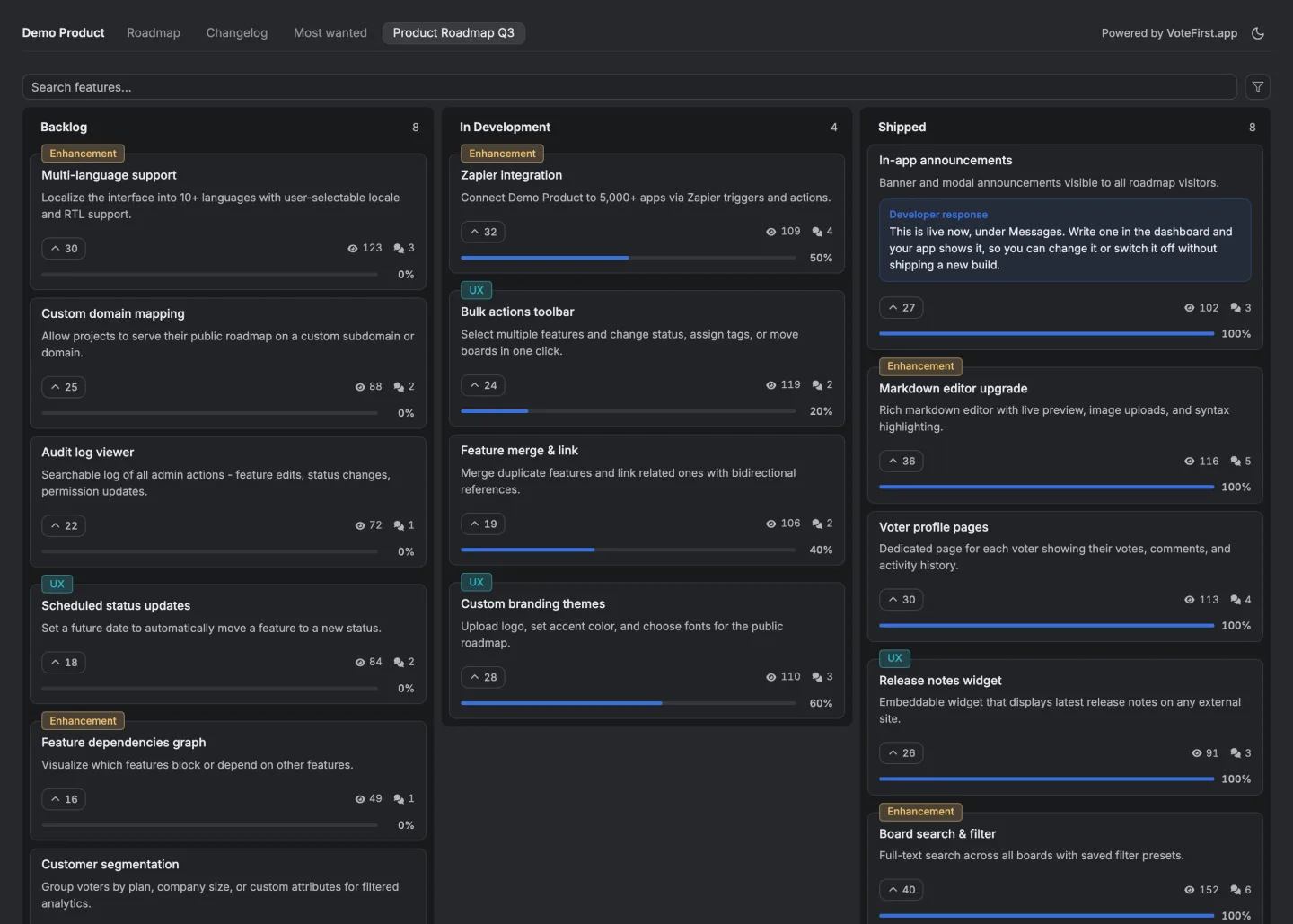
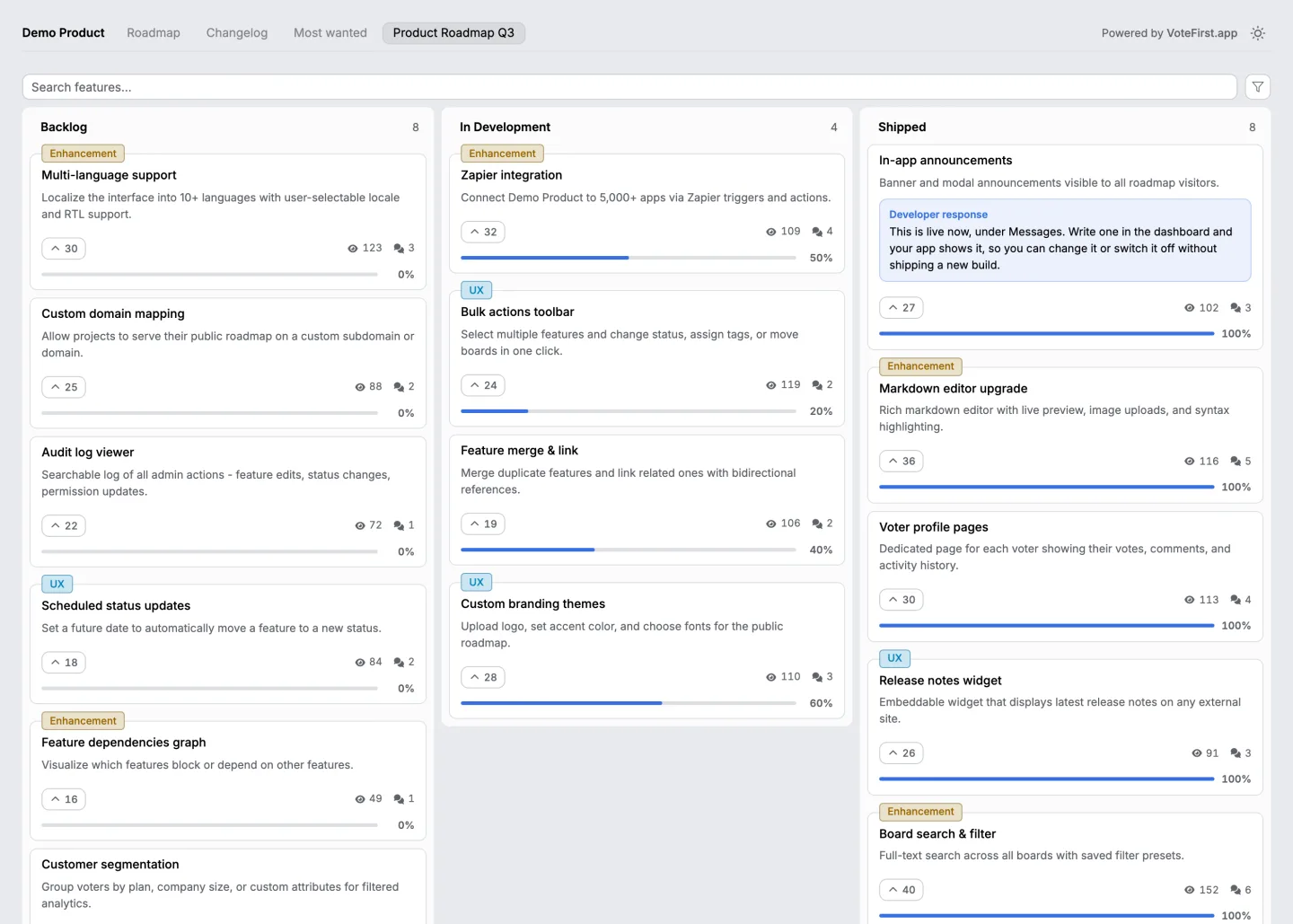
The demo board is open with no account and carries the same thing this post is describing.
Want a board rather than a list? Seven idea management tools, what each bills on and what it costs.
So do suggestion boxes work?
On the median board, the median request on page one has nine votes on it.
Not the quiet corner of the board. Page one, which is the part the platform decided was most worth showing. On nineteen of the thirty six, the median request there has fewer than ten votes. On eight of them, fewer than five.
The top of each board looks healthier and is less useful than it looks. The most voted request had fewer than twenty five votes on eight of the thirty six boards, and on one of them the single most popular thing anybody had ever asked for had two votes.
These aren't hobby projects. They're companies that decided to run a public feedback board and put it on their own domain.
So the box gets filled. What it collects is a long flat list of things a handful of people each want, and almost nothing that a reasonable person could call a signal.
Does a suggestion box tell you what to build?
Less than you would hope, and there's a number for that too.
On the median board, the single most voted request holds sixteen per cent of all the votes on page one. The range runs from six per cent to sixty three per cent, and only one board in the thirty six is anywhere near that top figure.
Think about what a sixteen per cent share means in practice. It means the loudest thing on your board isn't loud. It's slightly ahead.
If you built the top request and nothing else, you would have addressed a sixth of the expressed demand on the most visible part of your own board, and the other five sixths would be spread across dozens of things with single digit support each.
That's the honest shape of the data, and it's the opposite of the promise. The pitch for a suggestion box is that it surfaces the thing everybody wants. What it actually surfaces is that there's no thing everybody wants, which is useful information and isn't what anybody was hoping to hear.
How many votes do you need before the count means anything?
More than most of these boards have, and the shape of the top of a board says so more clearly than the median does.
We took the five most voted requests on every board that had at least five, which is thirty five of the thirty six, and compared the fifth with the first.
On the median board the fifth most voted request carries forty one per cent of the votes the top one has. On ten of those thirty five it carries at least half.
That's a cluster, not a ranking. The board has taken a few dozen requests and told you that five of them are roughly equally wanted, which you could probably have guessed, and it has done it with a precision the numbers don't support.
Put that next to the median request having nine votes and you get the practical rule. A gap of three votes between two requests is one person having a bad afternoon.
Treat the difference between the first and the fifth as real if you like. Treat the difference between the third and the eighth as noise, because on most of these boards it is.
The number does become useful, but it takes a scale most boards never reach. Until then the vote count is a tie breaker between things you were already going to consider, and reading it as a mandate is how a team ends up building the thing four people wanted loudly.
Does weighting the votes fix it?
Partly, and it fixes a different problem than the one above.
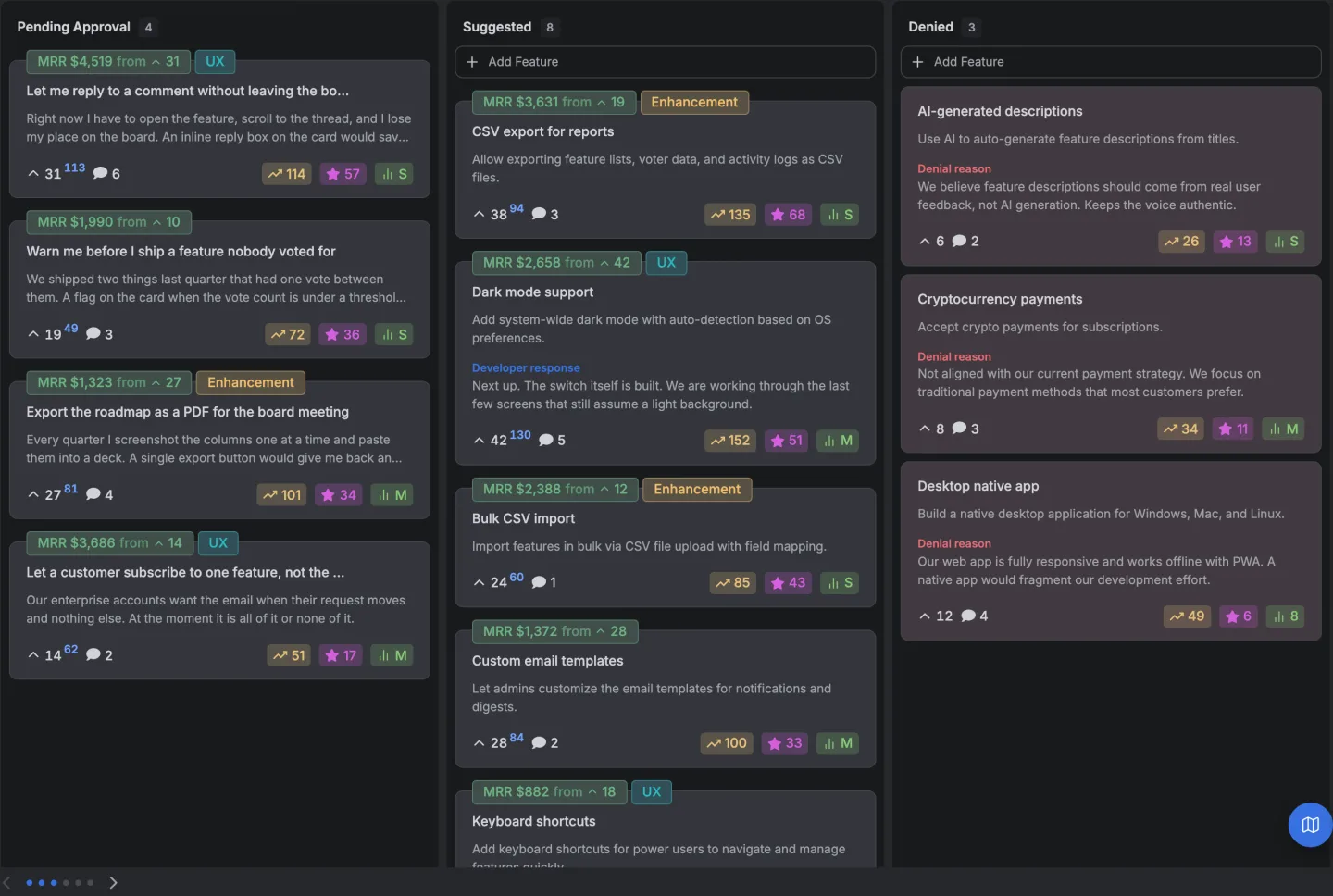
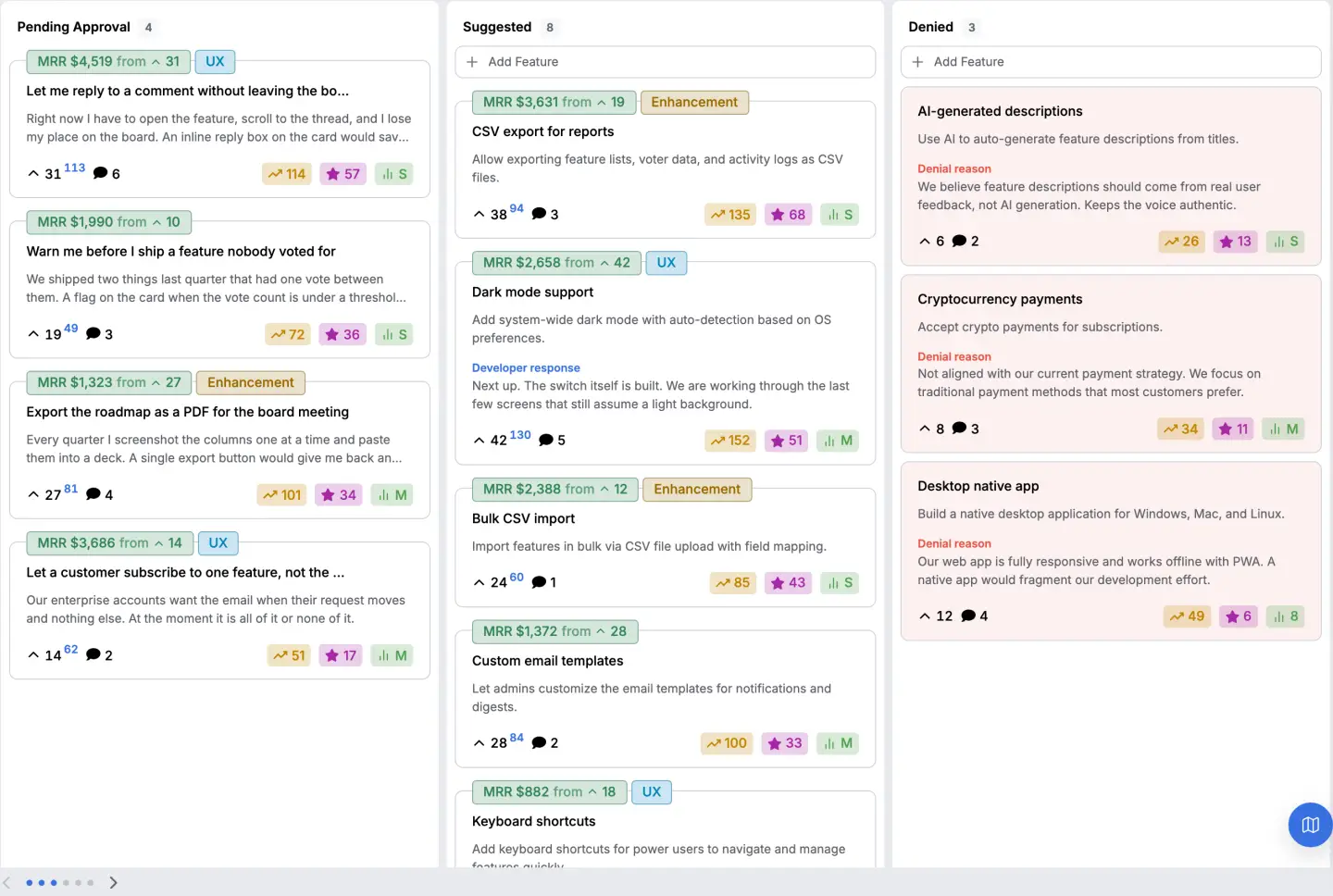
Our own board can multiply a vote by what the person casting it pays you, and the mechanism is written out in full here. That changes what the number means. It doesn't manufacture a signal out of nine votes.
Where it helps is the case a headcount actively hides. Eleven people ask for one thing and four ask for another, and two of those four are the accounts that pay for the office. A plain count says build the first one.
A weighted count says look again, and looking again is the correct response. We keep both numbers on the same card for exactly that reason, because the useful moment is the one where they disagree.
Where it doesn't help is the case most people are in. If everybody who votes on your board pays you roughly the same, or pays you nothing yet, then weighting has nothing to weigh and this whole section is irrelevant to you.
We would rather say that here than have somebody buy on it and find out.
Why do so many of them go quiet?
On twenty six of the thirty six boards, page one still carries a request from 2021 or earlier. The oldest one anywhere on a page one dated from 2011.
Remember the caveat. That's the sort order, not proof of neglect, and a fifteen year old request sitting on page one may simply be popular.
But it does tell you what a visitor sees, and what a visitor sees on most of these boards is a front page carrying requests that are five years old and still open. Whatever is true inside the company, that's the impression the box gives.
There are four reasons this happens, and only the first one is about effort.
Nobody closes the loop. Somebody asks, the request sits there, and no matter what happens next the person who asked hears nothing. This is the one that kills a board, because a person who was ignored once doesn't come back to be ignored again, and they were your best contributor. The fix is mechanical rather than cultural, and it's the reason our own changelog is built out of the board instead of being a separate document.
The box is asked to do a job it can't do. Prioritisation is a decision about cost, risk, strategy and who is paying you. A vote count is one input to that and a weak one. When a team expects the box to decide, and it doesn't decide, the box gets blamed and abandoned.
It's put somewhere nobody goes. A link in the footer collects the requests of people who read footers. That's a real population and it's not your customers.
Nobody says no. A board where nothing is ever declined fills up with items that will never be built, and every one of them is a small lie to the person who asked. The number of open requests goes up forever and the page stops being readable. Saying no in public is unpleasant and it's the single most valuable thing you can do with the box.
When does a suggestion box actually work?
Four conditions, and you need all four, not most of them.
Somebody owns it by name. Not the team. A person, with a recurring slot in their week, whose job includes reading what came in. A box with no owner is a form that writes to nowhere.
Every item gets an answer, including no. Yes, no, or not now with the reason. The answer matters far more than the decision. People accept a no from somebody who read their request and they don't forgive silence.
It's where the work is. Inside the product, at the moment somebody is annoyed, rather than on a page they have to go looking for. That's the entire argument for putting the form where the frustration happens instead of on a contact page.
The people who asked hear when it ships. Not a general announcement. The specific people who asked for the specific thing. If you do one thing from this post, do this one, and if your tool can't do it then do it by hand with a list of names in a text file.
Those four are also, roughly, the four things the boards we measured were not doing. We can't prove that from outside, because we can only see the page.
But a front page where the median request has nine votes and the oldest thing on it's from 2021 is what those four failures look like from the street.
Does any of this apply to the box in the office kitchen?
Partly, and it's worth separating because half the people asking this question mean the workplace one.
The physical or internal suggestion box has a problem ours doesn't, which is that the person suggesting has to work with the person deciding.
That changes everything about who writes what. Anonymity isn't a nice extra there, it's the whole mechanism, and any advice that ignores that's advice about a different thing.
What does transfer is the loop. An internal box fails for exactly the same reason a customer facing one does, which is that people stop writing when nothing visible happens.
The condition about answering every item, including no, is the one that matters most in a workplace, and it's the one that's hardest because the no is delivered to somebody you'll see on Tuesday.
What doesn't transfer is the counting. Votes on an internal board measure who is comfortable being seen agreeing with their manager, which isn't the same as demand. That distortion has a name and its own page.
We don't sell an internal suggestion box and we aren't going to pretend the numbers above are about one.
Should you run one at all?
If the four conditions aren't going to be true, no. Run an inbox instead, and read it.
A great many teams asking about a feedback board should still be using a spreadsheet and an email address, and the four conditions under which that's the correct tool are written out alongside the three signs that you've crossed the line.
A suggestion box that nobody owns is worse than a spreadsheet, because it's a public promise you're not keeping.
If the four conditions can be true, then a box is worth having, and the value isn't in the vote counts. It's in having one address to send people to, one place where the answer lives, and one mechanism that tells the person who asked when the thing arrived.
The counting is a byproduct and it's the least important part, which isn't what anybody in this category will tell you.
14 days, a card at signup, then $9 or $39 a month.