Almost every tool in this category limits you by seats, projects or boards. Frill limits you by ideas, which is the content of the board itself, and that is a different kind of ceiling because it arrives exactly when the board starts working.
If you are comparing Frill on price alone you will miss this, so it goes first.
Everything below was read on their own pricing page on 9 September 2026.
What is Frill?
Frill is a feedback board, a roadmap and a changelog sold together. Its distinguishing feature is the unit it meters, which is the number of ideas on the board rather than the number of seats or projects.
What does Frill cost?
Four plans, priced per workspace rather than per person.
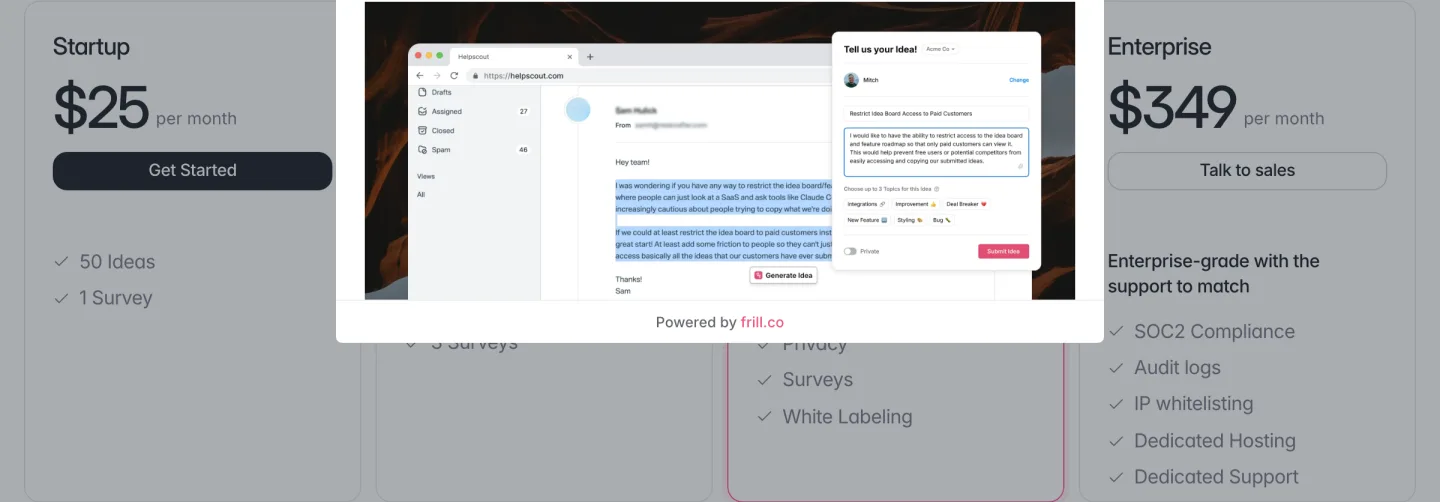
| Plan | Price | The limit that matters |
|---|---|---|
| Startup | $25 | 50 Ideas, 1 Survey |
| Business | $49 | Unlimited Ideas, 3 Surveys |
| Growth | $149 | Unlimited Ideas, Privacy, Surveys, White Labeling |
| Enterprise | $349 | Everything above |
Their page also carries a yearly toggle. With it switched on the same four plans read twenty two, forty four, a hundred and thirty six and three hundred and nineteen, which we moved the switch and read rather than taking from a summary.
Unlimited admins and unlimited widgets are on every paid tier. That is a genuinely good decision and the opposite of how most of this category ladders, where the second colleague is what pushes you up a plan.
The trial is fourteen days and does not ask for a card. There is no free plan.
You can check this on a board of your own rather than take the table's word for it, and a trial is 14 days with a card at signup.
What happens when you hit fifty ideas?
You move to Business, which is forty nine dollars a month.
That is a doubling of the price, triggered by your own users doing the thing you bought the product for. Fifty ideas is not many. A board that gets shared once in a release note can pass it in a week.
There are only two honest ways to read this. Either Startup is an evaluation tier and Business is the real entry price, or you plan to prune the board, which means deleting or archiving ideas people submitted.
Neither is a scandal, and both are worth knowing before you compare twenty five dollars against anybody else's entry plan.
Ours has no limit on the number of requests at any price, on any plan here. That is a real difference and it is the only place on this page where we clearly beat them.
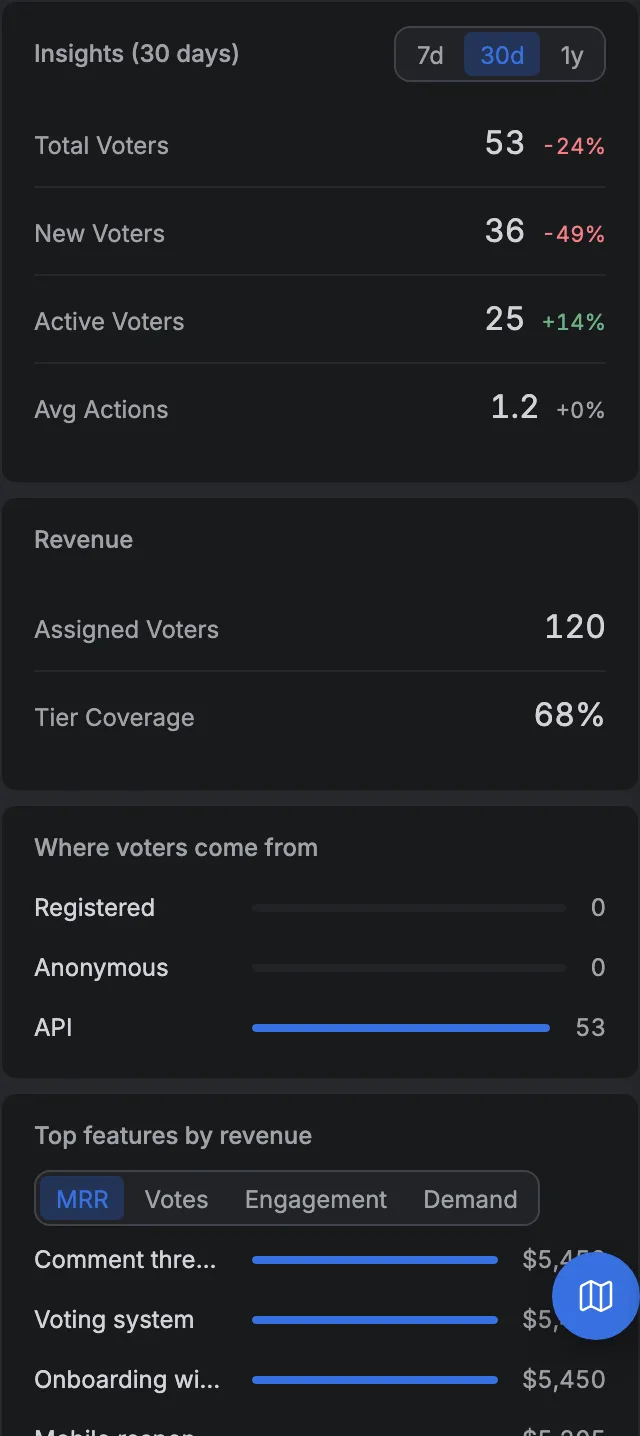
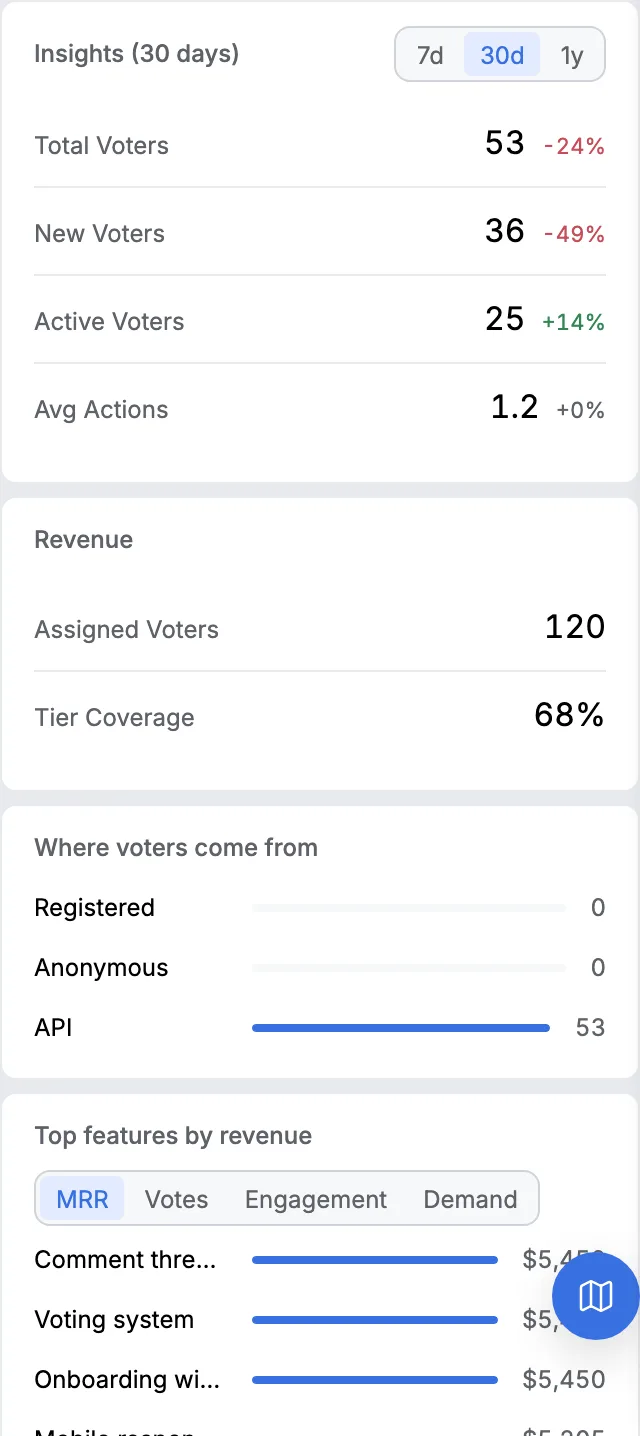
Does Frill weight votes by revenue?
No. Their Priority Matrix scores benefit against cost, which is a different thing.
That is not a criticism. Benefit against cost is a legitimate prioritisation frame and plenty of teams prefer it, because it asks what a feature is worth to build rather than who asked for it.
It just does not answer the question this product was built for, which is whether the twelve people asking for a feature are twelve free accounts or most of your revenue. Seven of the twenty one tools we checked do answer that, and Frill is not one of them.
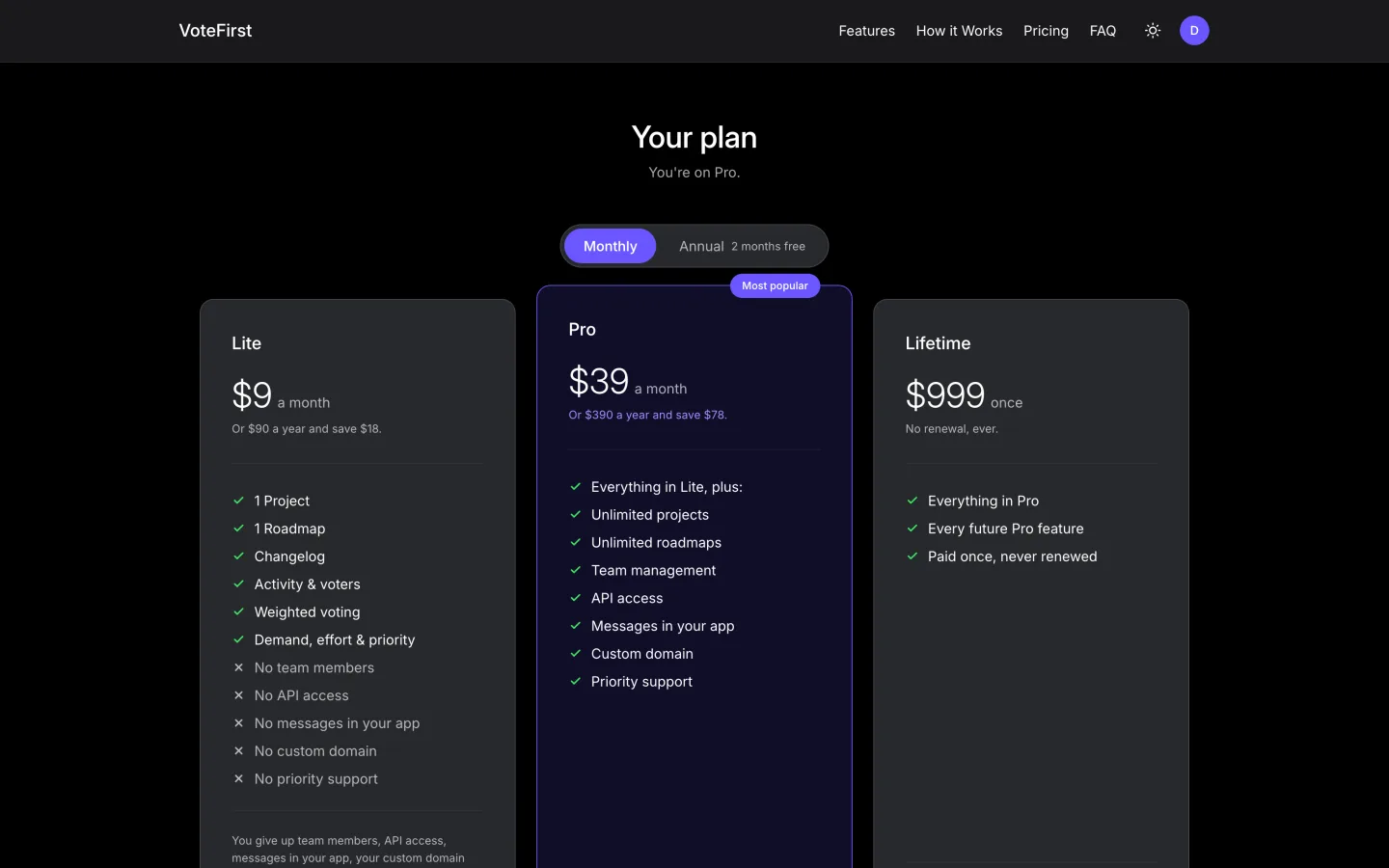
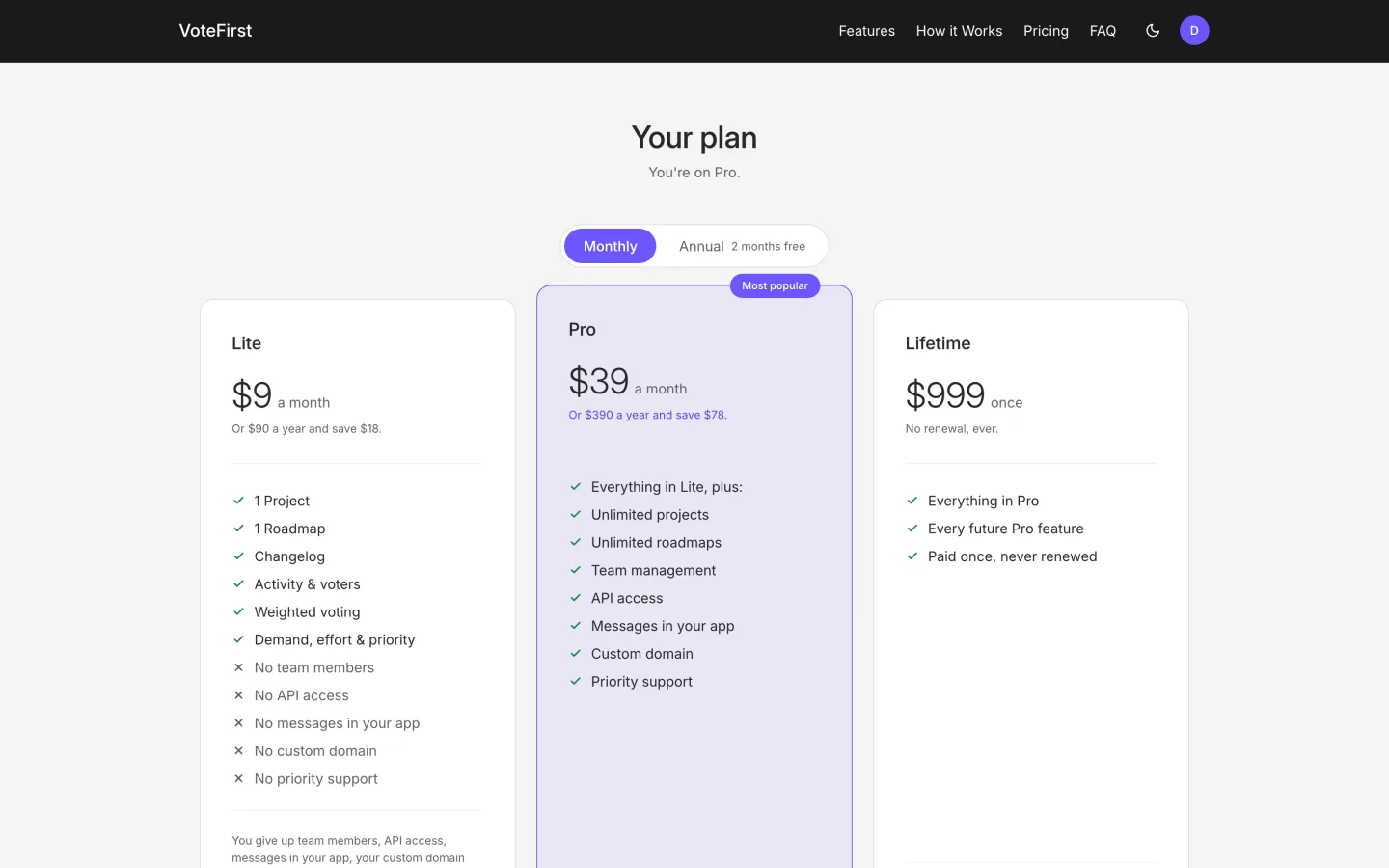
14 days, a card at signup, then $9 or $39 a month.
Is Frill still being worked on?
Yes. Their own changelog widget posted on 13 August 2026.
We check this on every one of these pages because an abandoned tool with a live pricing page is the worst thing you can accidentally buy, and their own changelog is the fastest honest signal.
What do you get that we do not have?
Surveys, and a knowledge base of prioritisation framing.
Startup includes one survey, Business three, and Growth adds privacy surveys. We have no survey feature at all and no plans for one. If asking your users a direct question matters as much as collecting what they volunteer, that is a real gap on our side.
Does Frill have a free plan?
No, not any more. Their pricing page read on 14 September 2026 carries a fourteen day trial that asks for no card and no free tier under it.
Does Frill have a public roadmap, single sign on and a CSV export?
Frill carries a roadmap and micro roadmaps, and its customers publish them. Frill carries single sign on on every paid tier. Frill carries bulk CSV import as well as export, which is the pair you want when you are moving in rather than out.
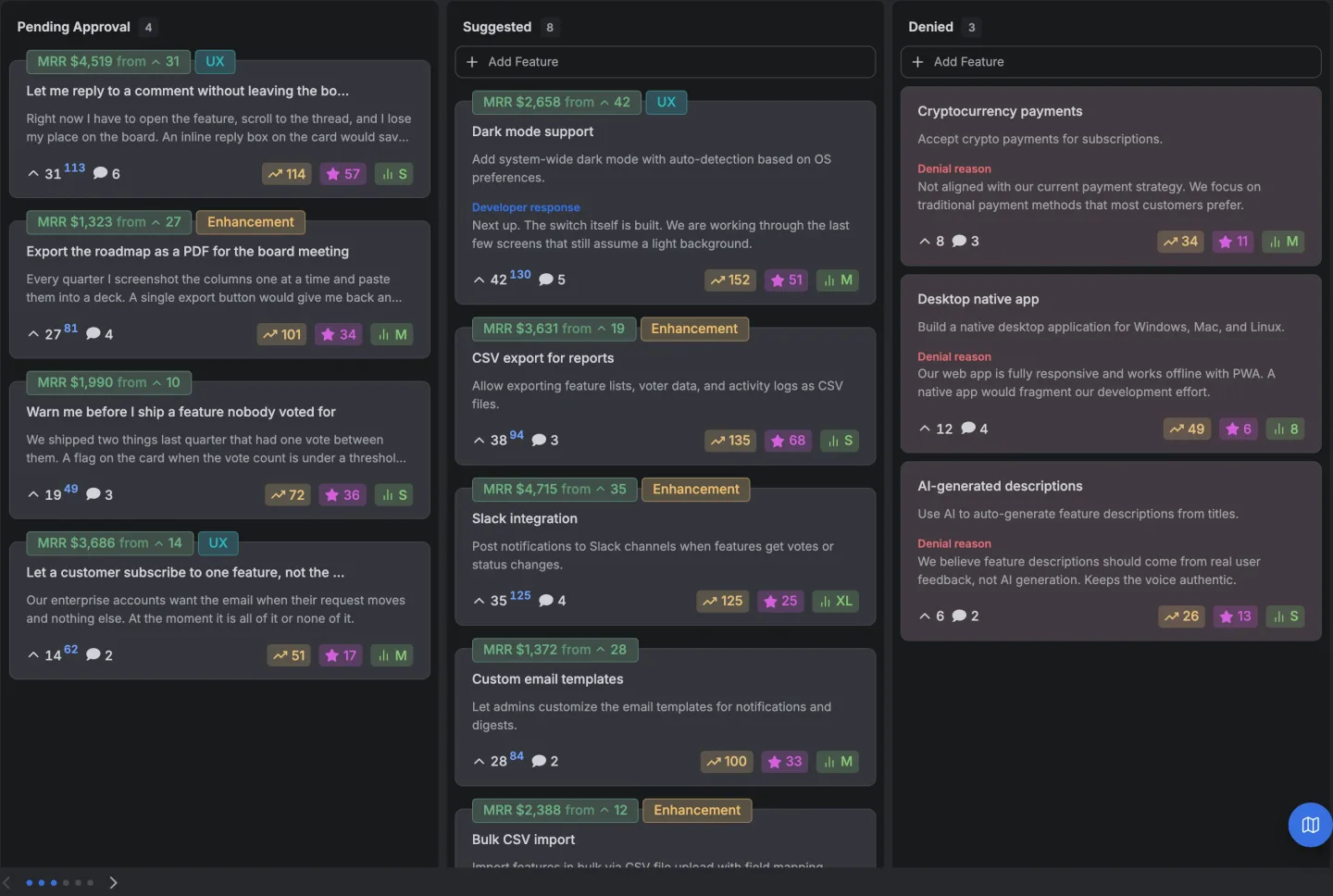
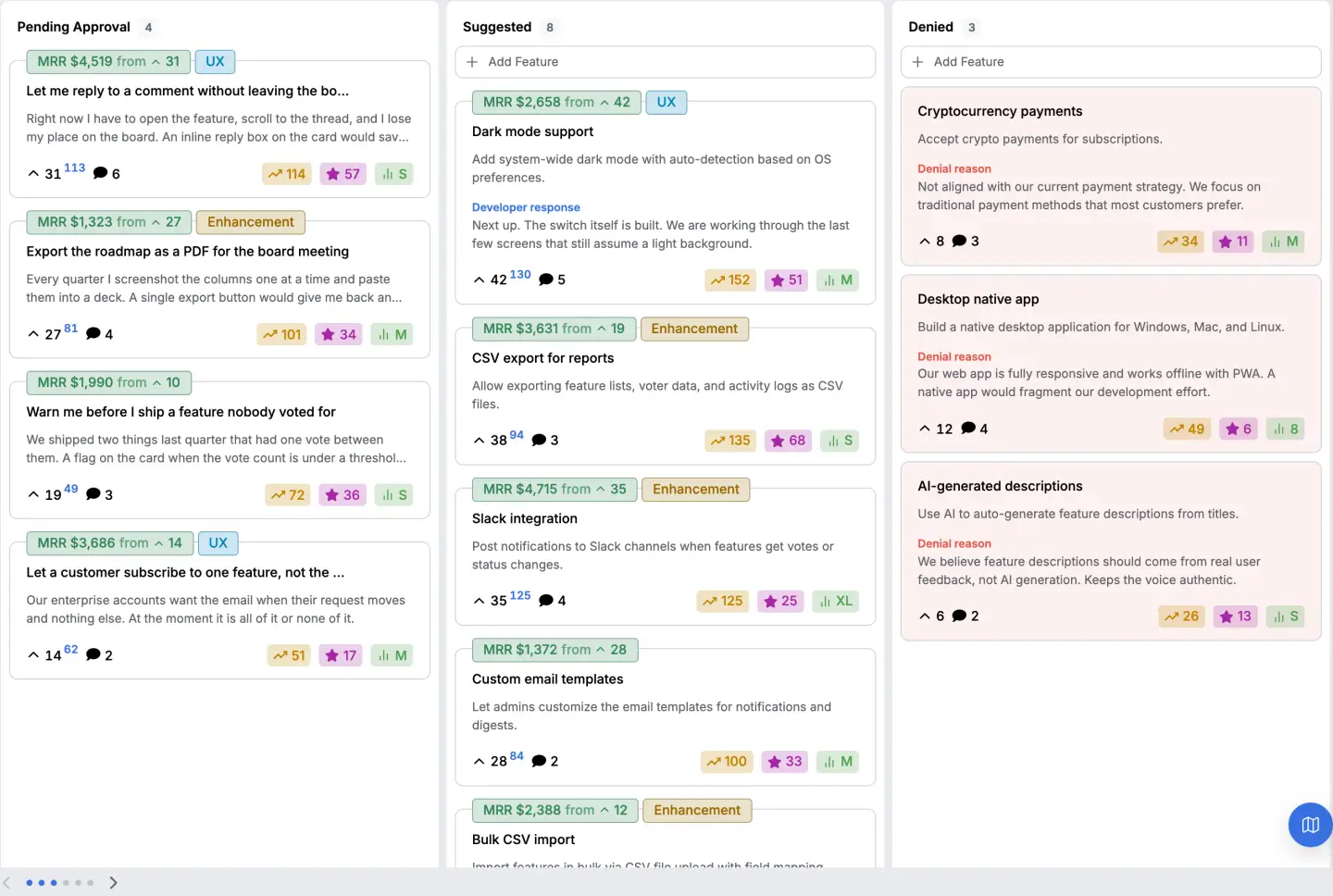
Ours publishes a public roadmap with a Denied column on every plan, and signs a voter in with a token from your own application on the thirty nine dollar plan rather than with SAML.
Is there a free Frill alternative?
Yes, several, and none of them is Frill. Fider is the free one to know about, because it is open source and its hosted tier runs to two hundred and fifty feedback items.
UserJot gives two boards and three admin roles, Supahub gives one board and one admin, Featurebase gives one seat, and Sleekplan's Indie tier is a single admin workspace that does not expire.
All five were read on their own pages on 14 September 2026. This product is not one of them. There is no free plan here, only a fourteen day trial that asks for a card at signup.
Is Frill worth it, and when is it the better answer?
Three cases.
You want surveys and a board from one vendor. We do not have surveys.
You have several colleagues. Unlimited admins on every paid tier. Our nine dollar plan has no team members and they start on our thirty nine dollar plan.
Your board will stay small. Fifty ideas at twenty five dollars is fine for a first product, and their fourteen day trial costs nothing to find out.
What does ours cost?
Nine dollars a month for one project, with no cap on how many requests the board holds.
That plan is one project, one roadmap and every widget, with weighted voting included, and no API, no custom domain and no team members. Thirty nine dollars adds those.
Against Frill the comparison is narrow. They are more product than us, with surveys and unlimited colleagues. We are cheaper, we do not cap the board, and we weight the vote by what the voter pays. Every price and unit in the category is on one page.
What moving actually involves
More work than a button, and the honest version is short. There is no importer for requests or votes on our side.
Voters and the revenue behind them come in from a CSV or from a billing connection, which is the part the weighting needs. The requests themselves are rebuilt by hand or by a script against the API, and the vote counts start again.
That is a real cost and it is worth naming before anybody moves. The five steps, with the endpoint each one uses, are written out in full, and they are the same five whatever you are leaving.

