Rapidr gives you a lot on its entry plan, including two things VoteFirst does not have at any price.
It also publishes a feature comparison table with five rows marked as not yet available, and if one of those five is the reason you were considering them, that is worth finding before you start a trial rather than after.
Everything below was read in a browser on their own pricing page on 9 September 2026.
What are the alternatives to Rapidr?
Rapidr is forty nine dollars a month for five colleagues, with five things on its own comparison table marked as coming soon. Below is the field it sits in, with the unit each tool bills on.
| Vendor | From | Billed per | Free plan | Trial |
|---|---|---|---|---|
| Trello | $5/user/mo | user | Yes | – |
| VoteFirst | $7.50/mo | plan | – | 14 days, card |
| Features.Vote | $7.50/mo | project | – | 14 days |
| Jira Product Discovery | $10/creator/mo | creator | 3 creators | – |
| LoopedIn | $12/mo | plan | 1 of each | – |
| WishKit | $12.50/mo | project | 5 requests | – |
| Sleekplan | $13/mo | workspace | 1 admin | 30 days, no card |
| Upvoty | $13.50/mo | project | – | 14 days |
| Noora | $14/mo | workspace | – | 7 days |
| Convas | $15/mo | tracked user | 25 users | – |
| FeedBear | $15/mo | project | – | 14 days |
| Supahub | $15/mo | workspace | 1 board | 10 days |
| ProductLift | $19/mo | workspace | – | 14 days |
| Productboard | $19/maker/mo | maker | 500 notes | – |
| Roadmunk | $19/creator/mo | creator | – | 14 days |
| Ducalis | $20/mo | changelog subscriber | 500 subs | – |
| Frill | $22/mo | workspace | – | 14 days |
| Fider | $25/mo | workspace | 250 items | – |
| Featurebase | $29/seat/mo | seat | 1 seat | – |
| Headway | $29/mo | plan | Yes | – |
| Nolt | $29/mo | board | – | – |
| UserJot | $29/mo | workspace | 2 boards | 14 days |
| Aha! Ideas | $39/user/mo | user | – | Yes |
| Savio | $39/mo | paid user | – | 14 days |
| Beamer | $49/mo | monthly active user | 1,000 MAU | – |
| Feature Upvote | $49/board/mo | board | – | 30 days |
| Rapidr | $49/mo | workspace | – | 14 days |
| Suggested | $49/mo | plan | – | 15 days |
| Gleap | $49/mo | plan | – | 14 days |
| FeatureOS | $50/mo | plan | – | 30 days, no card |
| Olvy | $60/mo | plan | 25 items | – |
| AnnounceKit | $39/mo | module | – | 15 days, no card |
| Canny | $79/mo | tracked user | 25 users | – |
| LaunchNotes | $249/mo | plan | – | 14 days |
| Pendo | Not published | monthly active user | Beta | – |
| ProdPad | Not published | module | – | 7 days |
| UserVoice | Not published | quoted | – | 30 days |
| airfocus | Not published | quoted | – | – |
| ProductPlan | Not published | quoted | – | – |
| Productroad | $9/mo | plan | 50 users | 14 days, no card |
| Quackback | $29/mo | plan | 1 board, 50 posts | 14 days, no card |
| ProdCamp | $99/mo | plan | 2 admins, 1 product | – |
| Harvestr | $65/editor/mo | editor | – | 14 days |
| Productlane | $29/user/mo | user | – | Yes |
| Ideanote | $6/user/mo | user | 10 users, 250 ideas | – |
| Craft.io | $19/editor/mo | editor | – | 14 days, no card |
| HYPE Boards | €79/mo | plan | – | 14 days, no card |
| Noticeable | $24/mo | plan | 1 project, watermarked | 14 days, no card |
Read on each vendor's own pricing page, with the billing switch on the yearly side wherever one is published. From is the cheapest paid rate per month. What each one includes, as well as what it costs, is on one page.
The same two products, line by line
Read on each vendor's own pages on the date in the row above. Not published means nobody could read it on the pages opened that day, never that the feature is absent.
What does Rapidr cost?
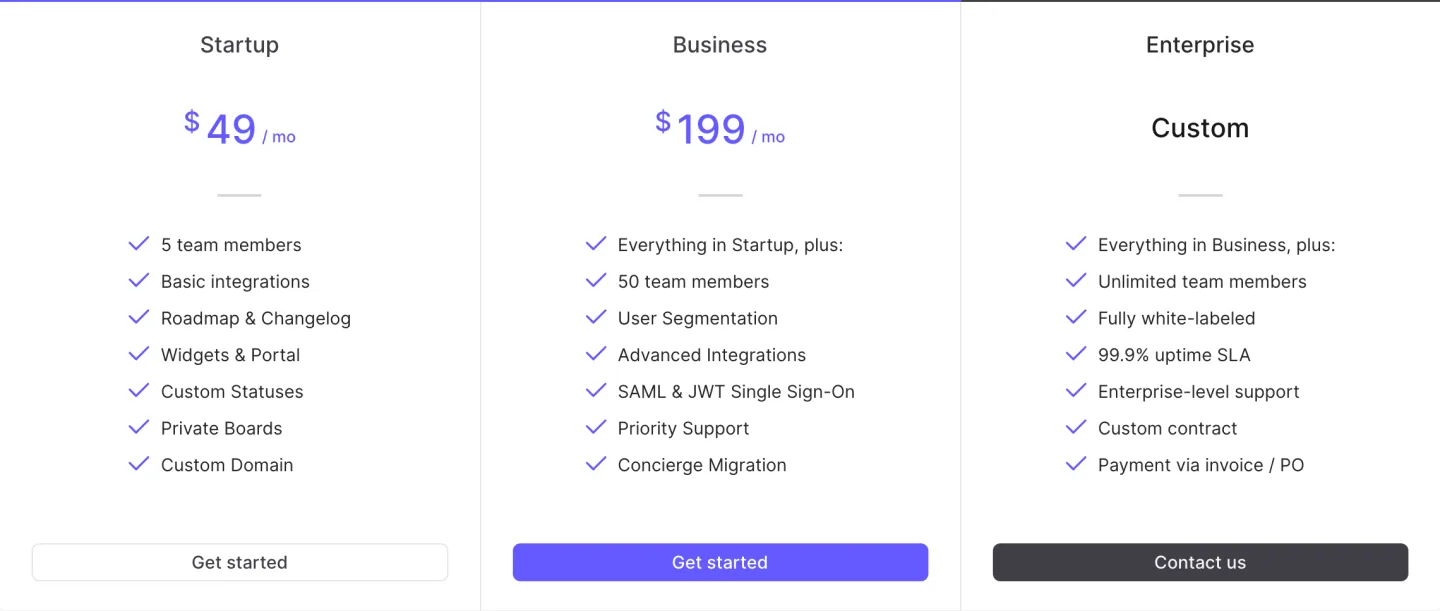
Three plans, priced per workspace with a team member cap.
| Plan | Price | Team members |
|---|---|---|
| Startup | $49 | 5 |
| Business | $199 | 50 |
| Enterprise | Custom | Unlimited |
No annual rate is published anywhere on the page, so both figures above are monthly ones. The page lists no free plan. The trial runs fourteen days and their page says it needs no card, no code, and that setup takes under fifteen minutes.
Startup includes basic integrations, roadmap and changelog, widgets and a portal, custom statuses, private boards and a custom domain. That is a generous entry plan and the private boards and custom domain are the parts VoteFirst cannot match.
Business adds fifty team members, user segmentation, advanced integrations, SAML and JWT single sign on, priority support and a concierge migration. Enterprise lifts the team member cap entirely and white labels the product.
The version of this argument worth having is the one you run yourself, and a trial takes 14 days and a card.
What is marked coming soon?
Five rows in their own comparison table are marked coming soon.
Zendesk, Salesforce, an admin digest, a priority filter and an MRR filter are each labelled coming soon on the page read.
The MRR filter is the one that matters for anybody comparing on revenue. It is the feature that would let you sort feedback by what the customer pays, and by their own published table it does not exist yet.
Rapidr has announced it, not shipped it, and neither can they until it ships.
This is what their table said on a date rather than a criticism. Publishing a roadmap inside a pricing table is more honest than most vendors manage, and the risk it creates is only that a reader skims the row and assumes it is ticked.
Do they weight votes by revenue today?
Not yet, by their own account.
User segmentation is on Business at a hundred and ninety nine dollars a month, and segmenting is not the same as weighting. Segmenting shows you a subset of the board. Weighting changes the order of the board itself. Their four plans, and what each one adds, are set out on the pricing page for them.
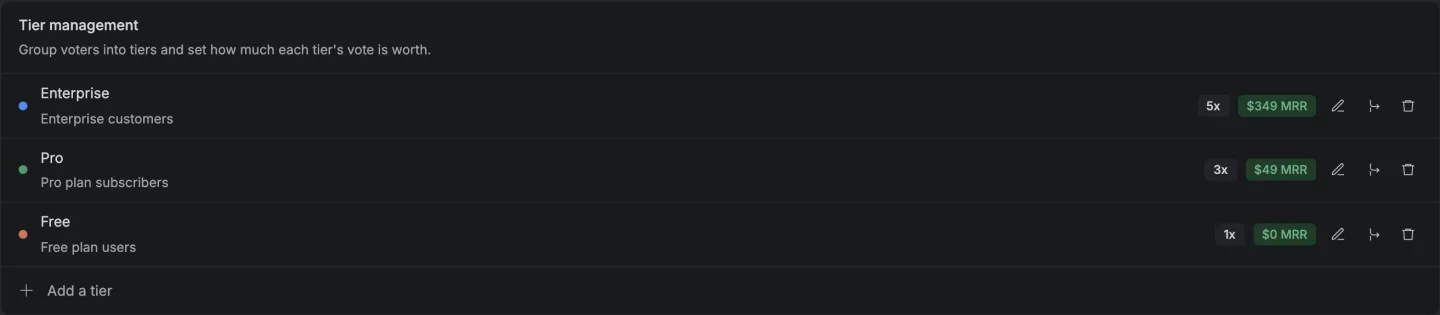
VoteFirst puts each voter in a tier with a whole number multiplier, writes that weight onto the vote at the moment it is cast, and keeps the plain count visible beside the weighted total. The mechanism is here.
Eight of the thirty two tools checked already ship a form of revenue weighting, so if that is your requirement there are several shipping answers today and Rapidr is not yet one of them.
14 days, a card at signup, then $9 or $39 a month.
What does Rapidr give you that VoteFirst does not?
Private boards, a custom domain on the entry plan, and five team members.
All three are real and none of them is close. VoteFirst's nine dollar plan has no team members at all, no custom domain, and nothing equivalent to a private board on any plan, since a VoteFirst board is published to everybody or to nobody with no password and no invite list.
Their custom domain is on the forty nine dollar plan and VoteFirst's is on its thirty nine dollar plan, so on that one specific feature VoteFirst is ten dollars cheaper. On everything else in this paragraph they win.


Is Rapidr still being worked on?
Yes. Their footer reads 2026 and five features are publicly marked as in progress, which is itself a sign of an active roadmap. Its help centre at help.rapidr.io stopped answering on 3 October 2026, so its older answers survive only in archived copies.
Does Rapidr have a free plan?
No. Their pricing page read on 14 September 2026 carries a fourteen day trial that asks for no card, and any plan can be refunded inside the first thirty days.
What this costs
Lite
$9 /mo
Pro
$39 /mo
Lifetime
$999 once
Fourteen day trial of Pro, card asked for at signup. Nothing here counts the people who vote, so the bill does not move when the board starts working. The long version, with what happens if you stop paying.
Does Rapidr have a public roadmap and single sign on?
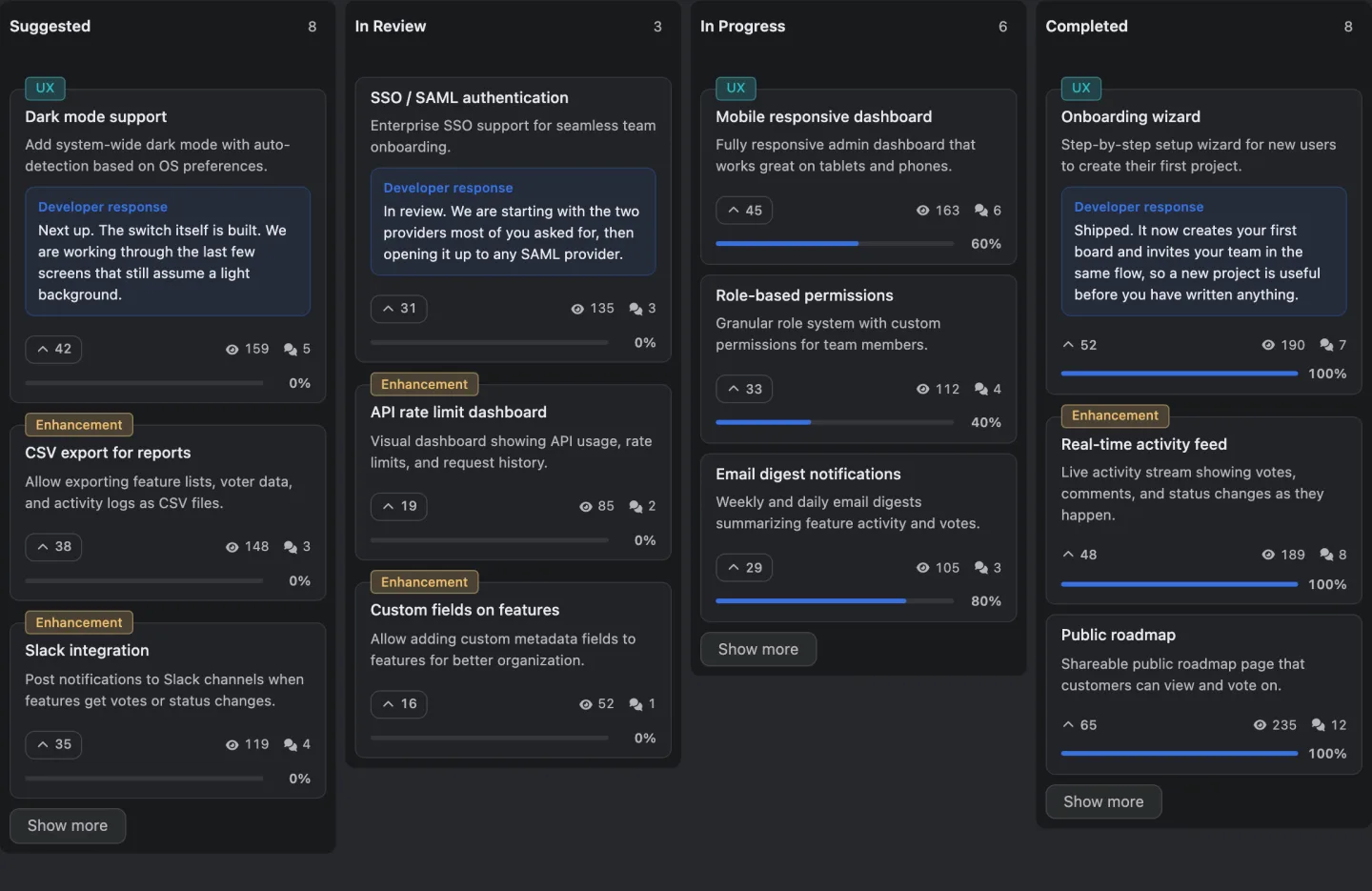
Rapidr carries a shareable roadmap beside the changelog. Rapidr puts single sign on on Business, both SAML and JWT. VoteFirst publishes a public roadmap with a Denied column on every plan, and signs a voter in with a token from your own application on the thirty nine dollar plan rather than with SAML.
Can people vote on a Rapidr board without an account?
No. Rapidr's help page, archived on 9 November 2025, answered the question with a no and recommended single sign on instead, which can hand each visitor a made up identity when anonymity is the point. A VoteFirst board counts a vote from the first page load with no account, telling one browser from another by a random cookie, and a setting can require sign in. Which other tools allow it is a table of its own.
Is there a free Rapidr alternative?
Yes, several, and none of them is Rapidr. Fider is the free one to know about, because it is open source and its hosted tier runs to two hundred and fifty feedback items.
UserJot gives two boards and three admin roles, Supahub gives one board and one admin, Featurebase gives one seat, and Sleekplan's Indie tier is a single admin workspace that does not expire.
All five were read on their own pages on 14 September 2026. VoteFirst is not one of them. There is no free plan here, only a fourteen day trial that asks for a card at signup.
Is Rapidr worth it, and when is it the better answer?
Three cases.
You need private boards. Theirs are on the entry plan and VoteFirst does not have them.
You have a team of five. Included at forty nine dollars. VoteFirst's are on the thirty nine dollar plan and the comparison depends on how many you need.
You want SSO and a custom domain without seat arithmetic. That is what they built the Startup plan for.
What does VoteFirst cost?
Nine dollars a month for one project, which is forty dollars a month less than their entry plan.
That plan is one project, one roadmap and every widget, with weighted voting included, and no API, no custom domain and no team members. Thirty nine dollars adds those.
So the comparison is straightforward. They give you more on day one and cost more than five times as much. VoteFirst gives you revenue weighted voting that works today, and they give you a table row that says it is coming. Every price and unit in the category is on one page.
Rapidr against the others, one at a time
One page here puts Rapidr against a single rival and works out which bill is smaller at each size.