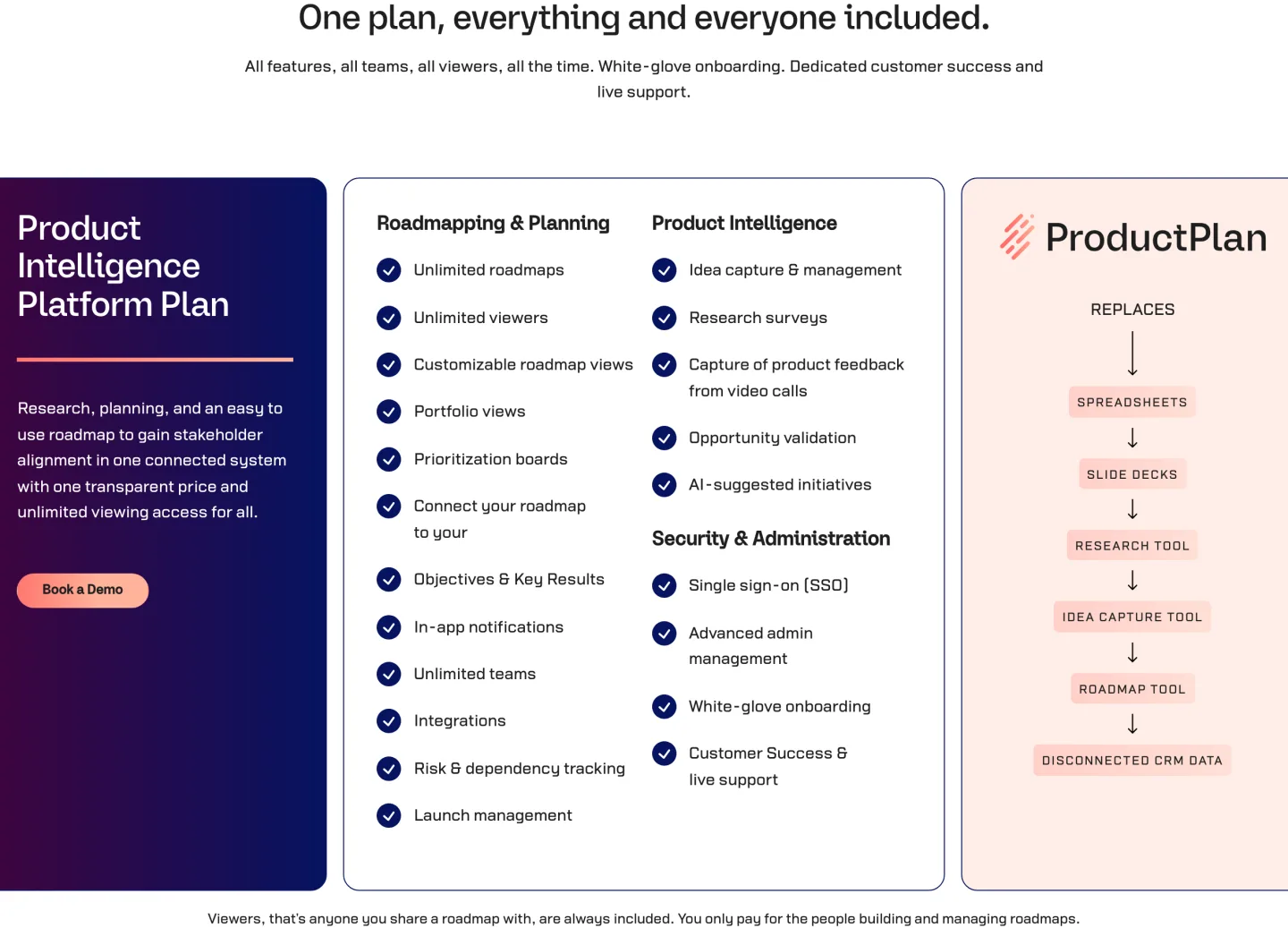
People looking at ProductPlan alternatives usually want a price first. Their pricing page has one plan on it, called the Product Intelligence Platform Plan, and the heading above it reads "One plan, everything and everyone included." There is no tier ladder to work through, which is genuinely simpler than most of this category.
There is also no price. The button says Book a Demo.
Everything on their side of this page was read on productplan.com/pricing on 14 September 2026.
What does ProductPlan cost?
Unpublished. One plan, quoted on a call.
What the page does publish is the unit, and it is unusually clear about it. "Viewers, that's anyone you share a roadmap with, are always included. You only pay for the people building and managing roadmaps."
- Roadmapping and planning. Unlimited roadmaps, unlimited viewers, customizable roadmap views, portfolio views, prioritization boards, objectives and key results, in app notifications, unlimited teams, integrations, risk and dependency tracking, launch management.
- Product intelligence. Idea capture and management, research surveys, capture of product feedback from video calls, opportunity validation, AI suggested initiatives.
- Security and administration. Single sign on, advanced admin management, white glove onboarding, customer success and live support.
So the shape is a per editor price with the viewers thrown in, and the number is behind a conversation. The whole of what their pricing page publishes is set out separately.
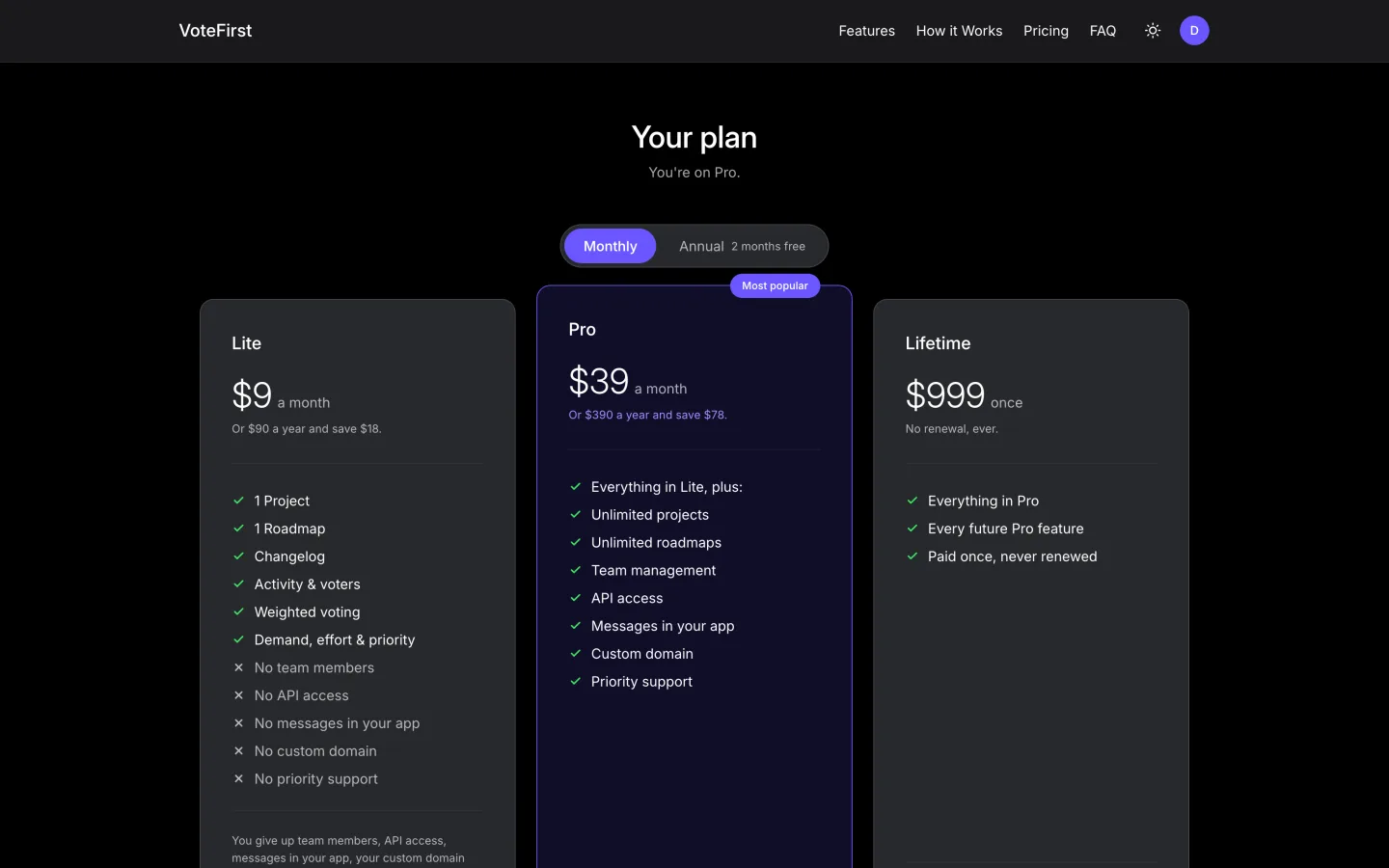
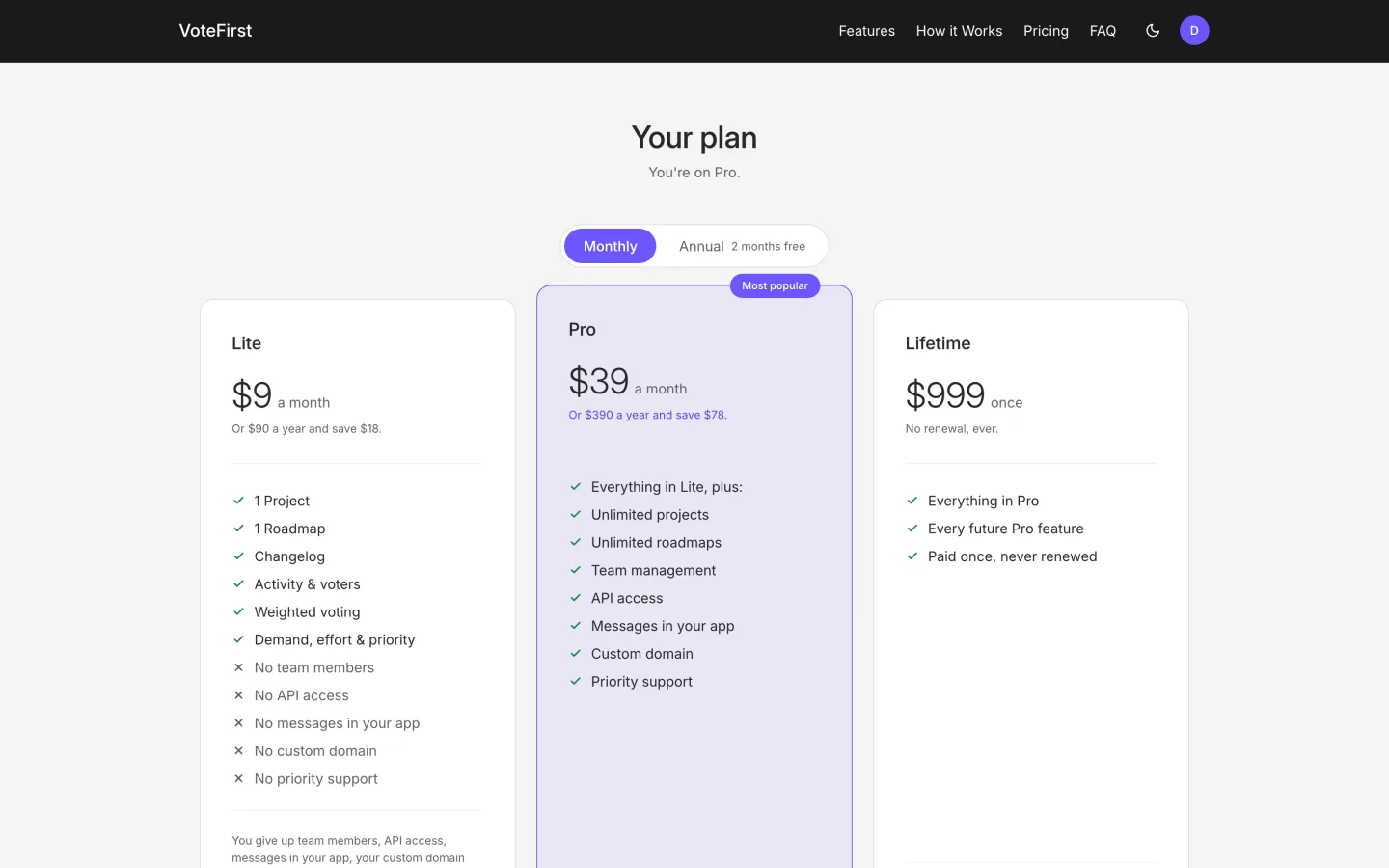
If you would rather read a number than book a call, a trial here runs 14 days and asks for a card at signup, and the bill after it is $9 or $39 a month.
What is ProductPlan?
A roadmap and product intelligence tool sold as a single plan, with unlimited viewers, portfolio views, prioritisation boards, research surveys and launch management in it.
Their own framing is what it replaces, being spreadsheets, slide decks, a research tool, an idea capture tool, a roadmap tool and disconnected CRM data. That is one subscription taking the place of several, for a company that has all of them.
Why do people look for a ProductPlan alternative?
The missing number is the first reason, and the reader who wants a public voting board is the second.
ProductPlan's own page frames the product as what it replaces, being spreadsheets, slide decks, a research tool, an idea capture tool, a roadmap tool and disconnected CRM data. That is a product operations buy for a company with several teams.
A founder who wants customers to vote and to see what shipped is not the buyer that page is written for, and the demo call will establish that slowly.
Is there a free ProductPlan alternative?
Yes, and none of them is this product. Fider is open source and free to host. UserJot publishes a free tier with two boards, and Supahub and Featurebase each publish one with a single board. All three were read on their own pages on 14 September 2026.
Here there is a fourteen day trial that asks for a card, then nine or thirty nine dollars a month. No free tier.
Where do the public roadmap and single sign on sit?
Inside the one plan, with the sharing model doing the work a public roadmap usually does.
ProductPlan does not sell a public roadmap in the feedback board sense. Their FAQ says any roadmap can be shared as a live link with customers, partners, executives or external vendors, always showing the latest version and at no extra cost, which is the same reach by a different route.
Single sign on sits inside ProductPlan's single plan under security and administration, beside advanced admin management, so nobody is upgraded into it.
Here the public roadmap is a page customers can open and vote on, on the nine dollar plan, and single sign on is not sold at all.
Does ProductPlan weight votes by revenue?
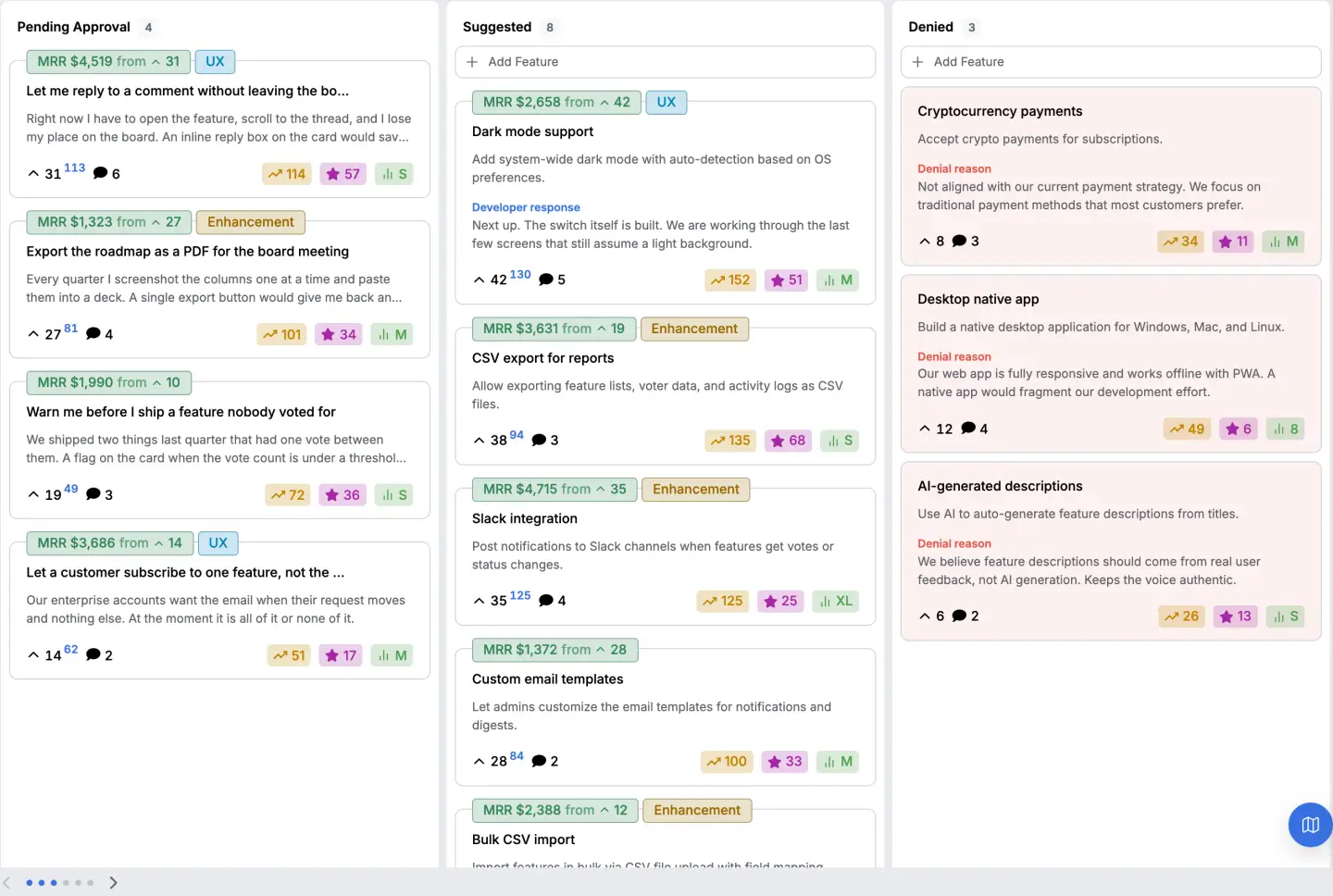
Their page lists prioritization boards, idea capture and opportunity validation. That is scoring and research, done by the product team.
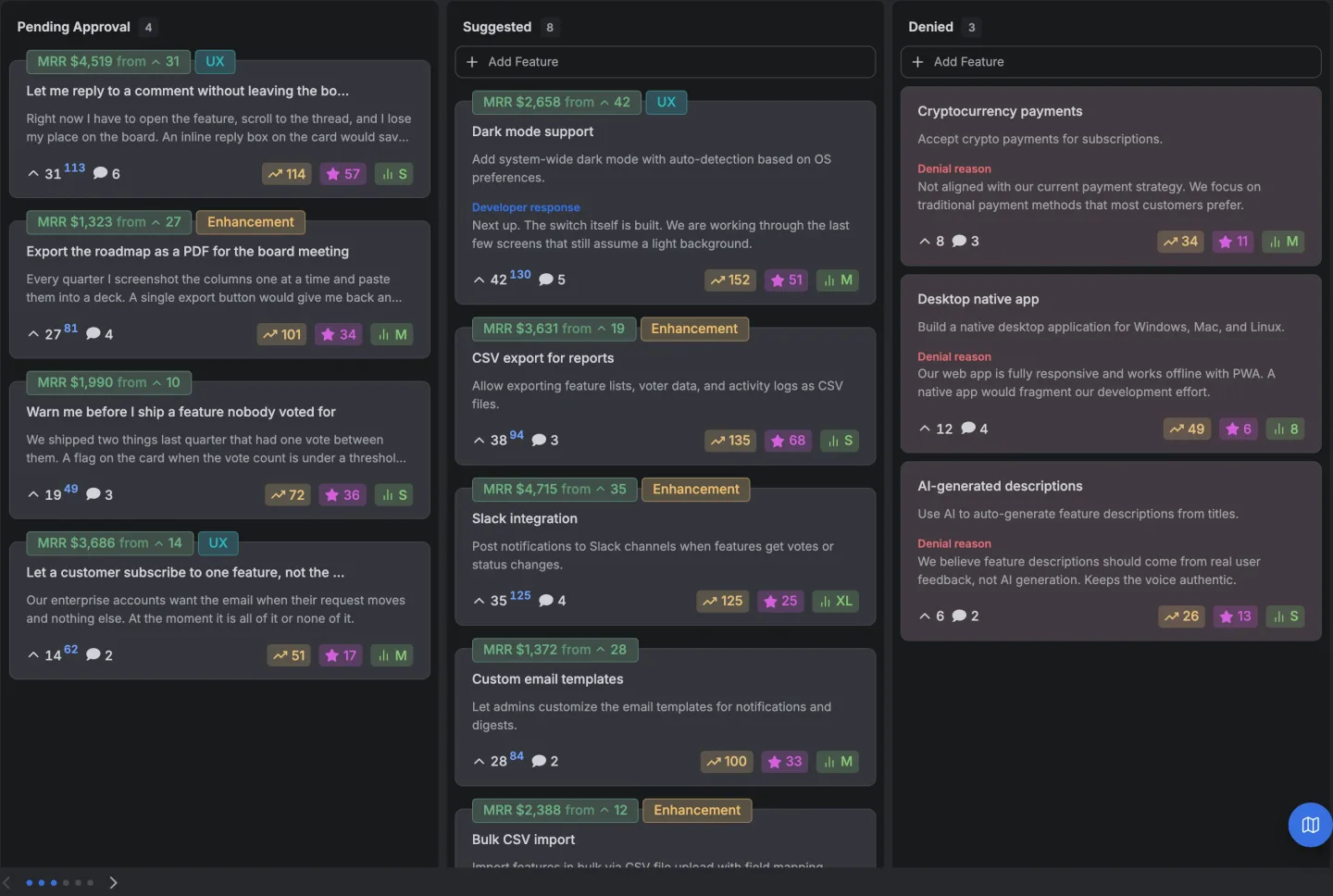
Weighted voting is the other direction. The customer votes, their plan decides what the vote is worth, and the board reorders itself. One is a team deciding with evidence, the other is a mechanism that keeps deciding while nobody is watching. Ours is written out with the formula and the code.
Does ProductPlan have a free plan?
Nothing on the page read on 14 September 2026 names one, and the only route in is the demo form.
Is ProductPlan worth it?
Unanswerable from the outside, because the price is not on the page, and that is the point worth making rather than a verdict to pretend to.
What is clear is the shape of the trade. Everything in one plan, viewers free, no tier to outgrow, and a conversation before you can price any of it. If your company buys software that way, that is a normal Tuesday. If you wanted to start this afternoon, it is a wall.
What does ours cost, and when is ProductPlan the better answer?
Nine dollars a month for one project and thirty nine for unlimited projects, the API, a custom domain and a team.
They are the better answer when the roadmap is the deliverable. Portfolio views across teams, launch management, risk and dependency tracking, research surveys and white glove onboarding are a real product suite, and none of it exists here. If your problem is presenting a plan to executives, buy that.
Buy this if your problem is the opposite one, which is customers asking for things and no way to tell which of them pays. The category table lists every published price, and theirs is one of the four rows with no number in it.
14 days, a card at signup, then $9 or $39 a month.
What moving actually involves
More work than a button, and the honest version is short. There is no importer for requests or votes on our side.
Voters and the revenue behind them come in from a CSV or from a billing connection, which is the part the weighting needs. The requests themselves are rebuilt by hand or by a script against the API, and the vote counts start again.
That is a real cost and it is worth naming before anybody moves. The five steps, with the endpoint each one uses, are written out in full, and they are the same five whatever you are leaving.

