ProdPad is not a feedback board that grew. It is a product management platform where feedback exists to justify an idea, and once you see that, most of the differences stop looking like gaps and start looking like a different opinion about what feedback is for.
That opinion is defensible. It is also not the one you are shopping for if you arrived here wanting a public page where customers vote and the tally decides. This page is about telling those two apart, using their own documentation rather than a feature grid.
Everything below was read on their site and in their help centre on 9 September 2026, and where we could not confirm something, this page says so instead of guessing.
What is ProdPad?
A platform with modules. Their pricing page asks you to select modules and build a package rather than pick a plan, and the module list on their own navigation runs to roadmaps, ideas, feedback, portfolio management, objectives, reporting, automations and an AI assistant.
The feedback module is one part of that, and their feedback page names seven ways in. Portals and widgets, an email dropbox, a browser extension, messaging apps, a CRM integration, a support system integration and internal tools.
That is a lot of doors, and it tells you who they built for. Somebody whose feedback already arrives in six places and needs one place to put it.
Our product is one door. Customers arrive at a board, and everything else is built around what happens there.
None of the above is hard to verify, because the trial is 14 days and the price after it is $9 or $39 a month.
Does ProdPad have a public voting board?
They have a public portal, and what a visitor does on it is not quite voting. Being careful here matters, so what follows is exactly what could and could not be confirmed.
Their help centre documents a portal at a public address of the form portal dot prodpad dot com followed by a portal id, which their own article says is public and open for everyone to view when enabled.
It can be embedded in your own site, and there is a separate article for embedding it in SharePoint.
The customisation article is the interesting one. It lists every control the portal editor exposes, in four sections, and there is no vote control among them.
What it does describe is a visitor picking an idea from the list, which opens a feedback capture modal with a submit button. So the documented interaction is submitting feedback against an idea rather than adding to a count on it.
Now the honest caveat. A release note from 2018 mentions a portal bug about clicking Want on an idea, so a want button existed at some point and their help centre search returns 21 articles for the word vote, nearly all of them old release notes.
We could not confirm from current documentation whether a visitor can vote on a portal idea today, and their own feedback portal, embedded on their own site, showed a loading message and issued no network request at all while our browser had non essential cookies declined.
So we stopped there rather than write a sentence we could not stand behind.
What we can say is what their marketing says. The words vote, voting and upvote do not appear on their idea management page or their feedback management page.
Their idea page describes seeing which ideas are wanted by customers and which are getting the most love from the team. That is a deliberate vocabulary and it is consistent across both pages.
Ours is the opposite deliberate choice. The board is a tally, the number on the card is the point, and a visitor can vote without an account or an email address.
How does ProdPad rank ideas by revenue?
They do it, they document it clearly, and the mechanism is genuinely different from ours in a way that matters.
In ProdPad, an admin types an annual revenue figure onto a company record. An idea then shows a total revenue value, calculated from the companies linked to the feedback associated with that idea, and a company that sent several pieces of feedback is counted once.
It appears as a column in the ideas list, on by default, and you can filter it by minimum and maximum and sort on it. Their help centre says the figure is capped at 9,999,999,999 and displays in your account currency followed by a yearly suffix.
Compare that with what we do, because the shapes are different rather than one being better everywhere.
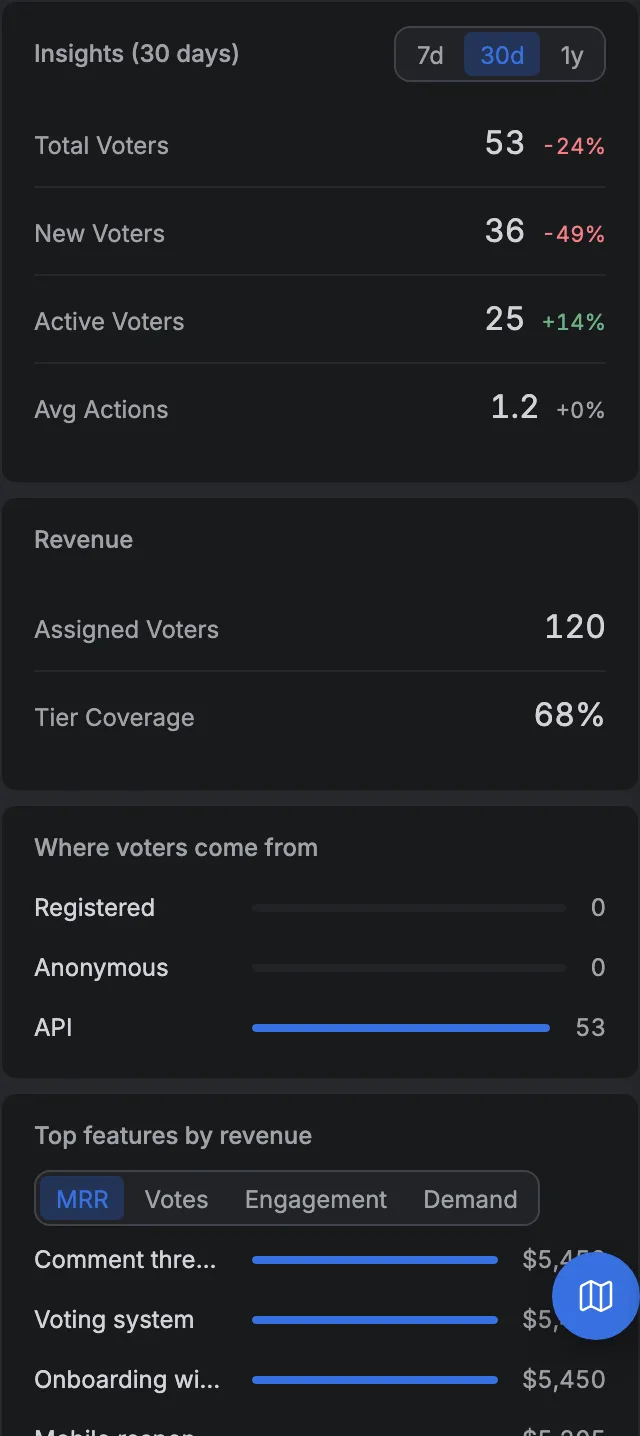
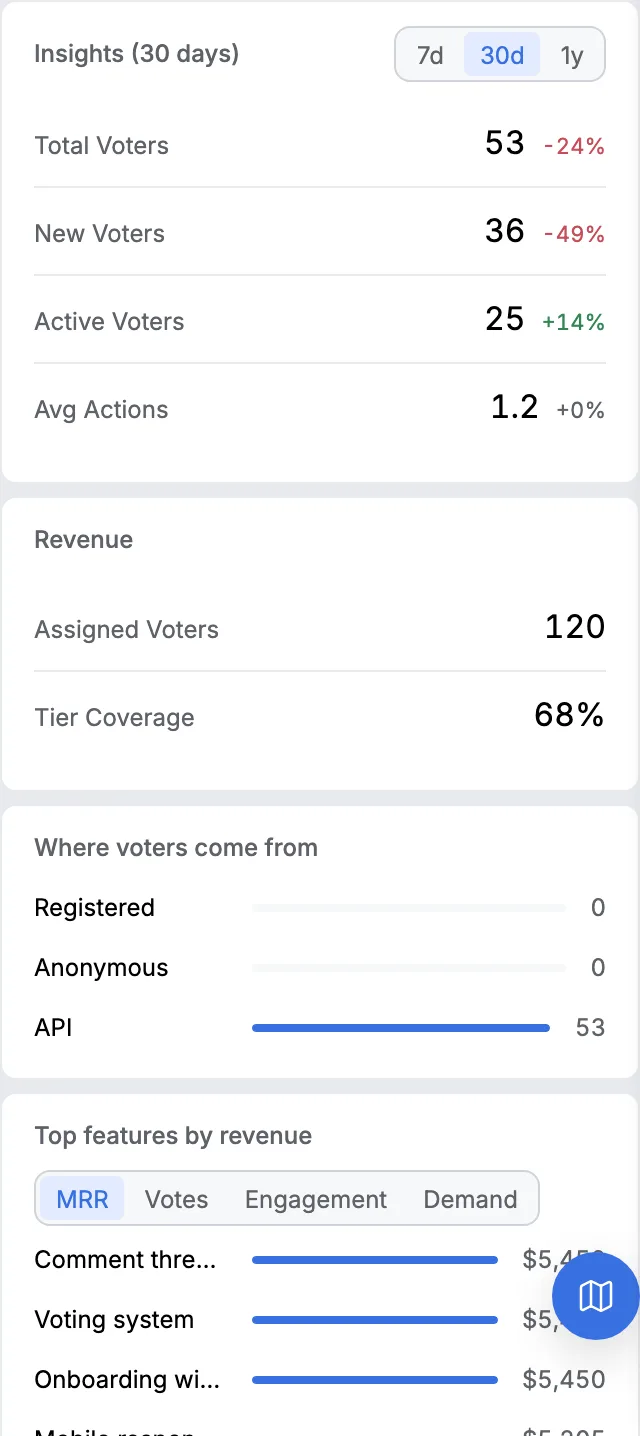
Ours attaches money to the vote rather than to the feedback. A voter is assigned to a tier, the tier carries a monthly figure, and weighted voting multiplies that voter's vote so the ranking itself moves. Theirs leaves the ranking alone and gives you a separate column to sort by.
Ours can be populated without typing. Tier assignments can come from a Stripe or Paddle connection or a CSV of voters, so the figure follows the subscription rather than somebody's memory of it. Theirs is a number an admin enters and maintains by hand, which is more work and also more control.
Ours is monthly and per voter. Theirs is annual and per company.
Ours also has a limit worth naming, which is that a voter who has never been assigned to a tier contributes nothing to the total, and the revenue screen prints your tier coverage so you can see how much of the picture is missing.
If you want the money to change the order of the list, that is our design. If you want the money as a column you consult while a human decides, that is theirs.
What does ProdPad cost?
We cannot tell you, and not for lack of trying.
Their pricing page is a package builder rather than a price list. You select modules and it prices what you selected. On two separate loads in our browser the builder area rendered blank, so no figure was ever shown, and there is no fallback list of plan prices anywhere on the page. Their frequently asked questions do carry some of the commercial terms, and those are quotable. Annual billing is 20 percent off any recurring card subscription. Card payments run through a third party processor. Invoicing and multi year discounts go through their sales team.
Two of their answers are worth reading whichever tool you pick. Reviewers are free and unlimited, and a reviewer can add and edit their own ideas and feedback while only viewing and commenting on other people's.
And their trial runs at least 7 days and can be extended past 30 by completing tasks inside the product, with their page saying a card is not asked for to start it.
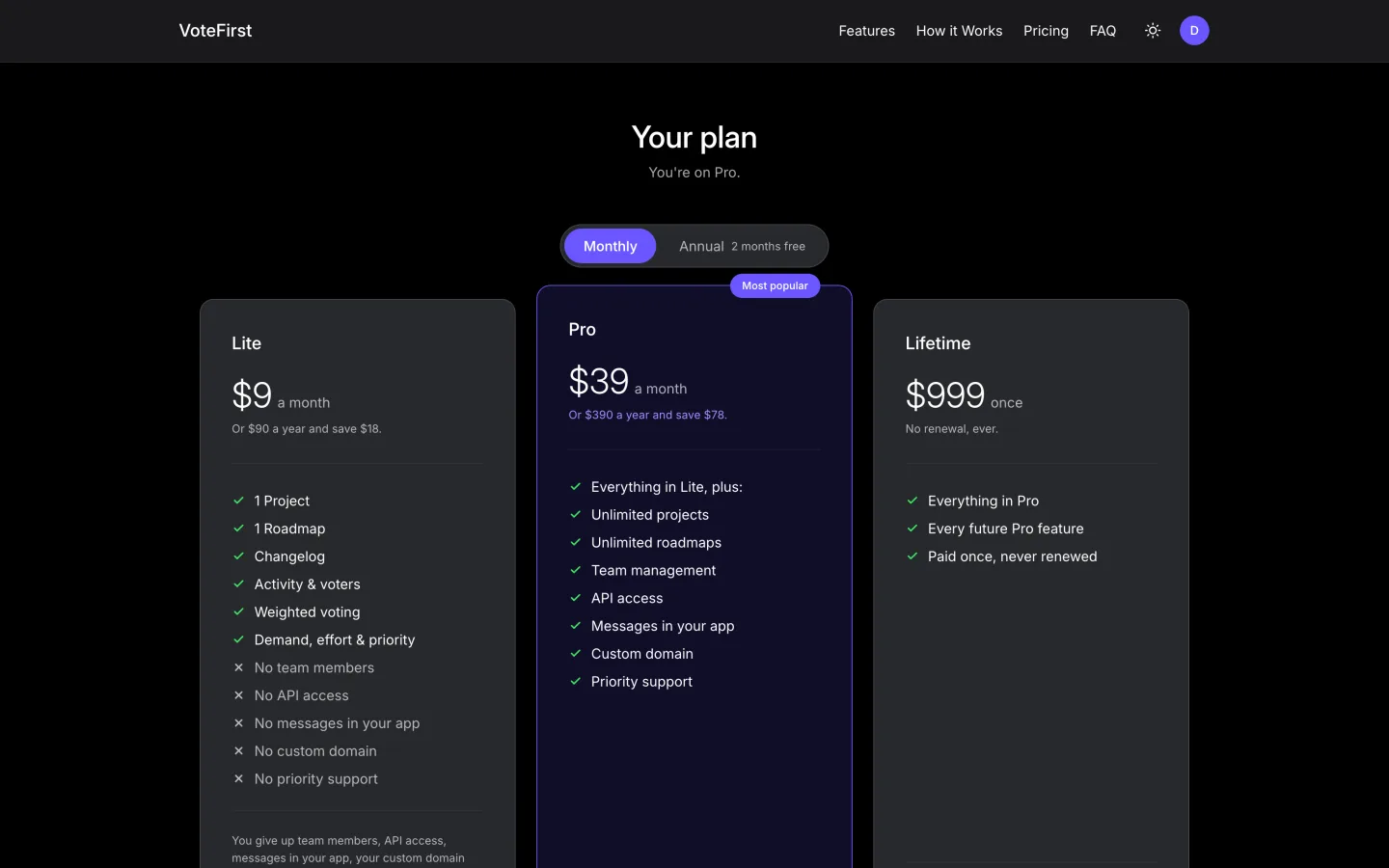
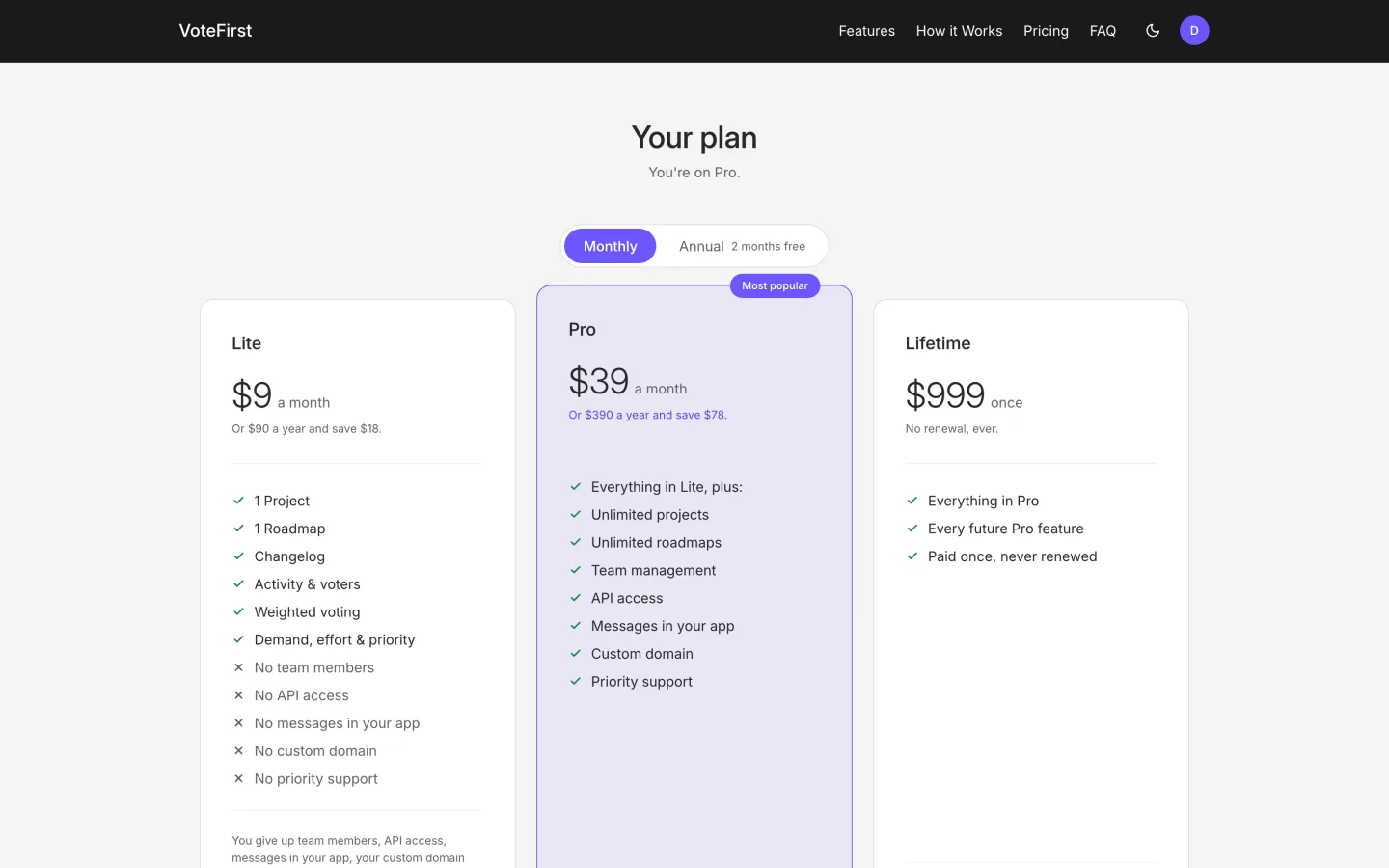
Ours is a price list. Nine dollars a month for one project with the board, the roadmap, the changelog and weighted voting, and thirty nine for more projects, the API and a custom domain. The pricing page has it in full.
There is a fourteen day trial and a card is required to start it, which is a real difference from theirs and we would rather write it down than let you find it at the signup form.
14 days, a card at signup, then $9 or $39 a month.
Does ProdPad have a free plan?
No, and their trial is the most unusual in the category. Their pricing page read on 14 September 2026 offers seven days that can be extended past thirty by completing tasks, and it asks for no card. There is nothing free at the end of it.
Does ProdPad have a public roadmap and single sign on?
ProdPad's own words are lean product roadmaps, and the roadmap is the centre of the product. Single sign on is not published anywhere on ProdPad's own pages read on 14 September 2026, so nobody could read whether it exists.
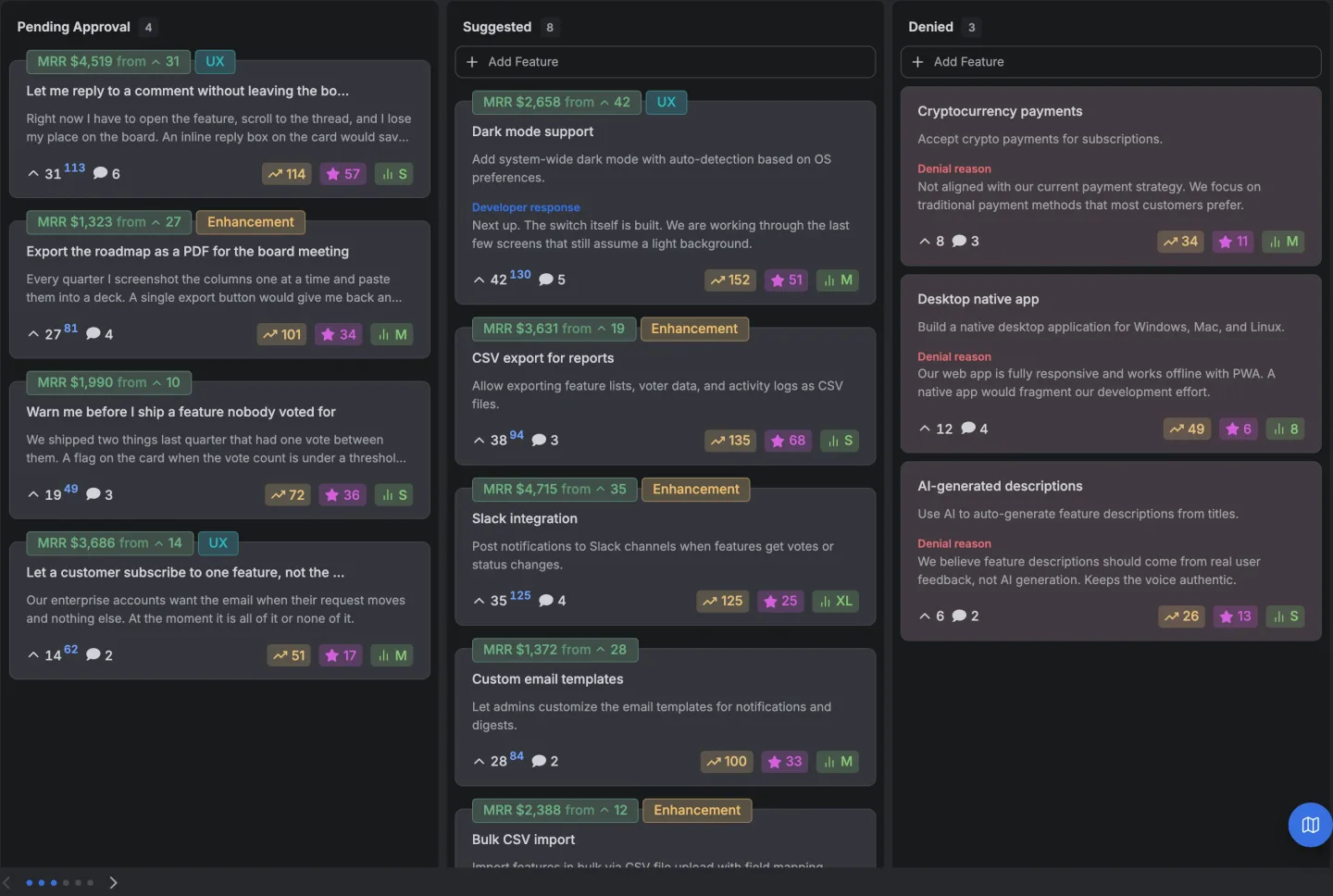
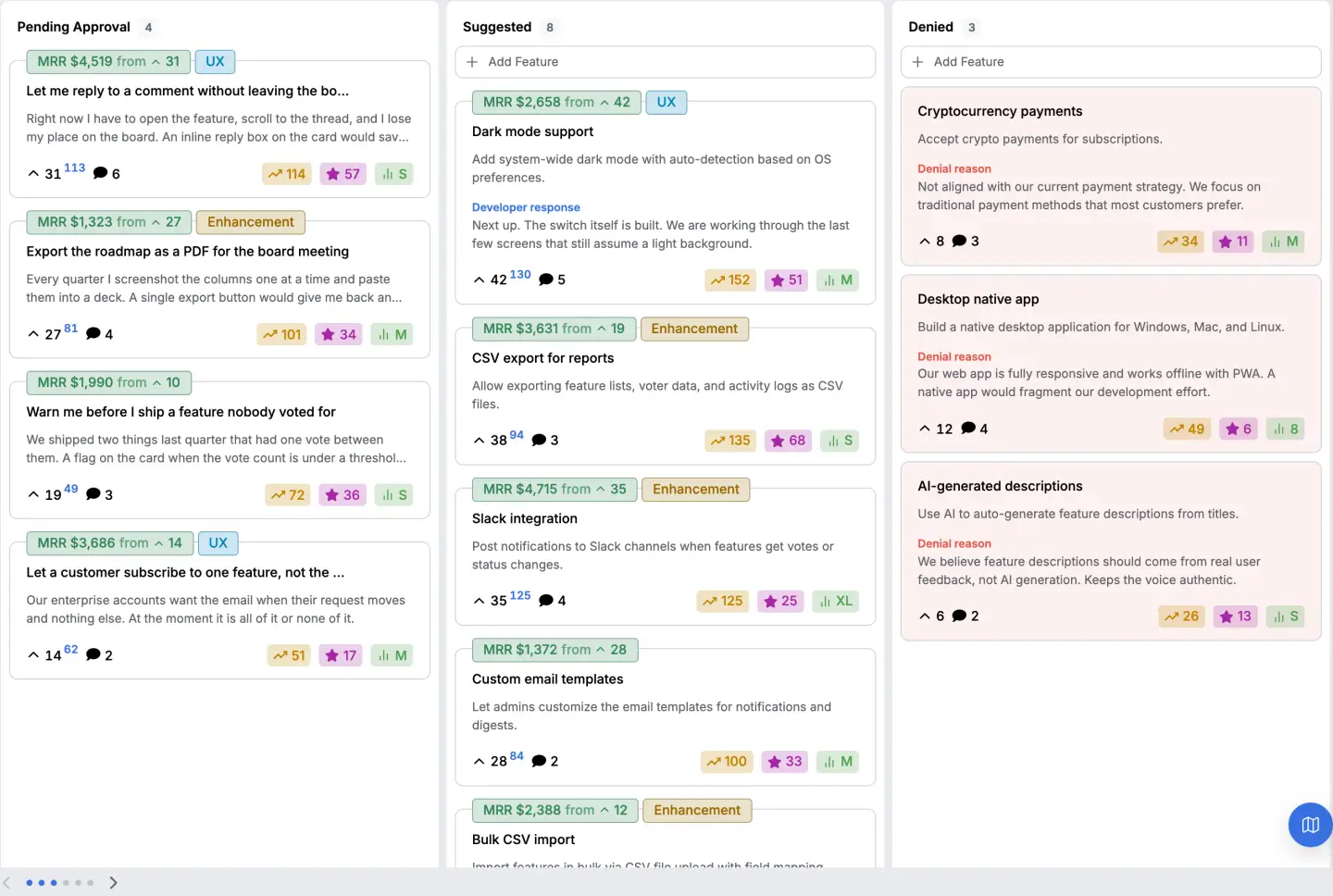
Ours publishes a public roadmap with a Denied column on every plan, and signs a voter in with a token from your own application on the thirty nine dollar plan rather than with SAML.
Is there a free ProdPad alternative?
Yes, several, and none of them is ProdPad. Jira Product Discovery is free forever for three creators, and Productboard's free plan carries five hundred feedback notes with one teamspace and one portal.
Both were read on their own pricing pages on 14 September 2026. This product is not one of them. There is no free plan here, only a fourteen day trial that asks for a card at signup.
Is ProdPad worth it, and who should pick it instead?
Several kinds of team, and pretending otherwise would waste your afternoon.
If your feedback arrives through a support system, a CRM and three messaging apps, they have connectors for that and we do not.
If you need the themes in a pile of feedback surfaced automatically, they lean hard on that and it is a real part of what you would be buying, and we have nothing of the kind.
If your organisation needs objectives, portfolios across many products, and a two way Jira sync, that is a platform question and we are not a platform.
And if you need to invite the whole company as free readers who can post their own ideas, their reviewer role is built for exactly that and is unlimited at no cost.
The case for us is narrower and it is easier to state.
You want a public page your customers reach without an account, you want the vote count to be the ranking rather than a column beside it, and you want the money behind those votes to arrive from your billing system rather than from a field somebody remembers to update.
What does switching actually involve?
More care than either of us would like, and the honest version is short.
ProdPad exports ideas to CSV and PDF, and their help centre says all users can do it. On our side there is no importer for requests or votes today.
We import voters and their revenue, from a CSV or from a billing connection, and that is the part that matters most for weighting. Rebuilding the requests themselves is manual work, or a script against our API, and you should plan for the vote counts starting again.
That is a genuine cost and it is the reason we would rather you switched because the board is the thing you wanted than because a comparison page told you to.
If you are weighing this up, the alternatives page lists the rest of the category with the same treatment, and our own roadmap runs on the product, publicly, and you can vote on it right now without signing up for anything.