UserVoice's own pricing page carries no figure of any kind, and the only button on it is a call to book a demo. Upvoty's page carries three cards with a monthly figure on each.
That is not a small gap between two similar tools, it is two different ways of selling software, and everything below was read on each vendor's own pages on 15 September 2026.
What does each one charge?
| Vendor | From | Billed per | Free plan | Trial |
|---|---|---|---|---|
| VoteFirst | $7.50/mo | plan | – | 14 days, card |
| Upvoty | $13.50/mo | project | – | 14 days |
| UserVoice | Not published | quoted | – | 30 days |
Read on each vendor's own pricing page on 2026-09-15.
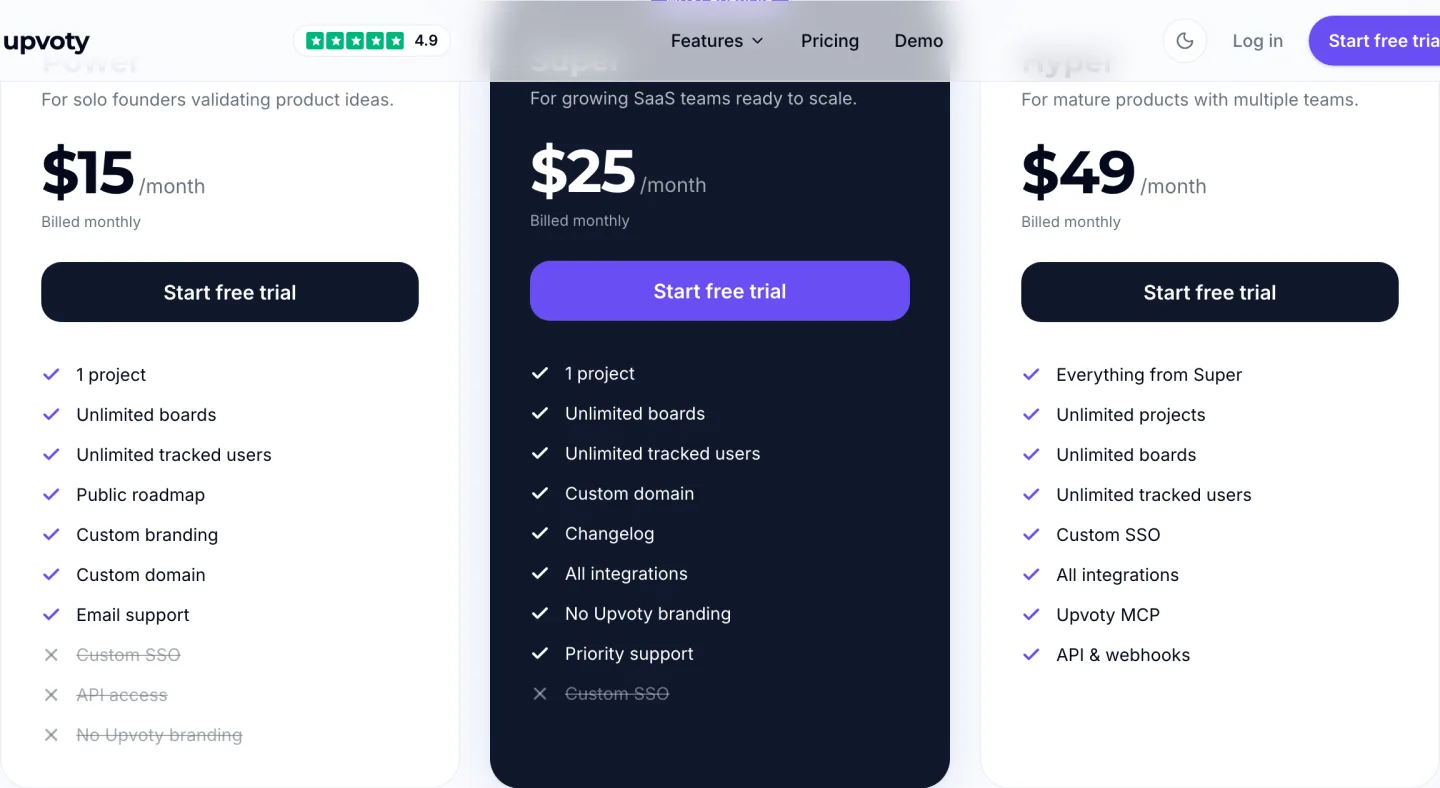
There is no proof image for UserVoice on this site, and there cannot be one. Their pricing page prints no figure, so there is nothing on it to photograph.
Upvoty's cheapest plan is Power, at fifteen dollars a month or thirteen fifty billed yearly, for one project with unlimited tracked users. UserVoice's page says the quote is based on feedback volume, the tools you use and the integrations you connect, and never on seats, with no rate attached to any of it.
How much does UserVoice cost compared to Upvoty?
The honest answer is that only one side of this table has numbers in it.
| Your situation | UserVoice | Upvoty |
|---|---|---|
| One person, one board, wants it live this afternoon | Not published, and the trial itself is booked through a demo call | $13.50/mo billed yearly, live as soon as you sign up |
| A team running two products, no procurement process | Not published | Power covers one project each, so two projects need Hyper at $44.10/mo billed yearly |
| A company where procurement expects a contract and a named account owner | Not published, and this is the shape their own sales process is built for | Also not published. Upvoty's enterprise line, above Hyper, is quoted by email rather than priced |
There is no size at which UserVoice's page gives you a number, and there is one size at which Upvoty's page stops giving you one too. Above Hyper, Upvoty asks for a conversation the same way UserVoice does for every plan.
Which one should you choose?
They are built for buyers at opposite ends of the same category, and the honest answer names both.
UserVoice's revenue weighted insights are the most prominent claim of its kind in the whole category, and it is a genuinely serious enterprise capability rather than a marketing line.
It ties feedback to accounts and to the revenue behind them, and it is built for a company where sales, success and product all need to read the same picture.
Upvoty is the simpler, cheaper, faster tool, and for a solo founder or a small team that is not a compromise, it is the correct answer. One project, unlimited voters, a card free trial, and a published price you can read in ten seconds.
Why choose UserVoice over Upvoty, or Upvoty over UserVoice?
Because one of them sells a platform through a sales process and the other sells a plan through a signup form.
Choose UserVoice when your feedback programme has a named owner, a budget and departments that need to agree, because the four to six week onboarding and the dedicated success manager are what serving that customer looks like.
Choose Upvoty when you want a board running before the end of the day and you are comfortable picking a plan yourself, because nothing on their page asks you to talk to anyone first.
Nothing here counts the people who vote, so a busy board costs the same.
Is there a cheaper alternative to both?
Several, and the cheapest one depends on what you are actually buying.
Against Upvoty's per project rate, a flat plan is cheaper the moment you need a second product without paying for their top tier. Against UserVoice, there is no published rate to be cheaper than, only a sales process to avoid.
The full field, with the unit each vendor bills on, is one page, and this product is nine dollars a month for one project.
What does each do with a vote from a big customer?
The same two products, line by line
Read on each vendor's own pages on 2026-09-15. Not published means nobody could read it on the pages opened that day, never that the capability is absent.
| Vendor | Weighting by revenue | API | Export |
|---|---|---|---|
| UserVoice | Revenue weighted insights, in their own words | Yes | – |
| Upvoty | – | Super, crossed out on Power | – |
A dash means nobody could read it on the pages opened that day, never that the feature is absent.
Eight of the thirty two vendors we checked in the wider category describe something revenue related in their own words, and UserVoice's is the loudest of the eight. Nothing on the Upvoty pages read that day mentions vote weight, MRR or customer tier at all.
UserVoice's own words are that it gives every function the same revenue weighted view so priorities stop changing. That is an answer to a coordination problem between departments, and it is a different question from what a flat priced board like Upvoty is trying to solve.
One line matters on Upvoty's own cheapest card. Custom single sign on, API access and removing the Upvoty badge are all crossed out on Power, and a text copy of the page will still show those words as if they were included.
Custom single sign on stays crossed out on Super too and only arrives on Hyper.
Can I move from one to the other?
UserVoice publishes a path, and it is a genuinely good one. Their own page says you can move existing feedback in by CSV or by their API, with their team taking on the difficult cases themselves.
Nothing on the Upvoty pages we read on 15 September 2026 says anything about importing from a competitor, so that absence is what we can honestly report, not proof that no such path exists.
Where we fit, and where we do not
We are not built for either end of this pair. There is no sales process at any price, and there is also no departmental platform behind the board.
Both of these products offer something we never do at any price. UserVoice puts a named success manager on every plan, and Upvoty's enterprise line above Hyper adds one too, alongside a custom data processing agreement. We have no account owner and no contract to sign, on any plan.
What this product does is put a whole number multiplier on a voting tier and write it onto the vote when it is cast, with the plain count still visible beside the weighted total.
Lite is nine dollars a month for one project, Pro is thirty nine for unlimited projects, a team, the API and a custom domain, and the weighting is included on both. There is no free plan and no private board at any price, and there is no AI feature of any kind.
What is UserVoice, and what is Upvoty?
UserVoice is an enterprise feedback and idea management product sold through a sales process, tying feedback to accounts across sales, support and product, with no price published anywhere on its plans page.
Upvoty is a feedback board with a roadmap and a changelog, priced per project at a flat published rate, with unlimited boards and unlimited tracked users on every plan.
Does either one have a free plan?
No. UserVoice's plans page, read on 15 September 2026, offers a thirty day trial arranged through a demo and no self serve tier at any price.
Upvoty's pricing page, read the same day, offers a fourteen day trial that asks for no card, and its fifteen dollar Power plan is the cheapest thing you can keep.
What this costs
Lite
$9 /mo
Pro
$39 /mo
Lifetime
$999 once
Fourteen day trial of Pro, card asked for at signup. Nothing here counts the people who vote, so the bill does not move when the board starts working. The long version, with what happens if you stop paying.
The honest summary
This is not a close race. One vendor prices by conversation and the other prices by card, and that single fact decides more about which one fits you than any feature row does. UserVoice for an organisation with a named owner and a budget for a guided rollout.
Upvoty for a founder who wants a board this afternoon at a published rate.
The UserVoice alternative page and the Upvoty one carry each side on its own.
14 days, a card at signup, then $9 or $39 a month.