Anybody looking for an Aha! Ideas alternative usually starts from the price, and the number on their pricing card is not the number you will pay, and this is one of the few tools in the category that tells you so on the same card rather than three clicks later.
Everything below was read on Aha!'s own pricing pages on 9 September 2026, with the billing toggle checked in both positions.
What does Aha! Ideas cost?
Per user, per month, with a floor.
| Plan | Paid yearly | Paid monthly |
|---|---|---|
| Ideas Essentials | $39/user/mo | $49/user/mo |
| Ideas Advanced | $59/user/mo | $74/user/mo |
Both plans carry a minimum of three paid users, printed under the price on both cards. So the actual entry price is the multiplication.
| Plan | Floor, yearly | Floor, monthly |
|---|---|---|
| Ideas Essentials | $117/mo | $147/mo |
| Ideas Advanced | $177/mo | $222/mo |
That is the useful number, and Aha! deserves credit for putting the minimum in the same block as the price. Several tools in this category bury the equivalent.
Their trial is thirty days on the Advanced plan, colleagues included, and their page says a card is not asked for.
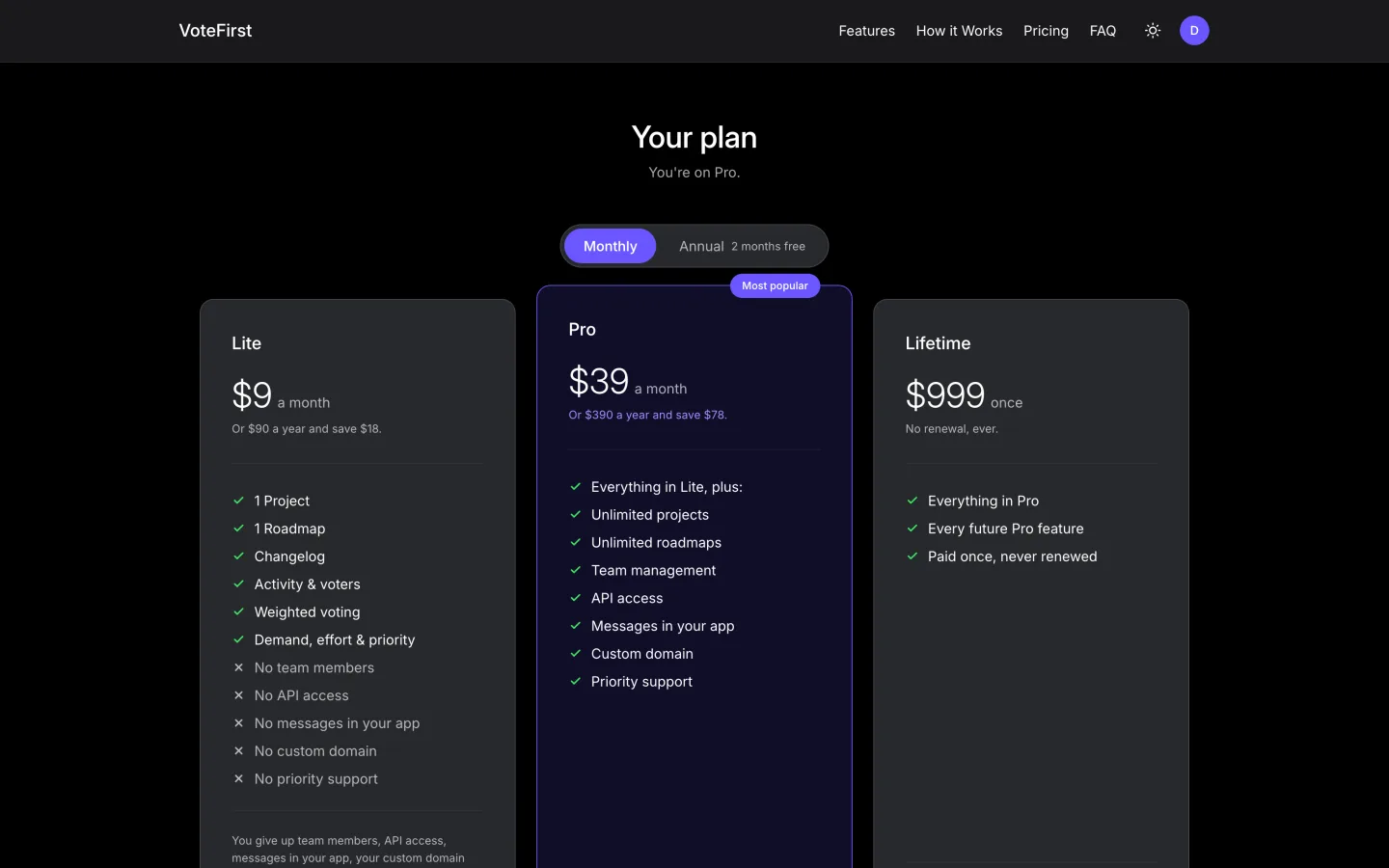
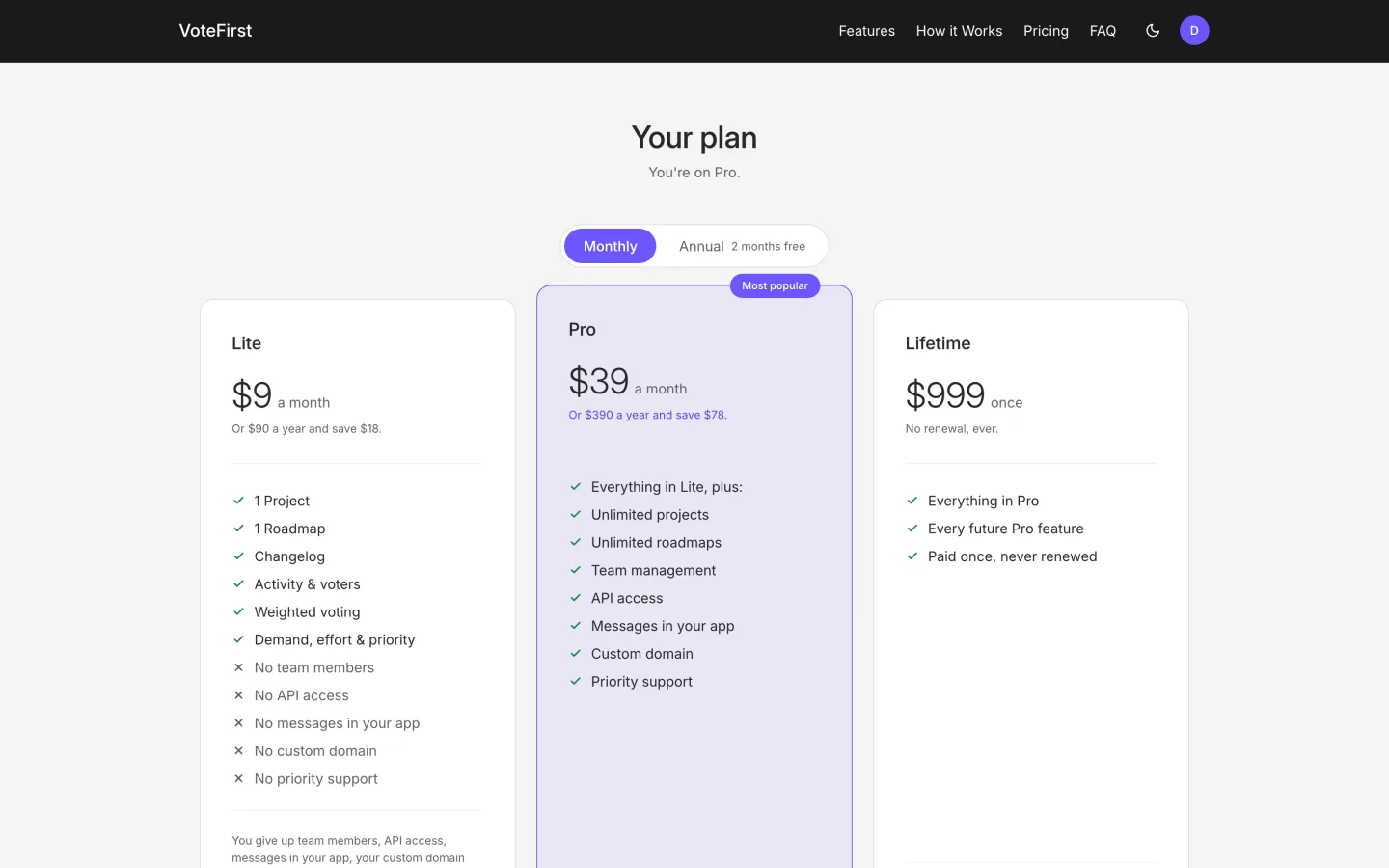
If you would rather try the alternative than read about it, a trial runs 14 days and asks for a card at signup, and it is $9 or $39 a month after that.
Who does Aha! charge for?
Your colleagues, and never your customers.
Portal users are unlimited and free. Their own answer to whether you can have unlimited portals and portal users is a plain yes, and you can create as many public and private portals as you want. If ten thousand customers vote on your ideas, none of them touches the bill.
The paid seat is for people inside your company, and on Aha! Ideas the definition is broader than you might guess. A contributor needs a paid seat. A reviewer, who can see ideas, add them and vote, needs a paid seat.
A viewer, who can only look at ideas and vote for them, also needs a paid seat. That rule is specific to this product and to the cheaper of their roadmap plans, and it reverses on the dearer one, which is worth an afternoon before you buy.
So the question that sets your bill is how many people at your company want to look at the list. Three is the floor whether you need three or not.
This is the opposite bet from the tools that meter tracked end users, and it is a much better bet if your board is public and busy. Which unit each tool in this category bills on is the whole point of the comparison page, and it matters more than any headline price.
14 days, a card at signup, then $9 or $39 a month.
What is on the higher plan?
The parts most people picture when they think of an ideas portal.
Essentials gives you the portals themselves, your branding on them, access control, scoring and prioritisation, themes, status automation, an AI assistant and integrations with fifteen or more tools.
Advanced adds proxy voting, dynamic forms, in app widgets, polls, the Salesforce, HubSpot, Zendesk and Jira integrations, feedback webhooks, customer segments, analysis by organisation, automation rules, merge suggestions, custom portal pages, portal translation and a branded portal domain.
Read that list again if you are shopping. A widget inside your own app, a custom domain on the portal and help finding duplicate ideas are the three things people most often assume are table stakes, and all three are on the plan that starts at a hundred and seventy seven dollars a month.
Does Aha! Ideas have a free plan?
No. Their pricing page read on 14 September 2026 carries a free trial that asks for no card, and no free tier under it. The cheapest thing you can keep is the thirty nine dollar seat, and the minimum is three of them.
Does Aha! Ideas have a public roadmap and single sign on?
The public roadmap your customers read comes from the Ideas portal in Aha!, and roadmaps for your own team are a separate product in the same suite called Aha! Roadmaps. Single sign on is not published anywhere on Aha!'s own pages read on 14 September 2026, so nobody could read whether it exists.
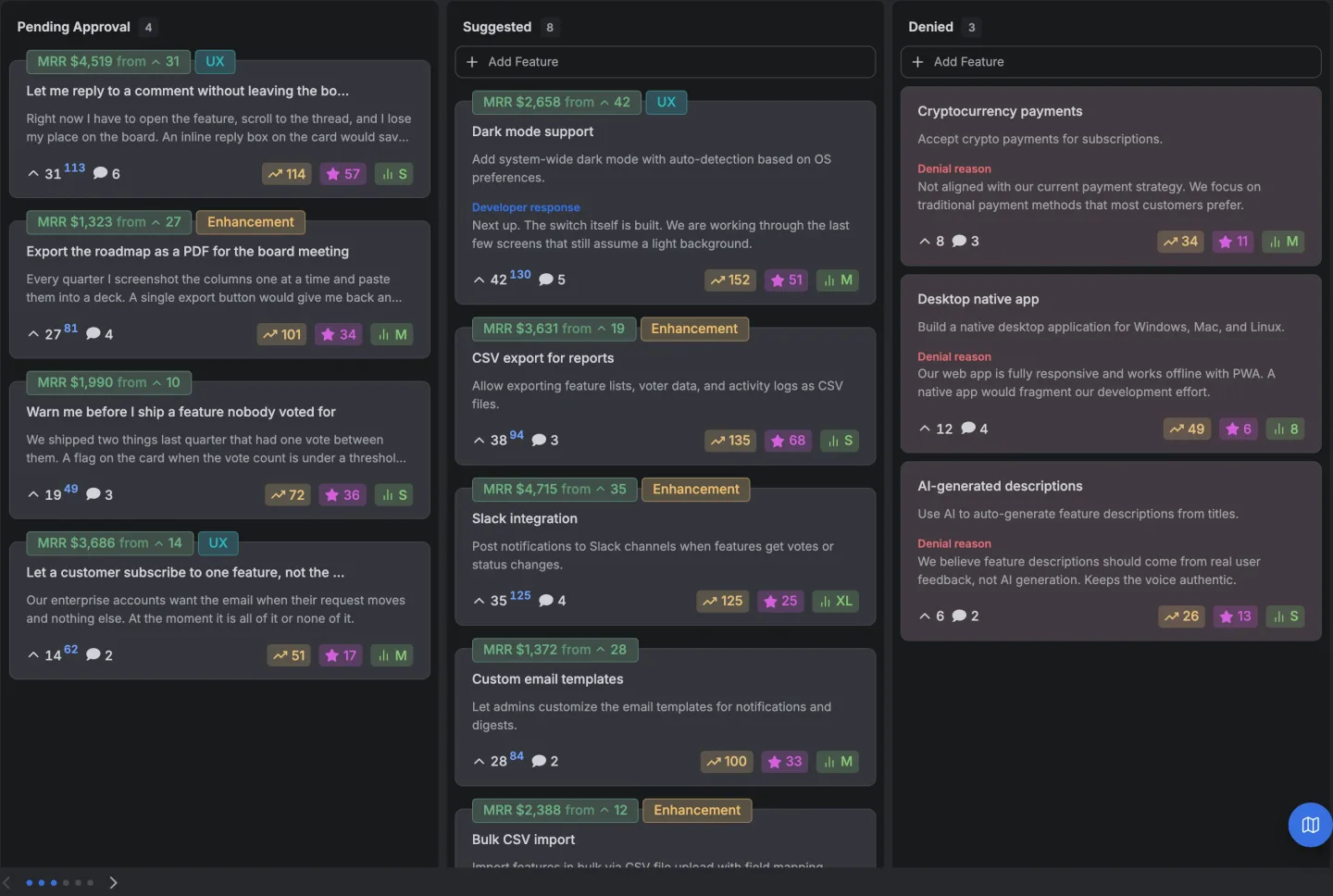
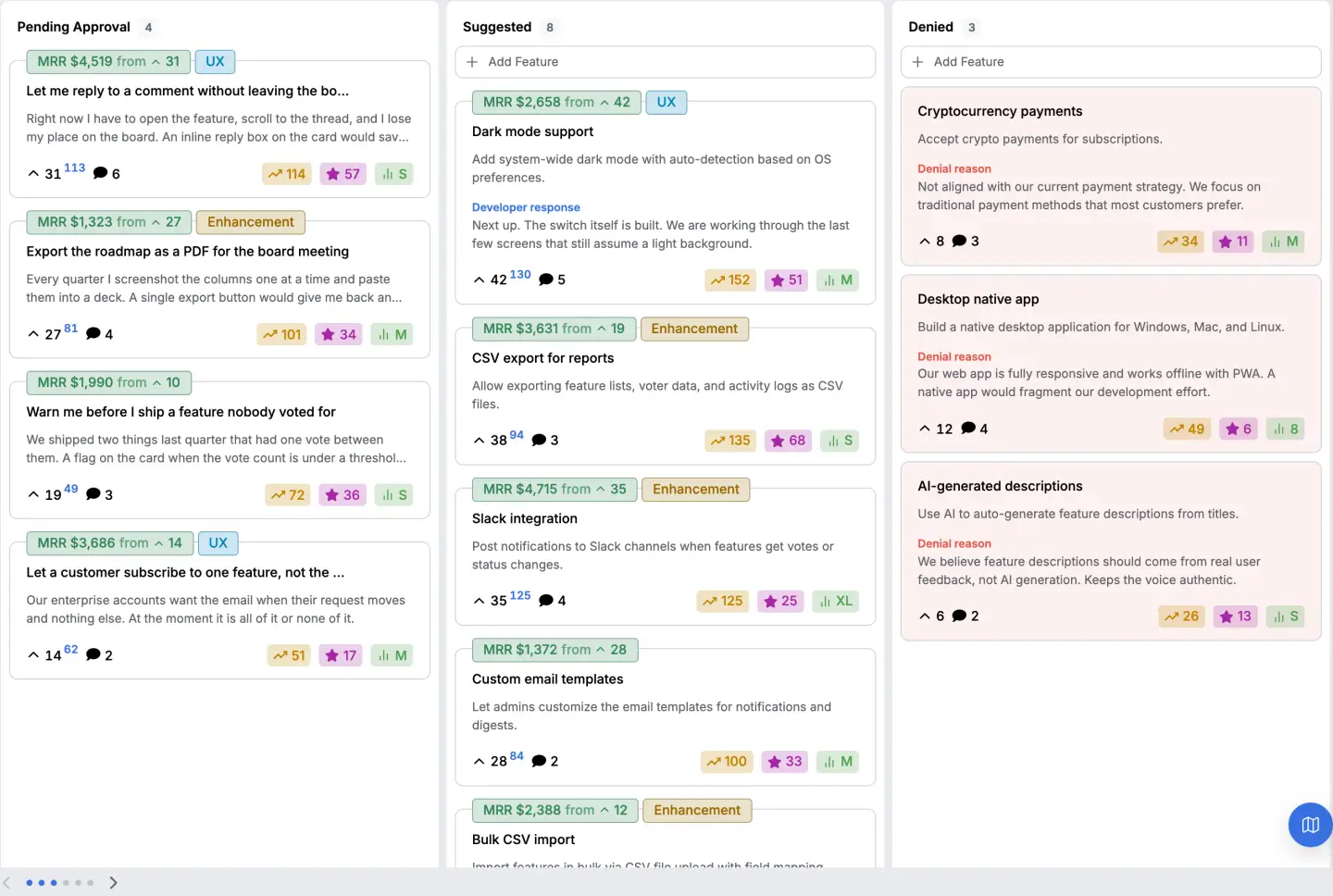
Ours publishes a public roadmap with a Denied column on every plan, and signs a voter in with a token from your own application on the thirty nine dollar plan rather than with SAML.
Is there a free Aha! Ideas alternative?
Yes, several, and none of them is Aha! Ideas. Jira Product Discovery is free forever for three creators, and Productboard's free plan carries five hundred feedback notes with one teamspace and one portal.
Both were read on their own pricing pages on 14 September 2026. This product is not one of them. There is no free plan here, only a fourteen day trial that asks for a card at signup.
Is Aha! Ideas worth it, and what is it better at?
Quite a lot, and this is a bigger product than ours by an honest margin.
It is a suite. Aha! sells eight products, and Ideas is one of them. Roadmaps, Discovery, Whiteboards, Knowledge, Develop, Teamwork and Builder are the others, and buying Roadmaps includes Ideas Essentials. If you want strategy, release planning and delivery in the same account as your feedback, we do not offer that and are not going to.
Proxy voting and dynamic forms. Submitting an idea on behalf of a customer who told your account manager, and asking different questions depending on what somebody picked, are real capabilities that we do not have.
Feedback arriving from Salesforce, HubSpot and Zendesk. If most of your requests reach you through support and sales rather than through a public page, that ingestion is the product you want and it is theirs.
An AI assistant. They put one in every plan and describe idea analysis, theme organisation and drafting through it. We have no AI features and are not adding any, which is a deliberate choice rather than a gap we are closing.
Who should not move to ours?
Anybody in the paragraphs above, and one more group.
If three or more people at your company genuinely need to review and manage incoming ideas, and you want the roadmap and the delivery tooling in the same place, Aha! is a coherent purchase and moving to a nine dollar board would cost you things you use.
The comparison is only interesting at the small end. One person, or a small team, who wants a public page where customers post and vote, and who has looked at a hundred and seventeen dollars a month and thought about what else that buys.
What does ours cost?
Nine dollars a month, and thirty nine if you want colleagues.
The nine dollar plan is one project and one person. It carries the public board, voting without an account, the roadmap page and the changelog, and it has no seat minimum because it has no seats.
Colleagues are on the thirty nine dollar plan, and that plan does not count them.
We searched our own code three ways for a cap on team members and there is not one, so thirty nine dollars covers your team rather than one seat of it. That plan also carries the API, more than one project and a custom domain.
Neither plan meters the people who vote. Voting works without an account at all, and the roadmap is a public page rather than an internal view with a portal beside it.
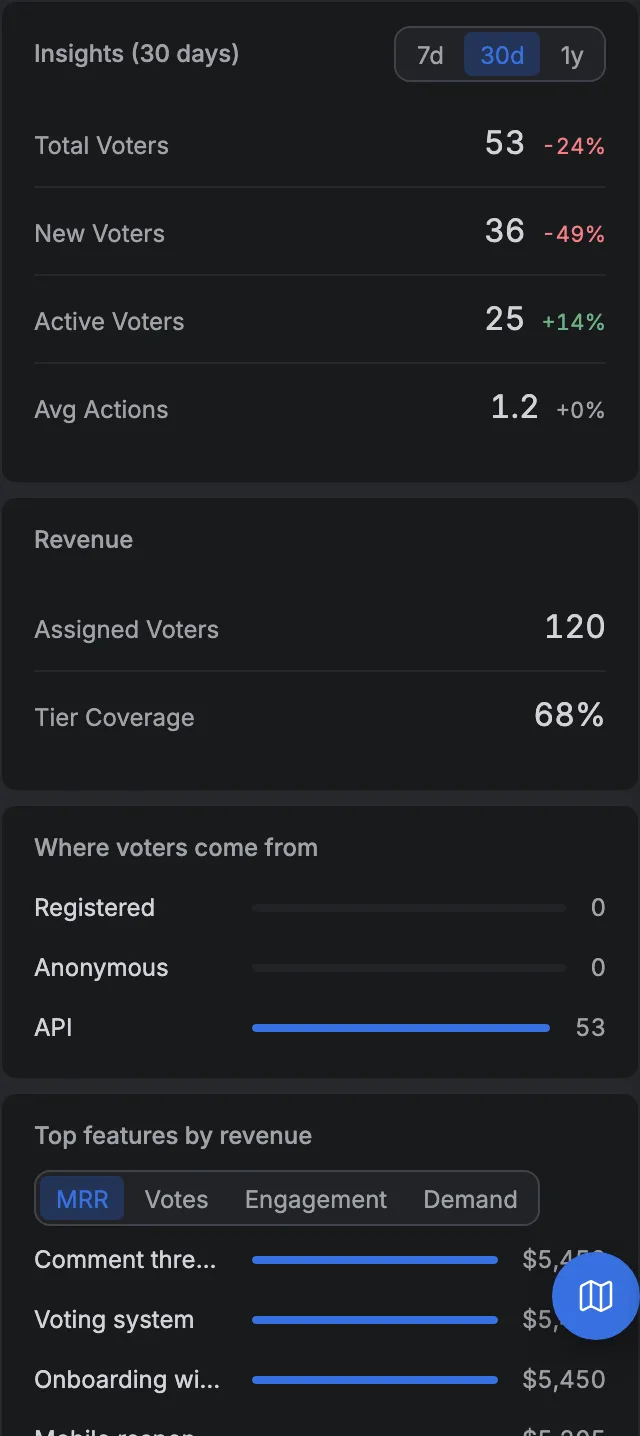
A vote can carry the weight of the customer who cast it, so three paying customers can outrank thirty who are not. That is the mechanism, and it is on the nine dollar plan rather than an upgrade.
Both prices are published and a card is required for the fourteen day trial.