There is no Pendo price on this page, because there is no Pendo price to put on it. That is the finding rather than a gap in our research, and it is worth understanding properly before you book the call.
Everything below was read on Pendo's own pricing page on 9 September 2026.
What does Pendo cost?
Four plans, and three of them answer with a button.
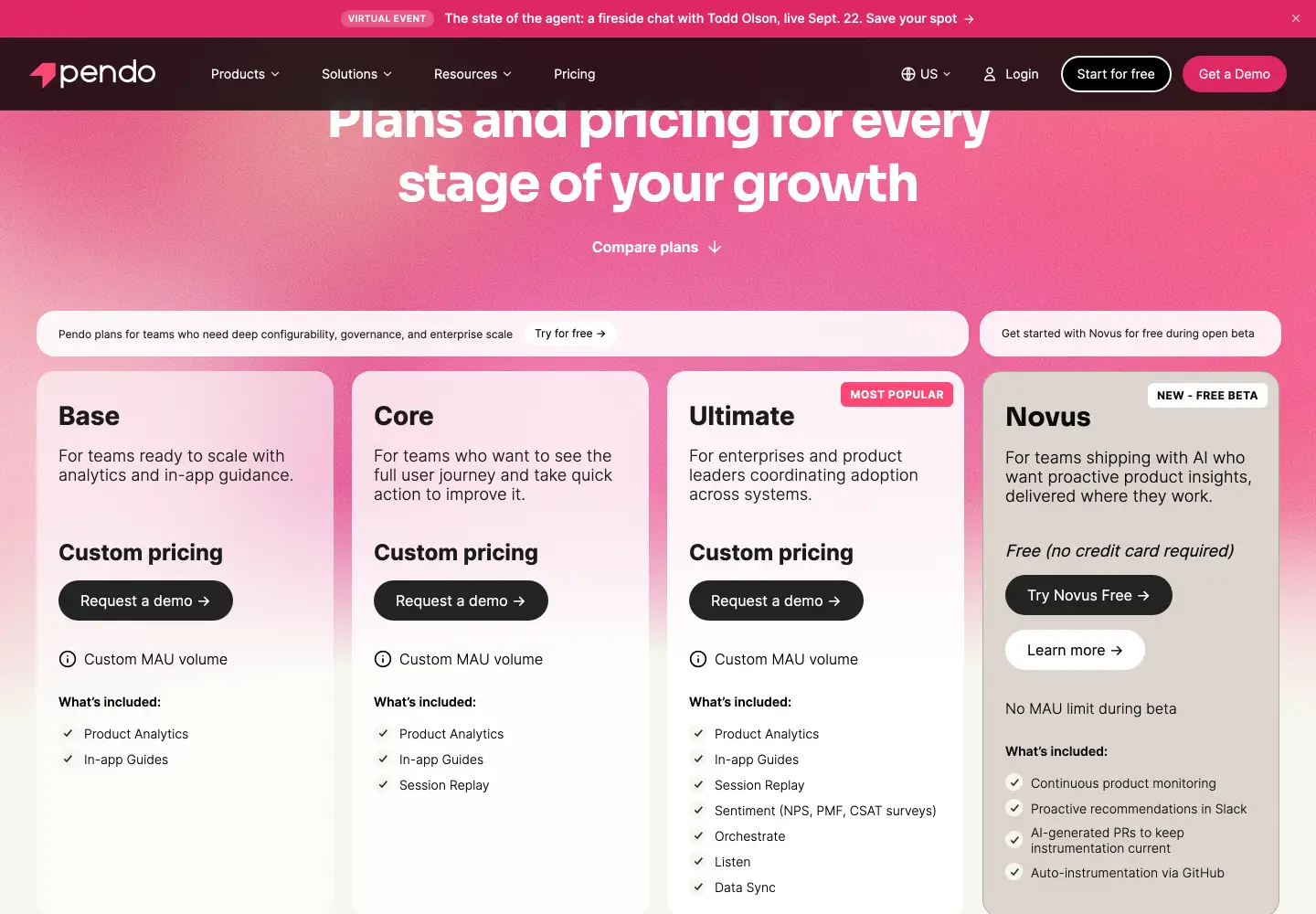
| Plan | Price on the card |
|---|---|
| Free | Free |
| Base | Custom |
| Core | Custom |
| Ultimate | Custom |
Each of the three paid cards carries a request a demo button in the place where a number would sit, and each says custom MAU volume where an allowance would sit.
Their pricing philosophy section says the pricing is clear upfront and that there is no bait and switch.
Both of those can be true alongside three cards reading custom pricing, because clear upfront plausibly means clear in the quote you are handed rather than clear on the website. It is still worth knowing that you cannot compare Pendo against anything until somebody has spoken to you.
That is not unusual at this end of the market. UserVoice does the same thing, and in both cases the absence is a fact about the buying process rather than an oversight.
The flat price is the whole of the comparison, and a 14 day trial with a card at signup is how you find out whether it holds for your numbers.
Does Pendo have a free plan?
Yes, in the form of the Novus beta on their pricing page read on 14 September 2026, which asks for no card. It is a beta rather than a standing tier, so check what it still includes before planning around it.
Does Pendo offer discounts?
Nothing that can be read from the outside.
A discount is a number against another number, and three of the four plans on the page read on 14 September 2026 carry no number at all. Whatever is offered arrives inside a quote, after somebody has spoken to you, and it cannot be compared against anything before that conversation.
The free Novus beta is the only thing on the page that costs nothing, and a beta is not a discount on a paid plan.
What is a monthly active user?
Their own answer is a unique visitor who was active in your app over the last thirty calendar days.
This is the part that actually matters, because it decides what your bill is made of. Pendo does not price on seats, boards, projects or workspaces. It prices on how many people use your product.
Their FAQ is explicit that neither the number of applications you track nor the number of sessions changes the price, so running Pendo across several products costs no more than running it across one.
Read that against what you might be buying it for. If the reason you are looking at Pendo is the feedback and idea management side, the meter is counting everybody who opens your app, including every person who will never give you feedback at all.
A board that charges for voters is metering participation. Pendo is metering your product's success.
Neither is wrong. They are different bets, and the second one is a much larger commitment if your product is popular and your feedback programme is small.
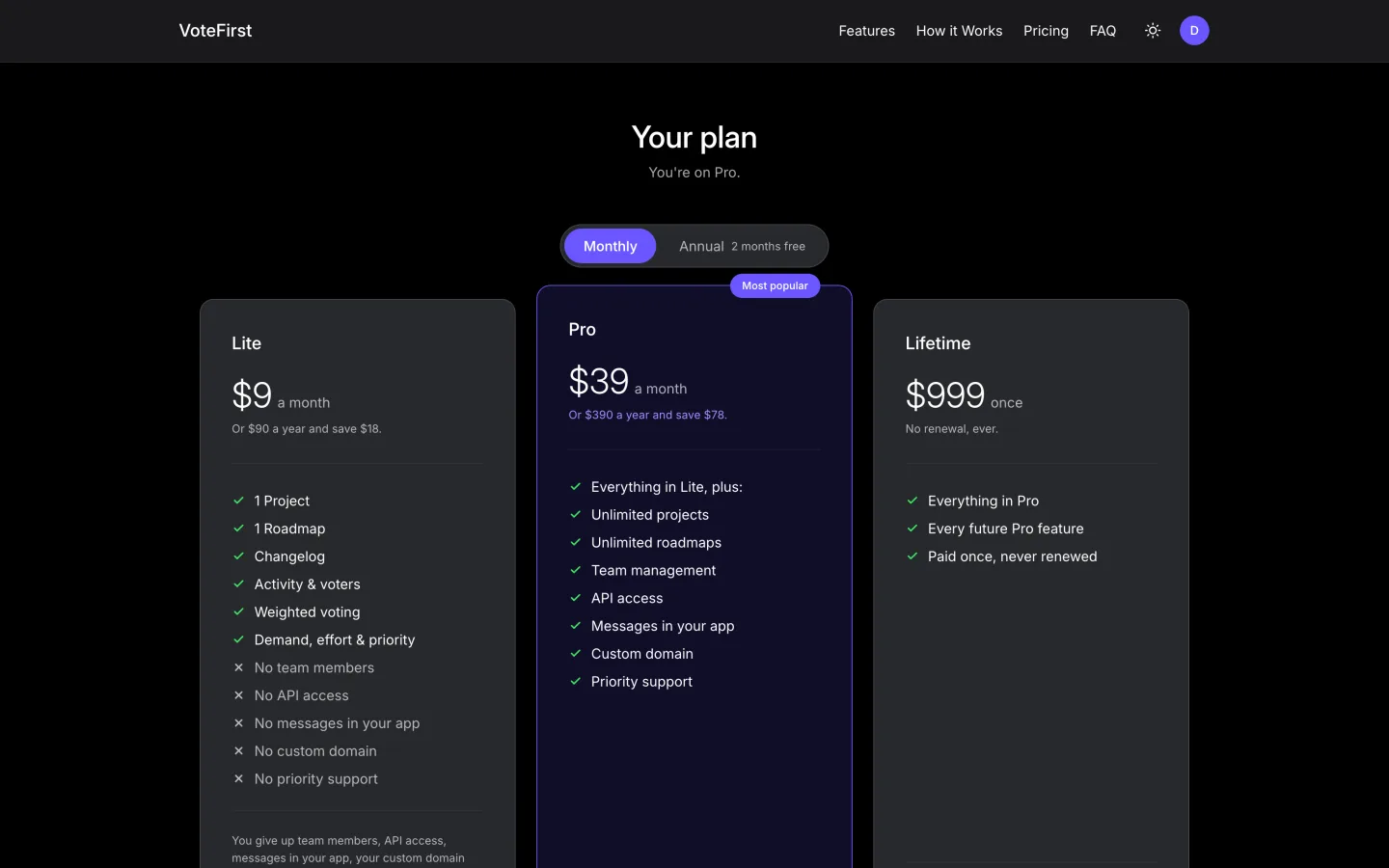
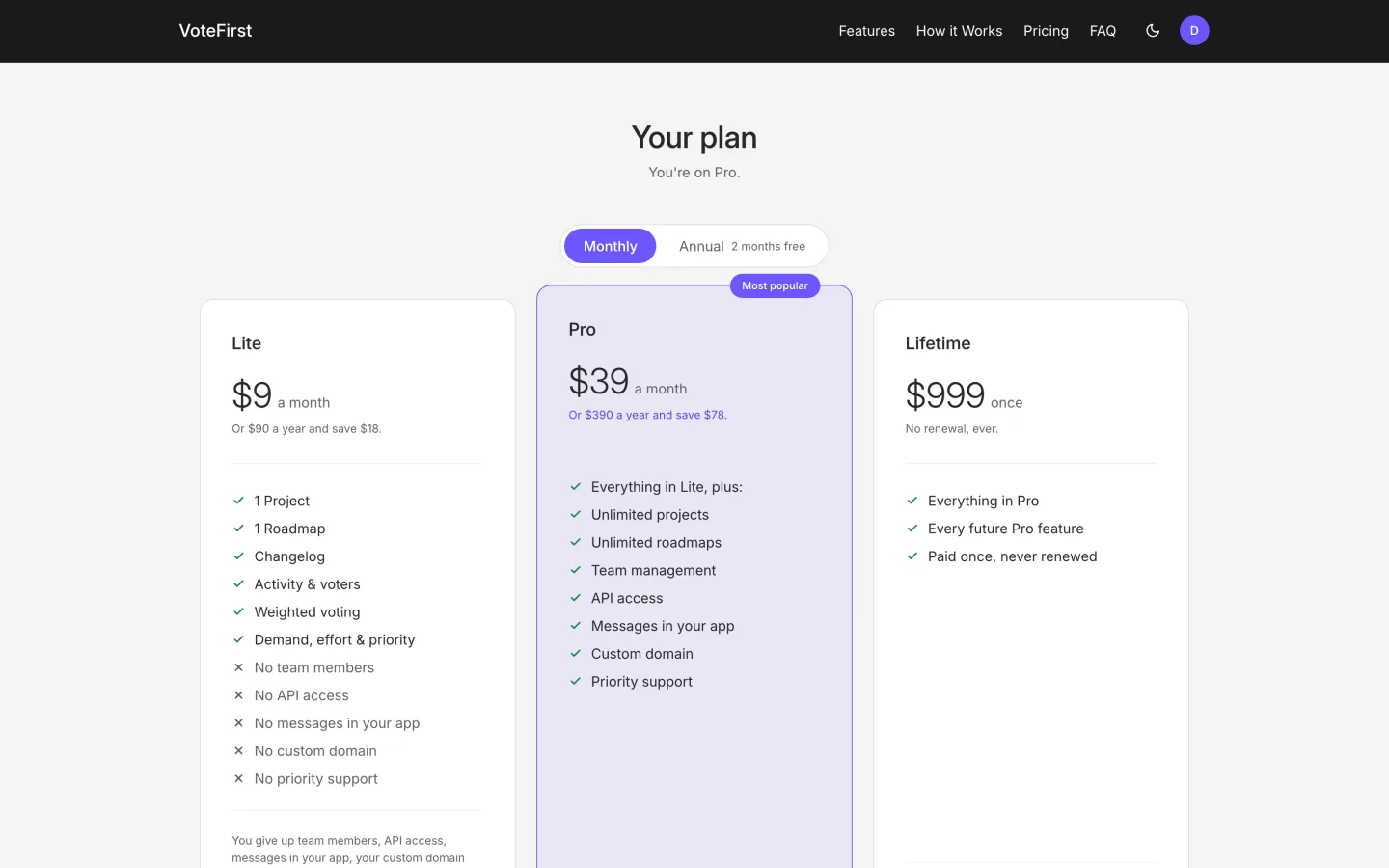
14 days, a card at signup, then $9 or $39 a month.
What happens if you go over?
Two different answers, depending on whether you are paying.
On a paid plan, exceeding the limit does not interrupt anything. Their page says the functionality keeps running and your account representative gets in touch to work out whether it is growth that needs a contract change or a configuration problem.
On the free plan it stops you. Their page says exceeding the limit means you cannot create new guides, NPS surveys or segments until you upgrade. Existing ones are not described as breaking, and creating new ones is where the wall is.
Is everything included?
Their philosophy section says yes and their comparison table says it depends, and both are defensible once you know what a module means.
The all in access block says that when you buy a Pendo module you get full functionality, with no gated features and no forced upgrades. The comparison table further down the same page then marks several capabilities as purchasable add ons rather than included.
| Capability | Free | Base | Core | Ultimate |
|---|---|---|---|---|
| Analytics and in app guides | Included | Included | Included | Included |
| Session replays | Not listed | Add on | Included | Included |
| Product discovery | Not listed | Add on | Add on | Included |
| Sentiment, meaning NPS and surveys | Included, Pendo branded | Add on | Add on | Included |
| Journey orchestration | Not listed | Add on | Add on | Included |
The resolution is the word module. You get all of a module you have bought, and the modules are bought separately. That is a coherent position and it is not what the sentence sounds like on first reading, which is why it is worth spelling out rather than scoring a point off.
The practical version is that product discovery, which is the family the feedback and ideas work lives in, is an add on on two of the three paid plans and included only on the top one.
What is free?
More than most free plans in this category, and capped at five hundred monthly active users.
Their comparison of the free plan to the trial says Pendo Free is free forever and includes product analytics, in app guides, Pendo branded roadmaps and Pendo branded NPS surveys, with support for unlimited web and mobile app keys up to that five hundred user cap.
Two details in there are worth pulling out. The roadmaps and the surveys carry Pendo's branding rather than yours. And a roadmap built in Pendo cannot be shown to customers at all today, on any plan, which is their own answer rather than our claim.
Their trial is separate and runs thirty days across the whole platform, and their page routes it through a conversation with sales rather than a signup form.
What does a team of four cost a year?
Nobody outside Pendo can tell you, and this section exists to say which figure is missing rather than to guess at it.
The sum needs two numbers. The rate, which every paid plan on their page gives as custom pricing, and the monthly active user count in your own product, which you have and we do not.
Without the first one there is no arithmetic to do, and filling it in from a review site would be inventing the central fact of this page.
What can be said from their own page is the shape of the bill. The meter is monthly active users in your application rather than seats or voters, so the bill moves with how many people use your product and not with how many give you feedback.
What does this cost on VoteFirst?
Nine dollars a month, and thirty nine if you want colleagues.
The nine dollar plan is one project and one person, and it carries the public board, the roadmap page, the changelog, the widgets and weighted voting. Thirty nine adds more projects, the API, a custom domain and team members, and it does not count the team.
Neither plan meters the people who use your product, and neither meters the people who vote. A board with ten voters and a board with ten thousand cost the same, which is the opposite end of the design space from a monthly active user meter.
The two products are not really substitutes, and the alternative page is honest about which one you probably want.
If a public page where customers post and vote is the whole job, both of our figures are published, a card is required for the fourteen day trial, and the real billing unit of every tool in the category is on one page.