The short version
- Six destinations app feedback lands in, and only three reach a person who can act.
- Store reviews give you no device, usually no version, and no way to reply properly.
- Three tests decide what is worth acting on.
- Four screens from a real iPhone app talking to a real board.
The interesting thing about the mobile app feedback examples below isn't what people write. It's where it arrives, because three of the most common destinations are places the person who could fix the thing never looks.
The ten below are written for this post, not copied from any app's reviews. Each is paired with where that kind of message usually ends up and what actually happens to it there.
Where does app feedback actually go?
Six destinations, and they sort cleanly into the ones that reach a person and the ones that reach a number.
A store review reaches a number. A one star rating with no words changes an average and tells nobody anything. A support message reaches a person, and is by far the most useful thing an app receives, and is also the one that gets answered and then deleted.
There's a board that collects the third kind, open without an account.
Want somewhere to put all of this? Twenty eight feedback tools, the price and the unit each one bills on, read on one day.
The ten, and where each one lands
| What somebody writes | Where it lands | What happens to it | |
|---|---|---|---|
| 1 | Crashes every time I open the camera on an older phone | Store review | Nobody sees the device. A developer reads the word camera and cannot reproduce it |
| 2 | Great app, wish it had dark mode | Store review | Counted as five stars, the request is lost |
| 3 | I cannot find how to change my email address | Support | Answered in one reply, and the fact that the setting is unfindable is never recorded |
| 4 | It logged me out again | Support | Treated as a session bug, when it is usually the third person that week saying the same thing |
| 5 | Please add an offline mode | In app form | A row in a spreadsheet, read monthly if anybody owns it |
| 6 | Sync between my phone and my laptop is hours behind | In app form | The most valuable message in this list and the one most likely to be filed and forgotten |
| 7 | The new update ruined the layout | Store review after a release | A one star spike, indistinguishable from every other kind of anger |
| 8 | Can it export to CSV? | Public request board | Counted. Other people add to it. Somebody hears back when it ships |
| 9 | Why is this a subscription now? | Store review and social media | A pricing objection, treated as a support problem, answered by nobody |
| 10 | I use this every day, do not change the home screen | Nowhere. Not written at all | The silent majority. No system on this page collects it |
The first pattern worth naming is that rows one, two, seven and nine all land in the store, where there's no conversation, no device information and no way to tell somebody the thing was fixed.
The store is a rating system that people use as a feedback channel because it's the only channel the app offered them.
The second is row ten. The people happy with your app write nothing, and the loudest part of any feedback channel is the part currently unhappy with a change.
What is worth acting on, and what is not?
Three tests, applied in order.
Does it contain a situation? Row six says what somebody was trying to do and what happened. Row two says what somebody wants. The first can be investigated. The second can only be agreed or disagreed with.
Did more than one person say it? A single message is an anecdote. A single message you've heard four times is a pattern, and the only way to know which one you're holding is to count.
Can you tell them when it changes? If the channel can't carry a reply, acting on the feedback produces no visible result to the person who gave it, and they won't give you another.
Row one fails the third test badly. A store review can be replied to publicly, but the person is usually gone, and the reply exists for the next reader rather than for them.
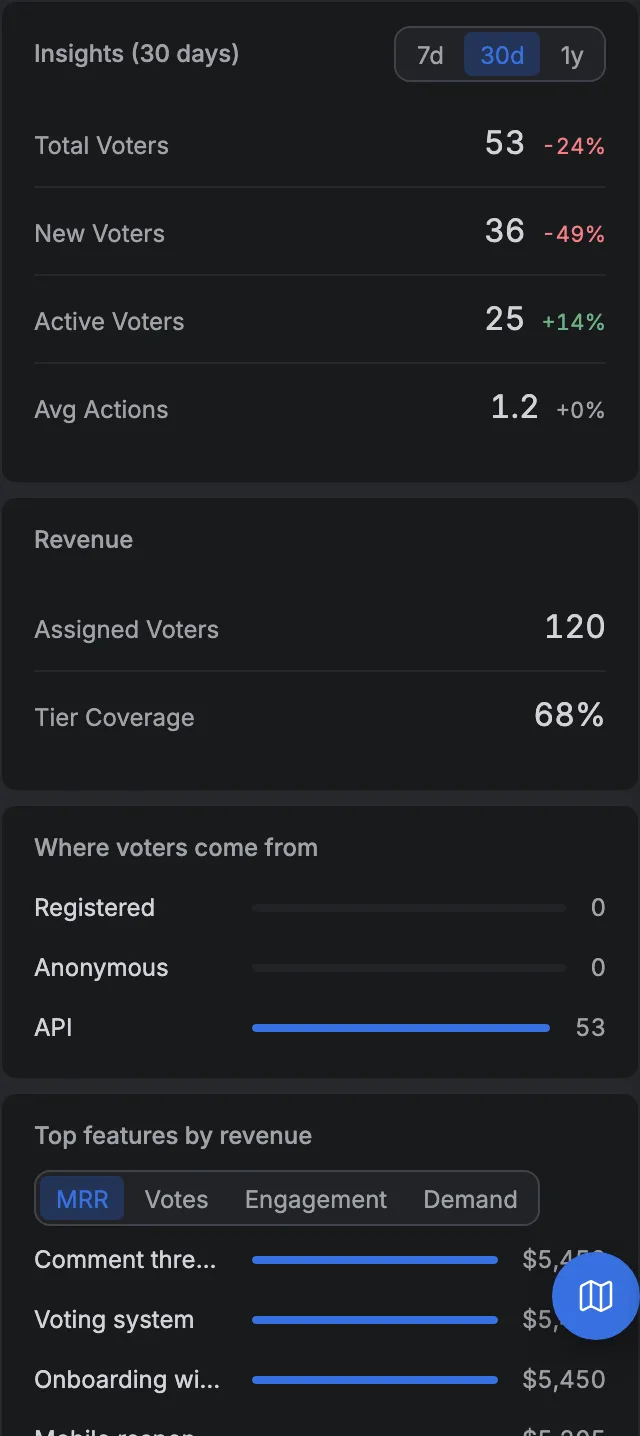
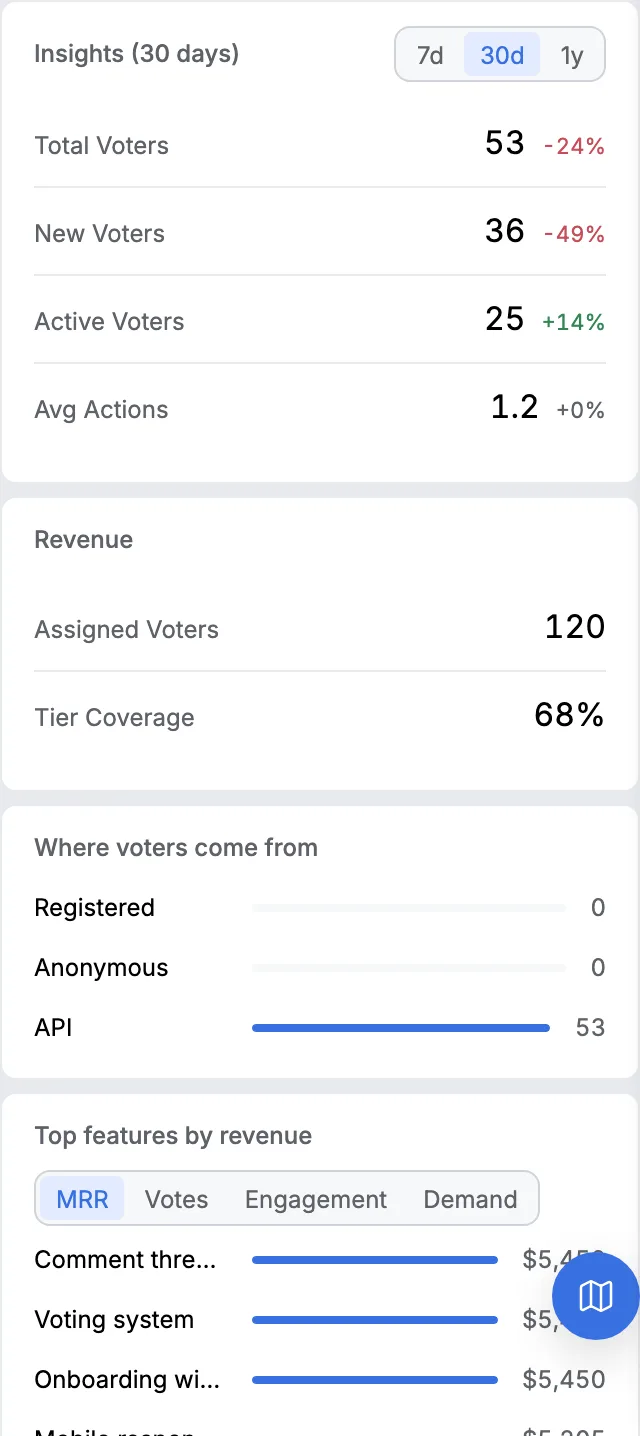
Three channels that never reach the person who could act
Store reviews. No device, no version in most cases, no thread. The signal arrives as a star average, and an average of a thousand ratings moves too slowly to tell you anything about last Tuesday's release.
Social media mentions. Fast, public, and answered by whoever runs the account rather than by anybody who can change the app. The useful content of these is almost always a repeat of something already in support.
The one star with no words. It records anger without a cause. There's nothing in it to act on, and reading a pile of them teaches a team that users are irrational rather than that the app has a specific problem.
How do you collect this without another tool?
One in app link, one address, one weekly hour.
The link goes where people are annoyed rather than in a settings menu nobody opens. The address can be a shared inbox. The weekly hour is spent writing one line per message into a sheet, holding the situation, the person, the date, and whether you've told them anything.
Two things this can't do, and they're the same two every manual system hits. It can't count the same want once when forty people phrase it differently, and it can't tell forty people at once that the thing shipped.
How a request board changes the mobile picture
It gives rows five, six and eight somewhere to land where they're counted and answered.
The board is public and works in a mobile browser, so a link from inside the app reaches it with no account and no install. What somebody writes there stays visible, other people add to it rather than writing it again, and the request carries the list of who asked.
That list is what makes the third test above pass. When a request moves, the people on it are told, and nobody keeps a record by hand.
The timeline is the part that matters when support is filing on behalf of people who wrote in, not posted, which is how rows three and four get onto the board at all.
Two limits worth being plain about. A board doesn't collect row ten, because nobody happy writes anything anywhere. And the counts on boards are smaller than people expect.
Thirty six public boards belonging to real companies were read on 27 August 2026 and on the median one the median request on page one had nine votes. The measurement and its limits are here. How the board is wired is written up here, and the same question for websites has its own page.
14 days, a card at signup, then $9 or $39 a month.
What do app feedback examples look like on the screen?
Four screens from one iPhone app talking to one board, shot on 15 September 2026.
Everything above is what people write and where it goes. This is what it looks like when the app carries the board itself, so the writing and the answering happen in the same place.
The app is the sample that ships with this product's Swift package. Five files, the package resolved by URL the way anybody else installs it, pointed at a board with real requests, real votes and real comments on it.
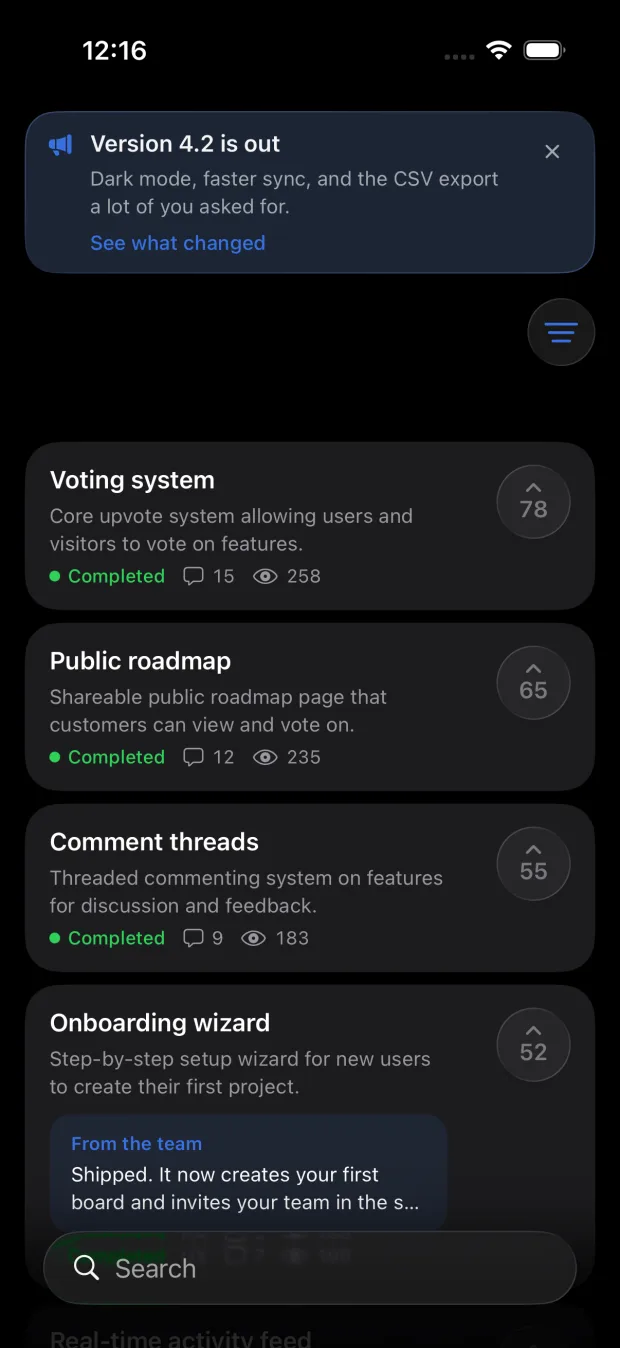
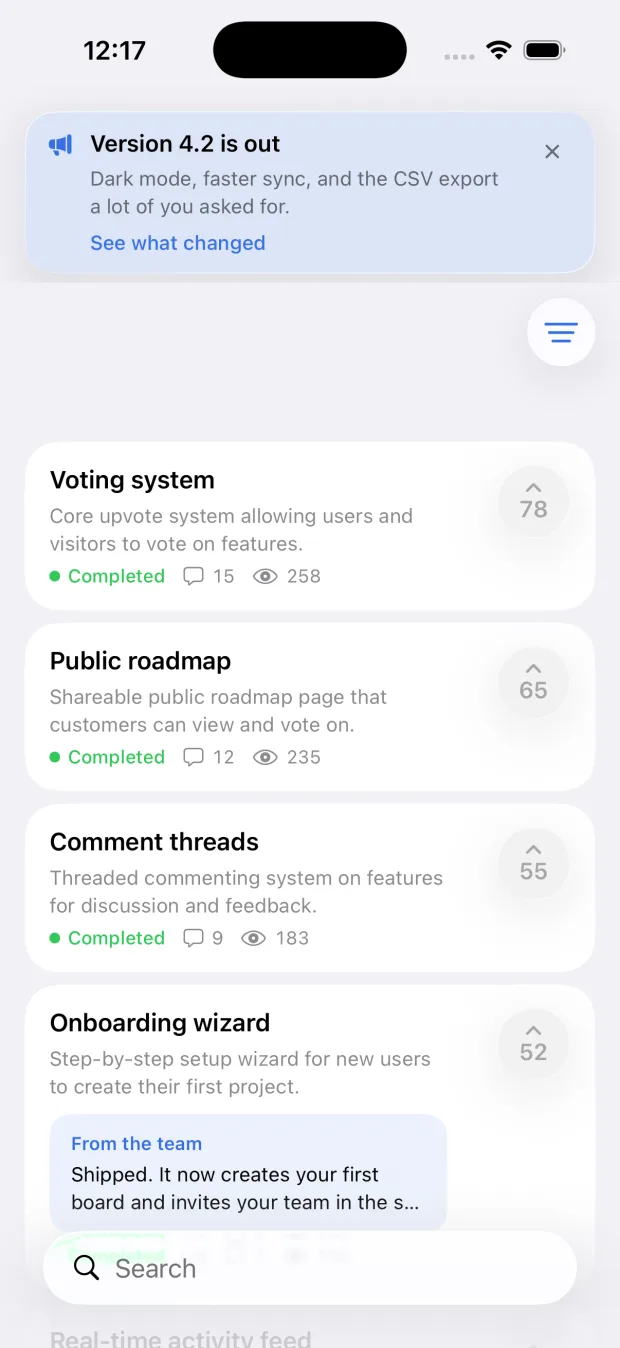
Four requests fit on the first screen. Voting system at 78 votes, Public roadmap at 65, Comment threads at 55 and Onboarding wizard at 52, with a fifth starting underneath. The top row carries 15 comments and 258 views.
A reply from the team sits on the fourth card, in the list, before anyone has tapped anything. That's the whole point of putting the board in the app: the person arrives to find other people wanted the same thing, and somebody answered.
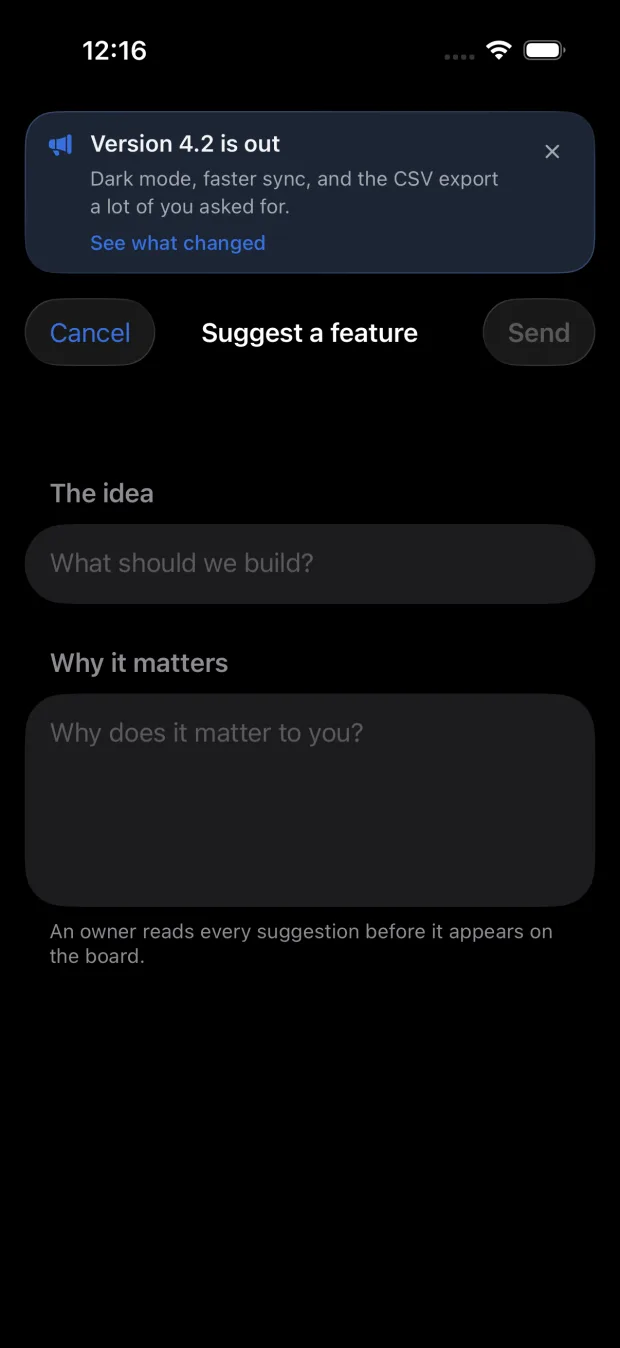
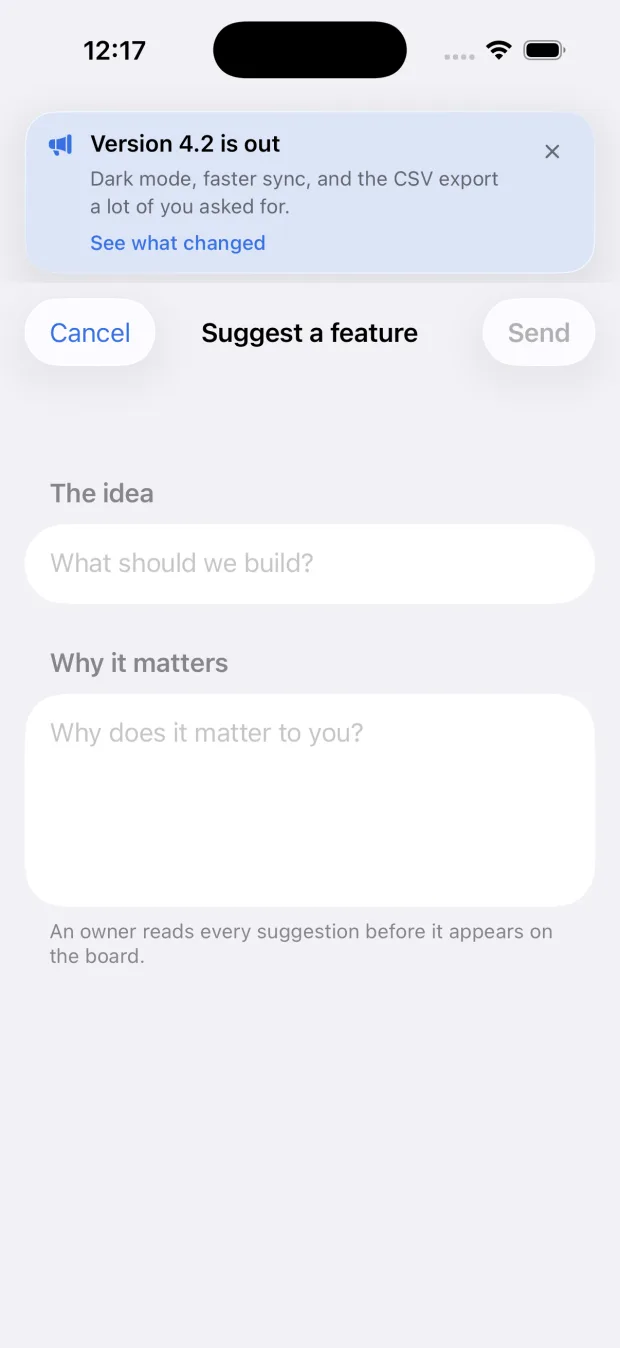
Two fields. What should we build, and why does it matter to you. The second is the one most forms leave out and the one that makes a request rankable later.
Under both is a line saying an owner reads every suggestion before it appears. Somebody who presses send and can't find their request assumes it vanished, so saying it's held first, on the form, is the difference between a queue and a black hole.
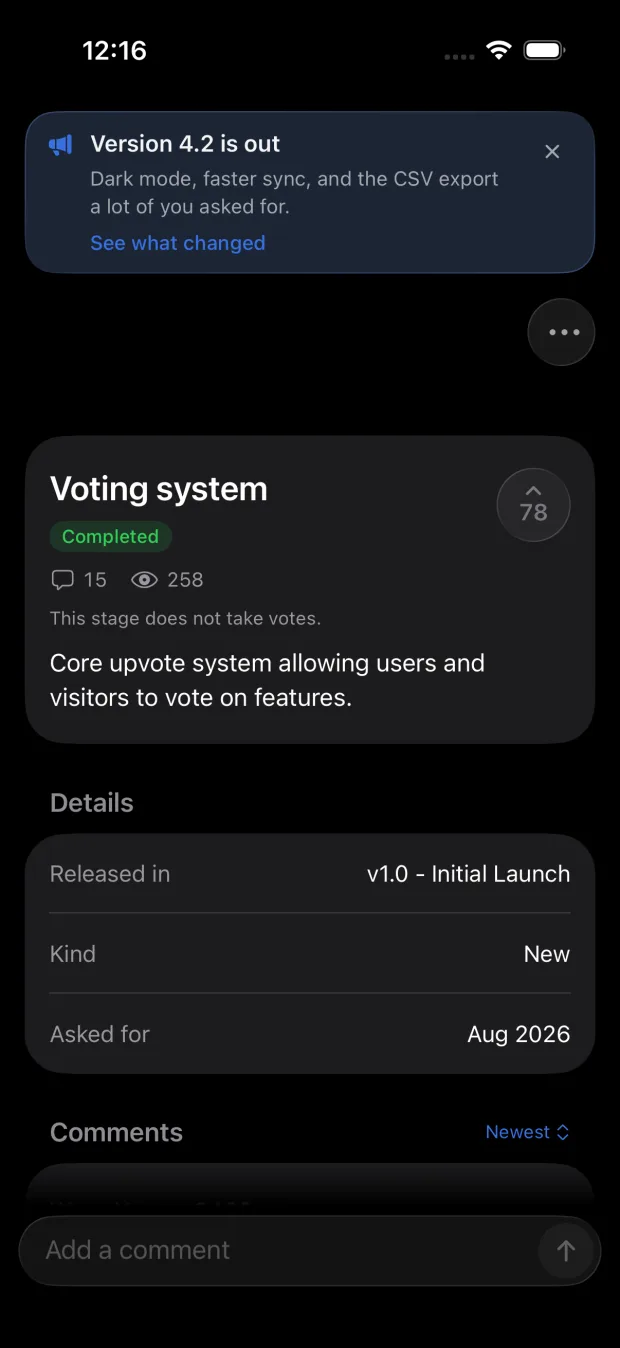
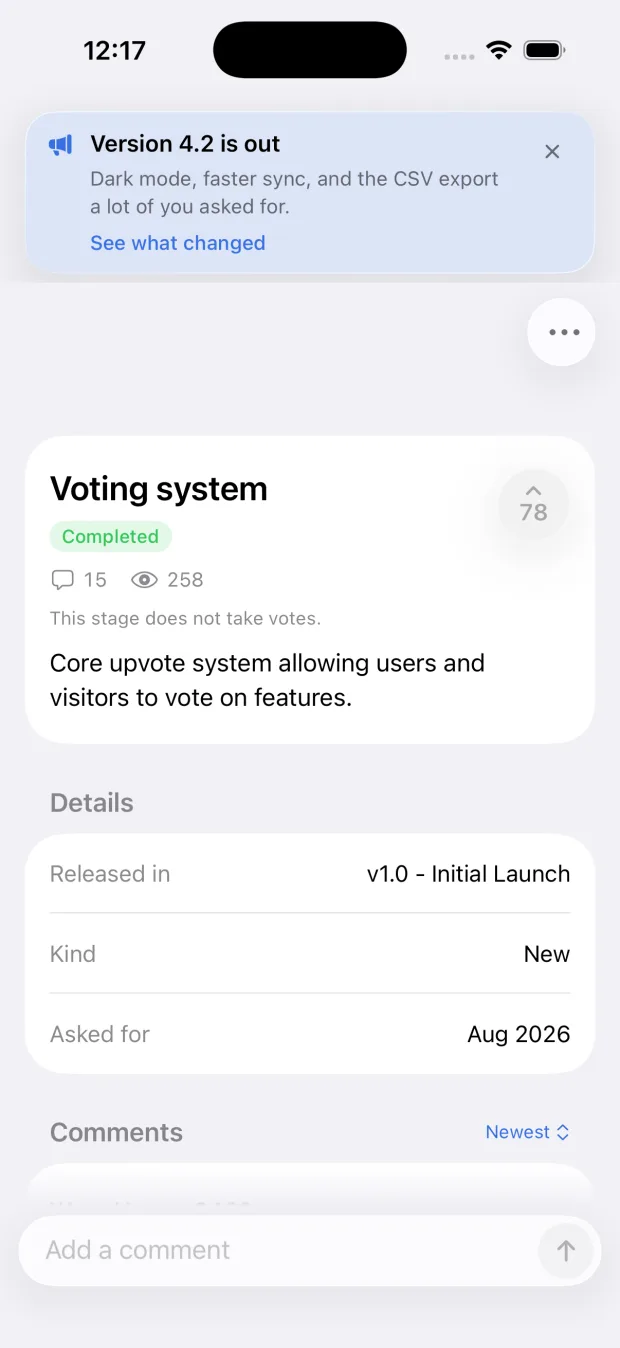
Voting system, opened. Completed, 78 votes, 15 comments, 258 views, and a line saying this stage doesn't take votes, because a finished thing can't be asked for again.
Underneath are the three details a person actually wants: the release it went out in, what kind of change it was, and the month somebody first asked for it.
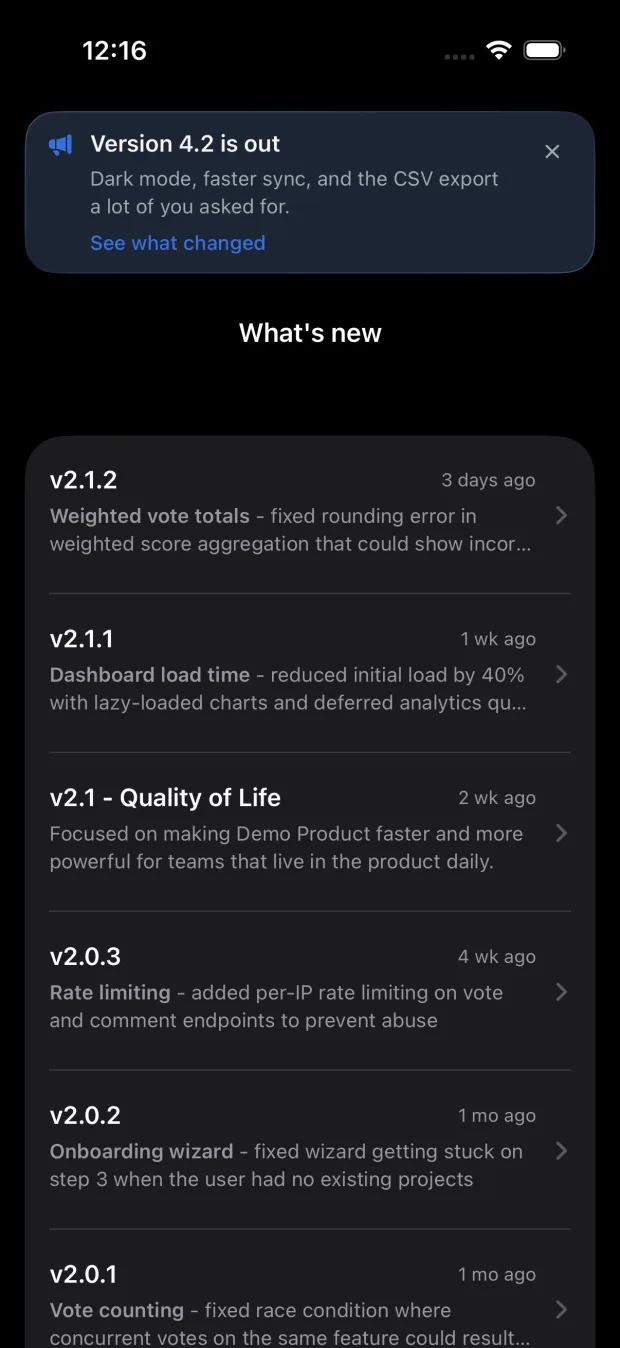
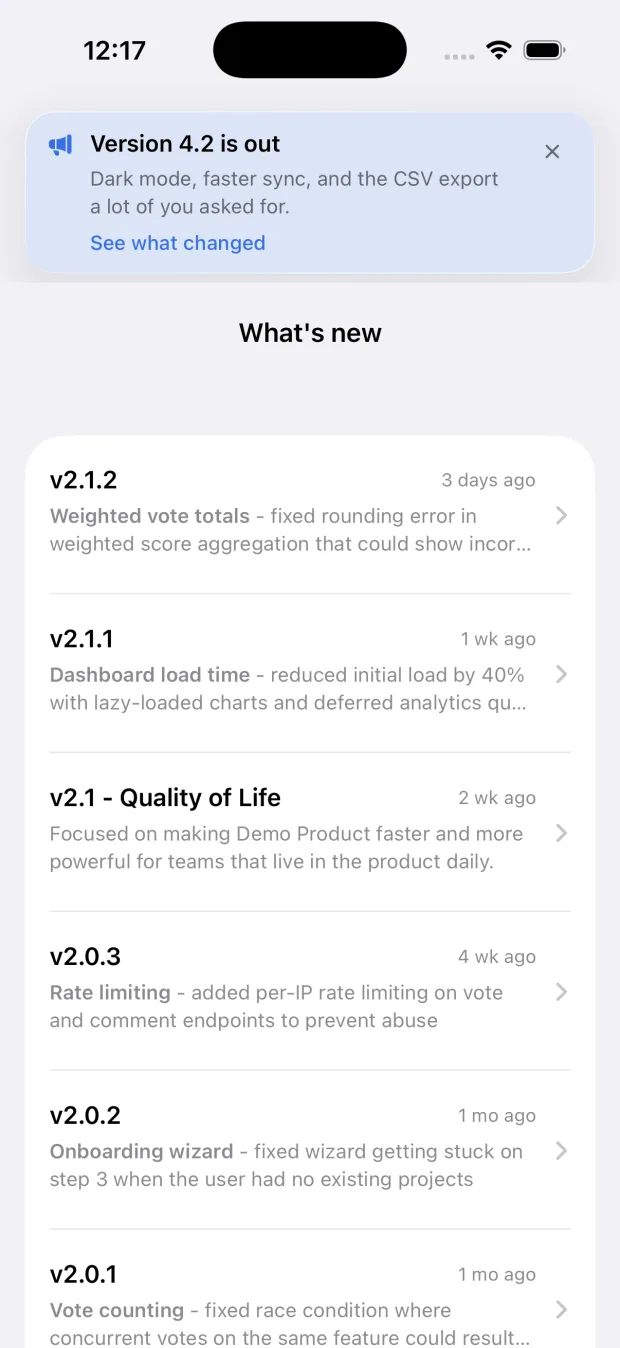
Six releases, newest first, each one dated in plain words. Three days ago, one week, two weeks, a month.
This is the half most apps skip. Somebody who voted in March opens the app in September and finds out it shipped, in the same place they asked, with no email and no release notes page on a site they never visit.