Productboard charges per maker and Aha charges per user, and on the surface that looks like the same idea priced two ways. It is not, because Aha will not sell you fewer than three seats and it charges for the people who only look.
Everything below was read on each vendor's own pricing page on 15 September 2026.
What does each one charge?
Nineteen dollars a maker, thirty nine dollars a user with a floor of three, and nine.
| Vendor | From | Billed per | Free plan | Trial |
|---|---|---|---|---|
| VoteFirst | $7.50/mo | plan | – | 14 days, card |
| Productboard | $19/maker/mo | maker | 500 notes | – |
| Aha! Ideas | $39/user/mo | user | – | Yes |
Read on each vendor's own pricing page on 2026-09-15.
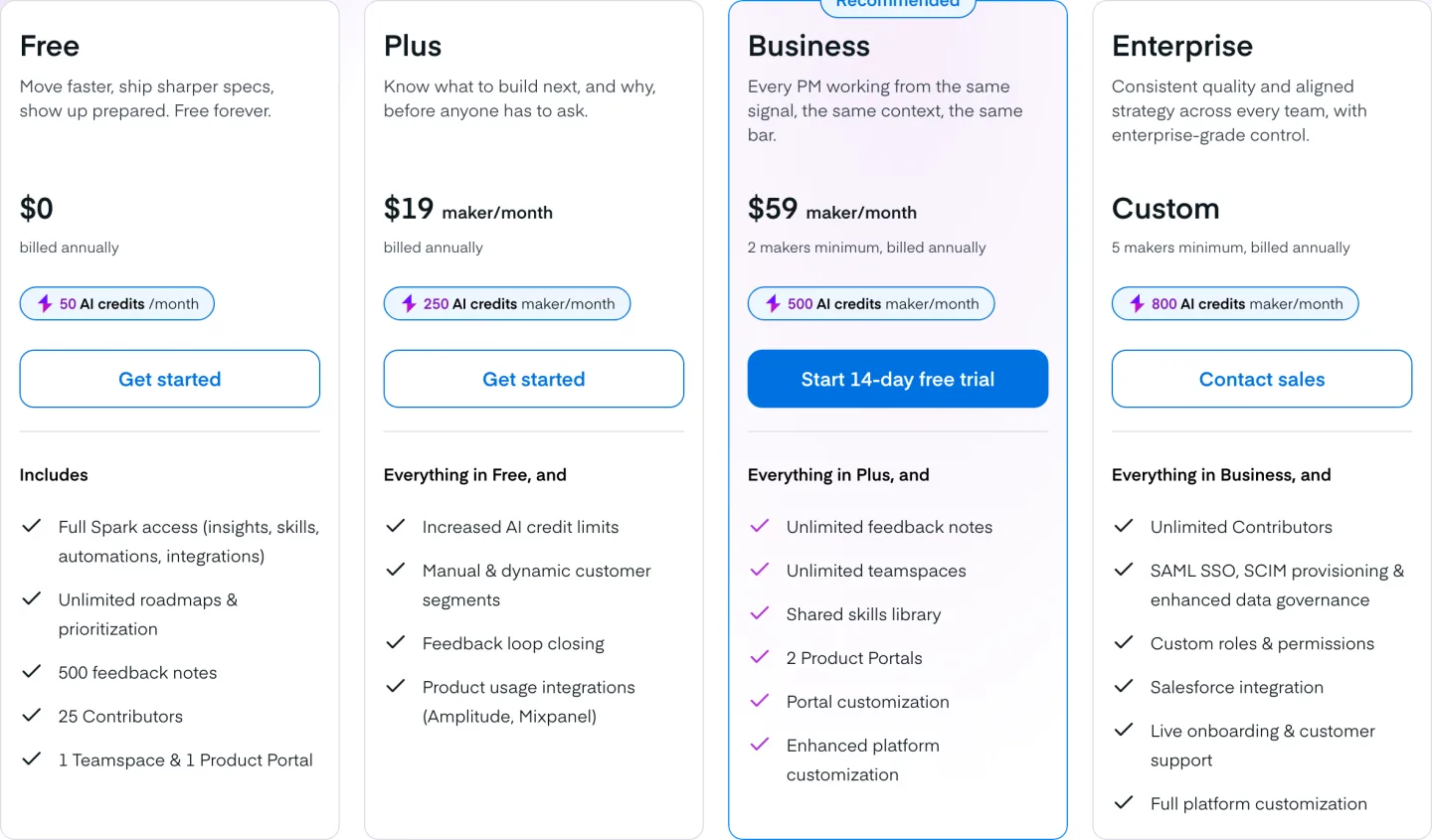
Productboard's rate has no floor under it. One maker on Plus is nineteen dollars, billed annually.
Aha's rate has a floor of three paid users printed under the price on its own pricing card, so the real entry price on Ideas Essentials is a hundred and seventeen dollars a month, billed annually, whether you need three seats or one.
Productboard's maker is a product manager who plans the work. Aha's paid seat is broader: a contributor, a reviewer who can see and vote on ideas, and a viewer who can only look and vote, all need a paid seat on Aha Ideas.
How much does Productboard cost compared to Aha?
It depends on how many of the people using the tool only need to look, because that is where the two products charge differently.
| Your situation | Productboard | Aha Ideas |
|---|---|---|
| 1 person managing feedback | $19/mo, one maker on Plus | $117/mo, the three seat floor applies even to one person |
| 4 people, all planning and prioritizing | $76/mo, four makers on Plus at $19 | $156/mo, four seats at $39 |
| 10 people, 3 who plan and 7 who only review | $57/mo, Productboard's contributors who do not plan are free | $390/mo, Aha Ideas charges the seven viewers a paid seat too |
The gap widens as the number of people who only look grows, because Productboard does not charge for a contributor who submits and comments, and Aha Ideas charges a viewer the same rate as somebody who plans the roadmap.
Aha does publish where that changes. On its Roadmaps Enterprise plan rather than Ideas, reviewers and viewers become free and unlimited. That rule is specific to the pricier roadmap product and does not apply to the Ideas plan priced here.
Which one should you choose?
Neither is aimed at a public board with no internal team, and the honest answer names what each is good at.
Aha's portal users are unlimited and free, no matter how many customers vote. Their own answer to whether you can have unlimited portals and portal users is a plain yes, and none of those votes touch the bill.
That puts the two products in the same category as this one on the one number that matters to a growing board.
Productboard's free plan is real, capped at five hundred feedback notes, one teamspace and one portal, and that is a better free offer than either of the other two products in this comparison, since neither Aha nor this product has a free tier at all.
Choose Productboard if a handful of makers need to plan a roadmap and the rest of your company only comments. Choose Aha if you want the wider suite, proxy voting and the AI assistant, and your reviewer count stays close to your maker count.
One project is nine dollars a month. Unlimited projects is thirty nine.
Why choose Productboard over Aha, or Aha over Productboard?
Because one prices the plan around who plans, and the other prices it around who is allowed to look.
Choose Productboard when your reviewers vastly outnumber your planners, because contributors do not count against the maker rate and only the people who own the roadmap do.
Choose Aha when you want one suite that also covers roadmaps, discovery, whiteboards and delivery, since buying Aha Roadmaps includes Ideas Essentials, and the three seat floor matters less once several of those seats are already doing real planning work.
The choice is really about your ratio of planners to viewers, and that ratio decides the bill more than either vendor's headline rate does.
Is there a cheaper alternative to both?
Several, and which one is cheaper depends on whether your bill is driven by seats or by something else entirely.
Against Aha's three seat floor, a flat price beats it the moment your team is smaller than three, and against Productboard's per maker rate, a flat price beats it the moment a fourth maker joins. The calculator runs both comparisons on a size you choose, at nine dollars a month for one project.
The whole field with the unit each vendor bills on is one page, and cheaper is the easiest axis to win and the least likely to be the one that matters to you.
What does each do with a vote from a big customer?
Neither vendor's own pages describe weighting a vote by what the voter pays, on the pages read on 15 September 2026.
Read on each vendor's own pricing page on 2026-09-15. A dash means nobody could read it on the pages opened that day, never that the capability is absent.
Productboard's language is about customer value and business outcomes, with no revenue or MRR wording on the pages we read.
Aha's Ideas portal scores and prioritizes, and its Advanced tier adds analysis by organisation and customer segments, which is closer to sorting by who the customer is than to multiplying a vote by what they pay.
Can I move from one to the other?
Partly, and what survives a move is the part that matters most.
Productboard's own page states plainly that the CSV it exports is the list of feature requesters, rather than the whole board with every vote and comment attached. Nothing in the pages we read on either vendor's site describes what an Aha Ideas export actually contains, so that is not a claim we can make here.
Who cast each vote, the comment threads, and every portal URL anybody has shared are the kind of thing an export usually loses, whichever two tools are on either end of the move.
Where we fit, and where we do not
Neither of these two is a feedback board with nothing else attached, and that is the honest reason a comparison on price alone undersells both of them.
Both ship an AI feature we do not. Productboard's own pricing page describes a large amount of AI tooling metered in credits per maker per month. Aha puts an AI assistant on every Ideas plan, described as handling idea analysis, theme organisation and drafting.
We have no AI feature of any kind and none is planned.
Both are one product inside a wider suite. Aha sells eight products and Ideas is one of them, with Roadmaps, Discovery, Whiteboards, Knowledge, Develop, Teamwork and Builder sold alongside it. Productboard bundles a strategy layer, teamspaces and prioritization tooling around its own feedback repository.
We have one project, one board, one roadmap and one changelog, and we are not building the rest of either suite.
What we do instead is put a multiplier on a plan and write that weight onto the vote the moment it is cast, on every plan including the nine dollar one, so three paying customers can outrank thirty who are not.
What is Productboard, and what is Aha?
Productboard is a product management platform, billed per maker, where a public feedback portal sits alongside roadmaps, prioritization, insights and a document layer built for a product organisation with several product managers.
Aha is a suite of eight products sold together, of which Ideas is the public facing feedback portal, billed per paid seat with a floor of three, and every internal role on that plan, contributor, reviewer and viewer alike, needs one.
Does either one have a free plan?
Productboard does and Aha does not. Productboard's pricing page read on 15 September 2026 gives five hundred feedback notes, one teamspace and one product portal on its free plan, capped by the volume of feedback rather than by the number of people using it.
Aha Ideas carries a free trial that asks for no card, and no free tier under it, so the cheapest thing you can keep is a seat, and the minimum order is three.
What this costs
Lite
$9 /mo
Pro
$39 /mo
Lifetime
$999 once
Fourteen day trial of Pro, card asked for at signup. Nothing here counts the people who vote, so the bill does not move when the board starts working. The long version, with what happens if you stop paying.
The honest summary
Productboard charges for the people who plan and lets everyone else comment for free. Aha charges for everyone who can even look, with a floor of three seats, and bundles that seat into a wider suite once you are past the floor.
Neither meters the customers who vote, and neither of them weights a vote by what the voter pays. Ours does, on every plan, starting at nine dollars flat.
The Productboard alternative page and the Aha one carry each side on its own.
14 days, a card at signup, then $9 or $39 a month.