Productboard's price rises with how many people on your team plan the product. Nolt's price rises with how many separate boards you run, and every plan it sells covers an unlimited number of the people who actually vote.
Nolt sits behind a check our own browser could not clear, so every Nolt figure on this page comes from notes taken on their own pricing page on 14 September 2026.
Productboard's figures were read on their own pricing page on 9 September 2026, across eight separate loads, because the page did not show the same thing twice.
What does each one charge?
Nineteen dollars a maker, twenty nine dollars a board, and nine, and two of the three climb for reasons that have nothing to do with how well the board is doing.
| Vendor | From | Billed per | Free plan | Trial |
|---|---|---|---|---|
| VoteFirst | $7.50/mo | plan | – | 14 days, card |
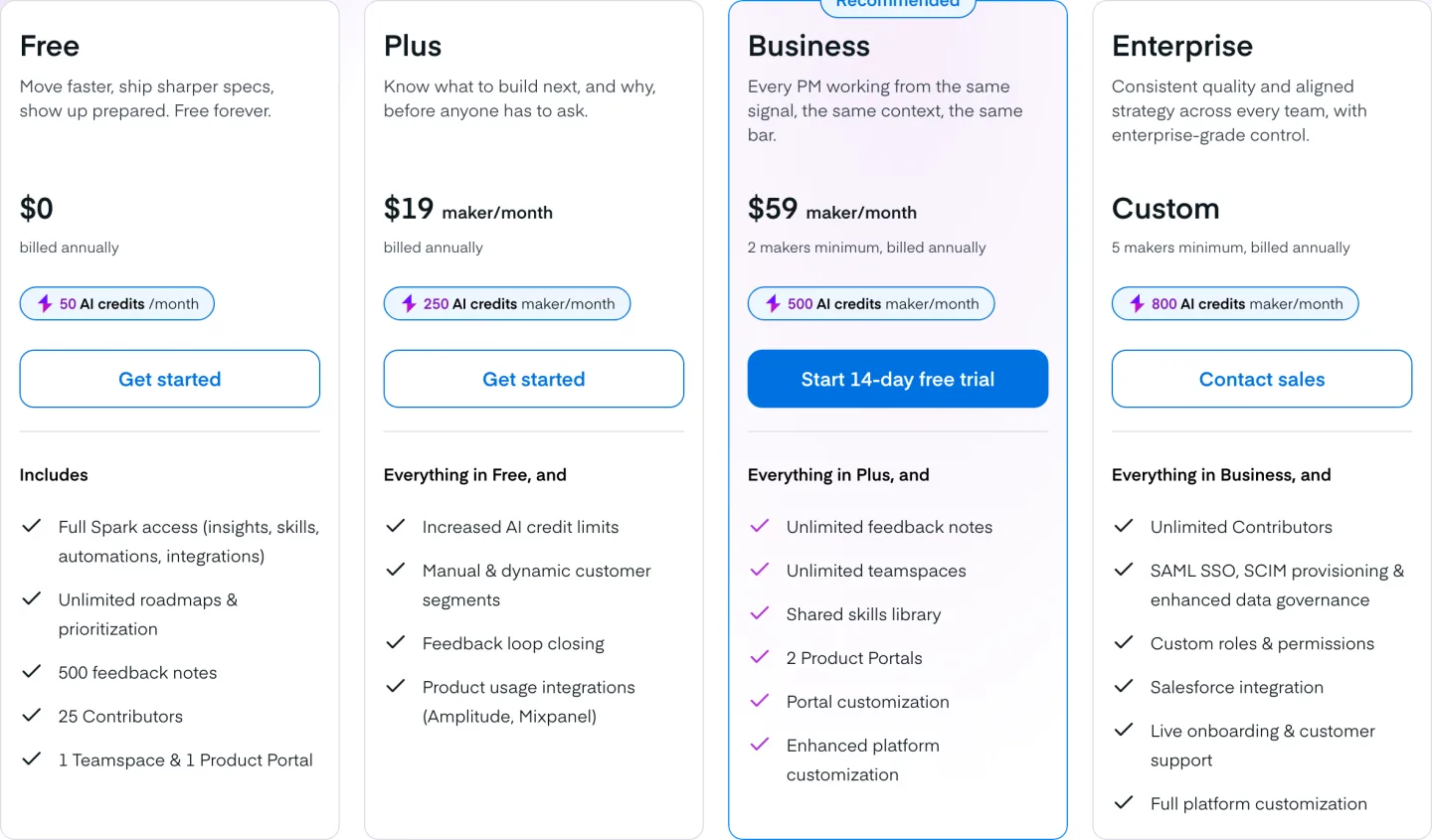
| Productboard | $19/maker/mo | maker | 500 notes | – |
| Nolt | $29/mo | board | – | – |
Nolt has no pricing proof image in our archive, because nolt.io sits behind a check the headless browser could not clear. The Nolt figures on this page are notes taken on their own pricing page rather than a screenshot of it.
Productboard's maker is a product manager or lead, and it is their own word. On eight consecutive loads on 9 September 2026, two showed a free plan and a nineteen dollar Plus tier, and six showed a page starting at fifty nine dollars a maker with no free plan at all.
Nolt's unit is the board, and their own headline is that every plan includes unlimited users, unlimited content and unlimited admins. Nobody who votes, and nobody on your team who only reads, appears on that bill.
How much does Productboard cost compared to Nolt?
The two units answer to different questions, your maker count for one and your product count for the other.
| Your situation | Productboard | Nolt |
|---|---|---|
| 1 maker, 1 product | $19/mo, Plus, the one maker minimum | $29/mo, Essential, one board |
| 4 makers, 1 product | $76/mo, Plus at $19 a maker | $29/mo, unchanged, a board does not meter makers |
| 8 makers, 2 products | $472/mo, Business at $59 a maker | $69/mo, Pro, five boards, three left over |
A single founder with one product is cheaper on Productboard's Plus tier than on Nolt's Essential plan. Add three colleagues and that reverses, because Nolt's flat rate does not move and Productboard's does.
Productboard's own feature table gives the Business plan a minimum of either two makers or five, stated both ways on the same page. Eight makers clears either reading, so the minimum does not change the sum above, but a team of two or three should get that minimum in writing before it signs anything.
Which one should you choose?
They answer to different shapes of company, and the honest answer names both.
Nolt is genuinely better for a team that keeps growing. Unlimited admins on the cheapest plan is a real decision, and it means the day you hire a fourth product person the bill does not move at all.
Productboard is the better tool once you need more than a board. Insights, prioritization, a document layer and integrations with Amplitude and Mixpanel sit behind the same price, and a single founder pricing it as a feedback board alone is pricing only a fraction of it.
Fourteen days of Pro, a card at signup, then nine or thirty nine a month.
Why choose Productboard over Nolt, or Nolt over Productboard?
Because one prices the people who plan the product and the other prices the products themselves.
Choose Productboard when you are one maker, or a small team that is not about to grow, because the per maker rate stays cheap right up until the fourth hire.
Choose Nolt when you already have several people who touch the roadmap, because a flat board rate stops caring how many of them there are.
Is there a cheaper alternative to both?
Yes, and which one depends on which number describes your company.
Against Productboard's per maker rate, a flat priced plan is cheaper the moment you have four colleagues. Against Nolt's per board rate, a flat priced plan is cheaper the moment you run only one product, and the calculator works both comparisons at a size you choose.
Ours is nine dollars a month for one project. The whole field with the unit each vendor bills on is one page.
What does each do with a vote from a big customer?
Neither one says anything about it on the pages we read.
Read on each vendor's own pages on the date in the row above. Not published means nobody could read it on the pages opened that day, never that the feature is absent.
Productboard's pages talk about customer value and business outcomes, with no revenue or MRR wording we could find. Nolt's pages, as recorded in our notes, say nothing about vote weight, MRR or customer tier either.
Eight of the thirty two tools we checked describe something revenue related in their own words, and this pair is not among them.
Can I move from one to the other?
Both let some data out, and what survives is worth checking before you decide either way.
Productboard's own export is the list of feature requesters rather than the whole board, so a move away from it starts with names rather than with requests, votes or comments.
Nolt's export sits on the Pro plan as a set of data export APIs, which is a wider door than a single CSV but still needs a script on the other end to rebuild anything.
Neither page we read describes what happens to comment threads, original timestamps or the identity behind each vote once the data leaves. What actually survives a Canny export is written up separately, and the same caution applies here.
Where we fit, and where we do not
We are not a product management suite and we are not a single purpose board with a long integration list either. There is no insights layer, no teamspace and no portfolio view.
Both of the products above carry a form of single sign on with SAML at their top tier, Productboard with SAML and SCIM and Nolt with SAML 2.0 on Enterprise.
We sign a voter in with a token from your own application on the thirty nine dollar plan, and we have no SAML at any price.
Both also sell a custom priced Enterprise tier for a negotiated contract. We do not. Lite is nine dollars, Pro is thirty nine, and Lifetime is nine hundred and ninety nine dollars once, with nothing above that to call and ask about.
What we do instead is put a multiplier on a tier, write that weight onto the vote when it is cast, and show the plain count beside the weighted total on the same card.
That is a difference from this pair rather than something only we have, since eight of the thirty two tools we checked describe something similar.
What is Productboard, and what is Nolt?
Productboard is a product management suite with an insights layer, prioritization, roadmaps and a customer portal, billed by the makers on your team. Nolt is a single public feedback board with a roadmap view, billed by the board, so the price depends on how many products you run rather than on how many people vote.
Does either one have a free plan?
Productboard does, on the loads where it appears. Two of eight loads on 9 September 2026 showed a free plan capped at five hundred feedback notes, one teamspace and one product portal, and the other six showed no free plan at all.
Nolt has none. Per our notes from 14 September 2026, every new board gets a ten day trial of the Pro plan with no card asked for, and there is nothing free once that ends.
What this costs
Lite
$9 /mo
Pro
$39 /mo
Lifetime
$999 once
Fourteen day trial of Pro, card asked for at signup. Nothing here counts the people who vote, so the bill does not move when the board starts working. The long version, with what happens if you stop paying.
The honest summary
Two units, and the choice is which one describes your company. Productboard for one maker or a small team that will not grow much. Nolt for a team that already has, or expects to have, several people touching the roadmap and does not want to pay for each one.
Neither weights a vote by what the voter pays, and neither publishes a rate that changes based on how many customers use the board at all.
The Productboard alternative page and the Nolt one carry each side on its own.
14 days, a card at signup, then $9 or $39 a month.