Two product management tools, and only one of them lets you see what a seat costs before you talk to anybody. The other asks for a demo booking on both of its plans. Everything below was read on each vendor's own pages on 15 September 2026.
What does each one charge?
Nothing printed on either airfocus plan, and nineteen dollars a maker a month on Productboard's own page.
| Vendor | From | Billed per | Free plan | Trial |
|---|---|---|---|---|
| VoteFirst | $7.50/mo | plan | – | 14 days, card |
| Productboard | $19/maker/mo | maker | 500 notes | – |
| airfocus | Not published | quoted | – | – |
Read on each vendor's own pricing page on 2026-09-15.
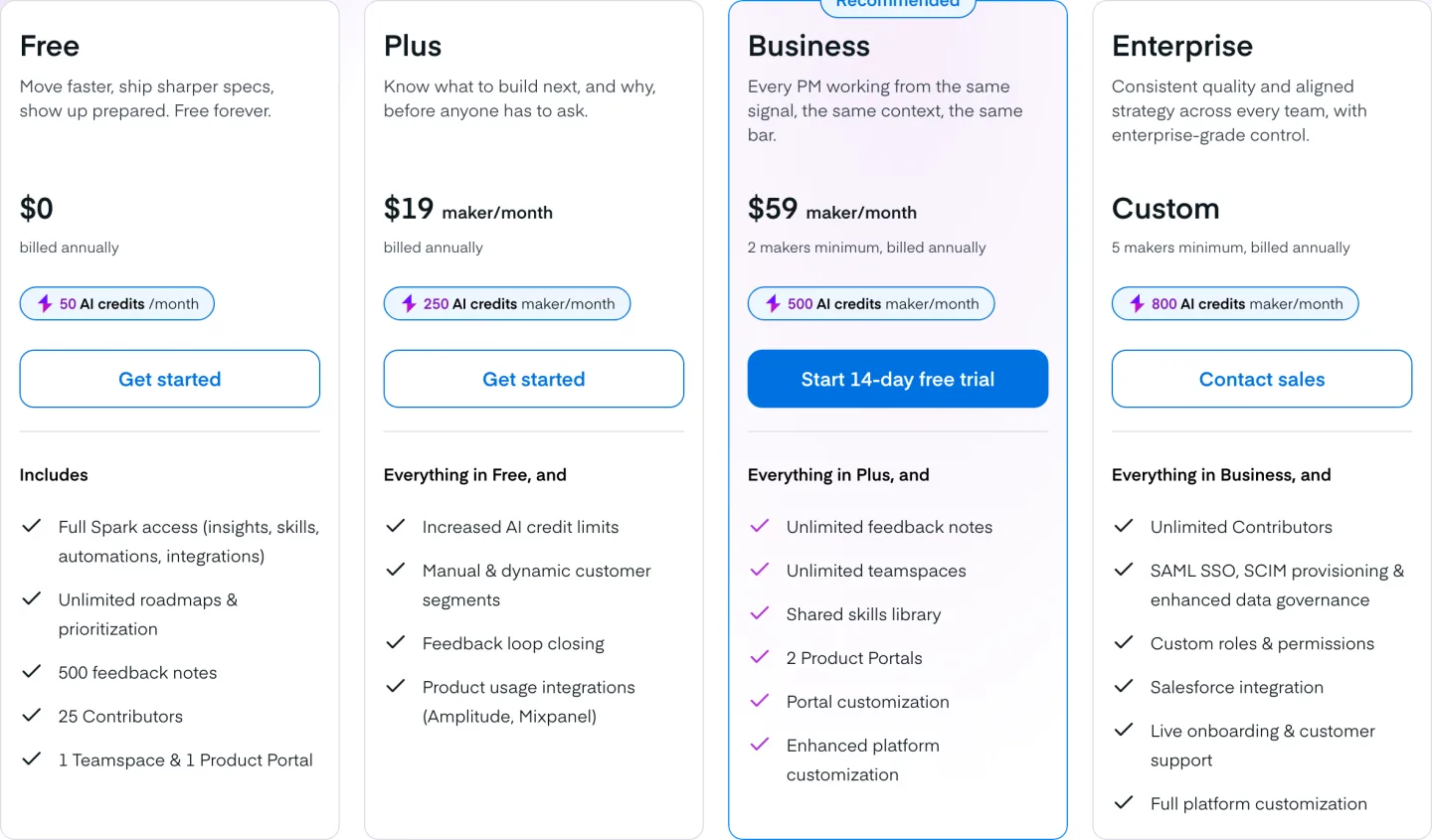
airfocus has no matching figure to show here. Its pricing page carries two cards, Professional and Enterprise, and the button under each one reads Request pricing rather than a number.
Productboard's maker is a product manager who plans the work, and a colleague who only comments is a contributor, uncounted on any plan.
airfocus runs the same split in reverse: contributors and workspaces are unlimited and free by its own FAQ, but no rate for the seat that is charged, the editor, appears anywhere on the page.
How much does airfocus cost compared to Productboard?
It depends only on how many people plan the roadmap, and one side of the arithmetic never fills in.
| Your situation | airfocus | Productboard |
|---|---|---|
| 5 people plan the roadmap, no moderation needed yet | Not published | $95/mo, five makers on Plus at $19 |
| 9 people plan the roadmap and want portal moderation | Not published | $531/mo, nine makers on Business at $59 |
| 14 people plan the roadmap across two products | Not published | $826/mo, fourteen makers on Business at $59 |
Nothing in the airfocus column ever changes, since a sales conversation stands between you and a figure no matter which row you are on. The number under Productboard simply multiplies your headcount by the printed rate for the tier you need.
Neither of airfocus's two plans carries a number at any size, and its own FAQ closes off the other route too: there is no free trial to test one instead. Objectives and OKRs and SAML single sign on are add ons on Professional, priced the identical way, on request.
Which one should you choose?
They compete for the same buyer, and the honest answer still names something real about each.
airfocus's plan list goes further into portfolio work than Productboard's. Capacity planning, portfolio dashboards and OKRs sit on airfocus's own Enterprise card, and neither term turned up on the Productboard pages we read.
Productboard is the one you can actually evaluate this afternoon. A printed rate, a working free plan, and a signup that needs no call, against a vendor that will not tell you what a seat costs until somebody has phoned you about it.
Why choose airfocus over Productboard, or Productboard over airfocus?
Because one of them treats the price as part of a sales conversation and the other treats it as a fact on the page.
Choose airfocus when a custom product hierarchy, capacity planning and an insights agent are things your procurement team will ask for by name, and a call before signing is not a barrier for you.
Choose Productboard when you would rather read a maker rate today and start on the free plan than schedule a demo to learn what either vendor charges.
Fourteen days of Pro, a card at signup, then nine or thirty nine a month.
Is there a cheaper alternative to both?
Yes, though the comparison only really works on one side of this pair.
Against Productboard's per maker rate, a flat price wins as soon as a sixth or seventh maker joins. A tool for pricing that out at your own headcount lives here.
Against airfocus, there is no published number to test that arithmetic on, so the honest answer is that we cannot say where a flat price wins.
Every tool in this category, priced beside the unit it bills on, is gathered on one page, and this one sits there at nine dollars a month for one project.
What does each do with a vote from a big customer?
Neither one multiplies a vote by what the customer behind it pays.
airfocus sells advanced prioritization and a feedback and insights module on Professional, which is scoring work a product team sets by hand. Productboard's prioritization language talks about customer value and business outcomes, and neither MRR nor revenue turned up on the pages we read.
We counted our own vendor matrix rather than guess at a figure. It tracks thirty two products against this exact question, and airfocus is not one of the thirty two rows in it at all. Productboard is a row, and it reads unpublished.
Four of the thirty two, Frill, ProductLift, Sleekplan and UserVoice, describe weighting a vote by revenue in their own words.
Can I move from one to the other?
Only one side of this is written down anywhere we read.
Productboard's own comparison table names its export plainly: the list of feature requesters, included on every plan. That is a roster of who asked, not the votes on a request or the comments underneath it.
airfocus's pricing and alternative pages say nothing about an export, what it contains or how to request one, so that claim is cut here rather than assumed.
Who actually cast a vote rather than just the running total, the back and forth under a request, and a portal link a customer already has saved tend to be the first things lost in any such move, on either side.
Where we fit, and where we do not
We are not a product management platform and we are not building toward one. There is no portfolio view here, no capacity planning, and no teamspace holding a shared roadmap strategy for several people to argue inside.
airfocus and Productboard both build in an AI layer, and neither one exists here. airfocus names an airfocus agent and an MCP server on Professional, with a separate insights agent added on Enterprise. Productboard's own pricing page describes AI tooling metered in credits per maker per month. Nothing on this side reads a ticket or drafts anything, and nothing like it is planned.
Both also carry a portal that can be closed, and ours cannot be. airfocus's branded customer or stakeholder portal sits behind a portal password with SSO protection on Enterprise. Productboard's portal gets moderation and portal single sign on starting on Business. A board here is public or it does not exist, and there is no private board at any price.
What this product does instead is put a multiplier on a tier and write that weight onto the vote the moment it is cast, on every plan including the nine dollar one, so a handful of paying customers can outrank a crowd who are not.
What is airfocus, and what is Productboard?
airfocus, sold by the company Lucid, calls itself a product intelligence platform. Prioritization, roadmaps, a feedback and insights module and a branded portal for customers or stakeholders sit inside it, billed by the editor seat at a rate only a sales call reveals.
Productboard bills by the maker seat and builds a larger system around it: a customer portal, roadmaps, prioritization and an insights layer, aimed at a product department running more than one person's worth of planning.
Does either one have a free plan?
Productboard does and airfocus does not. On the pricing page read 15 September 2026, the free tier stops at five hundred feedback notes with a single teamspace and one product portal, a ceiling set by the volume of feedback rather than by headcount.
airfocus names no free tier on the page it carries, and its own FAQ closes the other route too, saying plainly that no free trial exists and pointing instead to a personalised demo booking.
What this costs
Lite
$9 /mo
Pro
$39 /mo
Lifetime
$999 once
Fourteen day trial of Pro, card asked for at signup. Nothing here counts the people who vote, so the bill does not move when the board starts working. The long version, with what happens if you stop paying.
The honest summary
One of these two vendors will not show you a number until somebody has called you, and the other prints a maker rate you can read on the first visit and start against today.
airfocus goes deeper into portfolio work, capacity planning and OKRs for a product organisation that can sit through the call. Productboard is the one you can actually price, try and start without booking anything.
The airfocus alternative page and the Productboard one carry each side on its own.
14 days, a card at signup, then $9 or $39 a month.