These two products look like the same purchase. Both are roadmap tools sold to product teams, both open at nineteen dollars, and both put the price next to a word that means a person.
The word is where they part. Productboard counts makers. Roadmunk counts editors and then counts reviewers separately, and the second count is the one that surprises people six months in. Everything below was read on each vendor's own pricing page on 14 and 15 September 2026.
What does each one charge?
| Vendor | From | Billed per | Free plan | Trial |
|---|---|---|---|---|
| VoteFirst | $7.50/mo | plan | – | 14 days, card |
| Productboard | $19/maker/mo | maker | 500 notes | – |
| Roadmunk | $19/creator/mo | creator | – | 14 days |
Read on each vendor's own pricing page. The yearly rate is used wherever a vendor publishes one, because that is the number on their page with the switch left where they leave it.
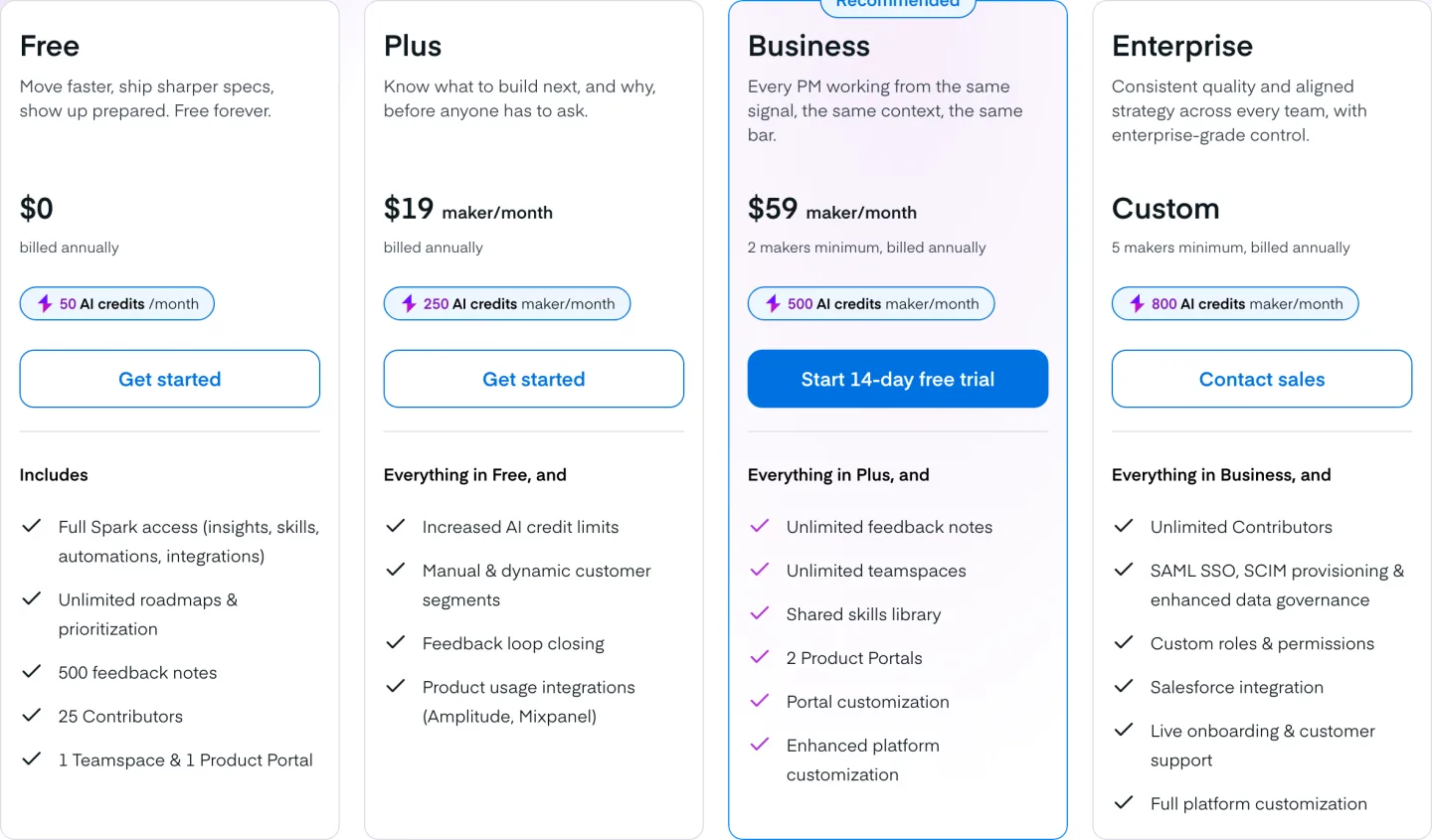
Productboard publishes four tiers and a free one.
| Plan | Paid yearly | Paid monthly |
|---|---|---|
| Free | $0 | $0 |
| Plus | $19/maker/mo | $25/maker/mo |
| Business | $59/maker/mo | $75/maker/mo |
| Enterprise | Custom | Custom |
Roadmunk publishes four as well, all of them billed annually, and it now answers under the name Strategic Roadmaps inside Tempo.
| Plan | Per editor | Reviewers included |
|---|---|---|
| Starter | $19 | 3 |
| Business | $49 | 5 |
| Professional | $99 | 10 |
| Enterprise | Custom | Custom |
The two nineteens are not the same nineteen. A maker is anybody who works in Productboard. An editor is anybody who builds roadmaps in Roadmunk, and everybody else who needs to look at one is a reviewer, which is a separate line at five dollars a month each once the included count runs out.
How much does Productboard cost compared to Roadmunk?
The honest answer needs a team in it, because both prices are a multiplication.
| Your team | Productboard Plus | Roadmunk Starter |
|---|---|---|
| 1 person who builds roadmaps, nobody else | $19/mo | $19/mo |
| 3 people who all build | $57/mo | $57/mo |
| 1 builder and 6 people who only read | $19/mo, if the readers never open it | $19 + 3 extra reviewers at $5, being $34/mo |
| 3 builders and 10 people who only read | $57/mo | $57 + 7 extra reviewers at $5, being $92/mo |
The pattern is that Roadmunk is cheaper than it looks with a small audience and more expensive than it looks with a large one. A roadmap exists to be shown to people, so the audience is the part that grows.
Productboard's free tier holds five hundred notes, which is its own kind of meter. Notes are the raw feedback you collect, so the free plan ends when the listening works rather than when the team grows.
Fourteen days of Pro, a card at signup, then nine or thirty nine a month.
Where does the second meter come from?
A reviewer, in Roadmunk's own description, is somebody who can read roadmaps and comment on them and cannot edit them. Their page gives that role comment rights on feedback, ideas and roadmaps, read only access to roadmaps and prioritization models, and the ability to submit customer feedback to the product team.
That is a useful role. It is also the role almost everybody in a company has, which is why the included counts are three, five and ten and why the line item exists at all.
So the honest way to price a team of five people who all need to see the roadmap, on Starter, is nineteen dollars for the one editor plus two reviewers past the included three, which is twenty nine dollars a month.
There is a third meter on Roadmunk worth knowing about before you commit. Two way Jira and Azure DevOps sync is nine dollars per collaborator a month as an option on Business, and it is only included from Professional upward, which is ninety nine dollars an editor.
Which one has the feedback side?
Both, at different heights.
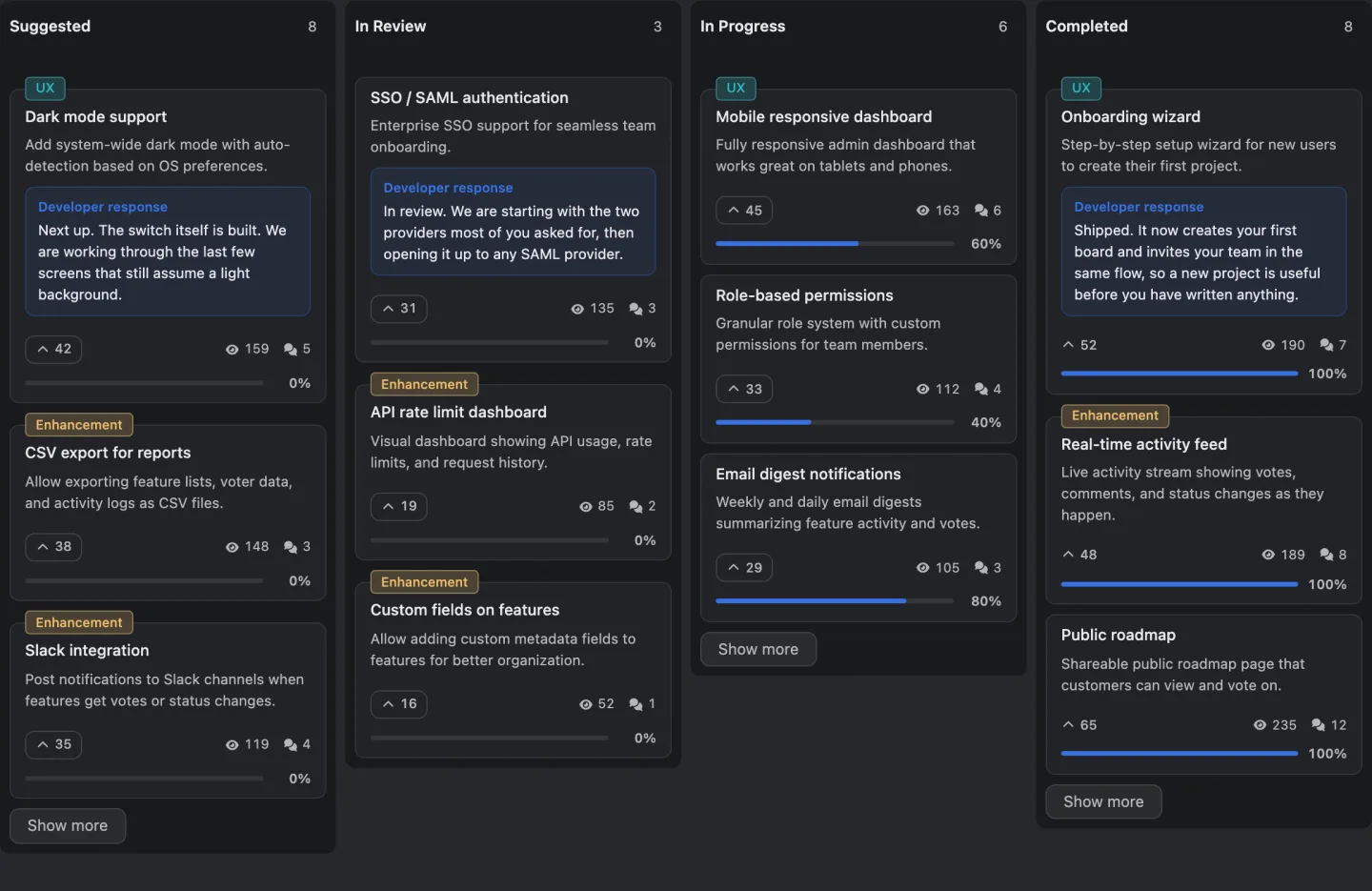
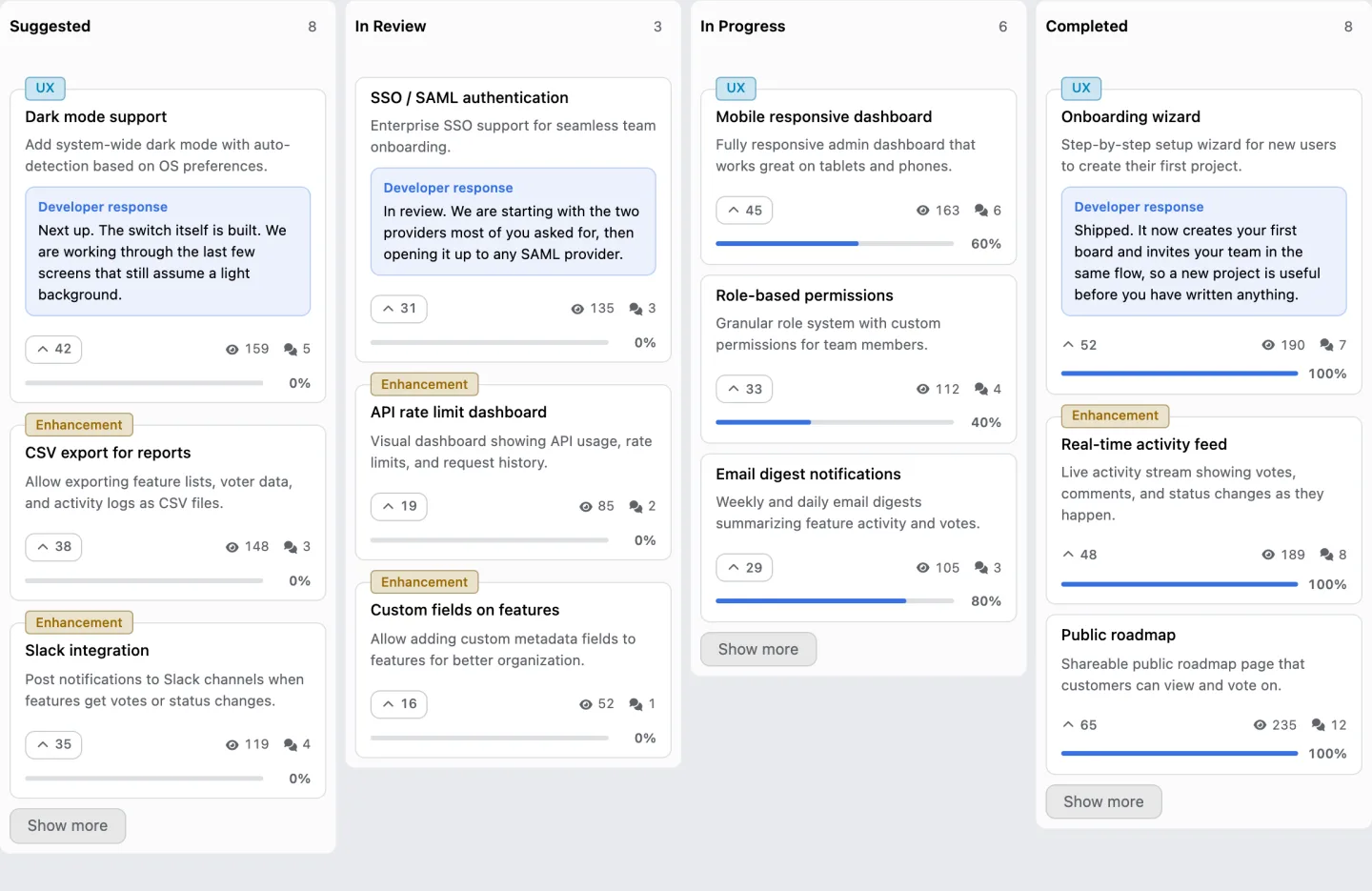
Productboard is built around collecting notes and turning them into features, so the feedback side is the product rather than a module bolted to it. That is what the five hundred note free tier is counting.
Roadmunk puts feedback and collection insights, customisable feedback portals, idea management and weighted prioritization on Business, which is forty nine dollars an editor a month. Below that the product is a roadmap you present, not a place customers write to you.
If the thing you actually wanted was a public board where customers post and vote, both of these are a long way round to it. Productboard's portal and Roadmunk's portal are features of a platform you are buying for other reasons.
Which one should you choose?
Productboard, if the job is turning a pile of customer notes into a prioritized roadmap and the team doing it is small. The per maker rate is honest about what it counts, the free tier is genuinely usable while you are collecting, and nobody pays to look at the output.
Roadmunk, if the job is presenting a roadmap to a large audience and you have already priced the reviewers. The presentation views are the strong part, and the Jira and Azure DevOps syncs on the higher tiers are why teams inside larger companies pick it.
Neither, if what you want is customers voting in public. That is a different product and it is what this site sells. One project is nine dollars a month with weighted voting on it, unlimited projects is thirty nine, and nothing anywhere counts the people who vote or the people who read.
Why choose Productboard over Roadmunk, or Roadmunk over Productboard?
Choose Productboard when your bottleneck is the input. It is better at holding a large amount of unstructured feedback and making it navigable, and the price only counts the people who do that work.
Choose Roadmunk when your bottleneck is the output. Its roadmap views were built for the meeting where somebody senior asks what is coming, and its reviewer role exists precisely so that meeting has an audience.
Choose neither when your bottleneck is that customers have nowhere to ask. A maker seat and an editor seat both assume the ideas arrive some other way.
What does the same team cost here?
Nine dollars a month for one project, or thirty nine for unlimited ones, and the number of people on your side is not part of the sum. Neither is the number of customers who vote, comment or read the roadmap.
What this costs
Lite
$9 /mo
Pro
$39 /mo
Lifetime
$999 once
Fourteen day trial of Pro, card asked for at signup. Nothing here counts the people who vote, so the bill does not move when the board starts working. The long version, with what happens if you stop paying.
That is the whole difference in a sentence. Productboard counts makers, Roadmunk counts editors and reviewers, and this counts projects.